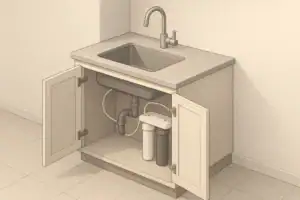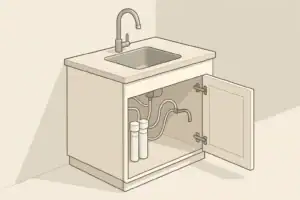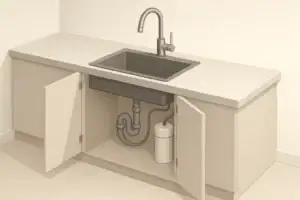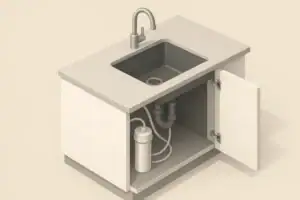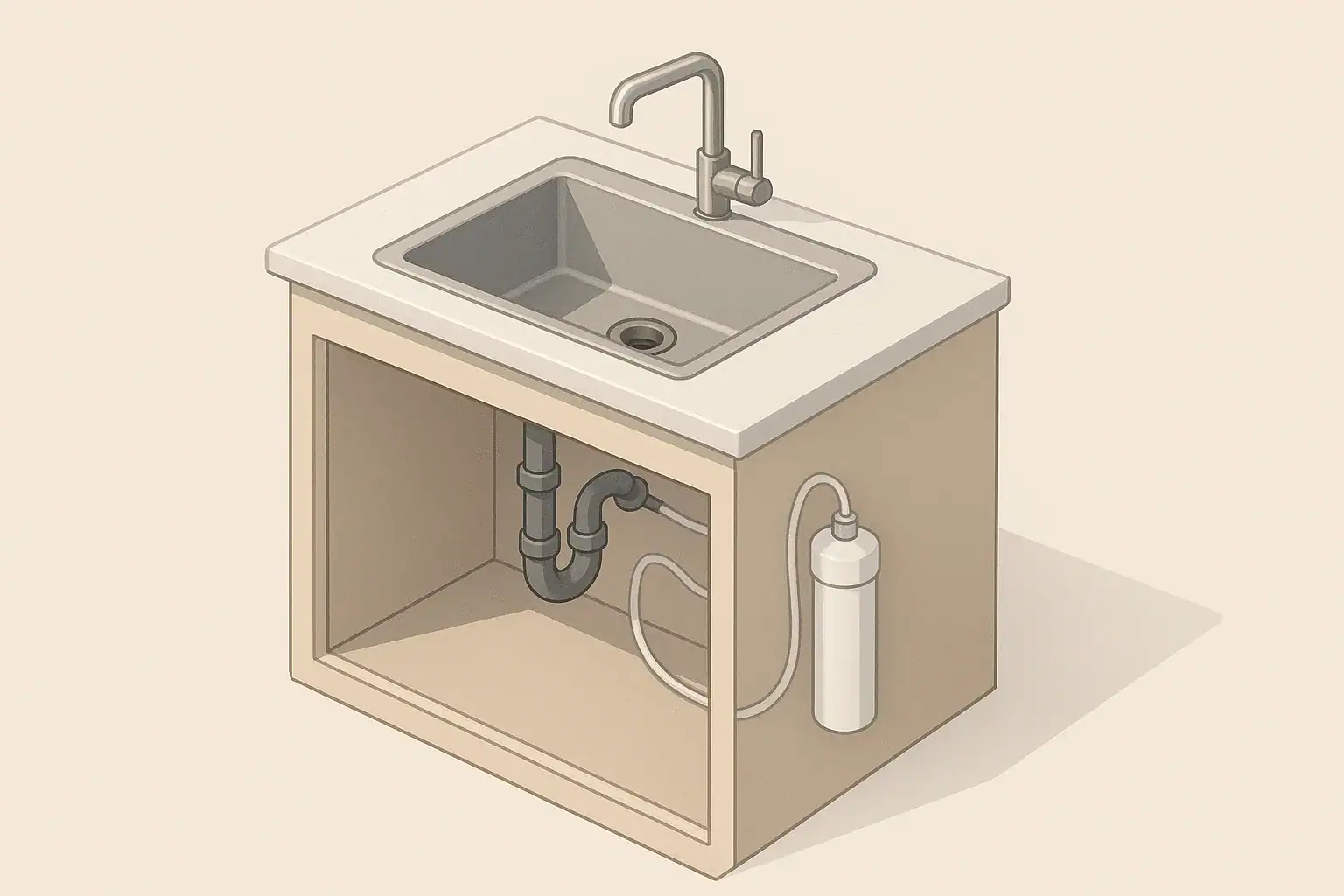
Under-sink water filters are usually rated by the number of gallons they can treat rather than by time alone. The cartridge typically has a stated capacity such as a few hundred or a few thousand gallons. That capacity is based on testing with specific water conditions and flow rates.
In everyday use, the actual replacement schedule depends on how quickly your household uses those gallons. A small household using filtered water only for drinking reaches the capacity much more slowly than a large household filling pots, bottles, and pet bowls from the same under-sink tap.
Instead of relying only on a simple rule like “replace every six months,” it is more accurate to estimate how many gallons you use per day and then convert the filter’s gallon rating into a timeline. From there, you can fine-tune the schedule based on taste, odor, and flow changes.
Why Under-Sink Filter Schedules Depend on Gallons, Not Just Months
The cartridge typically has a stated capacity such as a few hundred or a few thousand gallons. That capacity is based on testing with specific water conditions and flow rates.
In everyday use, the actual replacement schedule depends on how quickly your household uses those gallons. A small household using filtered water only for drinking reaches the capacity much more slowly than a large household filling pots, bottles, and pet bowls from the same under-sink tap.
Instead of relying only on a simple rule like “replace every six months,” it is more accurate to estimate how many gallons you use per day and then convert the filter’s gallon rating into a timeline. From there, you can fine-tune the schedule based on taste, odor, and flow changes.
Step 1: Estimate Your Daily Gallon Use at the Under-Sink Tap
The key to a realistic under-sink filter replacement schedule is knowing roughly how much filtered water you use each day. You do not need exact measurements; a reasonable estimate is usually enough.
Common Activities and Approximate Volumes
Start by listing how you use your under-sink filtered water:
- Drinking water (glasses, bottles, pitchers)
- Cooking water (boiling pasta, rinsing produce, soups)
- Coffee, tea, and other beverages
- Pet water bowls
- Appliances that connect to the under-sink line (for example, some countertop devices)
Then apply rough gallon estimates for each use. Common approximate volumes include:
- Standard drinking glass: about 0.1–0.2 gallons (12–24 ounces)
- Typical refillable bottle: about 0.2–0.3 gallons
- Medium pot for cooking: about 0.5–1 gallon
- Large pot or stockpot: about 1–2 gallons
- Coffee maker reservoir: about 0.25–0.5 gallons
- Pet bowl refill: about 0.1–0.2 gallons
You can refine these estimates by filling a known-size container (for example, a 1-gallon pitcher) and noticing how many times you fill it in a day or week.
Household Size and Usage Patterns
Daily gallons also depend on how many people use the tap and how they drink water. As a general example-only guideline:
- Single person, light use: about 1–3 gallons per day
- Couple or small household: about 3–6 gallons per day
- Family of four with cooking: about 5–10 gallons per day
These ranges can vary significantly. Some households primarily drink other beverages, while others fill multiple large bottles every day from the under-sink tap.
Example values for illustration.
| Household situation | Typical uses at under-sink tap | Example daily gallons range | How to refine your estimate |
|---|---|---|---|
| Single person, minimal cooking | Drinking glasses, occasional coffee | 1–2 gallons | Track how often you refill a 1-gallon pitcher over several days |
| Single person, frequent cooking | Drinking, daily meal prep, coffee/tea | 2–4 gallons | Note pot fills for pasta, rice, and soups in addition to drinks |
| Couple, moderate use | Drinking, coffee/tea, light cooking | 3–5 gallons | Count bottle refills and compare to a known-size pitcher |
| Family of 3–4, average cooking | Drinking, meal prep, pet water | 5–8 gallons | Track how many total gallons you use in one week, then divide by 7 |
| Family of 4+, heavy cooking | Frequent pot fills, batch cooking, bottles | 8–12 gallons | Measure pot volumes once, then count how many you fill daily |
| Entertaining or hosting often | Extra drink refills, large pitchers | Varies; add 1–3 gallons on busy days | Log use on hosting days separately to adjust your average |
Step 2: Convert Filter Capacity (Gallons) to Months of Use
Once you have a daily gallon estimate, you can translate your filter’s capacity into a rough replacement interval. Capacity is usually shown as a whole number of gallons. For example-only illustration, a filter might be labeled for something in the range of a few hundred to a few thousand gallons.
The basic formula is:
Replacement interval (days) = Filter capacity (gallons) ÷ Daily use (gallons per day)
Then convert days into months by dividing by about 30.
Example-Only Calculations
These sample calculations are for illustration, using made-up capacities and usage numbers:
- If a cartridge is rated for 300 gallons and you use 3 gallons per day:
300 ÷ 3 = 100 days (just over 3 months). - If a cartridge is rated for 1,000 gallons and you use 5 gallons per day:
1,000 ÷ 5 = 200 days (about 6–7 months). - If a cartridge is rated for 2,000 gallons and you use 8 gallons per day:
2,000 ÷ 8 = 250 days (about 8 months).
Many manufacturers also give a time limit such as “up to X months,” which is often based on a reference daily consumption. If your usage is higher than that reference, you may reach the gallon limit earlier. If your usage is lower, it can still be wise to replace the filter within the recommended time window to avoid issues like flow restriction or changes in taste.
Why Capacity Is an Estimate, Not a Guarantee
The stated gallon capacity is based on testing under specific conditions: particular levels of chlorine, sediment, and other parameters, plus a set flow rate and water temperature. Real household water can be clearer or more challenging than those test conditions.
Factors that may change how long a cartridge performs acceptably include:
- Higher sediment or rust loading than assumed in testing
- Presence of certain organic compounds or contaminants
- Water with more particulates that clog the media
- Frequently running water at the maximum flow rate
Because of this, treat the gallon capacity and your calculated timeline as guidelines. Actual performance should be checked through taste, odor, and flow observations, along with any system indicators if present.
Step 3: Watch for Taste, Odor, and Flow Changes
An under-sink filter can reach the end of its useful life before the calculated gallon limit if the incoming water is more challenging than assumed. It can also continue working acceptably to the end of the estimated capacity if conditions match more closely to the test scenario.
To keep water quality and convenience consistent, combine your gallon-based replacement schedule with regular sensory checks and system observations.
Common Signs It Is Time to Replace the Cartridge
Typical cues that a cartridge is nearing or past its effective capacity include:
- Noticeable change in taste compared to when the cartridge was new
- Return of chlorine-like odor or other smells that the filter previously reduced
- Gradual drop in flow rate even though household water pressure has not changed
- Visibly cloudy water (especially if the filter is designed to address sediment and turbidity)
- Reaching the time limit recommended by the system’s documentation, even if gallons are not fully used based on your estimate
Some under-sink systems include a simple reminder device or mechanical indicator that tracks either time or estimated volume. These can be useful, but they are still approximations; rely on a combination of measured estimates and these visual or mechanical cues.
When to Replace Earlier Than Planned
Consider replacing the cartridge earlier than your calculated schedule if you notice:
- Sudden and significant changes in local water quality reports
- Visible construction or repair work on nearby water mains that could stir up sediment
- Heavy usage periods, such as extended visits from guests or frequent large batch cooking
- Any unusual color, odor, or particulate matter in the filtered water
In these cases, your original daily gallon estimate may no longer be accurate, and the cartridge may be loaded more quickly than expected.
How Water Quality Affects Under-Sink Filter Lifespan
Two households can use the same under-sink system for the same number of gallons but have different experiences with cartridge life because their incoming water quality differs. More challenging water can shorten the practical lifespan of the filter media.
Key Water Characteristics That Influence Capacity
Several general water metrics can affect how quickly a filter’s capacity is used:
- Sediment and turbidity: Higher levels of suspended solids can clog sediment and carbon filters sooner.
- Iron and rust: Visible discoloration or known iron issues can load up pre-filters more quickly.
- Chlorine or chloramine levels: Higher disinfectant levels may consume activated carbon capacity faster.
- Organic compounds and VOCs: Filters designed to reduce a broad range of organic chemicals may reach saturation earlier with heavier loads.
- Microplastics and fine particulates: Smaller particles may gradually accumulate in filter pores, affecting flow.
If you are unsure about your water quality, you can refer to your local water utility’s consumer confidence report or use basic at-home tests for parameters like chlorine, hardness, and total dissolved solids. These measurements are not a direct indicator of when to replace the filter, but they give context for whether your water is likely to be more or less demanding on the cartridge.
Pre-Filtration and Multi-Stage Systems
Some under-sink setups include more than one stage of filtration, such as a sediment pre-filter followed by a carbon block. In these systems:
- The sediment pre-filter generally protects the main filter from clogging prematurely.
- The carbon or other media stages focus on taste, odor, and certain contaminants.
If sediment levels are high, the pre-filter may require more frequent replacement than the downstream stages. This can help extend the effective life of the more specialized cartridges, but it also means you should track separate replacement schedules for each stage.
Tracking Gallons: Practical Methods Without Special Devices
Some under-sink filters have built-in counters or volume-tracking valves, but many do not. Even without specialized devices, you can approximate gallons used well enough to plan replacements.
Method 1: Pitcher or Bottle Counting
This low-tech approach uses known container sizes:
- Choose a pitcher with a known capacity, such as 1 gallon.
- Each time you fill it from the under-sink tap, mark a tally.
- At the end of the day or week, add the tallies to get total gallons.
You can do the same with refillable bottles. For example, if you use a 0.25-gallon bottle and fill it four times per day, that is about 1 gallon per day for that user.
Method 2: Timed Flow Approximation
If you know roughly how many gallons per minute your under-sink faucet delivers when running filtered water, you can estimate use by timing how long the tap is open:
- Fill a container of known size while timing with a stopwatch.
- Divide volume by time to estimate gallons per minute (for example, 1 gallon in 1 minute = 1 gallon per minute).
- During typical use, periodically time how long the tap runs and multiply by this flow rate.
This method works best when household members have consistent habits, such as filling the same size cooking pot or bottle.
Method 3: Weekly Log and Averaging
To smooth out day-to-day fluctuations:
- Track estimated gallons used for seven days using any method above.
- Add the total gallons used over the week.
- Divide by 7 to get an average daily use.
This average is then used in the capacity calculation to set an initial replacement schedule, which you can adjust later if your habits or household size change.
Using NSF/ANSI Certifications When Planning Replacements
Under-sink filters are often evaluated according to NSF/ANSI standards. These standards can help you understand what types of contaminants the filter addresses and under what conditions it was tested. While they do not directly specify your personal replacement schedule, they give context for how the gallon capacity was established.
Common Standards for Under-Sink Filters
Several NSF/ANSI standards frequently appear on residential under-sink filtration systems:
- NSF/ANSI 42: Generally related to aesthetic effects, such as chlorine taste and odor, and particulate reduction.
- NSF/ANSI 53: Often associated with reduction of certain contaminants of concern such as lead and some volatile organic compounds, when claimed.
- NSF/ANSI 401: Addresses select emerging compounds, such as some pharmaceutical residues and chemicals, when claimed.
- NSF/ANSI 58: Applies to reverse osmosis systems, which are a different class of under-sink treatment that includes a membrane and usually a storage tank.
For an under-sink filter, the documentation may indicate one or more of these standards, along with the conditions under which testing took place. Those test conditions are part of how the filter’s gallon capacity and performance claims are established.
What to Verify About Certifications
When using certifications to inform your maintenance planning, consider:
- Which standard(s) the filter is evaluated to, relative to your water concerns.
- Whether the performance claims specify a particular life (in gallons) for each reduction claim.
- Any notes on pre-filtration, flow rate, and water quality assumptions used during testing.
This information helps you understand that changing water conditions, high usage, or bypassing pre-filters may lead to reaching the tested capacity sooner than expected.
Example values for illustration.
| Standard | General focus | How it relates to replacement schedule | What a homeowner can verify |
|---|---|---|---|
| NSF/ANSI 42 | Aesthetic effects (taste, odor, particulates) | Capacity often tied to how long taste and odor reduction was evaluated | Look for stated gallon rating for chlorine and particulate reduction |
| NSF/ANSI 53 | Selected contaminants of concern | Specific reduction claims may be valid up to a tested gallon limit | Check which contaminants are listed and any associated capacity notes |
| NSF/ANSI 401 | Selected emerging compounds | Performance can be sensitive to total loading and cartridge age | Confirm which compounds are covered and any related usage guidance |
| NSF/ANSI 58 | Reverse osmosis systems | Membrane and pre/post-filters may each have separate capacities | Review maintenance intervals for stages: pre-filter, membrane, post-filter |
| System documentation | Manufacturer-specific guidance | May provide both time and gallon-based replacement directions | Compare the suggested months of use with your calculated gallon schedule |
| Local water report | Source water context | Helps judge whether your water is more or less demanding than test conditions | Check disinfectant, turbidity, and any noted contaminants of concern |
Putting It All Together: A Simple Replacement Planning Routine
A gallon-based schedule does not have to be complicated. A straightforward routine can keep your under-sink filter effective without requiring constant attention.
- Estimate daily gallons: Use a one-week tracking period with a known container to get an average.
- Calculate a baseline interval: Divide the filter’s stated gallon capacity by your daily use to get days, then convert to months.
- Note the calendar date: When you install a new cartridge, write the expected replacement month on a label inside the cabinet.
- Monitor taste and flow: Pay attention to changes in taste, odor, or flow rate as you approach the estimated date.
- Adjust as needed: If you consistently notice changes earlier than planned, shorten your next interval; if the water remains clear and tastes the same until the recommended time limit, your estimate is likely appropriate.
By combining capacity-based calculations with simple observations and basic knowledge of your water characteristics, you can maintain a reliable under-sink filtration schedule grounded in gallons used rather than guesses.
Frequently asked questions
How do I calculate an under-sink filter replacement schedule based on gallons used?
Estimate your average daily filtered-water use, divide the filter’s stated gallon capacity by that daily number to get days of use, then convert to months by dividing by about 30. Use a one-week log or pitcher counting to refine daily use and adjust the schedule if you notice taste, odor, or flow changes earlier than expected.
Should I replace the sediment pre-filter more often than the carbon cartridge?
Yes—sediment pre-filters generally need replacing more frequently because they capture particulates that would otherwise clog downstream media. Depending on water quality and usage, pre-filters are commonly changed every few months while carbon cartridges often last longer (for example several months to a year); track each stage separately and follow observed signs of loading.
What immediate signs show a cartridge has reached capacity before the calculated gallons?
Common early indicators include a noticeable change in taste, return of chlorine-like odors, reduced flow rate, or visible cloudiness or particles in the filtered water. If any of these appear, replace the cartridge even if your gallon-based schedule hasn’t been reached.
Can I extend the life of my under-sink filter by reducing usage or adding pre-filtration?
Yes—reducing unnecessary tap use and installing a sediment pre-filter can lower the load on the main cartridge and extend its effective life. Regular maintenance and replacing the pre-filter when needed are key to preserving the performance of downstream media.
Are gallon ratings reliable for well water or very hard water?
Gallon ratings are less predictive for well or very hard water because higher sediment, iron, or mineral content can load filters faster than test conditions. Test your source water or consult a water-quality report and consider more robust pre-filtration or shorter replacement intervals for challenging water.
Recommended next:
- Under-Sink vs Pitcher: Which Is Better for Families?
- Best Under-Sink Filters for Chlorine Taste & Odor
- Under-Sink Filter Installation: Tools, Parts, and Common Mistakes
- No-Drill Under-Sink Filters for Renters: What’s Possible?
- Under-Sink Filters for Lead Reduction: What Certifications to Look For
- Under-Sink Filter Flow Rate Explained: Why GPM Matters
- More in Under-Sink Filters →
- NSF/ANSI standards explained (42/53/401/58)
- Clear trade-offs: pitcher vs faucet vs under-sink vs RO
- Maintenance planning: cost per gallon and replacement cadence