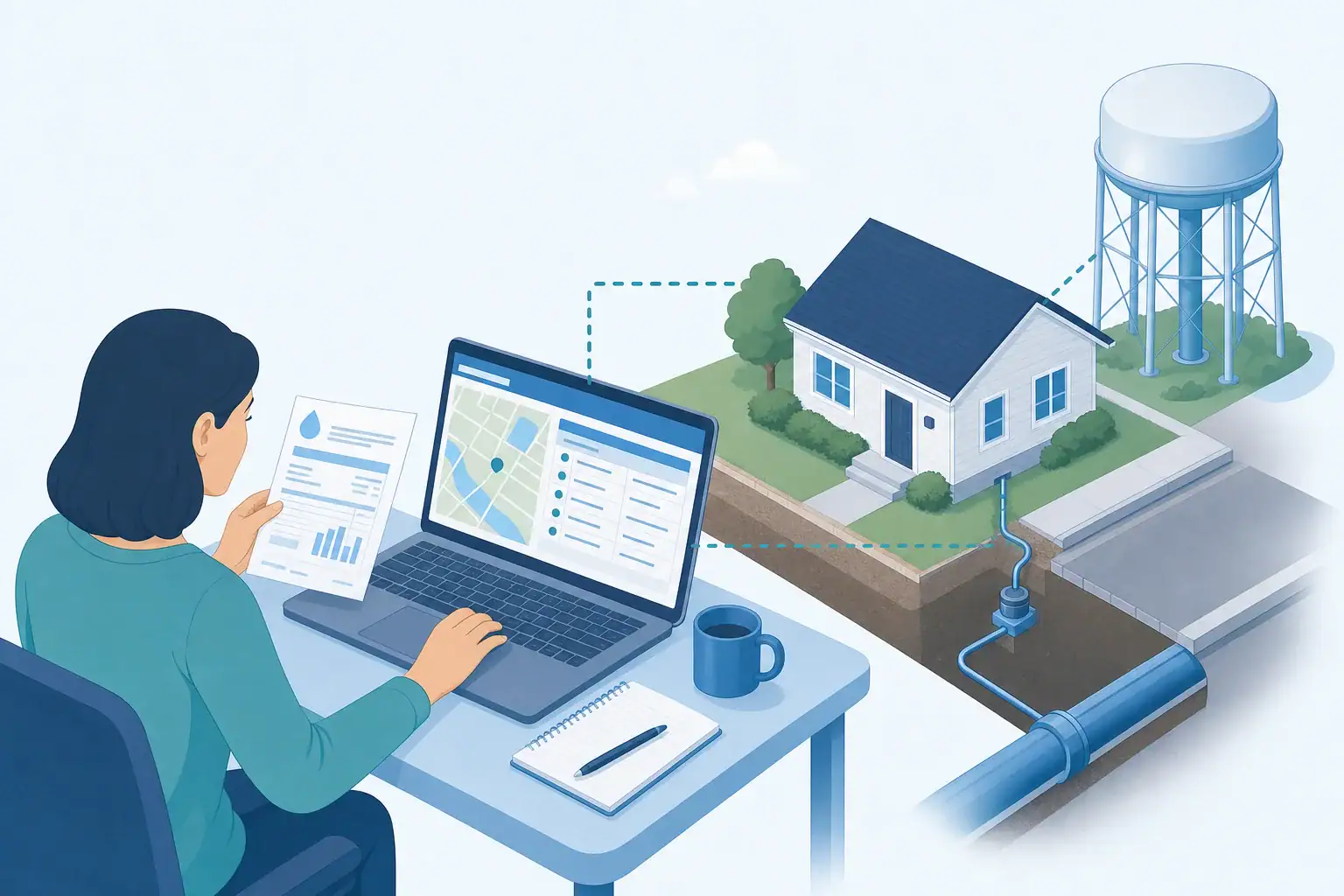
Quick answer: Start with the public water system ID on your bill or utility report. Confirm the service area, source, sample dates, monitoring period, violations, and current status. A drinking water viewer reports system-level records, not one home’s tap, so check newer utility information or arrange tap-specific testing when plumbing or stale records may matter.
Find the correct public water system first
A drinking water viewer is useful only when you open the record for the public water system that actually serves the address. Start with the public water system identifier, usually shown as a PWS ID or Water System ID, on a water bill, utility notice, or Consumer Confidence Report (CCR).
If you do not have the ID, search by system name and location, then verify the result before interpreting its data. Do not rely on a ZIP code or a familiar utility name alone: database names can differ from locally used names, and similarly named systems can operate nearby. The Texas Commission on Environmental Quality Drinking Water Viewer User Guide advises starting a name search with only the first one or two words and then opening the linked system profile.
Cross-check these identity fields
- PWS ID: Match it to a bill, CCR, utility, landlord, or state regulator whenever possible.
- System name and status: Make sure the record is for an active system rather than a former or similarly named one.
- City, county, and service area: Confirm that the listed location fits the property.
- System type: Check whether the record describes the type of regulated system expected for the address.
- Source type: Note whether the profile identifies surface water, groundwater, purchased water, or a combination.
- System relationships: Look for fields such as purchases from or sells to. A local distributor may deliver water supplied by another public water system.
If the address may be in more than one service area, or the system purchases water, ask the utility which system and facilities normally serve the property. Do not combine records from separate systems as if they describe one supply.
Which drinking water viewer fields matter?
Viewer layouts differ by state, but the key questions are consistent: what was evaluated, where, when, and with what compliance status? Missouri’s Drinking Water Viewer describes records that can include sample results, sampling points, schedules, inventory, violations, and enforcement information. It also cautions that submitted or in-process information may not yet appear.
Sample and monitoring fields to record
- Analyte: Identify the specific contaminant or water-quality parameter. A broad category is not the same as a result for one specific substance.
- Collection date: This is when an individual sample was collected.
- Monitoring period: Some compliance entries summarize a date range rather than a single sampling event.
- Sampling point or point type: Determine whether the record concerns a source, treatment facility, distribution-system location, or another designated point.
- Result and unit: Keep the number and unit together. A value without its unit and reporting context is not interpretable.
- Record type: Distinguish an individual sample from a calculated system summary or compliance determination.
The TCEQ guide describes a sample as a snapshot in time collected at a representative point and provides filters for collection date, analyte, sampling-point type, and monitoring period. A displayed sample therefore does not establish conditions at every residence or at a particular kitchen faucet.
Compliance, notice, and enforcement fields
- Violation category: Determine whether it is health-based, monitoring/reporting, public-notice related, or another category.
- Begin and end dates: These identify the period attached to the record; they do not by themselves describe present conditions.
- Compliance status: Look for whether a matter is open, resolved, returned to compliance, or still under review.
- Public notice: Check the utility’s current notice for instructions and updates.
- Enforcement action: Note its date and whether a listed compliance schedule remains open.
- Data-refresh notice: Find the viewer’s update information before assuming that its newest displayed entry is current.
A monitoring or reporting violation can indicate a compliance failure or missing information. It does not, by itself, prove that a contaminant exceeded a health-based limit. Likewise, an old record marked resolved should not automatically be treated as a current tap-water condition.
EPA’s ECHO drinking-water search help explains federal fields for system identity, violation categories, enforcement, and sanitary surveys. EPA also cautions that ECHO drinking-water data are not real time and can lag as data are reported quarterly. For current conditions, contact the local water system.
What a drinking water viewer cannot establish
A public viewer documents records for a regulated water system. It does not test the water at one kitchen faucet on a particular day. After water enters a property, it can contact a service line, building pipes, solder, faucets, and fixtures.
This distinction is especially important for lead. CDC identifies service lines and household plumbing components as possible sources of lead in drinking water and notes that tap-sampling results can vary with timing, season, sampling method, and flow. If lead is a concern, ask the utility about the service-line material and available testing options. See CDC’s guidance on lead in drinking water.
Do not use taste, odor, clarity, or a total dissolved solids reading as proof that water is safe or unsafe. Those observations can help describe a concern, but they do not replace contaminant-specific records or properly collected tap samples.
When to verify, contact the utility, or test the tap
| What you find | Best next step | Why |
|---|---|---|
| Several possible systems or an uncertain service area | Verify the PWS ID through the bill, landlord, utility, or state regulator. | A name or ZIP code may not precisely identify the serving system. |
| The system purchases water from another PWS | Contact the utility to identify the supplier and facilities that normally serve the address. | The supplier and local distributor can have related but distinct records. |
| A recent open violation or active public notice | Contact the utility and follow the current official notice. | A retail filter should not replace instructions issued for an active event. |
| An old or resolved violation | Verify the latest status, utility notices, and CCR. | A historical record does not establish a current problem. |
| A monitoring/reporting violation or missing result | Ask the utility or regulator what information was missed and whether later results are available. | This is an information gap, not automatic evidence of an exceedance. |
| Viewer data seem delayed, stale, or unclear | Check the current CCR and utility notices. | Newer utility information may not yet appear in the viewer. |
| Unknown service-line material, older plumbing, or a lead concern | Arrange tap-specific testing or ask about a utility sampling program. | System-level summaries cannot determine the result at one home. |
| A specific contaminant is credibly identified | Compare exact certified reduction claims. | The product claim must match the contaminant and product configuration. |
| Only taste, odor, clarity, or TDS is known | Identify the actual concern first. | These observations do not establish which treatment claim, if any, is needed. |
Use the current CCR without treating it as a tap test
Use the latest CCR to review the utility’s annual summary, reported results, source information, and contact details. Compare the CCR reporting period with the dates displayed in the viewer. If the two appear inconsistent, ask the utility which information is newer and whether a record has been corrected.
A CCR is also a system-level report, not a test of a particular home. Move to tap-specific testing when the question depends on the property’s service line or plumbing, when the concern is address-specific, or when official records do not resolve the uncertainty. Follow collection instructions from the utility, state or local health authority, or qualified laboratory rather than improvising a sampling method.
For help reading the annual report itself, see How to Read Your City’s Consumer Confidence Report.
Worked lookup example: record the context before shopping
Suppose a viewer entry lists an analyte result of 0.8 mg/L, a collection date of May 14, a distribution-system sampling point, and a monitoring period covering April through June. Before treating that number as a filter-shopping instruction, write down all four pieces of context: the analyte name, 0.8 mg/L, the sampling point, and both dates.
Next, check whether the entry is an individual result or a system summary, whether a related violation is open or resolved, and when the viewer was last updated. If the entry is old, unclear, or unrelated to the home’s plumbing question, obtain newer information from the utility or use tap-specific testing as appropriate. The point is not to infer a product from one number; it is to identify what the record does and does not answer.
Translate a verified concern into a filter claim
Only after identifying a credible, current concern should you compare treatment products. A treatment mechanism, such as activated carbon, ion exchange, or reverse osmosis, describes how a product may work in general. It does not prove that every product using that mechanism reduces the contaminant in question.
Search a certification directory using the exact manufacturer, model, and replaceable cartridge. NSF’s Certified Drinking Water Treatment Units database can be searched by manufacturer, model, product type, standard, and named reduction claim. NSF also notes that a search using multiple claims can return products certified for any selected claim unless the option requiring all selected claims is used.
Before relying on a product listing, confirm all of the following:
- The complete product and cartridge model numbers match the item being purchased.
- The named contaminant-reduction claim matches the verified concern.
- The certification listing is current and applies to that configuration.
- The manufacturer’s performance data sheet states the relevant claim and operating conditions.
- The installation and replacement requirements suit the household.
A standard number alone does not establish that every product certified to that standard covers every contaminant. The model, cartridge, named claim, listing details, and performance data sheet must agree. For a detailed check, see How to Verify a Water Filter’s Certification Claim.
Final drinking water viewer checklist
- Match the address to the correct PWS ID.
- Confirm system status, location, source, and supplier relationships.
- Record the analyte, result, unit, sampling point, collection date, and monitoring period.
- Separate individual samples from system summaries.
- Read the violation category, dates, current status, public-notice, and enforcement fields.
- Check when the viewer was updated and compare it with the latest CCR and utility notices.
- Identify questions the system-level record cannot answer about the home’s tap.
- Use tap-specific testing when plumbing or address-level conditions matter.
- Compare only exact, contaminant-specific certified claims once the concern is established.
Frequently asked questions
Can a drinking water viewer tell me whether my tap water is safe?
No. A viewer provides system-level regulatory and monitoring information. It cannot establish water quality at one faucet, especially where service lines or household plumbing may affect the result.
Does a monitoring violation mean a contaminant exceeded a health limit?
Not necessarily. A monitoring or reporting violation can mean required information or sampling was missing. Check the violation category, dates, current status, and any later results with the utility or regulator.
Should I buy a filter after finding a historical violation?
First verify the current status, recent utility notices, and the latest CCR. If a current, specific concern remains, compare only products with an exact, applicable certified reduction claim for that concern.
- NSF/ANSI standards explained (42/53/401/58)
- Clear trade-offs: pitcher vs faucet vs under-sink vs RO
- Maintenance planning: cost per gallon and replacement cadence