
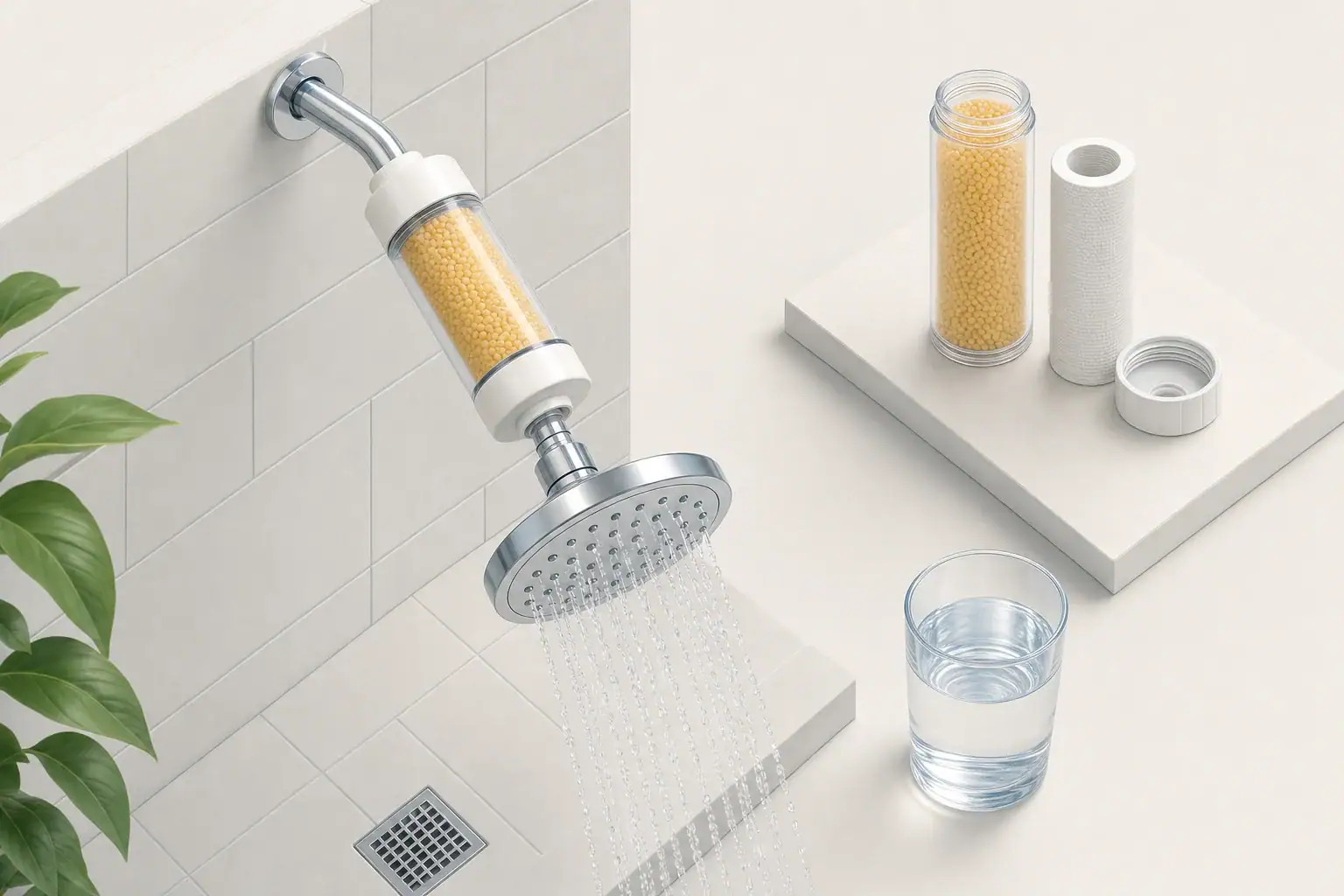
Vitamin C shower filters are point-of-use devices designed mainly to neutralize disinfectant chemicals in shower water. They are commonly installed between the shower arm and showerhead or incorporated into a filtered showerhead.
Despite the name, these products do not provide broad water purification. Their useful role is narrow: under suitable conditions, vitamin C can react with chlorine and, less predictably, chloramine. It does not soften water, remove dissolved salts, or reliably address most other contaminants.
Understanding that distinction helps set realistic expectations and makes it easier to compare vitamin C media with carbon, sediment filtration, and more comprehensive treatment systems.
How Vitamin C Shower Filters Work
Vitamin C is also called ascorbic acid. Some cartridges instead use sodium ascorbate, a related form that can perform a similar dechlorination function. When either material contacts an appropriate chlorine compound, a chemical reaction converts the active disinfectant into less reactive chloride.
This process is different from physical filtration. A sediment filter captures particles in pores, while activated carbon adsorbs certain compounds onto a large internal surface. Vitamin C is consumed as it reacts, so the cartridge eventually loses effectiveness even if it does not look dirty.
Contact time matters
A shower sends water through a small cartridge relatively quickly. The media must dissolve or contact the water fast enough for the reaction to occur before the water exits the showerhead. Performance can vary with:
- Water flow rate
- Cartridge design and media quantity
- Water temperature
- Chlorine or chloramine concentration
- Water chemistry, including pH
- Cartridge age and frequency of use
Visible vitamin C beads or a citrus-like cartridge appearance do not by themselves establish treatment performance. Useful evidence includes contaminant-specific testing at a stated flow rate and over a stated capacity.
What Vitamin C Shower Filters Can Reduce
The clearest application for vitamin C media is neutralizing free chlorine. Free chlorine may be present in municipally treated water as a residual disinfectant. When the cartridge is properly sized and fresh, the reaction can occur quickly enough for shower use.
Reducing free chlorine may also reduce a chlorine-like odor at the shower. Odor is not a precise performance measurement, however. A person may stop noticing an odor before chlorine is fully reduced, and some water odors come from causes unrelated to chlorine.
Chloramine performance is less straightforward
Vitamin C can react with chloramine, but chloramine is generally more persistent than free chlorine. Actual reduction in a compact shower cartridge depends heavily on dose, contact time, flow, temperature, and water chemistry. A product described only as a “chlorine filter” should not automatically be assumed to work equally well for chloramine.
Residents can check a utility’s annual water quality report or contact the utility to learn which disinfectant is used. Some systems may change treatment practices temporarily, so older information may not reflect current conditions.
Example values for illustration.
| Water concern | Expected role of vitamin C media | Practical note |
|---|---|---|
| Free chlorine | Can neutralize it | Performance depends on dose, flow, and cartridge condition |
| Chloramine | May reduce it under suitable conditions | Look for testing specific to chloramine |
| Chlorine-like odor | May improve it when chlorine is the cause | Odor alone does not verify reduction |
| Sediment and rust particles | No direct treatment | A separate physical filter or screen is needed |
| Hardness minerals | Does not remove them | Water softening requires a different process |
| Lead and other dissolved metals | Not a dependable treatment | Use treatment validated for the specific metal |
| VOCs and other organic chemicals | Not a broad treatment | Appropriate carbon media may address some compounds |
| Microorganisms | Does not disinfect water | Microbial concerns require an appropriate treatment method |
What Vitamin C Shower Filters Do Not Do
A vitamin C cartridge should not be treated as a complete contaminant filter. Its chemical action does not meaningfully lower total dissolved solids, and it does not create purified or sterile water.
They do not soften hard water
Hard water contains dissolved calcium and magnesium. These minerals contribute to scale on shower surfaces and may affect how soap behaves. Vitamin C does not remove them, so existing scale patterns generally remain.
Some shower cartridges combine vitamin C with other media and make broader conditioning claims. Even then, a small shower cartridge is not equivalent to an ion-exchange water softener. A hardness test before and after treatment is more informative than judging water by feel.
They are not reliable particle filters
Dissolved vitamin C media cannot trap sand, pipe scale, or rust. A cartridge may contain a screen, fiber pad, or another separate layer that captures some particles, but that function comes from the physical layer rather than the vitamin C.
They do not address every chemical concern
Vitamin C media should not be relied on for lead, arsenic, nitrate, PFAS, pesticides, or the broad range of volatile organic compounds. Some of these concerns are primarily relevant to water used for drinking and cooking, but each requires treatment selected and tested for that specific substance.
They also do not kill bacteria, viruses, or other microorganisms. A private well with a microbial concern needs appropriate testing and treatment rather than a shower cartridge marketed for chlorine reduction.
Vitamin C Versus Carbon Shower Filters
Vitamin C and activated carbon can both be used for chlorine-related concerns, but they work differently. Vitamin C reacts chemically with the disinfectant. Activated carbon uses adsorption and catalytic reactions, depending on the carbon type and the compound involved.
Standard activated carbon can reduce free chlorine and certain taste- and odor-causing compounds. Catalytic carbon is often considered when chloramine is present, although performance still depends on contact time, media volume, and flow.
Hot water and high shower flow can make treatment challenging for any small cartridge. Carbon also provides a surface where captured material can accumulate, making timely replacement and appropriate product design important. Vitamin C media has a narrower treatment scope but reacts rapidly with free chlorine when enough active material is available.
Combination cartridges may include vitamin C, carbon, and sediment media. More stages do not automatically mean better performance. Each stage needs enough media and contact time to perform its intended job.
Factors That Affect Real-World Performance
Flow rate and pressure
A higher flow rate reduces the time water spends inside the cartridge. It may also use up the media more quickly because more water passes through during each shower. If a filter causes an objectionable pressure drop, confirm that the cartridge is installed in the correct direction and is not clogged or overdue for replacement.
Removing a flow-control or plumbing safety component is not an appropriate response to poor performance. Instead, use a filter designed for the available pressure and desired shower flow, following the manufacturer’s installation limits.
Water temperature
Shower water is warmer than typical drinking water, which can affect reaction rates and cartridge materials. The filter housing, seals, and media should be intended for shower temperatures. A drinking-water cartridge should not be repurposed unless it is specifically rated for that installation and temperature range.
Disinfectant level and cartridge capacity
Two households with the same number of showers may experience different cartridge life. A home with higher flow, longer showers, or more disinfectant demand will consume reactive media faster.
Capacity claims are most useful when they identify the tested contaminant, flow rate, starting concentration, and endpoint. A general gallon rating without those conditions provides limited information.
How to Evaluate a Vitamin C Shower Filter
Start by identifying the problem to solve. A chlorine odor points toward disinfectant treatment, while white scale points toward hardness. Orange particles may indicate sediment or corrosion products. Matching the technology to the water concern is more effective than choosing by the number of advertised filter stages.
When comparing products, look for clear answers to these questions:
- Is the unit intended for free chlorine, chloramine, or both?
- Is contaminant-reduction testing available at a stated shower flow?
- Does the testing cover performance near the end of cartridge life?
- What temperature and pressure range is allowed?
- How is replacement timing determined?
- Are replacement cartridges readily identifiable and properly sealed?
- Does the housing use materials intended for hot-water contact?
Independent certification or testing can be useful, but the details matter. A certification for material safety, structural integrity, or chlorine reduction does not automatically verify reduction of chloramine, metals, hardness, or unrelated chemicals. Check the exact performance claim and operating conditions rather than relying on a general certification reference.
Installation, Testing, and Maintenance
Most shower filters attach to standard shower plumbing without changes inside the wall. Installation should follow the supplied directions, including flow orientation, washer placement, flushing, and hand-tightening guidance. Excessive force can damage threads or crack a plastic housing.
After installation, inspect all connections while the shower is running. A slow leak can cause hidden moisture damage. If a connection cannot be sealed using the approved washers or thread-sealing method, stop and correct the fit rather than overtightening or bypassing components.
Checking whether the filter is working
Odor and water feel are subjective. A disinfectant test designed to distinguish free chlorine from total chlorine can provide better information, particularly when chloramine is used. Testing immediately after installation and again as the cartridge ages can show whether performance is declining.
Follow the test method carefully because sampling technique, timing, temperature, and interfering substances can affect results. Consumer test strips are useful for general screening but may not provide laboratory-level precision.
Replacing and storing cartridges
Use the stated replacement interval as a starting point, then account for household use and test results. Replace a cartridge sooner if measured reduction declines, flow becomes restricted, the housing leaks, or the media shows a condition the instructions identify as unacceptable.
Long periods without use can leave water standing inside the housing. Follow the product’s directions for flushing, temporary storage, and restarting after an absence. Do not open, refill, or chemically clean a sealed cartridge unless its instructions specifically permit that procedure.
Example values for illustration.
| Observation | Possible explanation | Practical response |
|---|---|---|
| Chlorine odor returns | Media may be depleted | Test the water and replace if reduction has declined |
| Total chlorine remains after treatment | Chloramine may not be adequately reduced | Confirm the utility disinfectant and product claim |
| Shower flow decreases gradually | A screen or separate filter layer may be clogged | Inspect and replace according to instructions |
| Flow drops immediately after installation | Incorrect orientation, packing material, or poor fit | Turn off the shower and verify installation directions |
| Water leaks around the housing | Seal, thread, or housing problem | Stop use and correct or replace the affected component |
| Filter has been unused for an extended period | Water has remained stagnant inside | Follow the specified flushing or replacement procedure |
| Rated service period has passed | Remaining reactive capacity is uncertain | Replace or verify performance with an appropriate test |
Related guides:
Shower Filters for Chlorine: What They Can (and Can’t) Do •
Chlorine vs Chloramine in Tap Water: Taste, Smell, and Filtration •
KDF Media Explained: Why It’s Common in Shower Filters •
How Often to Replace Shower Filter Cartridges
Setting Realistic Expectations
A vitamin C shower filter is best viewed as a targeted dechlorination device. It can be a practical option where free chlorine at the shower is the main concern and where the cartridge has credible performance information for the household’s flow conditions.
Results with chloramine require closer scrutiny because reaction conditions and short contact time can limit reduction. Checking the utility’s disinfectant type and reviewing contaminant-specific testing are important steps before choosing this type of filter.
Claims about softer skin, smoother hair, or other personal outcomes are difficult to separate from water hardness, bathing products, temperature, and individual differences. Chlorine reduction does not guarantee a particular cosmetic or health result.
If the actual concern is scale, sediment, metals, microorganisms, or drinking-water contaminants, a different treatment method is needed. Water testing and a clear definition of the problem provide a more reliable basis for choosing treatment than broad claims about cleaner or purer shower water.
Frequently asked questions
Do vitamin C shower filters remove chlorine?
They can neutralize free chlorine when the cartridge has sufficient active media and appropriate contact time. Results vary with flow rate, disinfectant level, and cartridge condition.
Do vitamin C shower filters work for chloramine?
Vitamin C can react with chloramine, but reduction in a small shower cartridge is less predictable. Check whether the product provides chloramine-specific performance information.
Will a vitamin C shower filter soften hard water?
No. Vitamin C does not remove calcium or magnesium, so it will not provide the scale reduction associated with a water softener.
How often should a vitamin C shower filter cartridge be replaced?
Follow the stated replacement interval, adjusted for shower frequency, flow rate, and test results. Replace it sooner if chlorine reduction declines, flow is restricted, or the housing leaks.
- NSF/ANSI standards explained (42/53/401/58)
- Clear trade-offs: pitcher vs faucet vs under-sink vs RO
- Maintenance planning: cost per gallon and replacement cadence