
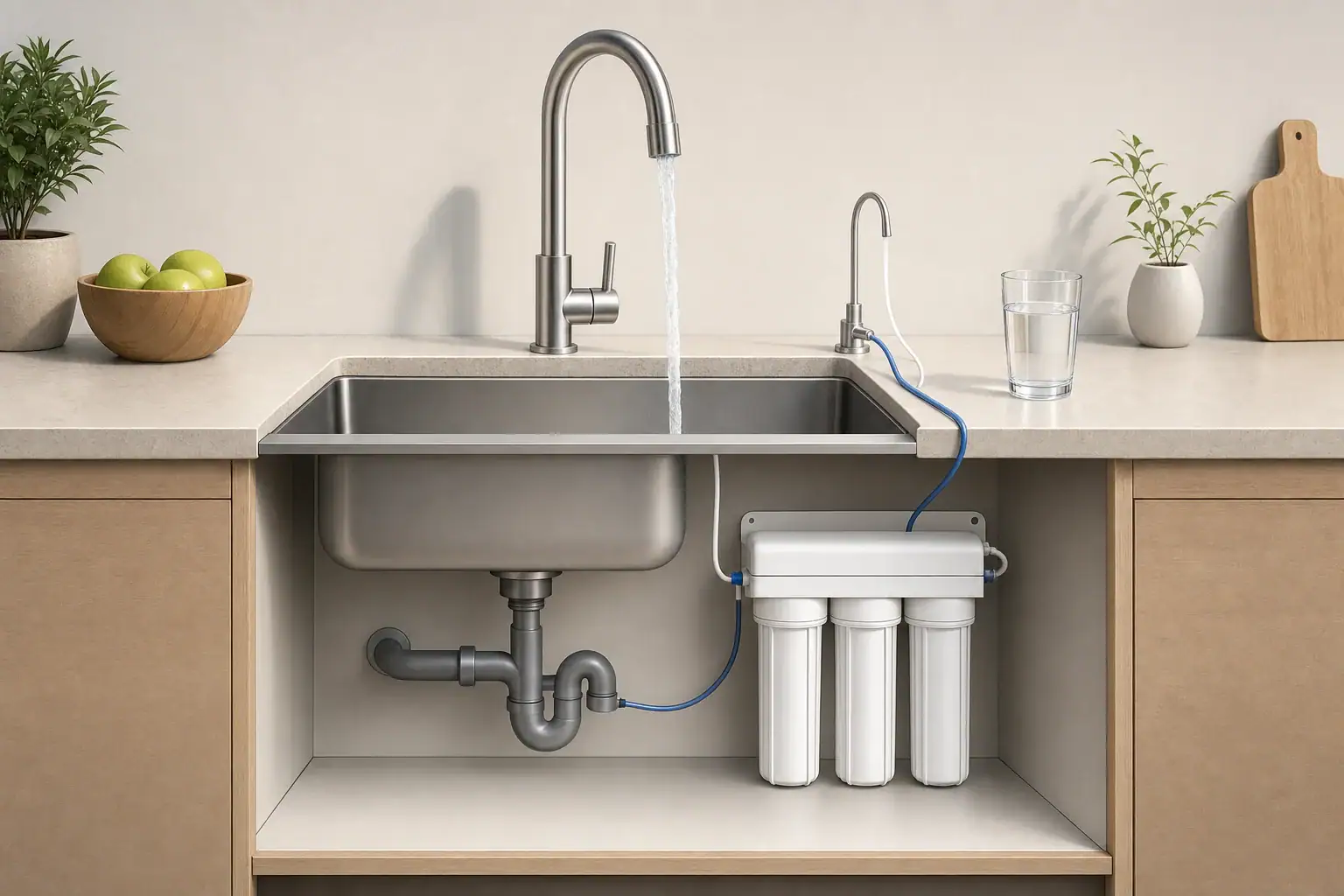
A water filter package may describe capacity in gallons, months, gallons per day, or some combination of these measurements. Although the numbers can look precise, they do not always predict exactly how long a filter will last in a particular home.
Capacity depends on water use, source-water quality, flow rate, filter design, and the specific substances a cartridge is intended to reduce. Understanding these variables makes it easier to compare systems and replace filters at reasonable intervals.
What a Water Filter Capacity Claim Actually Means
A gallon rating generally describes the volume of water a filter is expected to treat under defined conditions. A month rating is usually an estimated service interval based on assumed household use. Neither number should automatically be treated as a guarantee.
Capacity may refer to different aspects of performance:
- Contaminant-reduction capacity: The volume treated before performance for a specified substance is expected to fall below the tested level.
- Physical holding capacity: The amount of sediment or debris a cartridge can collect before flow becomes restricted.
- Recommended service life: A general replacement interval intended to account for normal use and sanitation considerations.
- Production capacity: For reverse osmosis systems, gallons per day usually describes potential output rather than cartridge life.
One cartridge can also have different capacities for different substances. For example, its stated capacity for chlorine taste and odor may not be the same as its capacity for another specifically tested reduction claim. The relevant rating is the one connected to the performance that matters for the household.
Gallons Versus Months: Which Limit Applies First?
When a replacement instruction lists both gallons and months, it commonly means the filter should be changed when either limit is reached first. The gallon figure accounts for water volume, while the time limit accounts for age and ordinary service conditions.
Consider a cartridge described as lasting up to 300 gallons or six months. At two gallons per day, 300 gallons would last about 150 days, or roughly five months. At four gallons per day, the same volume would be reached in about 75 days. These are calculations, not predictions of actual performance.
A low-use household should not assume that a cartridge can remain installed indefinitely merely because it has not reached its gallon rating. Likewise, a high-use household may reach the gallon limit well before the stated number of months.
Example values for illustration.
| Claim type | Example | What it generally describes |
|---|---|---|
| Gallon capacity | 300 gallons | Total treated volume under stated conditions |
| Time interval | Six months | Estimated calendar-based service period |
| Combined limit | 300 gallons or six months | Replacement when the first limit is reached |
| Daily production | 50 gallons per day | Potential reverse osmosis output, not filter life |
| Rated flow | 0.5 gallon per minute | Water delivery rate under specified conditions |
| Sediment size | Five-micron nominal | Particle-filtration characteristic, not service duration |
| Estimated membrane life | Two years | General planning interval affected by feed water and use |
Why Real-World Filter Life Can Differ From the Label
Capacity testing or manufacturer estimates use particular water conditions, pressures, flow rates, and operating patterns. Household conditions may be different, sometimes substantially.
Water quality and contaminant load
Water with more sediment can block cartridge pores and reduce flow sooner. Higher concentrations of chlorine, organic compounds, hardness minerals, iron, or other constituents may also affect certain filter media or pretreatment stages.
This does not mean that visibly clear water is necessarily easy on every filter. Many dissolved substances cannot be seen. A current utility report or appropriate water test provides more useful information than appearance alone; learn how to read a Consumer Confidence Report before comparing source-water conditions.
Household water demand
A filter serving drinking water for one person has a different workload from a system supplying a large family, cooking, pets, an ice maker, and frequent beverage preparation. Guests and seasonal occupancy can also change demand.
Point-of-use filters usually treat only water from one outlet. Whole-house filters may process nearly all water entering the home, so their gallon totals can rise much faster.
Flow rate and contact time
Some filter media work best within a specified flow range. Excessive flow can reduce contact time, while a clogged filter may deliver water too slowly for practical use. A high gallon rating does not necessarily mean a high flow rate.
Pressure and temperature
Reverse osmosis production ratings are sensitive to feed-water pressure and temperature. Colder water generally passes through an RO membrane more slowly. Low pressure can also reduce production and may change wastewater efficiency, depending on system design.
How to Estimate Household Filter Usage
The most useful estimate starts with the amount of filtered water actually used, not total household occupancy by itself. Track typical use for several days or read a dedicated system meter if one is provided.
Include all demands served by the filter:
- Drinking water
- Cooking and food preparation
- Coffee, tea, and other beverages
- Refrigerator dispensers and ice makers
- Pet water
- Humidifiers or small appliances when filtered water is used
To estimate service time from a gallon rating, divide rated gallons by average filtered gallons used per day. A 600-gallon cartridge serving three gallons per day has a simple calculated life of 200 days. If its instructions also specify replacement every six months, the calendar interval would arrive first.
For irregular use, a weekly estimate may be easier. Add the gallons used in a typical week, then divide the capacity by that total. Keep in mind that the result is only a planning estimate because incoming water quality and operating conditions may change.
Avoid confusing total water use with filtered use
A household might use many dozens of gallons per person each day across showers, toilets, laundry, and cleaning. That total is not relevant to a drinking-water filter connected only to a kitchen faucet. It is relevant to a whole-house filter installed on the main supply.
When comparing capacity claims, first confirm which fixtures and appliances the system will serve.
Capacity Claims for Different Filter Types
Not every water treatment technology uses capacity terminology in the same way. Direct comparisons can be misleading unless the measurement describes the same function.
Carbon and sediment cartridges
Carbon cartridges may have gallon ratings tied to taste, odor, chlorine, chloramine, VOC, or other specific reduction testing. Sediment cartridges are often replaced based on pressure drop, visible loading, flow restriction, or a recommended maximum interval rather than a meaningful universal gallon count.
Pitcher, faucet, and refrigerator filters
These small filters usually combine a gallon limit with a month estimate. Their actual life can vary considerably with daily use. Small media volume also means that frequent use may consume rated capacity quickly.
Under-sink multistage systems
Different stages may have different schedules. A sediment prefilter might load first, while a carbon stage has a separate rated capacity. Replacing every stage solely because one cartridge is due may be unnecessary unless the system instructions specify a coordinated service schedule.
Reverse osmosis systems
An RO membrane’s gallons-per-day figure describes production under rated conditions. Prefilters, postfilters, and the membrane have separate replacement considerations. Membrane condition may be assessed through production, system behavior, and appropriate water-quality measurements rather than elapsed time alone. See the RO filter replacement schedule for a stage-by-stage overview.
UV treatment units
UV systems are commonly managed by lamp operating time and scheduled maintenance, not gallons alone. They also depend on suitable incoming water clarity and correct operating conditions. A UV unit should not be treated as a substitute for filtration when sediment or other treatment needs are present.
Building a Practical Replacement Schedule
A useful schedule combines the stated limits with observed household conditions. Record the installation date, estimated starting meter reading if available, cartridge model or type, and the reason for replacement.
Replace a cartridge when its applicable gallon or time limit is reached, or earlier when system instructions call for it. Possible signs that service may be needed include:
- A noticeable and persistent reduction in flow
- Return of a taste or odor the filter previously reduced
- An indicated pressure change across a monitored housing
- Visible sediment loading in a cartridge designed for inspection
- A system alert or service indicator
- Water-quality measurements that no longer meet the intended performance target
These signs are not interchangeable. For example, loss of flow can indicate sediment loading, but a carbon filter can exhaust some reduction capacity without producing an obvious taste change. A timer light may track elapsed time rather than gallons actually used. If your filtered water flow suddenly dropped, check for other system causes as well.
During replacement, follow the system’s service and sanitation instructions. Use compatible components, confirm that housings are properly seated, and check for leaks after returning the system to normal operation. Do not bypass pressure controls, shutoff devices, or other safety features.
Example values for illustration.
| Filter or stage | Primary planning basis | Useful observation |
|---|---|---|
| Pitcher cartridge | Gallons or months, whichever comes first | Tracked refills and installation date |
| Faucet-mounted filter | Rated gallons and elapsed time | Daily use and flow change |
| Sediment prefilter | Pressure drop or service interval | Reduced flow or visible loading |
| Carbon block | Claim-specific capacity and time limit | Usage record and intended reduction target |
| RO prefilters | Scheduled interval and feed conditions | Pressure, production, and sediment load |
| RO membrane | Performance trend rather than GPD alone | Production rate and appropriate measurements |
| UV lamp | Operating time specified for the unit | Service indicator and maintenance record |
Related guides:
Filter Capacity in Gallons: How Manufacturers Calculate It •
Replacement Planner Basics: Estimate Your Next Filter Change Date •
Filter Capacity Calculator: Convert Daily Use into Months •
Cost per Gallon Calculator: How to Compare Filters Fairly
How to Compare Capacity Labels Before Choosing a Filter
Start by identifying what the capacity number measures. A large gallon figure has limited value if it applies only to a feature that is not relevant to the household’s water or if the required flow rate is too low for the intended fixture.
Check the following details:
- Whether the rating applies to the cartridge, membrane, or complete system
- Which specific reduction claim is associated with the stated capacity
- Whether gallons, months, or the first limit reached controls replacement
- The rated flow or daily production under stated test conditions
- Required water pressure, temperature range, and source-water conditions
- Whether separate stages have different service intervals
- Whether performance claims reference independent testing to an applicable standard
Capacity is most useful when considered alongside water quality, flow needs, maintenance effort, and replacement cost. A smaller filter with a clearly documented rating may be easier to plan around than a larger advertised number with little explanation of the test conditions or applicable reduction performance.
Frequently asked questions
Should I replace a water filter by gallons or months?
Use whichever limit the manufacturer says comes first. Gallons track treated volume, while the month limit addresses time in service and typical operating conditions.
How do I calculate how long a filter will last?
Divide the rated gallon capacity by your average daily filtered-water use. Compare that result with the stated calendar replacement interval and follow the earlier limit.
Does a slow water filter always mean the cartridge is exhausted?
Not always. Reduced flow can indicate sediment loading, low supply pressure, or another system issue. Check the service instructions and replace the applicable stage when its limits or condition indicate service is due.
Does reverse osmosis gallons per day indicate membrane life?
No. Gallons per day describes potential water production under rated conditions. RO prefilters, postfilters, and the membrane each have separate maintenance and replacement considerations.
Can clear water make a filter last longer?
Clear water may contain less visible sediment, but it can still contain dissolved substances that affect filter performance. Capacity depends on the specific water conditions and the filter media involved.
- NSF/ANSI standards explained (42/53/401/58)
- Clear trade-offs: pitcher vs faucet vs under-sink vs RO
- Maintenance planning: cost per gallon and replacement cadence