
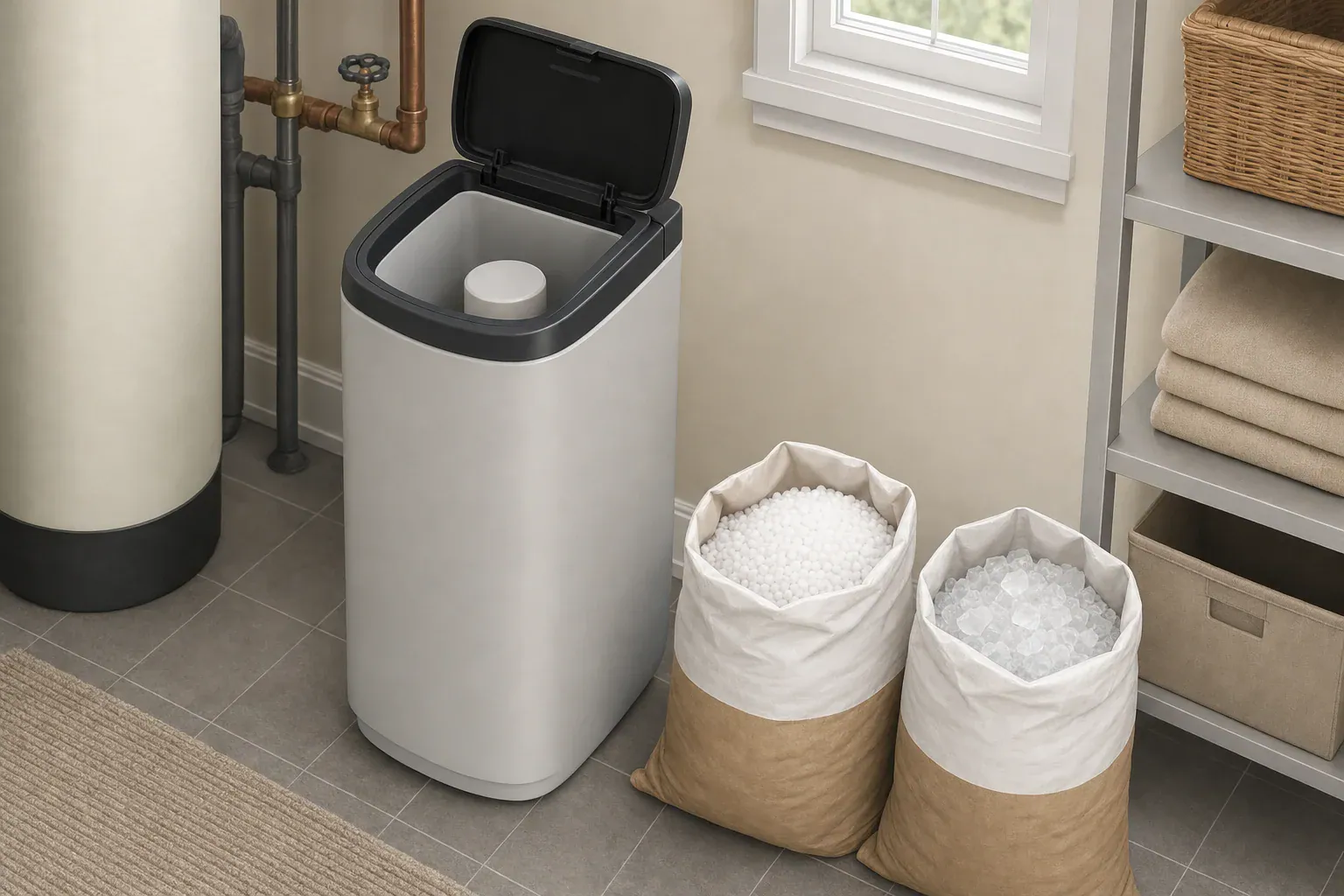
Quick answer: For water softener salt pellets vs crystals, check your owner’s manual first. If it permits both pellets and coarse solar crystals, either can be suitable. Compare the actual bag’s impurity or insoluble-content information, your tank’s history of bridging or mush, and local price per pound.
Do pellets and crystals soften water differently?
Salt pellets and coarse solar crystals are physical forms of salt used to make regeneration brine in a conventional ion-exchange water softener. They are not different water-treatment technologies.
Diamond Crystal states that crystals, pellets, and cubes can all soften water effectively, while advising owners to follow their equipment manual when choosing a form. This is manufacturer guidance rather than a controlled head-to-head comparison, but it supports a practical point: salt shape alone does not establish better softening performance. Source: Diamond Crystal water-softener salt FAQs
Water softener salt pellets vs crystals: what should you compare?
Start with the manual, then compare the specifications and real-world fit of the products available locally. Do not rely on broad claims that one shape always dissolves faster, lasts longer, or prevents all tank problems.
1. Follow your softener’s instructions
Salt compatibility is model-specific. For example, the Whirlpool WHES33 manual directs owners to use nugget, pellet, or coarse solar salt with less than 1% impurities. Source: Whirlpool WHES33 Installation and Operation Manual
Rheem’s Preferred Compact product guidance recommends evaporated salt pellets or solar salt crystals with less than 1% impurities and advises against block salt. Those examples do not authorize every form or crystal size in every softener. Find your exact model number and follow its manual, especially where it specifies a salt form, impurity limit, or excluded product type. Source: Rheem Preferred Compact guidance
2. Compare bag specifications, not shape alone
“Pellet” and “crystal” describe physical form, not a universal purity grade. Check the product bag or manufacturer listing for salt purity, water-soluble content, insoluble content, and additives. A product with a stated impurity limit that meets your manual’s requirement gives you more useful information than its appearance alone.
For example, Diamond Crystal lists Bright & Soft pellets as typically 99.8% salt and more than 99.7% water-soluble. Its Solar Naturals crystals are listed as typically 99.6% salt with low insoluble content. These figures apply only to those named products; they do not show that all pellets are purer than all crystals. Source: Bright & Soft pellets specifications · Source: Solar Naturals crystals specifications
3. Match the form to a recurring tank issue
A salt bridge is a hardened crust above the water level that creates an empty space beneath it. Salt mush is soft, partly dissolved material that accumulates toward the bottom of the brine tank. They can look similar from above, but they are different conditions and should be handled using the procedure for your softener. Source: Diamond Crystal salt-maintenance FAQs
Diamond Crystal says the larger size of pellets or cubes may make them less susceptible to bridging. That is a conditional manufacturer statement, not a guarantee or a measured bridge-reduction rate. If your compatible system repeatedly develops a hard bridge, pellets can be a reasonable next-bag trial. Source: Diamond Crystal comparison of crystals, pellets, and cubes
4. Compare local cost fairly
Compare like-sized bags with similar stated specifications. Divide the shelf price by net bag weight to calculate price per pound:
Price per pound = bag price ÷ net weight in pounds
Hypothetical example: a 40-pound bag priced at $10 costs $0.25 per pound ($10 ÷ 40 lb). A 40-pound bag priced at $12 costs $0.30 per pound ($12 ÷ 40 lb). If both meet the manual’s requirements, the first bag costs $0.05 less per pound. This calculation does not predict how long either bag will last, because salt use depends on water hardness, water use, and the softener’s settings. If you need help interpreting hardness units, see water hardness in grains per gallon vs ppm.
Pellets or crystals: a practical selection table
| Situation | Practical next step |
|---|---|
| Your manual permits only one salt form | Use that form and meet any stated impurity limit. |
| Your manual permits pellets and coarse solar crystals | Compare the bags’ stated specifications, availability, price per pound, and your tank’s history. |
| A hard crust forms above the water repeatedly | Follow the manual’s bridge-clearing instructions. If pellets are permitted, consider them for the next refill as a trial. |
| Soft compacted material collects near the tank bottom | Treat it as possible salt mush and use the manufacturer’s cleaning or troubleshooting instructions. |
| Residue is a recurring concern | Compare stated insoluble-content or water-solubility information among compatible products rather than choosing by shape alone. |
| Your current compatible salt works without tank problems | There may be little practical reason to switch forms solely because of marketing claims. |
| You cannot find the manual | Locate the model number and obtain the manufacturer’s instructions before changing salt types. |
Can you switch from crystals to pellets?
You can generally switch when your softener manual permits both forms. Diamond Crystal says mixing salt shapes is generally acceptable, subject to the softener manufacturer’s instructions. A clean, normally operating brine tank does not automatically need to be emptied just because the next permitted bag has a different shape. Source: Diamond Crystal water-softener salt FAQs
Before switching, inspect for an existing bridge, mush, or substantial residue. A new salt shape will not remove buildup already in the tank. Use the equipment manual’s maintenance procedure rather than using unapproved chemicals or forceful methods that could damage tank components.
A brine-tank observation checklist
Use this quick check whenever you add salt or suspect the softener is not regenerating normally:
- Confirm that the product’s form and stated impurity information meet the manual’s requirements.
- Look for a hard crust, an uneven cavity beneath the salt, soft bottom buildup, or unusual residue.
- Note whether the salt level appears to decline between refills.
- If the tank looks full but hard-water symptoms return, check the manual’s troubleshooting section or contact a qualified service provider.
- Keep outside water, debris, and non-approved products out of the brine tank.
EPA WaterSense advises cleaning the brine tank as needed to remove buildup, following the manufacturer’s instructions, at least every few years. It does not set separate cleaning intervals for pellets and crystals. Source: EPA WaterSense guide to selecting and maintaining a water-efficient water softener
The practical choice
When both are permitted, either compatible pellets or coarse solar crystals can be a sensible choice. Choose based first on your manual, then on the actual bag specifications, past tank behavior, and price per pound. Pellets are a reasonable trial for recurring bridges; compatible crystals remain a practical option when they have performed reliably and offer better local value.
Frequently asked questions
Are salt pellets always better than crystals?
No. Pellets and crystals are forms of salt, not universal performance grades. The better choice is the one your manual permits and whose product specifications, price, and tank performance fit your situation.
Do pellets prevent salt bridges?
Not necessarily. A manufacturer notes that larger pellets or cubes may be less susceptible to bridging, but this is not a guarantee. Follow your manual’s bridge-clearing procedure and investigate other operating or maintenance issues if bridging continues.
Should I empty the brine tank before switching salt forms?
Not solely because you are changing between permitted forms. Inspect for a bridge, mush, or residue first. If buildup is present, follow the cleaning instructions for your exact softener model.
- NSF/ANSI standards explained (42/53/401/58)
- Clear trade-offs: pitcher vs faucet vs under-sink vs RO
- Maintenance planning: cost per gallon and replacement cadence