
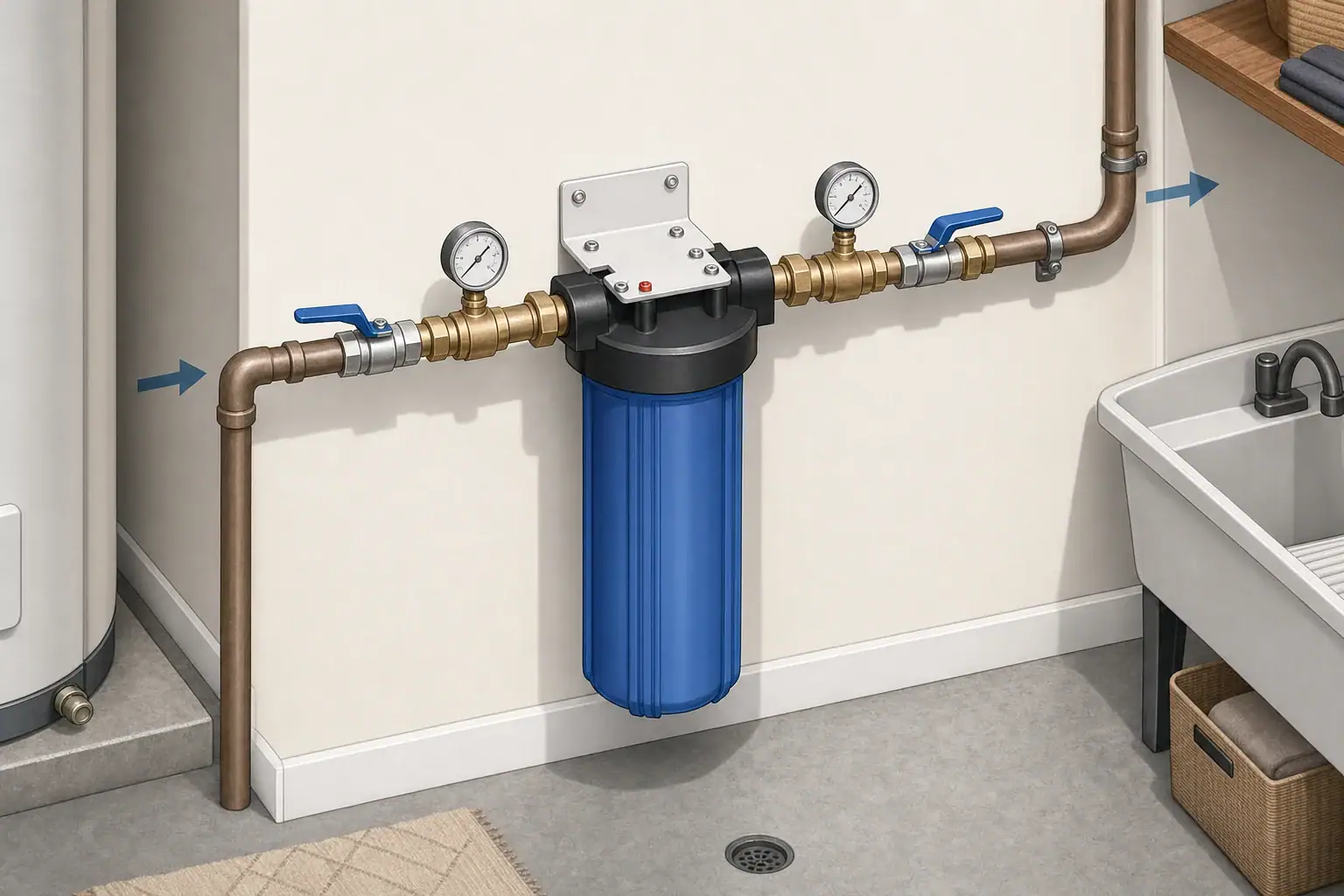
Quick answer: Read the inlet and outlet gauges at the same time while the same water demand is running. Subtract outlet pressure from inlet pressure, then compare that flowing difference with a clean-filter baseline taken under matching conditions. Static readings show available supply pressure more than filter restriction; follow your system manual for service decisions.
How whole house filter pressure gauges show pressure drop
Whole house filter pressure gauges are most useful as a pair: one measures pressure upstream of the filter stage and the other measures it downstream. Read both gauges simultaneously while water is flowing, then calculate the differential pressure:
Pressure drop (ΔP) = inlet pressure − outlet pressure
For example, if the inlet gauge reads 62 psi and the outlet gauge reads 57 psi during the same demand, the pressure drop is 5 psi.
Pressure drop changes with flow rate and with the exact cartridge and housing. A Pentair Pentek P Series specification sheet shows different initial pressure-drop values for different cartridge models at the stated flow conditions. Those figures are product-specific, not a universal target for whole-house filters.
That is why one gauge reading alone, or two readings taken under different water demands, cannot reliably identify a restricted filter.
Static pressure versus flowing pressure
Static readings
Static pressure is measured with water-using fixtures and appliances off. The EPA’s WaterSense home-maintenance guidance describes checking household service pressure with water use turned off and a gauge connected to a hose bibb. This is a useful supply-pressure check, but it is not a filter replacement test.
With little or no water moving through a filter, inlet and outlet readings may be similar. Similar static readings do not establish that the cartridge has low resistance under flow.
Flowing readings
Flowing, or dynamic, pressure is measured while a controlled water demand is active. Use the same fixture or fixture combination, similar valve positions, and approximately the same demand each time. Let the readings settle, then record both gauges together.
Do not subtract a static inlet reading from a flowing outlet reading. Because the system is operating under different conditions, that calculation is not a meaningful filter differential.
Where to install whole house filter pressure gauges
To assess one stage, pressure-sensing points must be on opposite sides of that stage: upstream of the housing and downstream of it. A 3M filter-housing installation manual illustrates inlet and outlet gauges and states that gauges help identify pressure drop and element-replacement needs.
That 3M document applies to a specific commercial housing, not every residential installation. Use only ports, fittings, and gauge locations approved for your equipment. Follow local plumbing requirements, and use a qualified plumber if the housing or pipework was not designed for gauge installation.
On a multistage system, a gauge before the first stage and one after the last stage show the total pressure loss across the system. They cannot identify the restrictive stage by themselves. Approved measurement points between stages are needed to separate the losses.
Pressure-drop measurement checklist
- Identify the equipment. Record the housing, cartridge, or media-tank model numbers. Do not rely on appearance or nominal cartridge size.
- Read the exact manual. Look for operating-pressure limits, flow conditions, initial pressure-drop information, and any manufacturer service trigger.
- Check the gauges. Confirm that both use the same units and behave consistently under unchanged conditions. A sticking gauge or blocked sensing port can imitate a filter problem.
- Record static readings. With household demand off, note the inlet and outlet pressure and date.
- Create repeatable demand. Run the same fixture or fixture combination the same way for every comparison. A whole-house flow-rate guide explains why household demand affects system performance.
- Record flowing readings together. Wait for the gauges to stabilize, then write down inlet and outlet pressure at the same time.
- Calculate ΔP. Subtract the outlet reading from the inlet reading.
- Set a clean-filter baseline. When the correct new cartridge is installed and operating normally, record the flowing differential and the fixture setup used.
- Compare like with like. A trend measured at the same demand is more useful than an isolated reading.
- Use the model-specific instructions. Inspect or service the stage according to its manual rather than a generic pressure-drop number.
Why both gauges can fall when fixtures open
Opening fixtures creates flow through the service line, pressure regulator, valves, plumbing, and filter. Each component can contribute resistance, and the incoming supply can vary. The Portland Water Bureau’s pressure and flow guidance notes that plumbing restrictions can limit flow even when static pressure appears normal and that supply pressure may decline during higher-demand periods.
Therefore, both gauges can drop from their static readings without demonstrating that the filter is clogged. The useful comparison is the difference between the two flowing readings under repeatable demand.
- If both readings decline by similar amounts and ΔP remains near the clean baseline, supply pressure or an upstream plumbing component may deserve attention.
- If inlet pressure is comparable to earlier readings but outlet pressure falls farther than before, increasing ΔP, restriction in the measured filter stage becomes more plausible.
Worked example: comparing a clean baseline
Assumptions: the same fixtures are running as when the clean baseline was taken, and both gauges read in psi.
Current readings: 62 psi inlet − 57 psi outlet = 5 psi ΔP.
If the clean-filter differential at that same demand was 2 psi, the differential has increased by 3 psi. That supports inspecting the cartridge, housing, and valve positions. It does not automatically mean replacement is required.
Some manufacturers provide their own instructions. For example, an Aquasure multistage system manual directs users to record a new-filter pressure baseline and gives a service trigger for that system. Its stated trigger should not be transferred to unrelated housings or cartridges.
How to interpret the gauge pattern
| Observed pattern | What it may indicate | Next check |
|---|---|---|
| Inlet pressure is similar to earlier readings, outlet pressure is lower, and ΔP has increased | Restriction within the measured filter stage is more plausible. | Confirm the cartridge model and valve positions; inspect and service only as the equipment instructions direct. |
| Both readings fall similarly and ΔP remains near the clean baseline | Supply pressure or an upstream regulator, pump, valve, or plumbing issue may be contributing. | Compare upstream performance under the same demand; consult the utility, well-system instructions, or a plumber as appropriate. |
| ΔP is high immediately after the specified new cartridge is installed | Demand may be unsuitable for the stage, or there may be a cartridge, valve, or installation issue. | Verify cartridge identity, valve positions, and manufacturer pressure-drop data at the relevant flow. |
| Static readings look normal, but both pressures drop sharply under demand | The supply or plumbing may not sustain that demand. | Check upstream restrictions, partly closed valves, pressure-regulator concerns, and service-line limitations. |
| A gauge sticks, jumps, or differs under unchanged conditions | The gauge or pressure-sensing port may be unreliable. | Have the instrument and port checked before attributing the result to the filter. |
When a rising differential justifies inspection
A sustained rise from the clean-filter baseline, measured under matching demand, is a reasonable reason to inspect the stage. Check that the correct cartridge is installed, confirm intended valve positions, and follow the housing instructions for isolation, depressurization, and service. Do not loosen a pressurized housing or gauge fitting.
There is no verified universal acceptable pressure-drop value for all whole-house filters. Cartridge construction, media, housing design, and flow demand differ. If the manual gives no differential-pressure trigger, use the trend as diagnostic information and contact the manufacturer or a qualified water-treatment professional about the exact model.
For related maintenance and diagnostic tasks, see whole-house filter bypass valve layouts, whole-house low-pressure troubleshooting, and this whole-house maintenance calendar.
Pressure gauges evaluate hydraulic performance only. They do not demonstrate contaminant reduction, certify a cartridge, or prove that water is safe to drink.
Frequently asked questions
What pressure drop means a whole-house filter needs changing?
There is no universal replacement pressure drop. Compare the flowing differential with your clean-filter baseline at the same demand, then follow the service trigger or replacement schedule in the manual for your exact housing and cartridge.
Can static pressure show whether a filter is clogged?
Usually not by itself. With fixtures off, little water moves through the filter, so inlet and outlet readings can be similar even when the stage creates a larger pressure drop during flow.
Do pressure gauges prove that a filter is removing contaminants?
No. Gauges show pressure behavior, not water quality or contaminant reduction. Check the product’s applicable performance documentation and certification listing for any specific reduction claim.
- NSF/ANSI standards explained (42/53/401/58)
- Clear trade-offs: pitcher vs faucet vs under-sink vs RO
- Maintenance planning: cost per gallon and replacement cadence