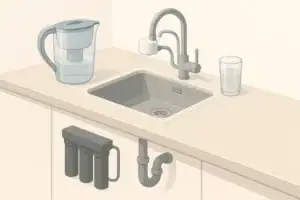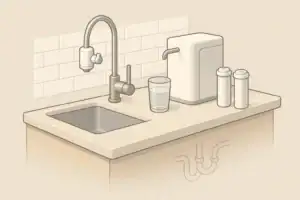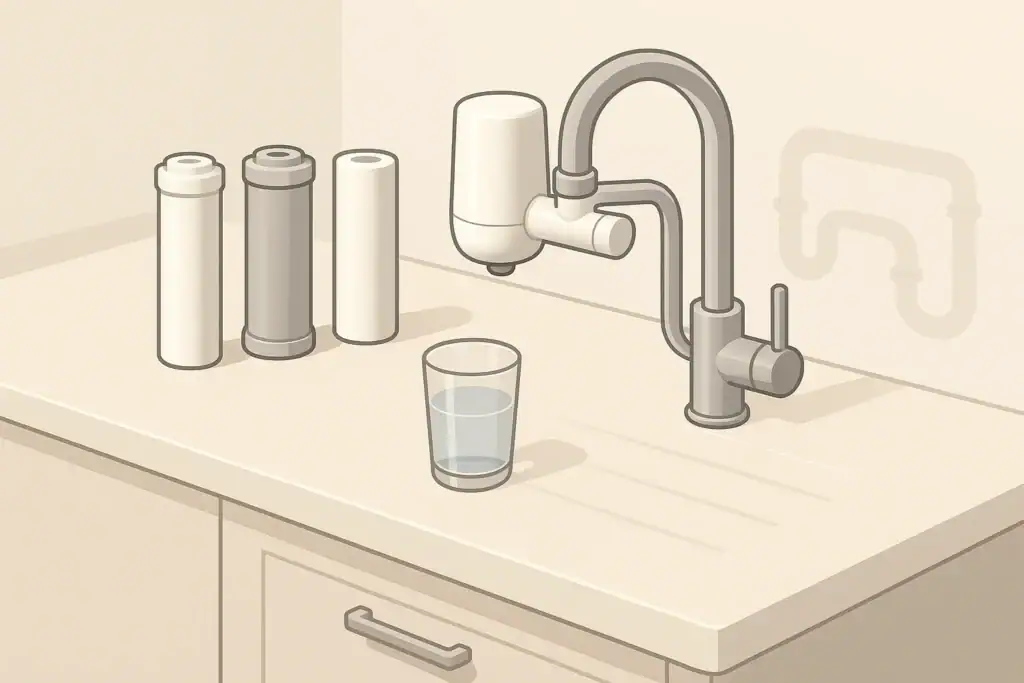
How Tank and Tankless RO Systems Work
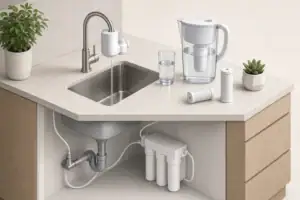
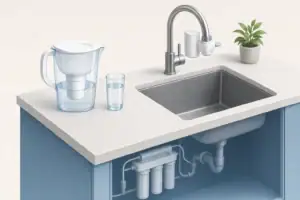
Reverse osmosis systems are commonly used under a kitchen sink to reduce dissolved minerals, some metals, certain chemicals, and taste or odor issues that simpler filters may not address as broadly. Both tank and tankless designs use an RO membrane, prefilters, and usually a postfilter. The difference is how they deliver water at the faucet. If you want a broader overview of treatment capabilities, see what reverse osmosis removes.
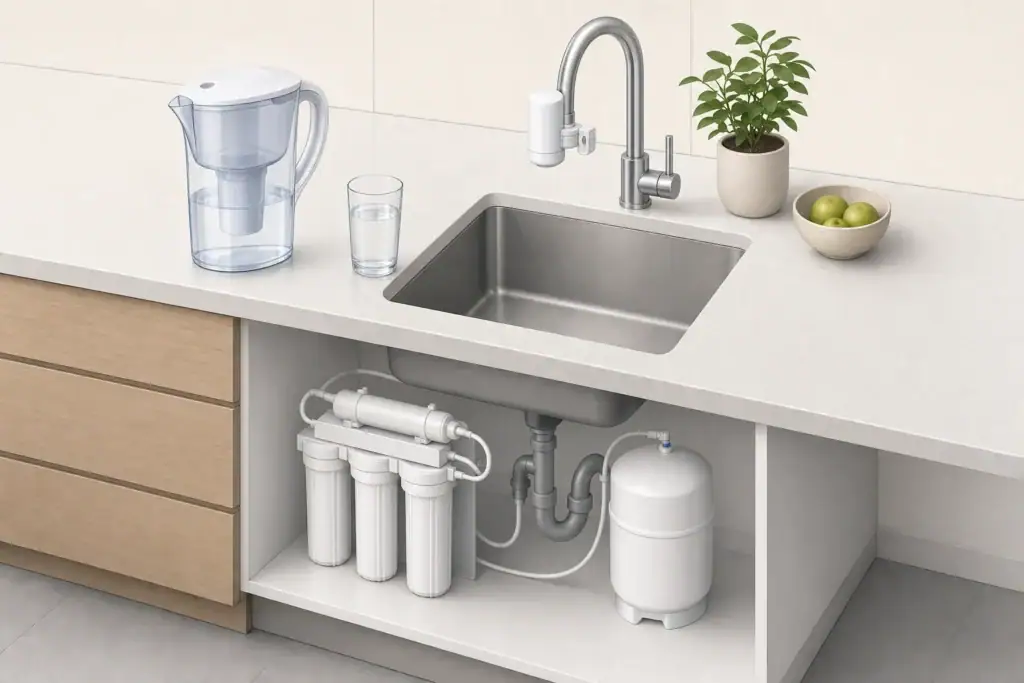
A tank RO system makes water slowly and stores it in a pressurized reservoir. When you open the dedicated RO faucet, stored water is pushed out of the tank. A tankless RO system makes water on demand and does not rely on a large storage reservoir. It often uses higher-capacity membranes and may include an electric pump, flow controls, and sensors to support faster production.
Traditional tank RO systems
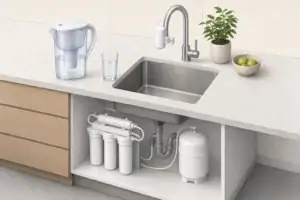
A tank RO unit typically includes sediment and carbon prefilters, an RO membrane, a storage tank, and a carbon postfilter. The storage tank is the key feature. Because RO production is slow, the tank lets the system build up several quarts of treated water between uses.
Tank systems are familiar, widely available, and often forgiving for normal kitchen use. Their main compromises are cabinet space, tank pressure changes as the tank empties, and periodic tank sanitation as part of good maintenance.
Tankless RO systems
A tankless RO unit eliminates the bulky storage tank and produces water as you draw it. Many models use a pump to improve membrane performance and deliver a steady stream. Some are compact vertical units with cartridge-style filters that slide in and out.
The tradeoff is that tankless systems depend more heavily on membrane capacity, household water pressure, and, for many designs, electricity. They may also cost more upfront and may require more careful compatibility checks before installation.
The Main Difference: Storage vs On-Demand Production
The simplest way to compare tankless RO vs tank RO is to ask whether you want stored water ready to dispense or compact on-demand production. Neither approach is automatically better for every home. The right choice depends on cabinet layout, how much water you draw at once, and how you feel about maintenance tasks. If you are comparing treatment options more broadly, the contrast in RO vs carbon under-sink systems can also help frame the decision.
With a tank, the system can deliver a strong initial flow because the water is already waiting under pressure. After the tank is partially depleted, flow can slow and recovery depends on the membrane production rate. With tankless RO, there is no large reserve. The system must produce water in real time, so faucet flow depends on membrane capacity, pump design if present, inlet water temperature, and pressure.
Water temperature matters for both types. RO membranes generally produce less water in colder water conditions and more in warmer conditions, within normal household ranges. This is one reason rated daily production should be treated as a comparison point, not a guarantee of the exact amount you will get at your sink.
Example values for illustration.
| Decision factor | Tank RO | Tankless RO |
|---|---|---|
| Cabinet space | Needs room for filters and a storage tank | Usually uses a smaller footprint without a large tank |
| Initial faucet flow | Often strong while the tank is full | Depends on on-demand production capacity |
| Long draw performance | Can slow as the tank empties | May provide steadier flow if sized well |
| Electricity | Many basic systems do not need power | Many units use power for a pump or controls |
| Maintenance style | More parts to clean around and a tank to monitor | Often cartridge-focused, with electronics on some units |
| Installation planning | Requires tank placement and tubing routes | Requires checking outlet access if powered |
| Best fit | Homes with enough cabinet space and moderate draw patterns | Tight cabinets or users who prefer no storage tank |
Space and Installation Tradeoffs
Space is one of the clearest differences. A tank RO system can work very well, but the tank takes up meaningful room under the sink. In a cabinet that already contains a garbage disposal, pull-out trash bin, cleaning supplies, or unusual drain routing, that tank may be the deciding factor. For more layout ideas, see this space-saving RO installation guide.
Tankless systems are often chosen because they leave more usable cabinet space. This can be useful in apartments, small kitchens, wet bars, or homes where the under-sink area is already crowded. The compact design may also make filter access easier if cartridges are front-facing.
Cabinet footprint and access
When evaluating either option, measure width, depth, and height with the cabinet contents in place. Leave practical service space so filters can be replaced without forcing tubing, pressing against drain pipes, or moving heavy objects each time.
A tank RO layout may allow flexible tank placement, but the storage tank still needs to sit securely and remain accessible. A tankless unit may be taller or deeper than expected, so check the clearance needed to remove cartridges.
Power and placement
Many tankless RO systems use electricity. That does not make them difficult to use, but it does add a planning step. The outlet should be suitable for the location and should not require unsafe extension cord routing or improvised wiring. If an outlet is not available, a qualified professional can advise on safe options.
Tank RO systems are often simpler in this respect because many basic designs operate using household water pressure alone. However, some tank systems include booster pumps or accessories, so the same power check may still apply.
Flow Rate and Daily Use
Flow rate is where expectations can become confusing. A tank system may feel faster when the tank is full, even if the membrane itself makes water slowly. A tankless system may have a rated production capacity that looks high on paper, but real faucet flow still depends on pressure, temperature, filter condition, and model design. Understanding the difference between water pressure vs flow rate makes these ratings easier to interpret.
For filling a single glass, either style can be convenient if properly installed and maintained. For filling a kettle, coffee maker reservoir, pet bowl, or cooking pot, the difference is more noticeable. Think about the biggest amount of RO water you normally draw at one time, not just your total daily use.
Short draws versus long draws
Tank RO systems are well suited to short, repeated draws throughout the day. The tank refills between uses. If several people fill bottles back to back, the tank may run low and the flow can drop until it recovers.
Tankless RO systems avoid the stored-water limit, but they must keep up in real time. A well-sized tankless unit can feel consistent, while an undersized one can feel slow during every draw. If your household often fills large containers, compare the expected faucet flow rather than relying only on gallons-per-day ratings.
Refrigerators and ice makers
Some homes connect RO water to a refrigerator or ice maker. This requires careful compatibility checks. Appliances may have minimum pressure or flow needs, and long tubing runs can reduce performance. Do not bypass check valves, pressure controls, leak protection, or other safety features to force compatibility. If your fridge setup is part of the plan, review refrigerator filter compatibility first.
A tank can sometimes help provide short bursts of stored water for an appliance, but it may also introduce pressure variation as it empties. A tankless system may need specific support for appliance connections. In either case, follow the system and appliance documentation or consult a qualified installer.
Maintenance, Leak Awareness, and Long-Term Ownership
Maintenance is not just about replacing filters. It also includes watching for pressure drop, unusual tastes, slow flow, leaks, and changes in drain behavior. Both tank and tankless RO systems need routine attention to work as intended. If you want a refresher on service timing, see the RO filter replacement schedule.
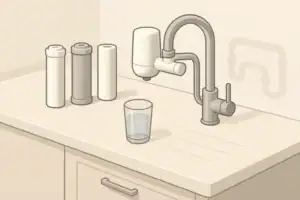
Prefilters protect the RO membrane from sediment and disinfectant exposure, such as chlorine, that can shorten membrane life. The postfilter polishes taste after the membrane or storage tank. Replacement intervals vary with water quality and use, so general schedules should be treated as planning estimates.
Filter changes and membrane life
Tank RO systems may use standard housings or twist-in cartridges. Standard housings can be economical but may take more time and care to service. Cartridge systems can be cleaner and faster, though cartridge cost and availability should be considered.
Tankless RO systems often use larger or integrated cartridges. Some have indicators that estimate filter life based on time or water use. These reminders are useful, but they should not replace observation. If flow drops suddenly or taste changes, maintenance may be needed sooner.
Sanitation and stagnant water
A tank system stores treated water, so sanitation is an important part of periodic service. The tank, lines, faucet, and housings can all be part of a maintenance routine. This is normal ownership, not a sign that tank systems are unsafe.
Tankless systems store far less water, but they still have internal wetted parts, cartridges, tubing, and a dedicated faucet. They also need periodic service. If the unit has electronics or leak detection, keep the area dry and do not ignore alarms or shutoff events.
Drain water expectations
RO systems send some water to drain while making treated water. The ratio varies by design, pressure, temperature, membrane condition, and whether a pump is used. Tankless systems with pumps often advertise improved efficiency, but actual performance depends on real conditions. A tank system can also perform well when pressure is adequate and filters are maintained. To compare this more directly, see RO waste water ratio.
Example values for illustration.
| Item | General planning interval | Notes |
|---|---|---|
| Sediment prefilter | About 6 to 12 months | May need earlier replacement with visible sediment or flow loss |
| Carbon prefilter | About 6 to 12 months | Important for taste and membrane protection on many city supplies |
| RO membrane | About 2 to 5 years | Depends on water quality, pressure, use, and prefilter maintenance |
| Carbon postfilter | About 12 months | Often replaced for taste and odor polishing |
| Storage tank check | During routine service | Applies to tank systems; check pressure and condition as directed |
| Sanitation | During scheduled service | Follow the system instructions and avoid improvised chemical use |
| Leak inspection | Regularly and after service | Look for moisture, loose tubing, or unexplained cabinet dampness |
Related guides: Reverse Osmosis 101: What RO Removes (and What It Doesn’t) • NSF/ANSI 58 Explained: What It Means for RO Systems • RO Filter Replacement Schedule: Prefilters vs Membrane • RO Waste Water Ratio: What’s Normal and How to Reduce It
Choosing Between Tankless RO and Tank RO
For many households, the choice comes down to priorities rather than water quality alone. Both designs can use similar treatment principles, but they package the system differently.
A tank RO system may be a practical fit if you have enough cabinet space, prefer a familiar non-powered layout, and mostly use RO water in short draws. It can also be a good choice when upfront simplicity matters and you are comfortable with tank-related maintenance.
A tankless RO system may be a better fit if under-sink space is limited, you prefer not to store treated water in a reservoir, or you want a compact cartridge-based design. It may also appeal to households that draw RO water frequently and want performance that does not depend on a tank refilling between uses.
Before choosing, review these practical questions:
- How much usable cabinet space is available after leaving room for service?
- Is a safe electrical outlet available if the system needs power?
- How much RO water do you draw at one time?
- Will the system serve only a dedicated faucet, or also another appliance?
- Are replacement filters easy to access and realistically within your maintenance budget?
- Does your water pressure meet the system requirements without unsafe modifications?
Neither tankless nor tank RO should be chosen based on a single specification. Look at the whole setup: space, flow, pressure, drain connection, filter access, service intervals, and how your household actually uses water. That practical fit matters more than choosing the newest design or the largest rating on the box.
Frequently asked questions
Is tankless RO always faster than tank RO?
Not always. Tankless systems can provide steady on-demand flow, but the actual speed depends on membrane size, pressure, temperature, and whether the unit uses a pump.
Does a tank RO system take up a lot of cabinet space?
Yes, the storage tank is usually the biggest space requirement. If your sink cabinet is crowded, that footprint can be a major factor.
Which system is easier to maintain?
It depends on the model, but tankless systems often use cartridge-style service, while tank systems may have more components and a tank to monitor. Both still need regular filter changes.
Can I connect either type to a refrigerator or ice maker?
Sometimes, but compatibility should be checked carefully. Appliance pressure needs, tubing length, and system design can affect performance.
Do tankless RO systems need electricity?
Many do, especially if they use a pump or electronic controls. Basic tank RO systems often do not need power, though some models may include powered accessories.
How do I choose between tank and tankless RO for my home?
Start with cabinet space, water use patterns, power access, and maintenance preferences. The better choice is the one that fits your actual setup and daily use.
- NSF/ANSI standards explained (42/53/401/58)
- Clear trade-offs: pitcher vs faucet vs under-sink vs RO
- Maintenance planning: cost per gallon and replacement cadence