
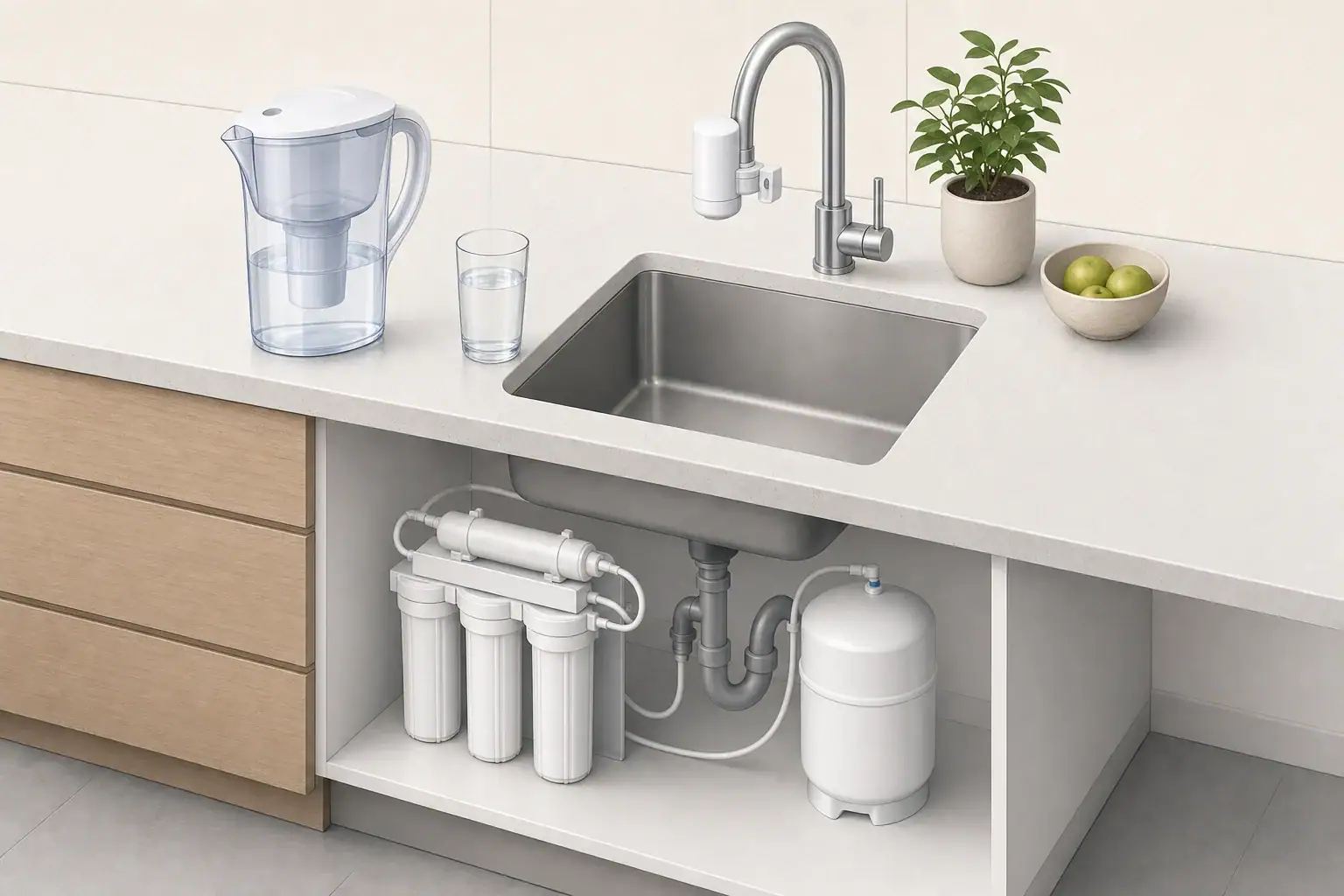
An under-sink reverse osmosis system sends concentrated water to the sink drain while producing treated water. The drain saddle is the small clamp-style fitting that connects the system’s drain tube to the sink drainpipe.
RO drain saddle placement affects drainage noise, clog potential, and the chance of wastewater backing into the tubing. The connection normally belongs on the sink side of the P-trap, but not every spot above the trap works equally well. Garbage disposals, dishwasher connections, pipe orientation, and local plumbing requirements all influence the decision.
Instructions supplied with the RO system should take priority because tubing sizes and connection designs vary. Local plumbing rules may also restrict mechanical drain saddles or require an approved air gap.
What an RO Drain Saddle Does
The drain saddle creates a low-pressure connection between the RO membrane’s drain line and the sink’s sanitary drain. It generally consists of two pieces that clamp around a drainpipe. A gasket seals the opening where the RO drain tube enters.
This fitting does not control the system’s wastewater flow. That job belongs to the RO flow restrictor and related internal components. The saddle simply provides a discharge point. It should never be connected to a pressurized water line or used as a substitute for an approved supply fitting.
The drain line may release water during production and for short flushing cycles, depending on the system design. Tank-based systems commonly drain while refilling the storage tank. Tankless systems may drain whenever treated water is being produced and during programmed flushes.
Choosing the Correct Drain Saddle Location
For a typical kitchen sink, the preferred location is on a straight, smooth section of drain tailpiece above the P-trap. A vertical section is often the most practical choice because wastewater can move downward without collecting around the opening.
Place the fitting where both saddle halves can sit flat against the pipe. Leave enough clearance to tighten the fasteners evenly, insert the tubing without a sharp bend, and inspect the connection later.
Account for disposals and dishwasher drains
On a double-basin sink with a garbage disposal, the drain saddle is usually better placed on the basin without the disposal when the plumbing layout allows it. This reduces exposure to ground food and forceful discharge from the disposal.
Avoid positioning the saddle directly across from or immediately beside a dishwasher drain inlet. Dishwasher discharge can be hot and turbulent, and it may push debris or wastewater toward a poorly positioned RO opening.
Keep the connection above the trap
The P-trap holds water to block sewer gases. An RO drain connection normally belongs upstream of that water seal. Installing it downstream of the trap can create sanitation, odor, and code concerns and should not be treated as an acceptable shortcut.
Example values for illustration.
| Potential location | General assessment | Reason |
|---|---|---|
| Straight vertical tailpiece above the trap | Usually preferred | Supports downward drainage and a flat saddle seal |
| Sink branch without a disposal | Often preferred | Reduces contact with food debris |
| Immediately beside a dishwasher inlet | Avoid when possible | Turbulent discharge may affect the RO connection |
| Disposal body or disposal outlet | Generally unsuitable | Food solids and vibration increase clogging concerns |
| Bottom of a horizontal pipe | Generally unsuitable | Debris and standing wastewater can collect at the opening |
| Curved pipe or trap bend | Unsuitable | The gasket may not seal evenly |
| Downstream of the P-trap | Generally unacceptable | May conflict with sanitation and plumbing requirements |
Common RO Drain Saddle Installation Mistakes
Drilling before checking the full assembly
A saddle may appear to fit until its back half contacts a cabinet wall, sink bowl, shutoff valve, or another drain fitting. Dry-fit both halves and check the tubing route before marking the hole.
Also confirm that the selected section is part of the drainpipe, not the sink body, disposal housing, or another component. If the plumbing layout is unclear, stop and have it identified by a qualified plumber.
Using the wrong hole size
Drain saddle openings are not universally sized. A hole that is too small may restrict drainage or prevent proper alignment. An oversized or irregular hole may extend beyond the gasket’s sealing area.
Use the hole diameter and method specified by the system or drain fitting manufacturer. Protect the cabinet, wear appropriate eye protection, and make sure the pipe is empty and stable before drilling. Do not attempt to drill a disposal or modify a component that is energized.
Leaving burrs or debris in the opening
Plastic shavings can partly block the small drain passage or catch additional debris. A rough edge may also interfere with the gasket. Remove accessible burrs and loose shavings without pushing debris farther into the drain.
Misaligning the saddle and drilled hole
The saddle’s port must line up with the drainpipe opening. Even a small offset can restrict flow, produce noise, or encourage buildup. A narrow, nonmetallic probe may be used gently to confirm alignment if the fitting instructions permit it. It should not be forced through the opposite side of the pipe.
Overtightening or unevenly tightening the clamp
Alternating between the fasteners helps keep the two saddle halves parallel. Overtightening can deform plastic drainpipe, compress the gasket unevenly, or crack the fitting. Undertightening can allow seepage.
Tighten only as directed for the fitting. The goal is even gasket contact, not maximum force. Recheck the area after the system has operated and after the sink has drained several times.
Creating a kinked or sagging drain tube
The RO drain tube should follow a supported route without pinching, sharp bends, or unnecessary low spots. A sag can retain water and sediment, while a kink can restrict discharge and increase noise.
Do not route the tube where stored items can pull it loose. Keep it away from sharp cabinet edges, hot appliances, and moving disposal components.
Ignoring the required air gap
An air gap creates physical separation intended to reduce the possibility of drain water moving backward toward the RO system. Some systems use an air-gap faucet, while certain installations use another approved arrangement.
Requirements vary by jurisdiction and system configuration. Do not remove, cap, or bypass an air gap simply because it makes noise. Gurgling may instead indicate poor tube routing, a partial blockage, or a drain connection that needs correction.
A Careful Installation Workflow
Before working under the sink, shut down the RO system according to its instructions. This commonly includes closing the feed-water valve, closing the storage tank valve when present, and opening the RO faucet briefly to relieve pressure. Place a towel or shallow container beneath the work area.
A practical sequence is:
- Identify the P-trap, sink tailpiece, disposal outlet, and dishwasher connection.
- Review the system instructions and applicable plumbing requirements.
- Select a straight section above the trap with adequate working clearance.
- Dry-fit the saddle and plan a smooth, protected tubing route.
- Mark and create the opening using the specified hole size.
- Remove loose debris and align the gasket and saddle port.
- Tighten the fasteners evenly without distorting the pipe.
- Insert and secure the drain tubing as specified.
After restoring operation, inspect the fitting while the RO system is producing water. Then fill and drain the sink to test the household drain under a higher-flow condition. Check for seepage, movement, unusual vibration, and water appearing in the RO drain tube when the sink is used.
A small amount of sound at an air gap can be normal during production. Persistent loud gurgling, spitting from the air-gap opening, or backup into the sink suggests that the drain path, connection alignment, or household drain may need attention.
Testing Drain Flow and Troubleshooting Problems
A newly installed saddle should remain dry on the outside and allow the RO concentrate line to discharge without kinking or backing up. Inspect it during initial production, after the storage tank refills, and again after several days of normal sink use.
If the saddle leaks
Shut down the RO feed before adjusting the fitting. Check whether the gasket is centered, the clamp halves are parallel, and the pipe surface is smooth. A cracked fitting, distorted drainpipe, or oversized hole generally calls for replacement or professional repair rather than extra sealant.
If drainage is noisy
Confirm that the tube is not excessively long, sharply bent, or sagging. Verify that the saddle opening is aligned and free of visible buildup. Air-gap systems may produce intermittent water sounds, but a sudden change in noise can indicate a developing restriction. See common noisy RO system causes and fixes for additional troubleshooting.
If wastewater flow seems excessive
Drain saddle placement usually does not determine the drain ratio unless the connection is obstructed. Feed pressure, water temperature, membrane condition, flow-restrictor condition, and system design are more direct influences. Learn more about RO waste water ratios.
Measure only if the system instructions provide a safe procedure. Compare observations with the expected performance range for that specific unit rather than treating one general ratio as universal.
Example values for illustration.
| Treated water collected | Drain water collected | Illustrative ratio | Practical response |
|---|---|---|---|
| 1 gallon | 1 gallon | 1:1 | Compare with the system’s stated range |
| 1 gallon | 2 gallons | 2:1 | May be normal for some efficient designs |
| 1 gallon | 3 gallons | 3:1 | May be normal for some conventional designs |
| 1 gallon | 4 gallons | 4:1 | Check pressure, temperature, and specifications |
| 1 gallon | 6 gallons | 6:1 | Inspect for maintenance or operating issues |
| No treated water | Continuous drain flow | Not calculable | Shut down and troubleshoot the system |
Related guides:
RO System Installation Guide: Space-Saving Layout Under the Sink •
RO Waste Water Ratio: What’s Normal and How to Reduce It •
Noisy RO System: Common Causes and Fixes •
Troubleshooting Low RO Flow: Pressure, Tank, or Clogged Filters?
When Professional Plumbing Help Is Appropriate
Some sink layouts do not provide a suitable straight drain section. Professional help is appropriate when the available connection would be downstream of the trap, the drainpipe is corroded or damaged, or the installation requires rearranging permanent plumbing.
A plumber can also determine whether local rules permit a drain saddle and whether an air gap or another approved drain connection is required. Rental residents should obtain property-owner approval before drilling or altering drain components.
Stop using the RO system and seek assistance if drain water backs toward the RO tubing, wastewater emerges from an air gap, the cabinet repeatedly becomes wet, or the household sink drain is slow. A blocked building drain should be corrected before the RO discharge connection is put back into service.
Frequently asked questions
Where should an RO drain saddle be installed?
Install it on a straight, smooth section of sink drainpipe above the P-trap, following the RO system instructions and applicable local requirements. A vertical tailpiece is often a practical location.
Can an RO drain saddle be installed on a garbage disposal?
Generally, no. Avoid the disposal body or outlet because food debris, vibration, and forceful discharge can increase clogging and connection problems. Use the non-disposal sink branch when the layout allows.
Why is my RO drain saddle leaking?
Common causes include a misaligned gasket, uneven clamp tightening, a rough or oversized drilled hole, or a cracked fitting. Shut off the RO feed before inspecting or adjusting the connection.
Does an RO drain saddle need to be above the P-trap?
In a typical installation, yes. The connection normally belongs upstream of the P-trap water seal. A downstream connection can create odor, sanitation, and plumbing-code concerns.
Is noise from an RO drain line normal?
Some intermittent sound, especially from an air gap, can be normal while the system produces water. Persistent gurgling or spitting may indicate a kinked tube, poor saddle alignment, or a developing drain restriction.
Can I use sealant to fix a leaking drain saddle?
Extra sealant is not a reliable fix for a damaged pipe, cracked saddle, distorted gasket, or oversized hole. Correct the underlying fit or replace the affected component as needed.
- NSF/ANSI standards explained (42/53/401/58)
- Clear trade-offs: pitcher vs faucet vs under-sink vs RO
- Maintenance planning: cost per gallon and replacement cadence