
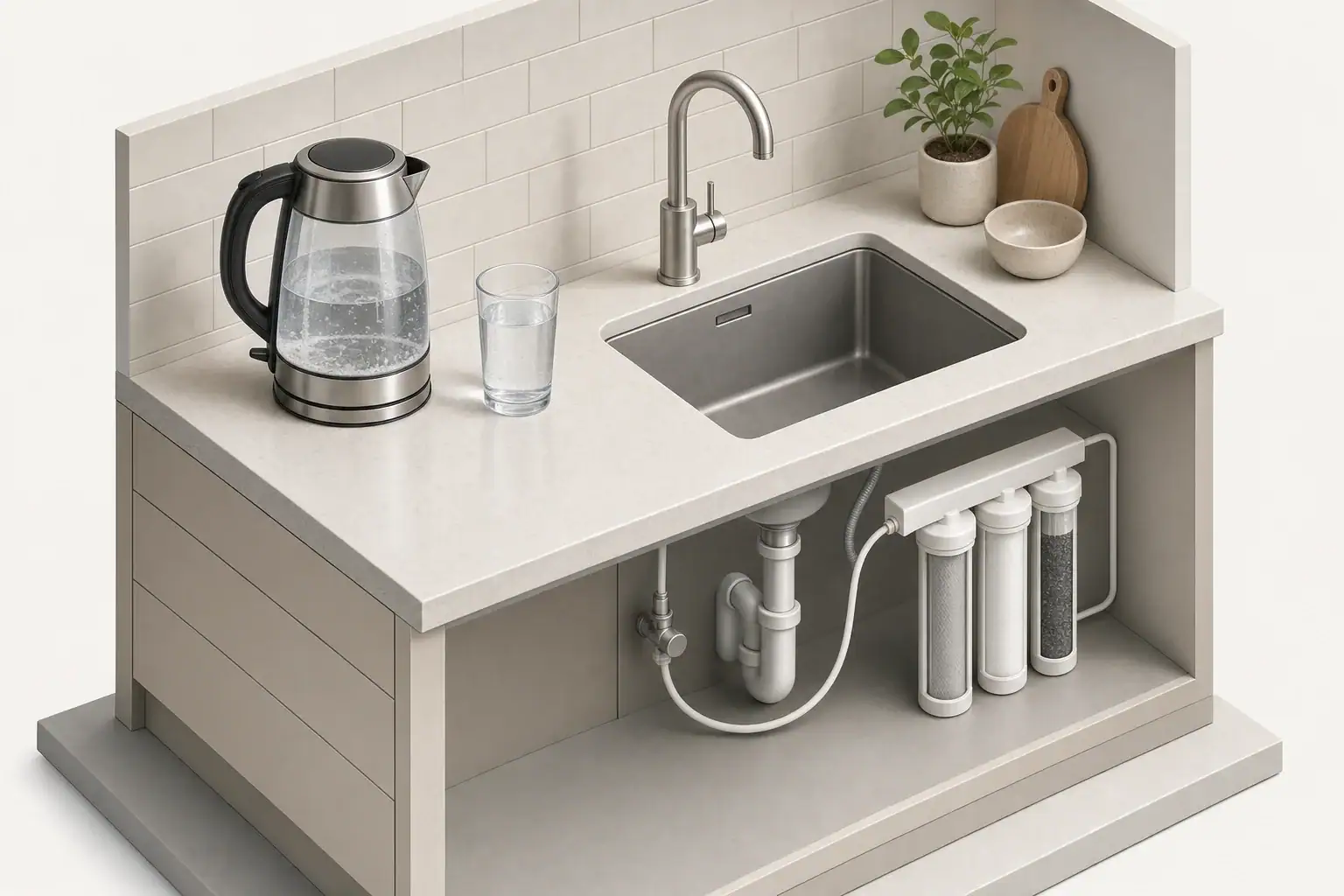
A white film on boiled water is usually associated with naturally occurring minerals, particularly in hard water. Heating changes how some dissolved minerals behave, causing them to form visible particles, a surface film, or a chalky deposit inside a kettle or pan.
Appearance alone cannot confirm that water is safe or contaminated. Mineral scale is generally an aesthetic and maintenance issue, while many contaminants of concern cannot be seen, smelled, or tasted. The location of the film, how it reacts to cleaning, and the source water’s test results provide more useful information.
Why Boiling Water Can Leave a White Film
Water can contain dissolved calcium, magnesium, bicarbonate, silica, sodium, and other substances picked up from soil, rock, plumbing, or treatment processes. These dissolved materials may be invisible before heating.
Heating changes mineral chemistry
When water is boiled, some carbon dioxide escapes. This shifts the water’s carbonate balance and can reduce the solubility of calcium carbonate. The calcium carbonate then forms fine particles or adheres to the container as scale.
Evaporation also concentrates substances that remain in the water. If part of the water boils away, the minerals are left in a smaller volume. A faint residue can therefore become more noticeable after repeated heating or when a kettle boils nearly dry.
The film may float or settle
Very fine mineral particles can collect at the surface because of water movement and surface tension. Other particles settle to the bottom or attach to heating elements and container walls. The result may look like:
- A thin white or cloudy surface film
- Small white flakes floating in the water
- Powdery sediment at the bottom
- A rough, chalky coating inside the kettle
- White spots left after droplets dry
These forms can occur together. A kettle with an established scale layer may also release flakes when it is heated.
Mineral Residue vs Possible Contamination
A white film that appears consistently after boiling is more commonly a mineral issue than evidence of harmful contamination. Hardness minerals are especially likely when the home also has scale around faucets, spots on glassware, or reduced efficiency in water-heating appliances.
Microorganisms do not usually create a recognizable white mineral-like film during ordinary boiling. Chemical contaminants such as lead, PFAS, nitrate, and many volatile organic compounds also cannot be identified by looking at boiled water. Boiling is not a general contaminant-removal method, and evaporation can concentrate some nonvolatile dissolved substances.
Residue may occasionally come from sources other than the water itself. Detergent left in a pot, a degrading appliance component, dust, or material released from a damaged container can affect appearance. Comparing the same water in a thoroughly rinsed glass or stainless steel vessel can help separate a water issue from a container issue.
Example values for illustration.
| Observation | More consistent with | Practical next step |
|---|---|---|
| Chalky coating after heating | Calcium carbonate scale | Check water hardness |
| White spots wherever water dries | Dissolved minerals | Compare hot and cold water deposits |
| Flakes from a kettle wall | Established scale layer | Inspect and descale as directed |
| Film appears in only one container | Container or cleaning residue | Test with a clean alternative vessel |
| Slippery or scented residue | Soap or detergent | Rinse the container thoroughly |
| Cloudiness clears from bottom upward | Air bubbles, not solids | Allow the glass to stand briefly |
| Sudden change with odor or color | Source or plumbing change | Stop relying on appearance and investigate |
Other Reasons Boiled Water May Look Cloudy or White
Trapped air
Cold or pressurized water can contain dissolved air. Heating, pouring, or a change in pressure releases that air as tiny bubbles, making the water look milky. Air-related cloudiness usually clears within a short time, often from the bottom of a glass upward, and leaves no solid residue.
Silica and mixed mineral deposits
Some water contains silica as well as hardness minerals. Silica deposits may look white, gray, or glassy and can be harder to remove than ordinary carbonate scale. Household deposits are often mixtures rather than a single mineral, so their texture and response to cleaning can vary.
Water softener effects
A conventional ion-exchange softener replaces much of the calcium and magnesium with sodium or potassium ions. This reduces typical hardness scale, but it does not necessarily reduce total dissolved solids. Softened water can still leave residue after substantial evaporation, although it is often less chalky and easier to rinse away.
Plumbing or appliance material
A residue that appears suddenly from one faucet or appliance may be related to local plumbing work, a deteriorating component, or debris released after a pressure change. Check faucet aerators and follow the appliance manufacturer’s cleaning and maintenance instructions. Do not bypass valves, pressure controls, or other safety features.
How to Evaluate White Film at Home
Simple observations can help identify likely mineral scale, but they do not replace water testing when safety is in question.
Compare boiled and unboiled samples
Place unboiled water in a clean, clear glass and boil a separate portion in a clean vessel. After cooling, compare clarity, sediment, odor, and residue. If the white material appears mainly after heating or evaporation, mineral precipitation is a reasonable explanation.
Check where the problem occurs
- Every faucet: The source water or whole-home plumbing is more likely involved.
- Hot water only: The water heater or hot-water plumbing may be contributing sediment.
- One faucet: Inspect the aerator and nearby plumbing.
- One kettle or pan: Consider scale already attached to that container or cleaning residue.
- Only after filtration: Review cartridge installation, flushing, and replacement instructions.
Use water quality information appropriately
Public water customers can review their utility’s consumer confidence report and ask whether the source water is considered hard. A basic hardness test can estimate calcium and magnesium levels. Alkalinity testing may provide additional context for scale formation.
A total dissolved solids meter measures electrical conductivity and converts it to an estimated concentration. It can show that dissolved ions are present or that water has changed, but it cannot identify individual contaminants or determine whether water is safe. See TDS vs hardness for a closer comparison of these measurements.
Private well owners should use a qualified laboratory for routine testing and after events such as flooding, repairs, or an unexplained change in water quality. The appropriate test panel depends on local geology, land use, plumbing, and state or local guidance.
Which Water Treatment Options Address Mineral Film
The right treatment depends on whether the goal is to prevent scale throughout the home, reduce dissolved minerals at one drinking-water tap, or simply maintain a kettle.
Sediment filtration
A sediment cartridge captures suspended particles above its rated size. It may help when flakes or plumbing debris are already present, but it does not remove calcium and magnesium while they remain dissolved. It therefore does not prevent hardness minerals from precipitating during boiling.
Activated carbon filtration
Activated carbon is mainly used for certain taste, odor, chlorine, and organic compound concerns. Standard carbon filtration does not substantially soften water or reduce most dissolved mineral salts. A carbon-filtered sample may still produce white film when boiled.
Ion-exchange softening
A properly sized and maintained water softener reduces calcium and magnesium, making it useful for controlling conventional hardness scale throughout a home. Softening changes the mineral composition rather than broadly removing all dissolved material. Households should account for regeneration, salt or potassium use, drainage, and maintenance.
Reverse osmosis
Reverse osmosis can reduce a broad range of dissolved ions, including hardness minerals, at a drinking-water point of use. It generally produces less boiling residue than carbon or sediment filtration alone. Performance depends on water pressure, membrane condition, pretreatment, temperature, and system design. Learn more about what reverse osmosis removes.
Reverse osmosis also produces a concentrate stream. Capacity, storage, flow rate, and the system’s drain-water expectations should be considered before installation.
Distillation
Distillation boils water and condenses the resulting vapor in a separate chamber. Most mineral salts remain in the boiling chamber, where they must be removed during maintenance. Distilled water and reverse-osmosis water are not identical, but either may greatly reduce visible mineral residue compared with untreated hard water.
Routine descaling
If the water is otherwise suitable and the main concern is a kettle deposit, regular descaling may be sufficient. Use the appliance manufacturer’s approved method and rinse thoroughly. Never mix cleaning chemicals, and do not use a procedure that could damage heating elements, seals, or protective coatings.
Practical Troubleshooting Based on What You Observe
Start with the least complicated explanation, but pay attention to changes that affect multiple fixtures or occur alongside unusual taste, odor, or color. Treatment should be selected from test results and the location of the problem rather than from the film’s appearance alone.
If a filter is already installed, verify that it is designed for the target issue. Replacing a carbon cartridge more frequently will not solve hardness if that cartridge has no softening or membrane stage. Likewise, adding a fine sediment filter will not capture minerals that are still dissolved.
Example values for illustration.
| Symptom | Likely category | Reasonable action |
|---|---|---|
| White chalky kettle scale | Hardness minerals | Test hardness and descale appropriately |
| Milky water that quickly clears | Dissolved air | Observe before changing treatment |
| White residue after complete evaporation | Dissolved solids | Compare untreated and treated samples |
| Musty or earthy odor | Source, plumbing, or filter issue | Check advisories and filter maintenance |
| Detergent-like film | Container residue | Use a thoroughly rinsed test vessel |
| Metallic taste with a sudden change | Plumbing or source change | Consider targeted laboratory testing |
| Residue returns after filter replacement | Filter does not address minerals | Review the treatment technology |
Related guides:
TDS vs Hardness: What’s the Difference? •
Best Filters for Hard Water Problems •
Whole House Filters vs Water Softeners •
Reverse Osmosis 101: What RO Removes
When Testing or Professional Guidance Makes Sense
Arrange appropriate testing if the film appears with an unexplained change in color, odor, or taste; if neighbors report a similar change; or if the issue begins after flooding, plumbing repairs, a long service interruption, or work on a private well. Contact the water utility when a public supply changes unexpectedly.
Follow official instructions during a drinking-water advisory. Boiling may be recommended for certain microbial situations, but it is not the correct response to every chemical contamination event. The responsible authority’s directions should take priority over general household advice.
For persistent scale, a water treatment professional or qualified laboratory can help distinguish hardness from silica, suspended sediment, or a plumbing-related source. Useful decisions come from matching test results to a specific treatment goal, such as reducing kettle scale, protecting water-heating equipment, or lowering dissolved minerals at the kitchen tap.
Frequently asked questions
Is white film on boiled water usually safe?
It is often caused by calcium and magnesium minerals, especially in hard water. However, appearance alone cannot confirm water safety, so investigate sudden changes in color, odor, or taste.
Does boiling water remove the white film?
No. Boiling can make mineral residue more noticeable because it changes mineral solubility and concentrates dissolved substances as water evaporates.
Why does my kettle release white flakes?
White flakes commonly come from an existing layer of mineral scale inside the kettle. Descale the appliance using its manufacturer-approved cleaning method and rinse it thoroughly.
Will a standard water filter stop white mineral residue?
Not necessarily. Sediment and carbon filters generally do not remove dissolved hardness minerals. Water softening, reverse osmosis, or distillation may reduce residue depending on the goal and system design.
- NSF/ANSI standards explained (42/53/401/58)
- Clear trade-offs: pitcher vs faucet vs under-sink vs RO
- Maintenance planning: cost per gallon and replacement cadence