
Understanding Hard Water and Why Filters Matter
Hard water is water with a higher concentration of dissolved minerals, mainly calcium and magnesium. Many U.S. homes have some degree of hardness, especially where water is drawn from limestone or similar geology.
Hardness itself is usually not a safety issue, but it can be a comfort, maintenance, and equipment problem:
- White or chalky scale on faucets, shower doors, and dishes
- Rough or “squeaky” feel on skin and hair after washing
- Reduced flow from clogged aerators and showerheads
- Scale buildup in water heaters, dishwashers, and coffee makers
Different hard water problems need different solutions. No single filter style solves everything, so it helps to separate your goals:
- Scale control: protecting pipes, heaters, and fixtures
- Feel and soap performance: showers, laundry, dishes
- Drinking water taste: scaling in kettles, coffee makers, and ice
This article focuses on the main filter and treatment types used with hard water, how they work, and which problems they address best.
Key Treatment Types for Hard Water Problems
Hard water treatment falls into a few broad categories. Some actually remove hardness minerals; others change how those minerals behave.
Salt-Based Ion Exchange Water Softeners
Ion exchange softeners are the most common way to deal with hardness in U.S. homes. These systems use a resin bed charged with sodium or potassium ions. As water passes through, calcium and magnesium are exchanged for sodium or potassium and flushed out during regeneration.
What they are best for:
- Whole-house protection from scale in pipes and water heaters
- Smoother feel on skin and hair
- Better soap lather and less soap needed
Limitations:
- Adds some sodium or potassium to the water
- Requires regular salt or potassium refills and periodic maintenance
- Does not remove other contaminants like chlorine, lead, or PFAS by itself
Salt-Free “Conditioners” and Scale Control Systems
Salt-free systems are often called conditioners, descalers, or physical water treatment. Many use template-assisted crystallization (TAC) or similar media that encourage calcium and magnesium to form tiny crystals that are less likely to stick to surfaces.
What they are best for:
- Reducing new scale buildup in pipes, fixtures, and some appliances
- Homes where salt-based softeners are not desired or allowed
- Low-maintenance scale control with no salt handling
Limitations:
- Do not actually remove hardness minerals from water
- Less impact on soap performance and skin feel compared to true softening
- Effectiveness can vary based on chemistry, temperature, and flow conditions
Reverse Osmosis (RO) Systems
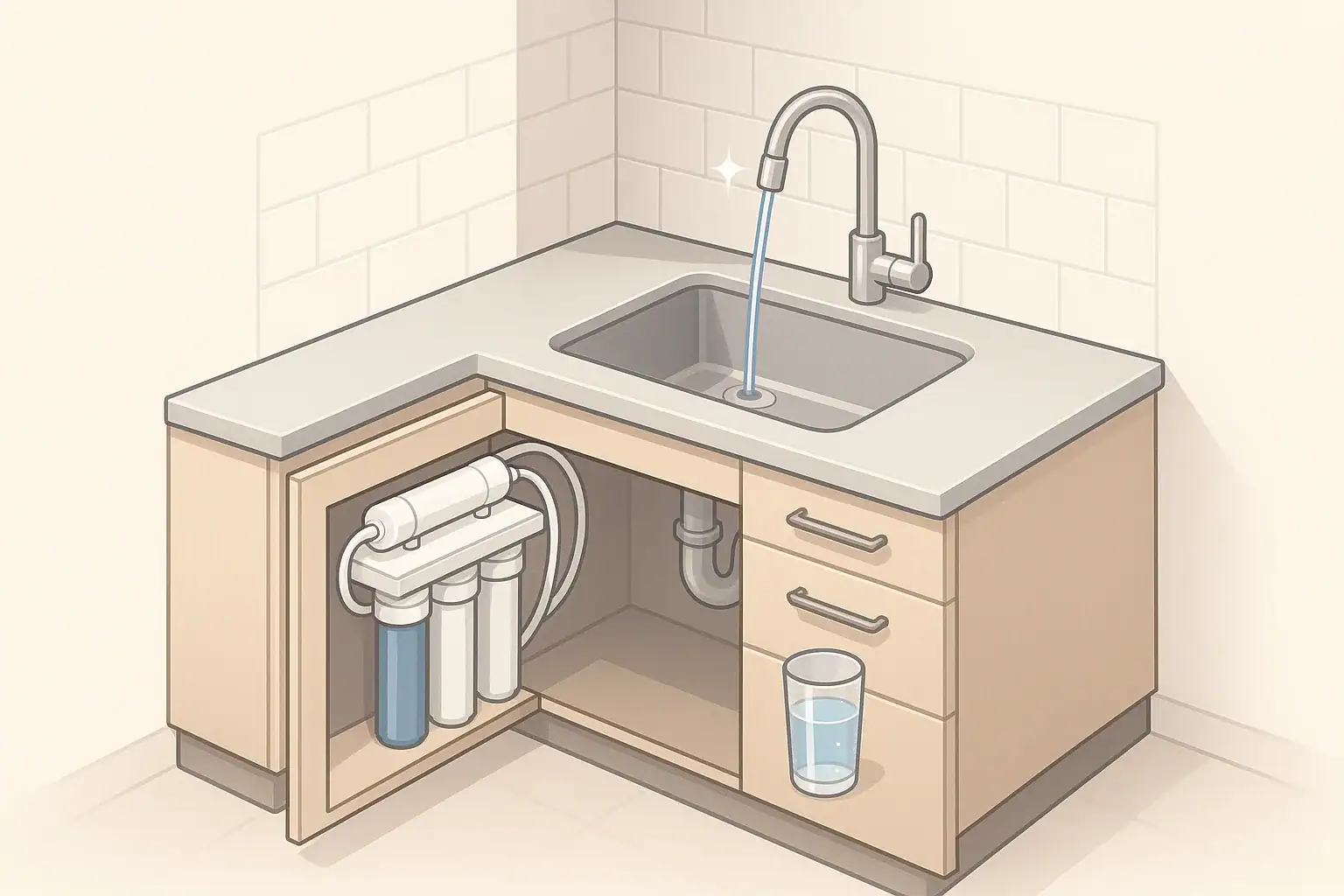
Reverse osmosis uses a semi-permeable membrane to reduce many dissolved solids, including hardness minerals. RO is usually installed at a single point of use, such as under the kitchen sink.
What they are best for:
- Reducing scaling in kettles, coffee makers, and countertop appliances
- Improving taste where mineral content affects flavor
- Targeted drinking and cooking water treatment
Limitations:
- Generally not used as a whole-house solution for scale
- Produces some wastewater during filtration
- Flow rate is limited compared to standard plumbing
Carbon, Sediment, and Other Common Filters
Standard sediment and carbon filters are often part of a broader setup. By themselves, they do not solve hard water, but they can be important partners — see our Carbon Block vs GAC vs Ion Exchange guide.
- Sediment filters protect softeners and RO by catching sand, rust, and silt.
- Carbon filters improve taste and odor by reducing chlorine and some organic compounds.
- Inline scale cartridges for coffee and ice machines may use media that bind or modify hardness locally.
In hard water areas, these filters are usually combined with a softener, conditioner, or RO rather than used alone.
Example values for illustration.
| Primary problem | Good option | Helps? | Notes (general examples) |
|---|---|---|---|
| Heavy scale in pipes and heater | Salt-based softener | Yes | Often chosen when hardness is above about 10 gpg (example only) |
| Moderate scale, want low upkeep | Salt-free conditioner | Often | Aim is to reduce new deposits, not remove minerals |
| Scaling in kettle and coffee maker | Under-sink RO | Yes (at one tap) | Protects small appliances used with RO water |
| Skin feels dry after shower | Whole-house softener | Commonly | Improves soap rinsing and feel for many users |
| Chlorine taste plus some scale | Softener + carbon filter | Yes (combined) | Softener handles hardness, carbon improves taste and odor |
| Apartment, no plumbing changes | Countertop filter or RO | Partially | Helps at one faucet; whole-building hardness remains |
Best Filters When Scale Is Your Main Problem
If your biggest concern is scale on fixtures, shower doors, and inside appliances, focus on systems that address minerals directly or reduce their tendency to form hard deposits.
Whole-House Softeners for Strong Scale Control
Whole-house ion exchange softeners are generally the most effective way to manage heavy scale in regions with high hardness. Incoming water passes through a tank filled with softening resin, and all downstream plumbing benefits.
Advantages for scale:
- Helps limit new scale in water heaters, extending useful life
- Reduces crusty buildup on faucets, showerheads, and glass
- Can make routine cleaning easier and less frequent
Planning points:
- Size softeners by hardness level, daily water use, and desired regeneration frequency.
- Consider a pre-filter if your water has noticeable sediment.
- Place the unit where it can treat most household water except outdoor spigots if desired.
Salt-Free Conditioners for Moderate Scale Concerns
Where hardness is moderate or you mainly want to reduce new spotting and scale, a salt-free conditioner can be a lower-maintenance option.
How they are typically used:
- Installed as a whole-house cartridge or tank after a sediment or carbon pre-filter
- Chosen when salt handling, drainage for regeneration, or local rules make softeners less practical
- Used to protect plumbing, fixtures, and some appliances from new scale
What to expect:
- Mineral spots may still appear but can be easier to wipe away.
- Existing heavy scale usually does not vanish on its own.
- Soap feel and lather may not change as dramatically as with a softener.
Point-of-Use Filters for Appliances
If your main concern is specific appliances, such as a coffee machine, ice maker, or small boiler, targeted filters can be efficient.
- Inline appliance cartridges can combine scale-reducing media with carbon for taste.
- Under-sink RO provides low-mineral water to any appliance filled from that tap.
- Pitcher filters with scale-reduction media can help with kettles and countertop brewers.
These solutions are more limited in scope but require less plumbing work and can be good for renters or small households (see Pitcher vs Under-Sink vs RO).
Best Filters for Hard Water Feel: Skin, Hair, and Soap
Many people first notice hard water not on their fixtures but on their skin, hair, and laundry. Soap and shampoo can be hard to rinse, and fabrics may feel stiff.
Why Hard Water Affects “Feel”
Calcium and magnesium react with soap to form residues that can linger on skin, hair, and fabrics. This can lead to a “film” feeling, difficulty rinsing, and more soap or detergent use.
Filtration methods that merely condition hardness often do not change this chemistry much. Systems that actually reduce hardness minerals provide the most noticeable difference.
Whole-House Softeners for Everyday Comfort
For improving showers, bathing, and laundry, whole-house softening is usually the most direct approach.
Common benefits reported by users (experiences vary):
- Easier rinsing of soap and shampoo
- Smoother feel on skin and hair
- Softer-feeling towels and clothing
- Less soap, shampoo, and detergent needed for similar cleaning
Keep in mind that individual preferences differ. Some people like the “slick” feel of softened water, while others prefer the feel of untreated water.
When a Softener May Be More Than You Need
If your hardness is only mild, and your main concern is occasional spotting rather than daily comfort, a full softener may feel like more system than the situation requires.
In that case, you might consider:
- Salt-free conditioner for light scale reduction
- Shower-specific filters that target chlorine for skin comfort (these do not generally soften but can improve smell and dryness for some users)
- Adjusting soaps and detergents to work better in your level of hardness
Best Filters to Protect Drinking Water Appliances
Hard water can shorten the time between descaling cycles on kettles, espresso machines, humidifiers, and similar equipment. If your goal is to protect these without re-plumbing the whole house, point-of-use options are useful.
Under-Sink RO for Low-Mineral Drinking Water
Under-sink RO systems are popular in hard water areas because they significantly reduce dissolved minerals at one tap (see Reverse Osmosis 101).
- Reduce scale on kettles, coffee makers, and countertop devices used with RO water
- Stabilize taste in brewed beverages where mineral levels matter
- Limit the need for frequent descaling of small appliances filled from the RO faucet
Considerations in hard water areas:
- Very hard water can shorten RO membrane life if there is no pre-softening.
- A softener upstream of RO can reduce membrane scaling and maintenance.
- Look at RO flow rate, storage tank size (if present), and expected gallons per day relative to your needs.
Inline and Pitcher Filters
Some inline cartridges and pitchers use media that reduce carbonate hardness or otherwise limit scale formation in appliances. These are often used with:
- Coffee and espresso machines
- Refrigerators with internal ice makers
- Portable kettles and tea brewers
They typically combine basic hardness reduction with carbon for taste. Capacity and performance vary, so pay attention to estimated gallon ratings and recommended replacement intervals.
How to Choose the Best Filter Setup for Your Hard Water
Because hard water problems are varied, the best filter setup often combines several components. A simple decision process can help you narrow options.
Step 1: Quantify Your Hardness
It is helpful to know approximate hardness before investing in equipment. Common approaches include:
- Reviewing a recent municipal water quality report for hardness
- Using a basic test strip kit at home for an estimated grains-per-gallon or milligrams-per-liter value
- Having a sample tested through a lab or local water treatment professional
Even a rough estimate (for example, slightly hard, moderately hard, or very hard) can guide decisions.
Step 2: Rank Your Priorities
Most households juggle several goals at once. Common priority sets include:
- Maximum scale protection: Whole-house softener plus pre-filter
- Comfort and appearance: Softener plus carbon filter for taste and odor
- Minimal maintenance: Salt-free conditioner and simple sediment/carbon filtration
- Renter or small apartment: Countertop or under-sink RO for drinking water, plus appliance cartridges as needed
Step 3: Consider Plumbing and Space Constraints
Not all options fit every home. Think about:
- Available space near the main water line or water heater
- Drain access for systems that need regeneration or reject water
- Pipe material and size, so any installation remains safe and compatible
- Rental limitations that restrict permanent changes
If you are not familiar with plumbing, it is safer to use existing connection points and follow manufacturer and local code requirements rather than improvising.
Step 4: Combine Systems Only Where It Adds Value
Layering treatment can make sense, but only when each stage has a clear role. Common, practical combinations include:
- Sediment pre-filter → softener → carbon filter for households on hard municipal water with chlorine
- Sediment pre-filter → salt-free conditioner → whole-house carbon where moderate hardness and taste are both concerns
- Softener (whole house) → under-sink RO (kitchen) for low-scale plumbing plus low-mineral drinking water
The more stages you add, the more replacement intervals and pressure drops you should track, so keep the system as simple as your needs allow.
Example values for illustration.
| Component | Typical role | Example check interval | Notes (hard water focus) |
|---|---|---|---|
| Sediment pre-filter | Protects softener/RO from particles | Every 3–6 months | Shorten interval if pressure drop or discoloration appears |
| Carbon filter (whole house) | Chlorine/taste reduction | Every 6–12 months | High hardness does not usually change this interval much |
| Softener resin bed | Ion exchange hardness reduction | Review condition every few years | Resin can last many years with correct sizing and regeneration |
| Softener salt or potassium | Regeneration supply | Check brine tank monthly | Usage depends on hardness level and water consumption |
| Salt-free conditioner media | Scale control without ion exchange | Every 2–5 years (varies) | Follow specific media capacity and local water conditions |
| RO pre-filters (sediment/carbon) | Protect RO membrane | Every 6–12 months | Hard water can stress the membrane; pre-filters are important |
| RO membrane | Dissolved solids reduction | Every 2–5 years | Lifespan is longer with pre-softening or moderate hardness |
| Appliance-specific cartridges | Scale control at coffee/ice equipment | Per gallon rating or 3–12 months | Interval depends strongly on hardness and usage volume |
Related guides: Pitcher vs Under-Sink vs RO: Which Fits Your Budget and Water? • Whole House vs Under-Sink: Taste vs Whole-Home Protection • Best Water Filter Setup for Apartments (Renters, Space, No Drill) • Carbon Block vs GAC vs Ion Exchange: Quick Guide to Filter Media
Practical Tips for Living With Hard Water Filters Long-Term
Once you have a system in place, a few habits make ownership easier:
- Track simple baseline numbers, such as hardness before and after softening, or approximate TDS before and after RO. This helps you notice changes over time.
- Watch for gradual pressure loss, which can signal clogged sediment or carbon filters.
- Check for salt bridges in softener brine tanks if you see regeneration issues, following safe manufacturer procedures.
- Descale small appliances periodically, even when using treatment, especially in very hard water areas.
- Review local water reports yearly, since source changes can alter hardness and treatment needs.
By matching a treatment approach to your specific hard water problems—scale, feel, or appliance protection—you can choose filters that are effective without being more complex than necessary.
Frequently asked questions
Do I need a whole-house softener to stop scale, or will a salt-free conditioner suffice?
It depends on hardness and goals: heavy, persistent scale is best handled by a salt-based ion-exchange softener; salt-free conditioners can reduce new deposits and require less upkeep but don’t remove minerals or usually improve soap feel as much. Test your hardness and match the solution to scale severity and maintenance preferences.
Will a softener change the taste of my drinking water or add sodium?
Ion-exchange softeners replace calcium and magnesium with sodium or potassium, which can slightly raise dissolved solids and alter taste for some people. The sodium increase is typically small but may matter for people on strict low-sodium diets; using potassium or treating drinking water separately with an under-sink RO are common alternatives.
Can I protect kettles, coffee machines, and ice makers without re-plumbing the whole house?
Yes. Point-of-use options—under-sink RO, inline appliance cartridges, or pitchers with scale-reduction media—can limit scale in specific appliances. Check capacity and replacement intervals, and note that very hard water can shorten RO membrane life unless the water is pre-treated.
How often should I maintain or replace filters and softener components?
Typical intervals: sediment pre-filters every 3–6 months, carbon filters 6–12 months, RO pre-filters 6–12 months, RO membranes 2–5 years, and salt-free media every 2–5 years. Check softener salt monthly and inspect resin condition every few years. Watch for pressure drops or reduced performance as early warning signs.
Recommended next:
- NSF/ANSI standards explained (42/53/401/58)
- Clear trade-offs: pitcher vs faucet vs under-sink vs RO
- Maintenance planning: cost per gallon and replacement cadence