
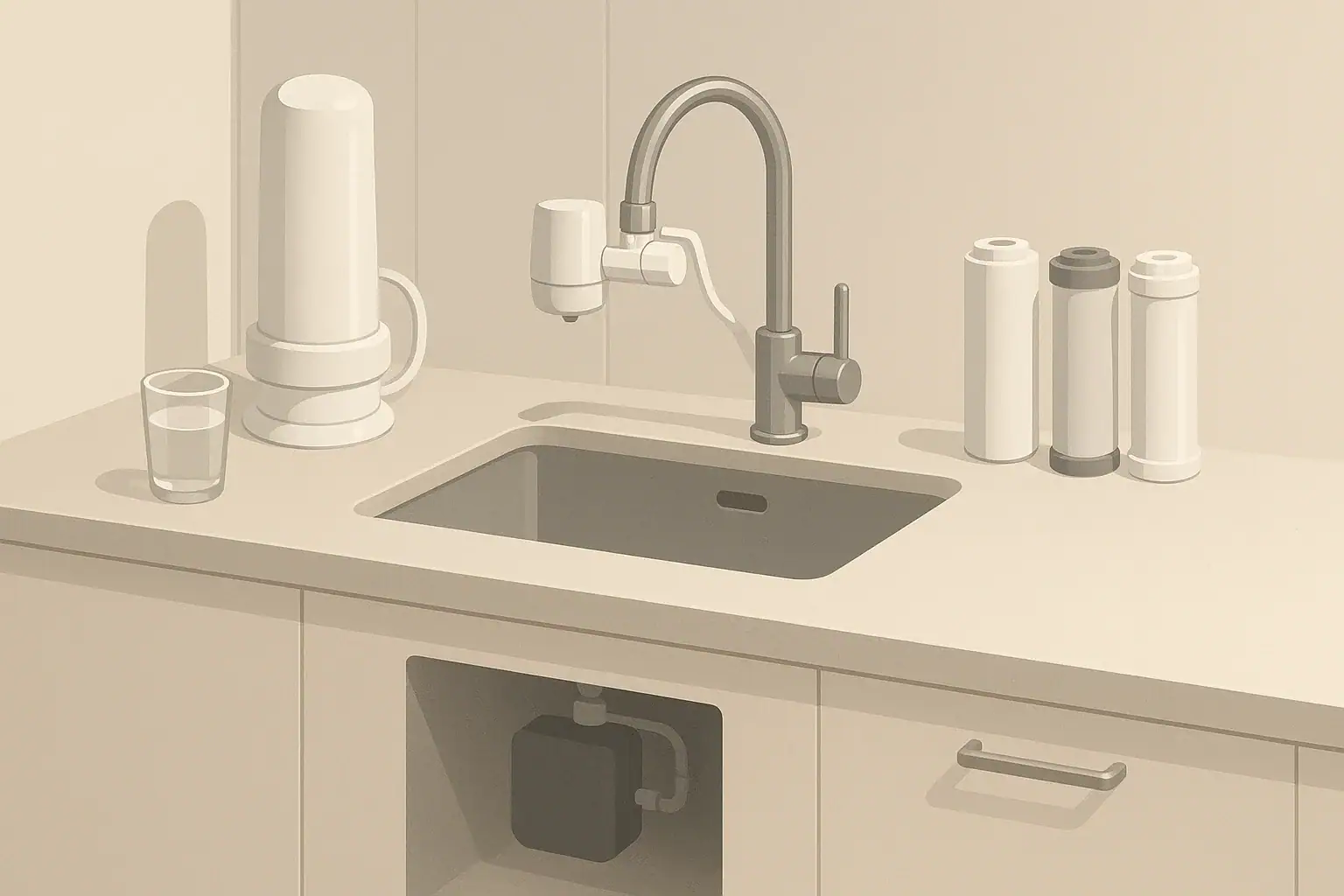
Buying a filter for a rental home is different from buying one for a house you own. You may want better taste, less chlorine odor, or added contaminant reduction, but you also need to avoid permanent plumbing changes, lease issues, wall drilling, and complicated move-out repairs.
The good news is that renters have several practical options. Pitchers, dispensers, faucet-mounted filters, countertop systems, and some portable reverse osmosis units can improve drinking water without altering the building. If you are deciding between a compact option and a more involved system, pitcher vs faucet-mount is a useful comparison. The best choice depends on your water source, the problem you are trying to solve, daily water use, available counter space, and how much maintenance you are willing to do.
This article focuses on renter-friendly filters that do not require permanent plumbing. It is written for typical U.S. rental homes and apartments, including city water and rental properties with private wells.
Why Rental Homes Need a Different Filter Decision
A homeowner can often install an under-sink system, drill a dedicated faucet hole, add a drain saddle, or modify plumbing with fewer constraints. A renter usually cannot make those changes without written approval. Even if a modification is reversible, leaks or damage may still become your responsibility.
A rental-friendly filter should be easy to install, easy to remove, and unlikely to affect the property. It should also be simple enough to maintain consistently. A high-performing filter that is ignored after installation can become less useful than a simpler filter that is replaced on schedule.
Key rental constraints to consider
- Lease rules: Some leases prohibit plumbing changes, drilling, or adding fixtures.
- Shared maintenance: In apartments, management may need access to plumbing, appliances, or shutoff valves.
- Move-out condition: The filter should leave the faucet, counter, sink, and cabinet in the same condition.
- Leak risk: Any device connected to pressurized water deserves regular checking.
- Storage space: Small apartments may not have space for tanks, large dispensers, or multiple cartridges.
Before buying anything that connects to a faucet or water line, read your lease and consider asking the landlord or property manager for written permission. For simple pitchers and gravity dispensers, permission is usually not an issue because they do not attach to plumbing.
Start With the Water Problem, Not the Product
The right rental home water filter depends on what you want to improve. Many renters are mainly trying to reduce chlorine taste, musty odors, or sediment particles. Others are concerned about lead from older plumbing, PFAS, VOCs, nitrate, hardness, or high total dissolved solids. Different filters address different issues, and no single compact filter is best for every situation.
City water versus well water
Most city water is disinfected and regulated at the utility level, but it can still pick up taste, odor, or metals from distribution pipes and building plumbing. Carbon filters are commonly used for chlorine taste and odor, and some are designed for additional contaminant reduction when tested to relevant standards.
Private well water is different. The property owner is generally responsible for testing and treatment. If a rental home uses a private well, ask whether recent water test results are available. A countertop or pitcher filter may help with taste, but it is not a substitute for proper well testing or whole-house treatment when the water has documented problems.
Use a test to narrow your choices
For practical shopping, start with what you know. A local utility water quality report can provide background for city water. A certified lab test is more useful for lead, nitrate, arsenic, bacteria, and other specific concerns. Home test strips can be helpful for quick checks such as hardness or chlorine, but they are not a replacement for laboratory results when a health-related contaminant is suspected.
Once you know the main issue, match it to a technology. Carbon is commonly used for taste, odor, chlorine, and some organic compounds. Sediment filters catch particles. Reverse osmosis reduces many dissolved substances, but it needs space, pressure, cartridges, and a way to manage reject water. If you want a deeper overview of what reverse osmosis removes, that can help set expectations. UV is used for microbial inactivation, but it requires electricity, clear water, and correct maintenance.
Example values for illustration.
| Option | Best fit | Plumbing impact | Main limitations |
|---|---|---|---|
| Pitcher filter | Low daily drinking water use | None | Slow filling and small capacity |
| Large gravity dispenser | Households that want more stored water | None | Needs counter or refrigerator space |
| Faucet-mounted filter | Quick access at one sink | Temporary faucet attachment | May not fit pull-down or specialty faucets |
| Countertop faucet-diverter system | More capacity than a small faucet filter | Temporary faucet attachment | Uses counter space and may need an adapter |
| Portable countertop RO | Broad dissolved-solids reduction for drinking water | None or temporary, depending on design | Slower production and reject water to empty |
| Shower filter | Bathing comfort and chlorine odor at shower | Temporary shower arm attachment | Does not treat drinking water |
| Existing refrigerator filter | Water from a refrigerator dispenser | Uses built-in appliance housing | Only treats that dispenser or ice maker |
Best Filter Types for Renters Without Permanent Plumbing
Most renters should begin with the least invasive option that addresses the actual water concern. More complex systems can be useful, but they also bring more maintenance, more parts, and more ways to leak or underperform.
Pitcher and dispenser filters
Pitchers and large gravity dispensers are the simplest rental choice. They require no tools, no faucet compatibility, and no landlord approval in most situations. If you are comparing portable options, pitcher filters for renters are often the best first stop. They are useful for improving taste and odor, especially where chlorine is the main complaint.
The tradeoff is speed and capacity. A small pitcher may be inconvenient for cooking, coffee, tea, pets, or multiple people. A larger dispenser can solve the capacity problem but takes up counter or refrigerator space. Cartridge life also varies with water quality and usage, so a busy household may replace filters more often than expected.
Faucet-mounted filters
A faucet-mounted filter screws onto the end of a compatible faucet and usually includes a valve to switch between filtered and unfiltered water. This is convenient for renters who want filtered water directly from the sink without filling a pitcher.
Compatibility is the biggest issue. Many modern pull-down, spray, or designer faucets do not accept standard adapters. Faucet-mount filter compatibility is worth checking before you buy. Some faucet filters can also reduce flow noticeably. Because the filter is attached to the faucet, it should be installed gently and checked for drips after each use.
Countertop faucet-diverter systems
A countertop system often sits beside the sink and connects to the faucet with a temporary diverter. It may use a larger carbon block or multi-stage cartridge than a small faucet-mounted unit. This can provide longer cartridge life and better flow, depending on the design.
The downside is counter space and appearance. The hose and diverter remain visible, and the system may not work with nonstandard faucets. It is still a temporary option, but it should not be forced onto an incompatible fixture.
Portable countertop reverse osmosis
Portable countertop reverse osmosis systems can be useful when a renter wants broader reduction of dissolved substances and does not want to install a permanent under-sink RO unit. Some models are filled manually and do not connect to plumbing. Others connect temporarily to a faucet.
RO systems are slower than basic carbon filters and create reject water as part of the separation process. They also require multiple filters or membranes over time. A renter considering portable RO should think about counter space, storage tank capacity, filter cost, noise, power requirements if any, and how reject water is collected or drained. For the performance side, NSF/ANSI 58 is the key standard to understand.
Refrigerator filters
If the rental already has a refrigerator with a built-in water dispenser or ice maker, replacing the existing filter cartridge may be an easy step. This does not expand filtration to the rest of the kitchen, but it may improve the taste of water and ice from that appliance.
Use the correct cartridge type for the appliance and follow the property rules. Avoid modifying refrigerator water lines unless the landlord approves and the work is done safely.
When Reverse Osmosis Makes Sense in a Rental
Reverse osmosis can be helpful when the goal is reducing a broad range of dissolved substances in drinking and cooking water. It is commonly considered for high total dissolved solids, certain metals, nitrate, fluoride, and some other contaminants, depending on system design and testing.
In a rental, the main question is not whether RO can be effective. The question is whether it can be used without permanent plumbing and with manageable upkeep. Traditional under-sink RO systems often require a feed-water connection, drain connection, storage tank, and dedicated faucet. Those features may not be acceptable in many rentals without written permission.
Portable countertop RO avoids many of those issues, but it still has practical limits. Output may be measured in batches rather than continuous flow. You may need to refill a source reservoir, empty reject water, clean internal tanks, and replace several filters on different schedules. If you only need better taste from chlorinated city water, a simpler carbon filter may be more convenient.
Consider remineralization for taste, not as a cure-all
RO water can taste flat to some people because many dissolved minerals are reduced. Some systems include a remineralization stage to adjust taste. This is mainly a preference and water chemistry issue, not a guarantee of better water for every household.
What Not to Do Without Permission
Renters should avoid plumbing work that changes the property or increases risk without approval. This includes drilling holes for a dedicated faucet, cutting into pipes, adding a permanent drain connection, replacing shutoff valves, or modifying built-in appliance lines. Even small changes can create lease problems if a leak occurs later.
Do not bypass pressure regulators, leak sensors, air gaps, backflow prevention features, or other safety components. Do not use makeshift adapters that strain a faucet or hose. If a system requires tools, pipe cutting, drain tapping, or electrical work near water, it is not a typical do-it-yourself rental filter choice unless the property owner approves and a qualified person performs the work.
Also avoid assuming that a filter can fix every water issue. If water has a sewage odor, visible contamination, persistent discoloration, or a lab result showing a serious concern, notify the landlord or appropriate property contact. A point-of-use filter may help with some drinking water concerns, but building-level or source-water issues may need professional evaluation.
How to Compare Claims, Standards, and Capacity
Filter packaging and product descriptions can be confusing. Terms such as advanced, premium, multi-stage, and high capacity are marketing words unless they are tied to specific tested reductions, cartridge life, and use conditions.
Look for clear information about what the filter is designed to reduce, how it was tested, and how long the cartridge lasts under typical conditions. NSF and ANSI standards are commonly referenced in the U.S. water treatment industry. A product may be certified for one claim but not another, so it is important to read the specific reduction claims rather than assuming one certification covers everything.
Questions to ask before buying
- What specific issue am I trying to address: chlorine taste, sediment, lead, PFAS, hardness, TDS, or something else?
- Does the filter type match that issue?
- Is the claim supported by testing or certification for the specific contaminant?
- How many gallons or months is the cartridge rated for under typical use?
- Will the flow rate be acceptable for daily use?
- Can I install and remove it without damaging the rental?
- Where will I store replacement cartridges and used components before disposal?
Capacity ratings are best treated as estimates. A cartridge used on water with high sediment, high chlorine demand, or heavy daily use may need replacement sooner. A noticeable drop in flow, return of taste or odor, or reaching the stated time limit are common reasons to replace a filter.
Maintenance, Replacement, and Leak Awareness
Every filter needs maintenance. For renters, maintenance is especially important because the goal is not only better water but also trouble-free use in someone else’s property. Keep a simple replacement schedule, save instructions, and check connections regularly.
For non-plumbed filters, wash reservoirs and pitchers as directed and avoid letting water sit for excessive periods. For faucet-connected filters, inspect the attachment point for drips. For countertop RO units, follow sanitation and cartridge schedules closely, especially if the unit stores water internally.
If you leave town, consider turning off or disconnecting temporary faucet-connected devices according to the product instructions. Do not leave pressurized temporary attachments unattended for long periods if the instructions warn against it. At move-out, remove the filter carefully, reinstall original faucet aerators or parts, and clean the area.
Example values for illustration.
| Filter type | Common task | Planning reminder |
|---|---|---|
| Pitcher | Replace cartridge and wash reservoir | Track both gallon use and calendar time |
| Gravity dispenser | Replace cartridge and clean tank | Large stored volumes still need routine cleaning |
| Faucet-mounted filter | Replace cartridge and check adapter | Watch for flow drop or small leaks |
| Countertop carbon system | Change cartridge and inspect diverter hose | Keep hose routed without sharp bends |
| Portable countertop RO | Replace prefilter, postfilter, and membrane as directed | Different stages may have different intervals |
| Refrigerator filter | Replace built-in cartridge | Reset reminders only after actual replacement |
| Shower filter | Replace cartridge or media | Reduced flow can signal clogging or scale buildup |
A Practical Shopping Checklist for Renters
For most renters, the best filter is the simplest one that solves the main water complaint without creating installation or maintenance problems. Start with a pitcher or dispenser if your goal is basic taste improvement and your household can tolerate slower filling. Choose a faucet-mounted or countertop diverter system if you want sink-side convenience and your faucet is compatible. Consider portable countertop RO only when you have a specific reason to want broader dissolved-substance reduction and are prepared for slower output and more maintenance.
Before purchasing, confirm the return policy, faucet compatibility, replacement cartridge availability, and space requirements. If the system connects to plumbing in any way, review the lease and ask for permission when needed. Keep all original faucet parts so the rental can be restored when you move.
A careful rental filter decision comes down to five points: identify the water concern, choose the matching technology, avoid permanent changes, maintain the filter on schedule, and remove it cleanly at move-out.
Frequently asked questions
Do I need landlord permission for a faucet-mounted filter?
Often yes, or at least it is wise to check if the filter connects to the faucet. Simple pitchers usually do not need permission because they do not attach to plumbing.
What is the easiest filter for a rental home?
A pitcher or gravity dispenser is usually the easiest because it requires no installation and no faucet compatibility. It works well for improving taste and odor in many homes.
Can a rental filter remove lead or PFAS?
Some filters are designed and tested for lead or PFAS reduction, but not all are. Check the specific product claims and certification details before buying.
Is reverse osmosis a good choice for renters?
It can be, especially if you want broader dissolved-substance reduction. Portable countertop units are usually more renter-friendly than under-sink systems, but they take more space and maintenance.
How do I know which filter type I need?
Start with the water issue you want to solve. Taste and odor may point to carbon filtration, while dissolved contaminants may call for reverse osmosis or a more specific certified system.
What should I do when I move out?
Remove any temporary filter carefully, reinstall original faucet parts, and clean the area. Keep the original components so the rental can be returned to its prior condition.
Related guides: Best Water Filter Setup for Apartments • Faucet-Mount Filters for Renters • No-Drill Under-Sink Filters for Renters • Lead in Tap Water • PFAS Removal Options
Recommended next:
- Pitcher vs Under-Sink vs RO: Which Fits Your Budget and Water?
- Whole House vs Under-Sink: Taste vs Whole-Home Protection
- Carbon Block vs GAC vs Ion Exchange: Quick Guide to Filter Media
- Best Water Filter Setup for Apartments (Renters, Space, No Drill)
- Best Filters for Hard Water Problems (Scale, Feel, Appliances)
- Best Filters for Chlorine Taste: Pitcher vs Faucet vs Under-Sink
- More in Comparisons & Buying Guides →
- NSF/ANSI standards explained (42/53/401/58)
- Clear trade-offs: pitcher vs faucet vs under-sink vs RO
- Maintenance planning: cost per gallon and replacement cadence