
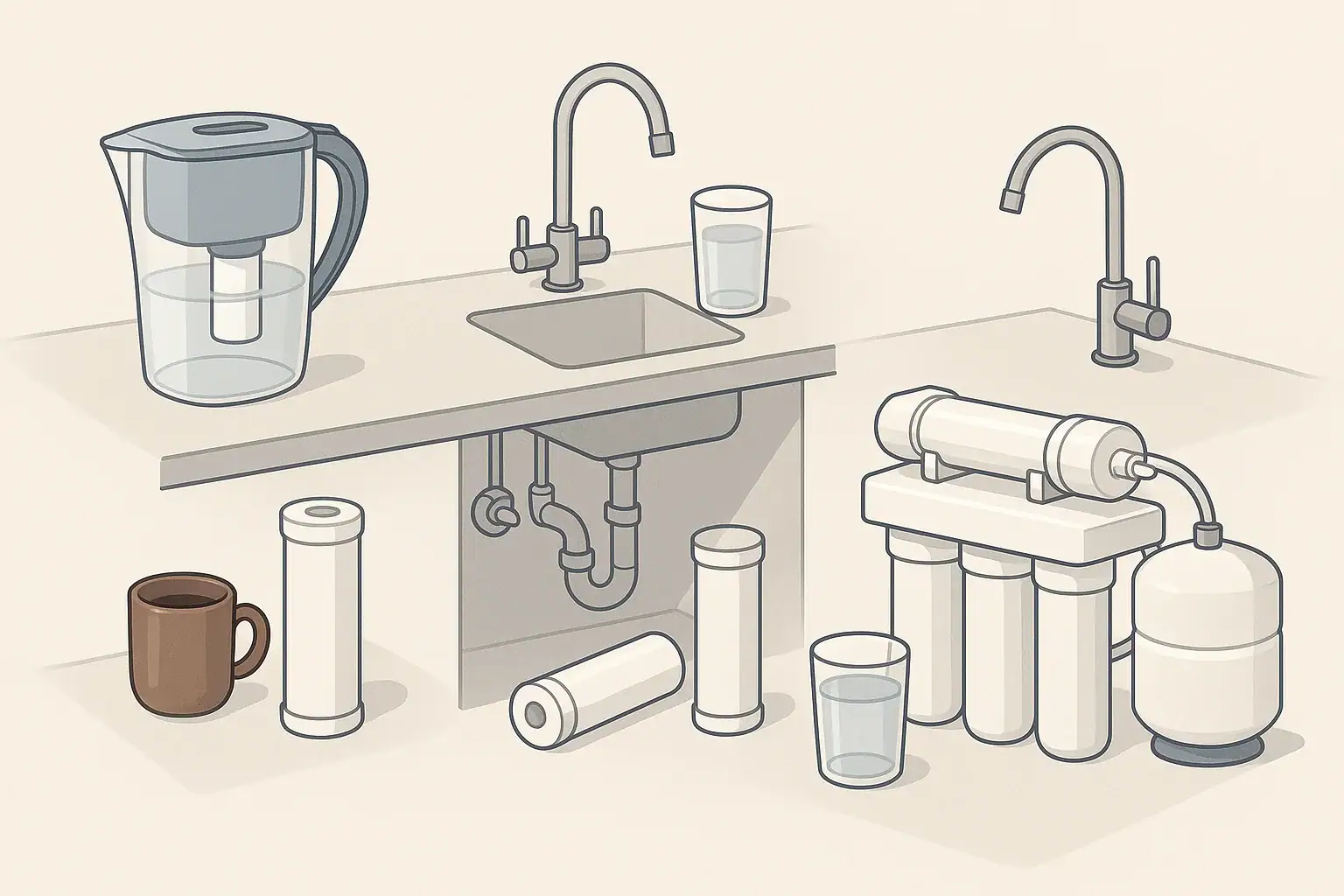
Coffee is mostly water, so the filter setup at your sink can change the way coffee tastes, extracts, and feels in the cup. For many homes, the practical question is not whether filtered water is useful. It is which setup fits your water, your brewing habits, and your tolerance for maintenance.
The three common choices are a filter pitcher, an under-sink carbon system, and reverse osmosis, often shortened to RO. Each can make sense for coffee lovers, but they solve different problems. A pitcher is simple and low commitment. An under-sink system is more convenient for daily brewing. RO offers a broader reduction approach, but it may need remineralization for coffee flavor.
This article focuses on taste, workflow, maintenance, and practical home use. It does not assume one best answer for every kitchen.
Why Water Matters So Much for Coffee
Water affects coffee in two main ways: flavor interference and extraction behavior.
Flavor interference is the easier one to notice. Chlorine taste, musty odors, metallic notes, and stale refrigerator water can show up in brewed coffee. Even a small off-taste in plain water may become more noticeable after heating.
Extraction behavior is more subtle. Minerals in water interact with compounds in coffee grounds. Water with very low mineral content can make coffee taste flat or sharp. Water with high hardness or alkalinity can mute acidity, dull aromatics, or contribute to scale inside kettles and coffee machines.
For coffee, the goal is usually balanced water, not perfectly empty water. TDS vs hardness is a useful distinction here: a good filter setup should reduce unwanted tastes while keeping or restoring enough mineral balance for pleasant extraction.
What Coffee Lovers Should Look for in Filtered Water
Before choosing a device, define the problem you are trying to solve. A coffee drinker using chlorinated city water has different needs than someone with hard well water, old plumbing, or very high total dissolved solids.
Key water characteristics for coffee
- Chlorine or chloramine: Common in municipal water and often noticeable in hot drinks.
- Hardness: Calcium and magnesium can support extraction, but too much can cause scale.
- Alkalinity: Affects perceived brightness and acidity in brewed coffee.
- TDS: Total dissolved solids gives a broad reading, but it does not say which minerals or compounds are present.
- Lead, VOCs, PFAS, or other concerns: These require filter selection based on tested performance claims and the specific water issue.
- Taste and odor: Often reduced well by activated carbon, depending on contact time and cartridge condition.
If your water tastes fine cold but your coffee tastes dull, hardness and alkalinity may be part of the story. If your water smells like a pool or has a medicinal taste, chlorine vs chloramine may be more relevant. If you are unsure, a recent local water report or a basic water test can help you avoid guessing.
Example values for illustration.
| Setup | Best fit | Main strengths | Main tradeoffs |
|---|---|---|---|
| Filter pitcher | Renters, occasional brewing, small kitchens | Low cost, no plumbing, easy to move | Slow filling, limited capacity, cartridge performance varies |
| Faucet-mounted filter | Temporary use where installation is limited | Convenient at the tap, simple installation | Can reduce faucet clearance and may have lower flow |
| Under-sink carbon | Daily coffee drinkers on city water | Good convenience, steady flow, taste and odor reduction | Requires installation space and cartridge changes |
| Under-sink multi-stage carbon | Homes with sediment or stronger taste issues | More targeted filtration stages, often better capacity | More cartridges to track |
| Reverse osmosis | High TDS, broader reduction goals, specialty control | Strong reduction of many dissolved substances | Slower production, drain water, possible need for remineralization |
| RO with remineralization | Espresso or pour-over users wanting consistency | More controlled water profile than plain RO | More parts, more maintenance, flavor depends on mineral stage |
| Refrigerator filter | Convenience for cold water users | Easy access if already installed | May be slow, may not suit hot beverage workflow |
Pitcher Filters: Simple, Portable, and Good for Small Batches
A filter pitcher is often the easiest starting point for coffee. It requires no plumbing change, works in rentals, and can be stored in the refrigerator or on the counter. For one or two cups a day, a pitcher may be enough.
Most common pitchers rely mainly on activated carbon, sometimes combined with ion exchange resin. Carbon can reduce many taste and odor issues, especially chlorine, depending on the design and cartridge condition. Some pitchers are also designed for specific contaminant reduction claims, but those claims vary by model and filter type.
Where pitchers work well
- You brew a small amount of coffee each day.
- Your main complaint is chlorine taste or general tap water flavor.
- You cannot modify plumbing.
- You want a low-commitment way to compare filtered and unfiltered coffee.
Where pitchers can fall short
Pitchers are limited by capacity and patience. If you make a full pot each morning, brew iced coffee, fill a kettle, and also drink filtered water, a pitcher for renters may become annoying quickly.
They can also be inconsistent if the cartridge is overdue, the reservoir is not cleaned, or filtered water sits for too long. For coffee, freshness matters. Water that has absorbed refrigerator odors or sat in a pitcher for days may not taste as clean as expected.
Under-Sink Carbon Filters: Convenient for Daily Coffee
An under-sink carbon filter is often the practical middle ground for coffee lovers on municipal water. It can provide filtered water directly from a dedicated faucet or sometimes through the existing cold-water line, depending on the system design and local plumbing requirements.
The key advantage is workflow. You can fill a kettle, coffee maker reservoir, or espresso machine pitcher without waiting for a small gravity reservoir to filter. For households that brew every day, convenience can be the difference between using filtered water consistently and giving up on it.
What carbon filtration is good at
Activated carbon is commonly used to reduce chlorine, many taste and odor compounds, and some organic chemicals. Carbon block filters generally provide more contact and finer structure than loose granular carbon, though performance depends on the cartridge and flow rate.
If your coffee tastes better when made with water that has less chlorine odor, an under-sink carbon system can be a strong fit. It usually avoids removing nearly all dissolved minerals, so the water may retain enough hardness and alkalinity for balanced coffee.
Planning considerations
- Space: Check under-sink room for housings, tubing, and access for cartridge changes.
- Flow rate: Very fine carbon blocks may reduce flow if undersized or clogged.
- Filter life: Replacement intervals are based on gallons, months, water quality, and use.
- Cold water only: Most point-of-use filters are intended for cold water, not hot-water lines.
- Leak awareness: Any under-sink water device should be installed carefully and checked periodically.
For coffee, under-sink carbon is usually most compelling when the water already has acceptable mineral balance but needs taste improvement. If you are comparing options more broadly, pitcher vs under-sink vs RO is a helpful side-by-side view.
Reverse Osmosis: High Control, but Not Always Coffee-Ready by Itself
Reverse osmosis uses a semi-permeable membrane to reduce a broad range of dissolved substances. It is commonly used where households want lower TDS or broader contaminant reduction than carbon alone can provide.
For coffee, RO has a special tradeoff. It can remove problem tastes and reduce dissolved minerals, but plain RO water may be too low in minerals for ideal flavor. Coffee brewed with very low-mineral water can taste thin, sour, or unbalanced. It may also behave differently in espresso machines and drip brewers.
When RO makes sense for coffee
- Your tap water has high TDS or strong mineral taste.
- Hardness is causing repeated scale problems in kettles or machines.
- You want a more controlled starting point for brewing water.
- You have specific water quality concerns that match documented RO reduction performance.
Remineralization matters
Many coffee users who choose RO also use remineralization. This may be done with a built-in remineralization stage, by blending a small amount of filtered tap water, or by using measured mineral additions designed for brewing. The safest and most practical method depends on the equipment and household water quality.
Do not bypass safety features, storage tanks, air gaps, or drain connections to change RO behavior. RO systems are designed around pressure, drainage, backflow protection, and sanitation. If a setup needs plumbing changes, use approved parts and qualified help when appropriate.
Tank versus tankless RO
Traditional RO systems often store filtered water in a small pressure tank. This helps with flow at the faucet but uses cabinet space. Tankless systems can save space but may require adequate water pressure and electrical power. Either type can work for coffee, but production speed matters if you fill large containers or brew for a group.
How to Choose Based on Your Home and Brewing Style
The best water filter for coffee depends on how much coffee you make, what your tap water tastes like, and how permanent a setup you want.
If you rent or move often
A pitcher or countertop-style filter is usually the lowest-risk choice. It avoids plumbing changes and lets you test whether filtered water improves your coffee. If you later move to a permanent kitchen, you can upgrade with better information.
If you brew daily on city water
An under-sink carbon system is often the strongest balance of convenience and flavor improvement. It can reduce common disinfectant taste while leaving much of the mineral content in place. For drip coffee, pour-over, French press, and cold brew, this is often enough.
If you use espresso equipment
Espresso is more sensitive to scale and water composition. Very hard water can create maintenance problems, while very low-mineral water can produce disappointing shots. RO with remineralization, softened and blended water, or a carefully chosen carbon system may be appropriate depending on the starting water.
If your water is from a private well
Well water should be tested before choosing a coffee filter setup. Taste issues may involve hardness, iron, manganese, sulfur odors, sediment, or other site-specific conditions. A small coffee filter should not be expected to solve whole-house well water problems.
Maintenance and Taste Troubleshooting for Coffee Water
Even a well-chosen filter can make coffee worse if it is neglected. Old cartridges can slow flow, lose taste reduction capacity, or allow water to sit in materials that need cleaning or replacement. Coffee equipment also needs regular descaling or cleaning based on the water used.
Keep a simple replacement schedule. Mark the cartridge date, track approximate use, and follow the system instructions. If taste changes suddenly, do not assume the coffee beans are the only cause. Check the water source, filter age, kettle cleanliness, and brewer reservoir.
Storage also matters. Filtered water is best used reasonably fresh. Covered containers are better than open ones, and pitchers should be washed routinely. For hot coffee, avoid using water with refrigerator odors or water that has been sitting in a machine reservoir for an extended period.
If you use RO, remember that several parts may need attention: sediment prefilters, carbon prefilters, the membrane, post-filter, remineralization cartridge if present, storage tank sanitation, and leak checks. Replacement timing varies with water quality and use, so general intervals are only starting points.
Example values for illustration.
| Symptom in coffee or water | Possible water-related cause | Practical check | Filter setup to consider |
|---|---|---|---|
| Pool-like taste | Chlorine residual | Smell cold tap water and heated water | Pitcher or under-sink carbon |
| Medicinal taste | Disinfectant residuals or plumbing interaction | Compare tap, filtered, and fresh-drawn water | Carbon system rated for the concern |
| Flat coffee | Very low mineral content | Compare plain RO with remineralized water | RO with remineralization or blending |
| Dull or chalky coffee | High hardness or alkalinity | Check for kettle scale and test hardness | RO, blending, or targeted treatment |
| Slow filter flow | Clogged cartridge or sediment load | Check replacement date and water pressure | Sediment prefilter or larger under-sink system |
| Musty taste | Stale stored water or exhausted carbon | Clean pitcher, reservoir, and brewer parts | Fresh cartridge and better storage habits |
| Scale in kettle | Hard water minerals | Look for white deposits after boiling | RO with remineralization or controlled blending |
Related guides: Best Filters for Chlorine Taste: Pitcher vs Faucet vs Under-Sink • Under-Sink Filters vs RO: Do You Need Remineralization? • TDS vs Hardness: What’s the Difference? • Remineralization Filters: Do You Need One with RO Water?
Practical Bottom Line for Coffee Lovers
Choose a pitcher if you want the simplest test, brew small batches, or cannot alter the sink area. Choose under-sink carbon if your main goal is better daily coffee from city water with minimal hassle. Choose RO if your water has high dissolved solids, repeated scale problems, or broader reduction needs, but plan for mineral balance if coffee flavor is a priority.
The best setup is the one that matches your actual water and brewing routine. For most coffee drinkers, improving taste and consistency matters more than chasing the most complex system.
Frequently asked questions
Is a filter pitcher enough for better coffee?
Yes, if your main issue is chlorine taste or you brew only small amounts. A pitcher is a simple way to improve water without installation.
Do under-sink carbon filters remove minerals from water?
Usually only a small amount, if any. They are mainly used to improve taste and odor while leaving much of the mineral content in place.
Is reverse osmosis bad for coffee?
Not by itself, but plain RO water can be too low in minerals for good flavor. Many coffee drinkers use remineralization to make the water more suitable.
What is the best setup for espresso?
It depends on your water. Espresso often benefits from controlled mineral content, so RO with remineralization or a carefully selected treatment setup is common.
How often should I replace a coffee water filter?
Follow the system’s rated schedule and change it sooner if taste, flow, or odor gets worse. Water quality and usage can shorten filter life.
Recommended next:
- Pitcher vs Under-Sink vs RO: Which Fits Your Budget and Water?
- Whole House vs Under-Sink: Taste vs Whole-Home Protection
- Carbon Block vs GAC vs Ion Exchange: Quick Guide to Filter Media
- Best Water Filter Setup for Apartments (Renters, Space, No Drill)
- Best Filters for Hard Water Problems (Scale, Feel, Appliances)
- Best Filters for Chlorine Taste: Pitcher vs Faucet vs Under-Sink
- More in Comparisons & Buying Guides →
- NSF/ANSI standards explained (42/53/401/58)
- Clear trade-offs: pitcher vs faucet vs under-sink vs RO
- Maintenance planning: cost per gallon and replacement cadence