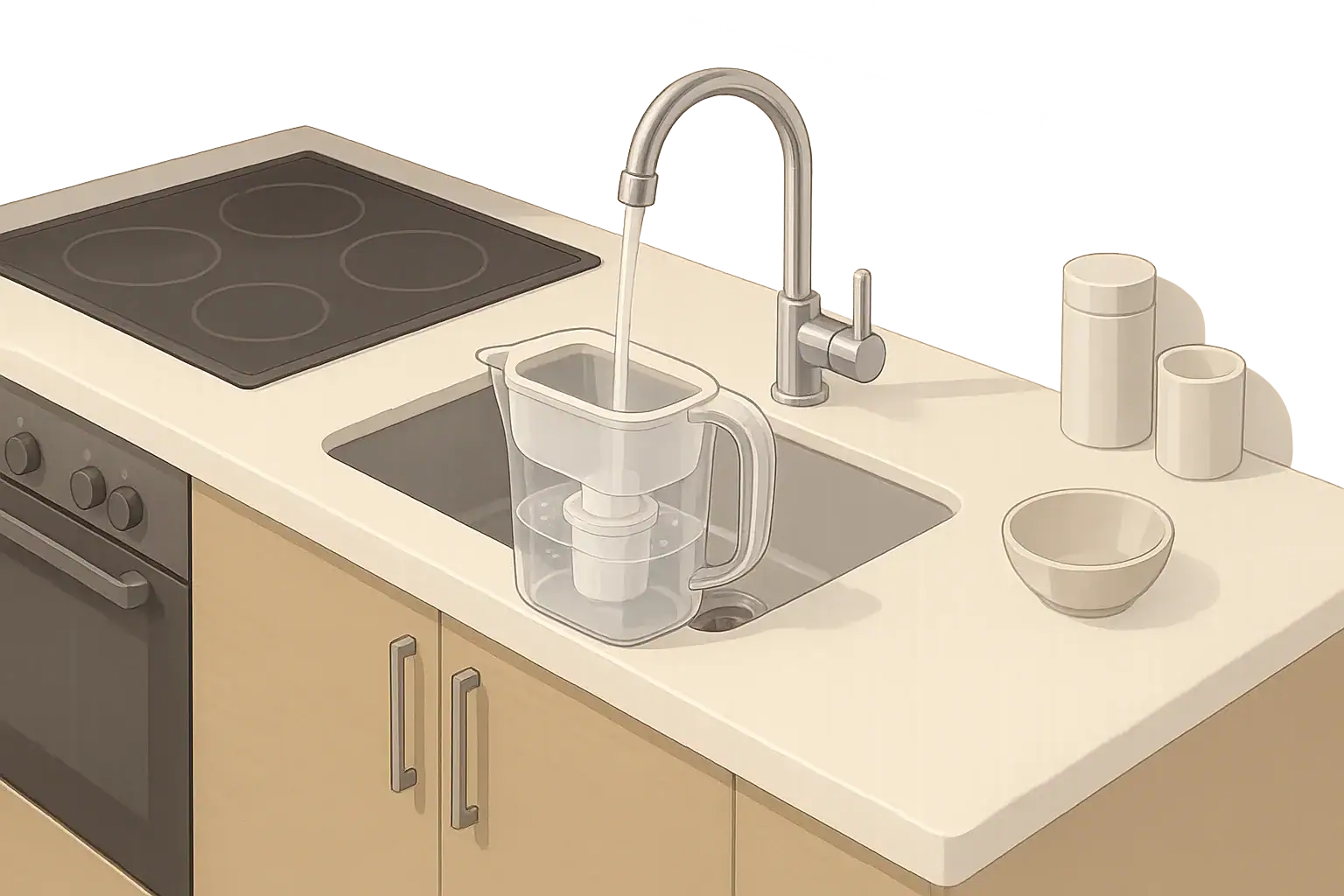
Why Pitcher Filters Work Well for Renters
Pitcher filters are popular with renters because they do not require tools, plumbing changes, or landlord approval. They sit on the counter or in the refrigerator and can be packed up easily when you move.
For many apartments in the United States, tap water meets basic safety regulations but may still have noticeable chlorine taste or odor, sediment, or other aesthetic concerns. A pitcher filter can help improve taste and appearance without permanent installation.
Compared with faucet-mount, under-sink, or whole-house systems, pitchers are generally:
- Low-commitment: no drilling or pipe changes
- Portable: easy to take to a new rental
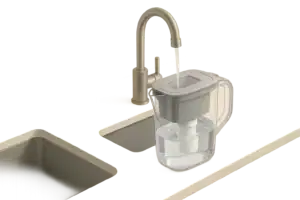
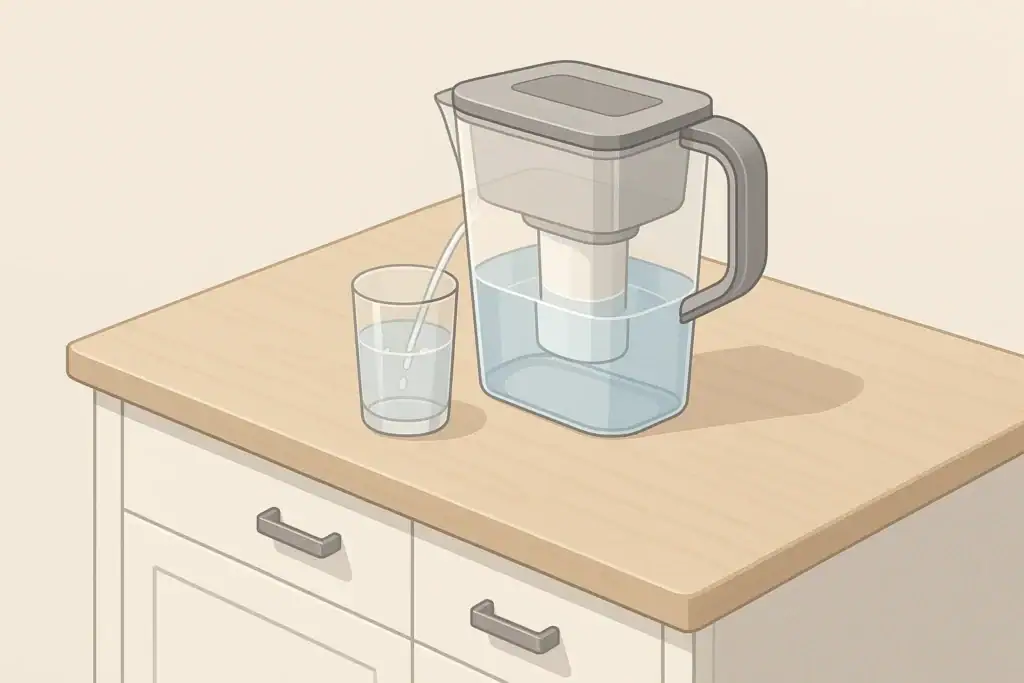
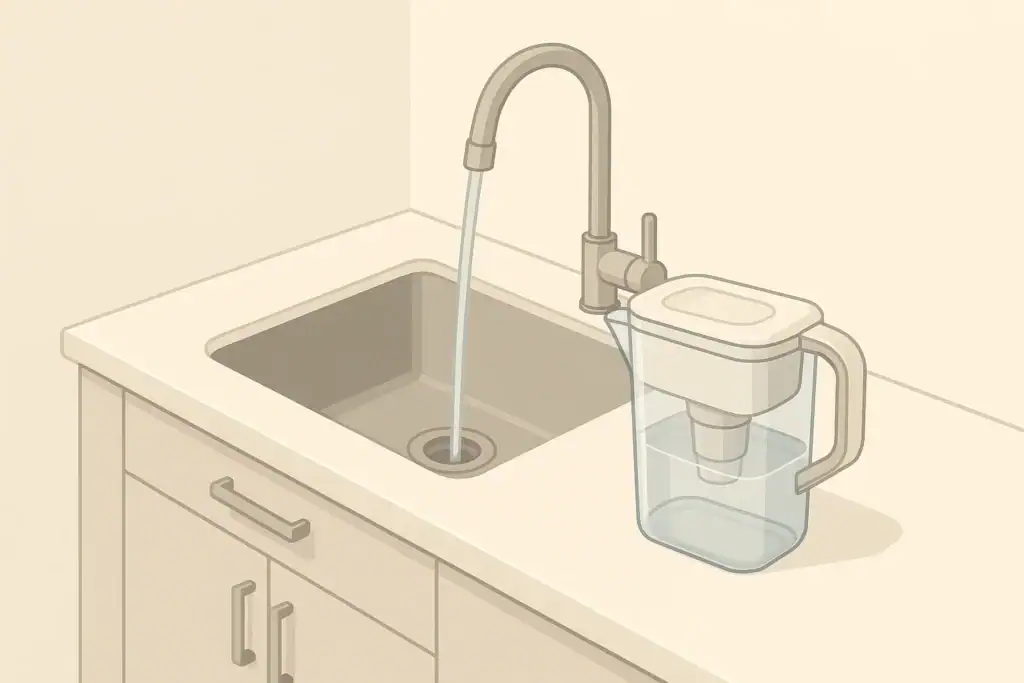
- Simple to use: pour water in the top, dispense from the bottom
- Predictable in cost: cartridge replacements are easy to plan
However, not all pitcher filters are equal. For renters, two practical questions dominate: how much water can it hold (capacity) and will it actually fit in your refrigerator (fridge fit)?
How Much Capacity Do You Really Need?
Capacity affects how often you refill the pitcher and how much filtered water is on hand for cooking, coffee, and drinking. Manufacturers usually list two capacities:
- Total volume: how much liquid the pitcher can physically hold
- Filtered volume: how much is available to pour at any moment (excluding unfiltered water still passing through the cartridge)
When you see capacity numbers, check whether they refer to total volume or usable filtered water. For daily life, the filtered volume is what matters most.
Match Capacity to Household Size
To estimate the right size, think about how much drinking and cooking water you use in a day. Many households underestimate this. Consider:
- Glasses of water per person
- Coffee, tea, and other beverages made with water
- Cooking needs, such as rice, pasta, or soups
A general way to think about sizing:
- Single renter: a small to medium pitcher may be enough if you are willing to refill more often.
- Two people: a medium size helps avoid constant refilling, especially if both work from home.
- Three or more people or frequent guests: a large pitcher or multiple pitchers can reduce refills.
You can roughly calculate a daily minimum by multiplying the number of people by a few glasses per person and then converting to total volume. A pitcher that holds at least that amount of filtered water will limit refills to about once per day.
Consider Refill Frequency and Flow
Capacity interacts with the speed of filtration. Some cartridges filter quickly; others are slower, especially if they use finer media for more advanced contaminant reduction.
Ask yourself:
- How often are you willing to refill the pitcher in a day?
- Are you okay waiting several minutes for a full refill, or do you prefer faster flow?
- Do you often host guests who might quickly drain the pitcher?
If you frequently run out of filtered water at busy times (like mornings or dinner), a larger capacity or a second pitcher may be more practical than a smaller, compact model.
Example values for illustration.
| Situation | Capacity focus | Fridge-fit priority | Typical tradeoff |
|---|---|---|---|
| Small studio, single renter, narrow fridge shelves | Small to medium | High: slim footprint, shorter height | More frequent refills, easier fit |
| Two adults, standard top-freezer fridge | Medium | Moderate: fits main shelf or door | Balanced refills vs. space |
| Household of three or more, open shelf space | Large | Moderate: may lose one full shelf section | Fewer refills, more bulk |
| Frequent cooking with filtered water | Medium to large | Medium: plan a dedicated spot | More capacity for pots and recipes |
| Very limited fridge space, many roommates | Small, possibly multiple pitchers | Very high: must share shelf space | Shared refilling responsibility |
| Renter who moves often | Medium | Flexible: fits a range of fridges | Portable and adaptable |
Measuring for Fridge Fit in a Rental
Fridge fit is especially important for renters because you do not usually choose the refrigerator model. Dimensions, shelf layout, and door bins vary widely between apartments, even within the same building.
Before choosing a pitcher, check the physical space you have. Relying on rough guesses often leads to awkward angles, stuck shelves, or a pitcher that will only fit on the counter.
Key Fridge Measurements to Take
Use a simple tape measure and note measurements in inches or centimeters. Consider both shelf and door storage options.
- Height: Measure from the shelf surface to the next shelf or to the top of the fridge compartment. Account for any light fixtures or protrusions.
- Depth: Measure from the back wall of the fridge to the inner edge of the door gasket. This determines how far a pitcher can extend before interfering with closing.
- Width: Measure the clear space left-to-right between items or shelf supports where the pitcher will sit.
- Door-bin opening: If you plan to store the pitcher in the door, measure the height and width between sidewalls and the depth from the back of the bin to the retainer bar.
Compare these numbers to the pitcher’s width, depth, and height. Leave a bit of extra clearance so the pitcher can slide in and out easily, even when the fridge is full.
Common Fridge Layout Challenges for Renters
Apartment refrigerators often have quirks that affect pitcher fit:
- Fixed shelves: Some fridges do not allow shelf height adjustment, which limits tall pitchers.
- Large crisper drawers: These can reduce usable shelf height above them.
- Door shelves that tilt: Certain door bins slant inward, reducing usable depth for bulky items.
- Shared space: Roommates’ items may leave only narrow slots.
If vertical space is limited, look for a shorter pitcher with a wider base. If shelf depth is limited, a narrow, tall design may work better. For very tight fridges, a compact pitcher on the door might be the most realistic option, though it may reduce capacity.
What Pitcher Filters Can and Cannot Do
Pitcher filters typically use gravity-fed cartridges, most often based on activated carbon and sometimes additional media. They are designed to improve taste and reduce certain contaminants, but they are not universal solutions.
Typical Uses in Rental Settings
In many U.S. rentals, municipal water may have:
- Chlorine taste and odor from disinfection
- Musty or earthy flavors from seasonal water changes
- Fine sediment or visible particles from distribution pipes
Pitcher filters are commonly used to:
- Reduce chlorine taste and odor
- Capture some sediment and large particles
- Improve the overall taste for drinking and cooking
Some cartridges are also designed to address specific contaminants such as lead or certain organic compounds. For that, product details and certifications become important.
Limitations to Keep in Mind
Pitcher filters are not designed for every water quality issue. In particular, gravity pitchers generally:
- Do not remove all dissolved minerals that affect hardness
- Do not function like full reverse osmosis systems
- May not be certified for microbial reduction unless explicitly stated
If your rental has complex water problems, such as very hard water, frequent boil-water advisories, or known localized contaminants, you may need to consider additional treatment options beyond a simple pitcher.
Understanding Certifications: NSF/ANSI Standards for Pitcher Filters
Because renters cannot easily change plumbing, it is useful to rely on third-party testing to understand what a pitcher filter is designed to do. In the United States, many water treatment products refer to NSF/ANSI standards. These include:
- NSF/ANSI 42: Aesthetic effects such as chlorine taste and odor, and some particulate reduction
- NSF/ANSI 53: Certain health-related contaminants such as lead and some heavy metals, when claimed and tested
- NSF/ANSI 401: Emerging compounds such as some pharmaceuticals and personal care products, when claimed and tested
- NSF/ANSI 58: Reverse osmosis systems, not typically applicable to simple pitchers but useful when comparing other filter types
When looking at certifications, focus on what the cartridge is specifically certified to reduce, not just which standard number appears in marketing materials. Two different products might both mention the same standard, but be certified for different contaminant lists within that standard.
How Renters Can Check Claims
For a practical approach:
- Look for clear language about which standard applies to which contaminant claims.
- Confirm that the type of filter (pitcher cartridge) is what has been tested, not just a different product line.
- Understand that certifications usually apply when the filter is used and maintained according to instructions.
If you are concerned about specific contaminants in your area, you can compare local water quality reports with the categories included in each standard to see whether a particular pitcher type addresses your main concerns.
Example values for illustration.
| Standard | Main focus | What to look for on a pitcher filter | Notes for renters |
|---|---|---|---|
| NSF/ANSI 42 | Aesthetic effects | Claims about chlorine taste, odor, and particulates | Common for basic taste improvement in apartments |
| NSF/ANSI 53 | Specific contaminants | Listings for substances like lead or certain metals | Relevant where building plumbing materials are older |
| NSF/ANSI 401 | Emerging compounds | Claims involving select pharmaceuticals or chemicals | Useful when comparing more advanced cartridges |
| NSF/ANSI 58 | Reverse osmosis systems | Typically applies to under-sink RO, not pitchers | Provides context when evaluating other filter types |
| Independent lab reports | Additional testing | Data that may accompany or supplement standards | Check that tests match the cartridge you plan to use |
| Usage conditions | How the standard was applied | Filter life, flow rate, and water quality assumptions | Performance generally assumes proper maintenance |
Maintenance, Filter Life, and Cost Planning for Renters
Pitcher filters are only effective if cartridges are replaced on schedule. In rentals where life is often busy and moves are frequent, it is easy to forget filter changes. Planning ahead helps maintain consistent performance and taste.
Understanding Filter Capacity and Life
Cartridges are usually rated for a certain volume of water or a time period, such as a set number of gallons or a certain number of months. These figures assume average water quality and usage.
In practice:
- Higher usage or very cloudy water can shorten effective life.
- Lower usage may mean you reach the time limit before the volume limit.
- Ignoring replacement guidance can lead to reduced flow and less effective filtration.
Some pitchers include simple mechanical indicators or reminder dials, while others rely on you to track dates manually.
Simple Replacement Habits for Renters
These strategies can make filter maintenance manageable in a rental:
- Set calendar reminders: Add replacement dates to a phone calendar based on the manufacturer’s interval.
- Track by refills: If you know your pitcher’s volume, you can estimate how many refills equal the cartridge’s rated capacity.
- Buy spares ahead: Keeping one extra cartridge on hand avoids gaps in use if a move or busy period overlaps with a scheduled change.
- Observe taste and flow: A noticeable drop in flow or changes in taste can signal it is time to replace the cartridge, even if the calendar date is not yet reached.
When you move to a new rental, it is usually a good idea to start with a fresh cartridge, especially if you are unsure how long the old one sat unused or if the new location’s water quality is very different.
Estimating Cost Per Gallon in a Rental Budget
Renters often budget carefully, and water filtration is one more recurring cost. To estimate cost per gallon for a pitcher filter, you can:
- Divide the price of a replacement cartridge by its rated capacity in gallons to get a rough cost per gallon.
- Multiply your estimated daily use by 30 to get a monthly volume, then calculate how long one cartridge might last.
This helps you compare a pitcher filter with other options like faucet-mount or under-sink systems, especially if you expect to stay in the same rental for several years. For short-term rentals, the low initial cost and portability of a pitcher often outweigh a slightly higher cost per gallon compared with more permanent systems.
Everyday Practical Tips for Renters
To make a pitcher filter work smoothly in a rental environment:
- Assign one fridge spot and keep it clear so the pitcher is easy to access.
- Encourage roommates to refill the top reservoir when they pour the last glass.
- Rinse the pitcher periodically following manufacturer guidance to prevent film or buildup.
- Store the pitcher in the refrigerator if you prefer cold water and want to limit microbial growth over time, especially in warm climates.
By paying attention to capacity, fridge fit, certifications, and simple maintenance routines, renters can use pitcher filters as a flexible, low-commitment way to improve the taste and usability of tap water in a wide variety of apartment setups.
Frequently asked questions
Can pitcher filters remove lead from water in older rental plumbing?
Some pitcher cartridges are certified to reduce lead when tested to standards such as NSF/ANSI 53; check the cartridge-specific certification and lab data before relying on it. Effectiveness depends on the cartridge media and local water chemistry, so if lead is a known concern run a water test and choose a cartridge with the appropriate certified claims.
What exact measurements should I take to make sure a pitcher fits in my refrigerator?
Measure the available height from a shelf surface to the next shelf or ceiling, the shelf depth from the back wall to the door gasket, and the clear width between obstructions. If you plan to use a door bin, also measure the bin’s opening height, width, and usable depth, and leave extra clearance so the pitcher slides in and out easily.
How often should renters replace a pitcher filter cartridge?
Cartridges are typically rated by gallons or a time period (commonly 1–3 months under average use); check the manufacturer’s rating and adjust for your daily volume and water quality. Set calendar reminders and consider buying a spare cartridge so you don’t miss replacements during busy periods or moves.
Is storing a pitcher in the refrigerator safer than keeping it on the counter?
Keeping the pitcher refrigerated slows bacterial growth and keeps water cold for drinking, but it does not sterilize the water or the pitcher. Regular cleaning and timely cartridge replacement are still important, and any water left standing for several days should be discarded and the pitcher rinsed before reuse.
Will a pitcher filter fix issues like hard water or exactly how much chlorine is removed?
Pitcher filters commonly improve chlorine taste and reduce particulates (often covered by NSF/ANSI 42), but they do not soften water or remove dissolved minerals that cause hardness. For hardness or other complex contaminants you may need different treatments, such as water softeners or higher-performance systems; compare local water reports to the filter’s certified claims to make the best choice.
Recommended next:
- Best Pitcher Water Filters for Better-Tasting Tap Water (Chlorine Focus)
- Pitcher Filter vs Bottled Water: Cost per Gallon Breakdown
- How Often Should You Replace Pitcher Filters? (By Household Size)
- TDS in Pitcher-Filtered Water: What Changes and What Doesn’t
- Pitcher Filter Maintenance: Cleaning & Sanitizing Without Off-Flavors
- Do Pitcher Filters Reduce Lead? How to Check Certified Claims
- More in Pitcher Filters →
- NSF/ANSI standards explained (42/53/401/58)
- Clear trade-offs: pitcher vs faucet vs under-sink vs RO
- Maintenance planning: cost per gallon and replacement cadence