
Why Lead in Tap Water Is a Concern for Homeowners
Lead can enter household water from plumbing materials such as service lines, solder and some fixtures. Because lead in water cannot be reliably detected by sight, taste or smell, appearance is not a useful way to judge either the water or a filter’s performance. The EPA recommends testing through a state-certified drinking-water laboratory when you need to determine the lead level at a particular tap. See the EPA’s guidance on testing drinking water for lead.
Some pitcher filters are certified to reduce lead, while others are intended only to improve taste and odor. The name of the brand or the presence of an NSF/ANSI number by itself is not enough. You need to verify the exact pitcher model, replacement cartridge and contaminant claim.
How Pitcher Filters Can Reduce Lead
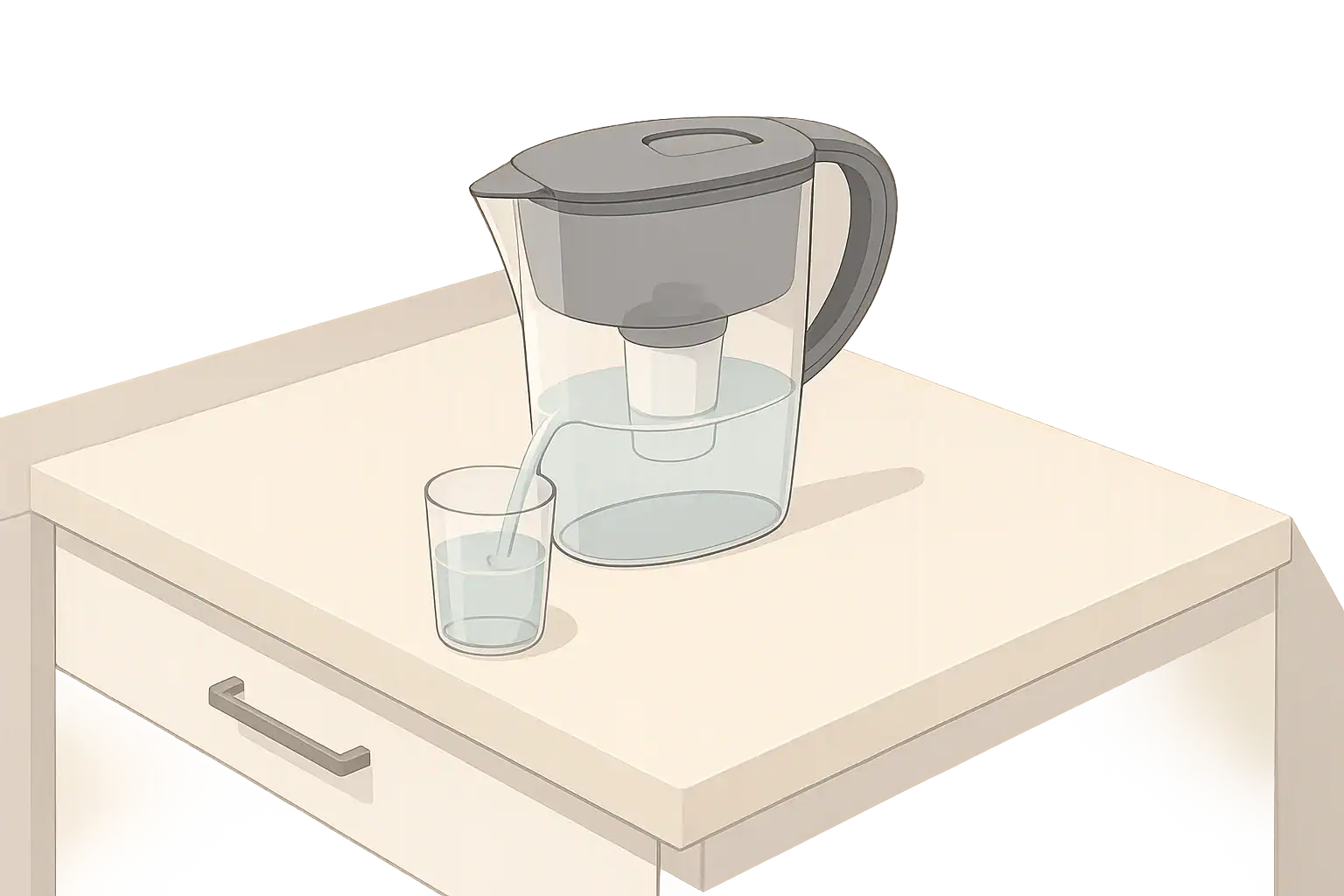
A pitcher is a gravity-fed point-of-use device. Water moves from an upper reservoir through a replaceable cartridge and collects in the lower chamber. Depending on the product, its media may use adsorption, ion exchange, mechanical filtration or a combination of methods.
Those media descriptions do not prove that a product reduces lead. Certification is based on demonstrated performance for a specified system and claim, not on a mandatory recipe such as a particular combination of carbon and resin. Two cartridges that look similar or use similar media can have different certified claims.
Basic pitcher cartridges commonly make aesthetic claims such as chlorine taste and odor reduction. A pitcher intended for lead concerns must have a lead-reduction claim covering the exact system being used.
Which Certifications Matter?
The EPA’s consumer tool for point-of-use and pitcher filters advises consumers to look for both:
- NSF/ANSI 53 with a lead-reduction claim, which addresses the health-related lead-reduction performance of the listed system; and
- NSF/ANSI 42, particulate reduction Class I, which is relevant to fine particles that may contain lead.
Under the certification testing described by the EPA, qualifying filters are evaluated to reduce lead to 5 parts per billion or less. This is a controlled certification benchmark, not a promise that every household sample will have the same result. Consult the EPA’s consumer tool for identifying filters certified to reduce lead.
| Standard or claim | What it tells you | What to verify for lead |
|---|---|---|
| NSF/ANSI 42 | Covers aesthetic effects and particulate-reduction claims | Standard 42 alone does not establish dissolved-lead reduction. EPA specifically identifies Class I particulate reduction as a companion claim to check. |
| NSF/ANSI 53 | Covers specified health-related contaminant-reduction claims | Confirm that lead is explicitly listed for the exact pitcher and cartridge. |
| NSF/ANSI 401 | Covers claims for selected emerging compounds | This is not a substitute for a listed lead-reduction claim. |
| NSF/ANSI 58 | Applies to reverse-osmosis systems | Relevant to an RO system only when its listing includes the contaminant claim you need; it is not the usual pitcher standard. |
Claims are contaminant-specific. A product certified under NSF/ANSI 53 for one contaminant is not automatically certified for lead. Likewise, an NSF/ANSI 42 taste-and-odor claim must not be treated as a general lead claim.
How to Verify a Lead-Reduction Claim
1. Record the exact pitcher and cartridge identifiers
Find the model number on the pitcher, packaging or manual and the replacement-element number on the cartridge or its package. A brand may sell several cartridges that fit similar pitchers but carry different certified claims.
2. Read the complete certification statement
Look for the standard, the named contaminant and the certifying organization. Wording such as “reduces contaminants” or “tested to NSF standards” is not as specific as a certification that names NSF/ANSI 53 and lead for the model in question.
3. Check the certifier’s official directory
Search by manufacturer, model and replacement element. Confirm all of the following:
- the pitcher model matches;
- the replacement cartridge matches;
- lead reduction is listed;
- the stated capacity matches the product literature; and
- the listing is current.
Certification status can change, so recheck the directory rather than relying only on an old package image or retailer description.
4. Distinguish certified capacity from calendar guidance
NSF’s public lead-reduction directory explains that a certified system has a stated filter capacity. A time estimate such as “about six months” is product-specific manufacturer guidance, not a universal interval created by NSF/ANSI 53. Replace the cartridge at the applicable capacity or earlier time limit stated by its manufacturer.
Worked Example: Model, Cartridge and Capacity
The following example illustrates the verification process; it is not a product recommendation and does not establish a claim for other pitchers from the same brand.
As of October 30, 2026, the NSF lead-reduction directory listed the Brita Tidal pitcher, model OB63, with replacement element OB06, at a certified capacity of 120 gallons.
Brita’s official Elite filter performance data identify OB06 as certified under NSF/ANSI 53 for lead reduction when used in OB63. The manufacturer reports 99.5% reduction at pH 6.5 and 99.6% at pH 8.5 in testing with a challenge concentration of 150 ± 15 ppb and a maximum permissible product-water concentration of 5 ppb.
The same manufacturer data specify replacement at 120 gallons or about six months, provide an operating-water range of 32–85°F and state that no more than two gallons should be processed daily for maximum efficiency. Those conditions belong to this particular pitcher-and-filter combination. They should not be copied to another product without checking its own listing and performance sheet.
| Item checked | Example finding |
|---|---|
| Pitcher model | Brita Tidal OB63 |
| Replacement element | OB06 |
| Certified claim | NSF/ANSI 53 lead reduction |
| Certified capacity | 120 gallons |
| Use conditions | Must be taken from the manufacturer’s instructions for this exact combination |
Choosing a Filter From Your Water Results
A laboratory result helps define the problem at the tap where water is collected. Contact your water utility or use a state-certified drinking-water laboratory and follow its sampling directions. Sampling protocol matters because lead levels can vary with the tap, plumbing and how long water has remained in contact with plumbing materials.
A certified pitcher can be practical when you need treated water mainly for drinking and cooking, can stay within its capacity and will use it consistently. It may also suit renters who cannot modify the plumbing.
Consider another point-of-use format when the household needs a larger volume or finds repeated pitcher filling impractical. Relevant comparisons include certifications for under-sink lead filters, lead claims on faucet-mount filters and lead claims on refrigerator filters.
Whole-house treatment is not automatically a better response to lead. Equipment installed upstream may not address lead introduced by plumbing located after the treatment unit. Focus first on the taps used for drinking and cooking, the source identified by testing and the certified claim of the proposed system. The EPA has specifically cautioned that upstream treatment may not address lead released from downstream interior plumbing in its guidance concerning filters and downstream plumbing.
For a broader convenience comparison, see under-sink versus pitcher filters for families.
Using and Maintaining the Pitcher
Certification applies to a defined system used under its specified conditions. The EPA advises following the exact installation and replacement instructions, not using an expired cartridge and never putting hot water through the filter. See the EPA’s instructions on using a filter for lead reduction.
- Use cold tap water. Do not run hot water through a pitcher cartridge.
- Prepare a new cartridge as directed. Flushing, soaking or discarding initial batches should be done only when the product instructions call for it.
- Let filtration finish. Allow water to pass completely through the cartridge before pouring.
- Do not overfill. Keep water from bypassing the cartridge or mixing unfiltered reservoir water with filtered water.
- Track capacity and time. Replace at the manufacturer’s gallon limit or earlier stated time limit, whichever applies first.
- Clean the pitcher as directed. Follow the manual for hand-washing, dishwasher compatibility and any parts that should not be submerged.
For help estimating use without treating household size as a substitute for the certified limit, see how often to replace pitcher filters.
Testing Before and After Filtration
Establishing the unfiltered baseline
Testing the drinking-water tap can establish whether lead is present and help you choose an appropriate response. Ask the laboratory which sample protocol fits your question. A first-draw sample and a flushed sample do not necessarily answer the same question.
Testing filtered water
Post-filter testing is not mandatory for every pitcher owner, but it can be useful when you want evidence of performance with your water. Tell the laboratory that the sample will come from filtered water and follow its collection, container, preservation and delivery instructions.
If a filtered sample does not show the expected reduction, check the exact model and cartridge listing, cartridge age and volume processed, installation, possible bypass and sampling method. Do not assume one unexpected result identifies the cause. Seek guidance from the laboratory, water utility or appropriate local drinking-water program.
Key Takeaways
- Some pitcher filters reduce lead, but the claim must cover the exact pitcher-and-cartridge combination.
- EPA advises checking for NSF/ANSI 53 with a lead-reduction claim and NSF/ANSI 42 Class I particulate reduction.
- NSF/ANSI 42 alone is not proof of dissolved-lead reduction, although its Class I particulate claim is relevant as part of EPA’s filter-selection guidance.
- Verify the model, cartridge, lead claim and capacity in the certifier’s official directory.
- Treat a calendar replacement estimate as product-specific guidance, not as a universal Standard 53 interval.
- Use cold water, prevent bypass and replace the cartridge within its stated limits.
- Use a state-certified drinking-water laboratory when you need to determine lead levels at your tap or assess filtered water.
Frequently Asked Questions
How can I verify that a pitcher filter is certified to reduce lead?
Record the exact pitcher model and replacement-cartridge number, then search the certifier’s official directory. Confirm that the listing names lead, matches both identifiers and shows the applicable capacity. Do not rely only on a brand-level claim or retailer description.
Does NSF/ANSI 42 certification mean a pitcher reduces lead?
Not by itself. EPA recommends NSF/ANSI 53 with a lead-reduction claim together with NSF/ANSI 42 Class I particulate reduction. A general Standard 42 taste-and-odor claim does not establish dissolved-lead reduction.
How often should I replace a lead-reduction cartridge?
Follow the instructions for the exact cartridge and do not exceed its stated gallon capacity or earlier time limit. Calendar estimates are product-specific; there is no single six-month rule for every filter certified under NSF/ANSI 53.
Can a pitcher remove all lead from tap water?
Do not interpret certification as a guarantee of complete removal in every home. Certification evaluates the listed system under specified test conditions and to its stated capacity. Household water chemistry, correct installation, cartridge age and use conditions can affect the result.
Should I test my water before and after using a pitcher?
Baseline testing can identify the lead level at the tap, and post-filter testing can be useful if you want to assess performance with your water. Routine post-filter testing is not mandatory for every owner. Use a state-certified drinking-water laboratory and follow its sampling protocol.
Recommended next:
- NSF/ANSI standards explained (42/53/401/58)
- Clear trade-offs: pitcher vs faucet vs under-sink vs RO
- Maintenance planning: cost per gallon and replacement cadence