
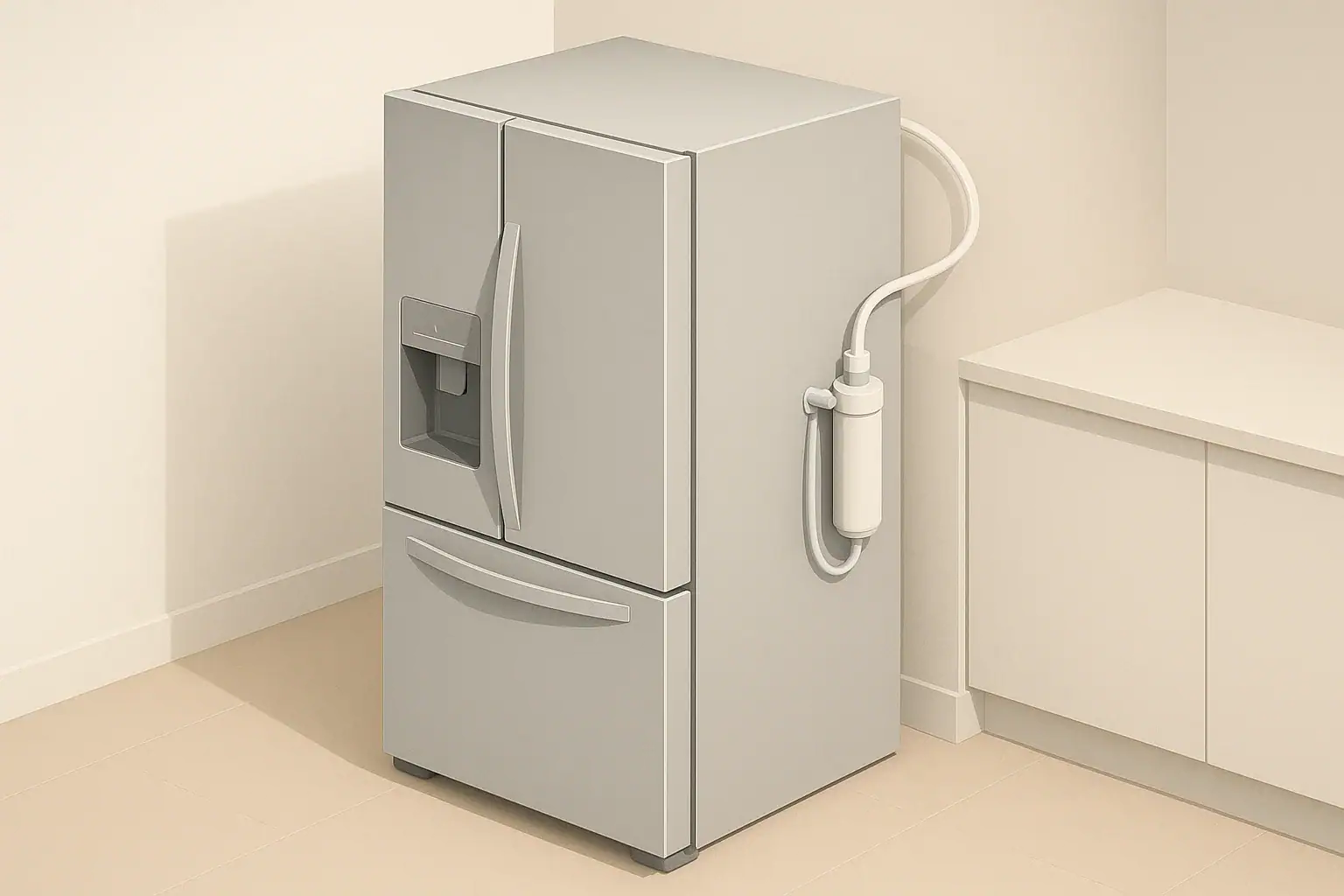
Many households rely on built-in refrigerator dispensers for everyday drinking water and ice. It feels convenient and cleaner than pouring straight from the tap. But if you are concerned about lead in your water, you cannot assume your refrigerator filter will automatically remove it.
Lead in household water usually comes from:
- Older lead service lines in the street or yard
- Lead-containing solder used in older plumbing
- Brass fixtures and valves that can leach small amounts of lead
Lead is a dissolved metal, not something you can see, smell, or taste. That makes it very different from problems like chlorine taste or visible rust. A filter that improves taste is not necessarily designed to deal with dissolved metals like lead.
Refrigerator filters are mainly designed to handle chlorine taste and odor and some sediment. Only some models are specifically engineered and tested to reduce lead. The only reliable way to know is to look for independent certifications and test results, not just marketing phrases.
Why Lead in Drinking Water Is a Concern for Refrigerator Filters
Many households rely on built-in refrigerator dispensers for everyday drinking water and ice. It feels convenient and cleaner than pouring straight from the tap. But if you are concerned about lead in your water, you cannot assume your refrigerator filter will automatically remove it.
Lead in household water usually comes from:
- Older lead service lines in the street or yard
- Lead-containing solder used in older plumbing
- Brass fixtures and valves that can leach small amounts of lead
Lead is a dissolved metal, not something you can see, smell, or taste. That makes it very different from problems like chlorine taste or visible rust. A filter that improves taste is not necessarily designed to deal with dissolved metals like lead.
Refrigerator filters are mainly designed to handle chlorine taste and odor and some sediment. Only some models are specifically engineered and tested to reduce lead. The only reliable way to know is to look for independent certifications and test results, not just marketing phrases.
Can Refrigerator Filters Reduce Lead?
Whether a refrigerator filter reduces lead depends on the filter design and the standards it has been tested against. There are three key points to understand:
- Not all fridge filters are rated for lead reduction.
- Lead reduction requires specific filter media and design.
- Performance depends on correct installation and timely replacement.
How Refrigerator Filters Work in General
Most built-in refrigerator filters use some combination of:
- Activated carbon to reduce chlorine taste and odor and some organic chemicals
- Mechanical filtration (small pores) to capture particles such as sediment and rust
- Specialized media in some filters to target metals like lead
Activated carbon is excellent at adsorbing chlorine and many organic compounds. However, lead behaves differently in water. To meaningfully reduce lead, filters usually need either specially treated carbon or additional media that bind or exchange lead ions.
NSF/ANSI Standards and Lead Reduction
Independent standards help you understand what a refrigerator filter has actually been tested to do:
- NSF/ANSI 42 – Aesthetic effects (taste, odor, and appearance), such as chlorine reduction.
- NSF/ANSI 53 – Health-related contaminants, including lead reduction and certain metals.
A refrigerator filter that is only certified to NSF/ANSI 42 has been tested for taste and odor improvement, but not necessarily for lead. For lead reduction, you want to see a claim tied to NSF/ANSI 53 or an equivalent independent test for lead.
Some filters are formally certified by a third party (for example, an organization that specializes in product testing), while others state they are merely tested to an NSF/ANSI standard. Certification is generally a stronger indication because it involves ongoing oversight, not just a one-time test.
Example values for illustration.
| Filter type | Installed location | Typical main purpose | Lead reduction potential (in general) |
|---|---|---|---|
| Refrigerator filter | Inside or behind fridge | Improve taste, reduce chlorine, protect ice maker | Varies; only some models are designed and certified for lead |
| Pitcher filter | Countertop or fridge shelf | Convenient filtered drinking water | Some cartridges are tested for lead; others are not |
| Faucet-mount filter | Attached to kitchen faucet | On-demand filtered water for drinking and cooking | Some units offer lead-rated cartridges |
| Under-sink carbon block | Under kitchen sink with dedicated tap | Higher-capacity taste, odor, and chemical reduction | Many models are available with specific lead claims |
| Reverse osmosis system | Under sink with storage tank | Broad reduction of dissolved solids and some contaminants | Often used where dissolved metals (including lead) are a concern |
| Whole-house filter | Main water line entry | Protect plumbing, reduce sediment, sometimes chlorine | Usually not focused on lead; mainly for particles and aesthetics |
How to Read Lead-Reduction Claims for Refrigerator Filters
Filter packaging and product pages can be confusing. Some words sound reassuring without guaranteeing any specific performance. To evaluate lead-reduction claims, pay attention to the exact language and look for independent verification.
Marketing Phrases vs. Testable Claims
Be cautious with vague wording. Common phrases that do not guarantee lead reduction include:
- “Helps provide cleaner, fresher-tasting water”
- “Reduces impurities” without naming them
- “Advanced carbon filtration” or “premium filtering” without details
Look instead for clear, testable language, such as:
- “Certified to NSF/ANSI 53 for the reduction of lead”
- “Tested by an independent laboratory for lead reduction”
- “Reduces lead when used as directed” with reference to a standard
If lead is not mentioned at all, or only appears in a very long list of generic “may reduce” contaminants without a standard or lab mentioned, treat the claim cautiously.
Where to Find the Details
To check a refrigerator filter’s actual capabilities, look in these places:
- Installation and user manual – Often includes a table of claims and related standards.
- Packaging fine print – May list specific contaminants and the standard, such as NSF/ANSI 53.
- Manufacturer specification sheet – Typically has a performance data sheet with test conditions and limitations.
On a performance data sheet, you may see information like initial concentration of lead, a range of example flow rates, or illustrative capacities. These are example test conditions, not guarantees for every home. Still, their presence shows that lead reduction was formally evaluated.
Recognizing the Limits of a Lead-Reduction Claim
Even when a refrigerator filter is certified for lead reduction, conditions matter. Typical limitations include:
- Flow rate – Filters are tested at a specified flow rate. Much higher flow can reduce contact time and performance.
- Service life – Claims apply only up to a certain volume or number of months, whichever comes first.
- Water quality – Very high sediment, extreme pH, or unusual chemistry can affect performance.
Certification does not promise that lead will be reduced to zero in every case. It means the filter met the standard’s requirements under controlled test conditions. To know the impact in your home, water testing is useful.
How to Test Lead Levels in Your Tap and Refrigerator Water
Testing your water before and after filtration is the most direct way to understand what your refrigerator filter is doing. It also helps confirm whether you should consider additional filtration beyond the fridge.
Step 1: Get Your Water Source Information
Start by learning about your local water supply:
- If you are on public water, review your water utility’s annual water quality report. It usually shows lead test results at distribution points, though not necessarily in your home.
- If you use a private well, there is no central report. Periodic testing for metals, including lead, is recommended by many local agencies.
Keep in mind that lead can enter water as it sits in your home’s plumbing, even if the incoming water from the utility is low in lead. That is why testing at the tap is important.
Step 2: Plan What and Where to Test
For refrigerator filters, it is helpful to capture a before-and-after picture:
- Unfiltered kitchen tap – Cold water at the sink, where the refrigerator line usually connects.
- Refrigerator dispenser – Filtered cold water from the fridge.
- Optional: Other points – For example, a basement spigot before it enters indoor plumbing, if accessible.
When planning testing, consider:
- Whether you want a first-draw sample (after water sits in the pipes overnight) to reflect worst-case plumbing contact.
- Whether you also want a flushed sample (after the water has run for a short time) to compare conditions.
Step 3: Choose a Testing Method
Common options for lead testing include:
- Certified laboratory testing – Often the most detailed and accurate, with specific instructions for sample collection and shipping.
- Mail-in test kits – Provide containers you fill at home and mail to a lab; results are sent back to you.
- Simple at-home screening tests – Quick checks that may be useful as an initial screen but may not be as precise as lab methods.
Follow the sampling instructions carefully. Label each sample (for example, “kitchen tap, first draw” and “fridge dispenser”) so you can compare results for your specific filter setup.
Step 4: Interpreting Your Results in Relation to the Filter
When you compare unfiltered tap water to refrigerator dispenser water, you may see one of several patterns:
- Both samples show non-detectable lead – Your plumbing and supply may not be contributing measurable lead under test conditions.
- Tap sample shows lead, fridge water shows substantially lower levels – Your refrigerator filter may be contributing to lead reduction.
- Tap and fridge samples show similar lead levels – Either the filter is not designed for lead, is not installed or maintained correctly, or conditions are outside what the filter can handle.
If results are unclear or right at the detection limit, consulting the lab or a local water professional can help you understand what the numbers mean in practical terms, especially when choosing whether additional filtration is worthwhile.
Installation, Maintenance, and When a Fridge Filter Is Not Enough
Even a well-designed, certified refrigerator filter can underperform if it is not installed, used, or maintained as intended. It is also important to know when it makes sense to add or switch to another type of system for more robust lead control.
Proper Installation and Use
When installing or replacing a refrigerator filter:
- Follow the manufacturer’s instructions for inserting and locking the cartridge.
- Flush the filter by running water through it for the recommended volume or time to remove loose carbon dust and air.
- Check for leaks at the connection points and correct any misalignment.
Improperly seated cartridges can let water bypass the filter media, reducing any potential for lead reduction and other contaminant removal.
Sticking to Replacement Schedules
Refrigerator filters have limited capacity. Over time, pores fill with particles and adsorption sites for metals and chemicals are exhausted. When this happens:
- Flow often slows down noticeably.
- Taste may gradually worsen.
- Lead reduction performance, if present, can decline.
Most refrigerator filters list an approximate replacement schedule, commonly around several hundred gallons or a number of months, whichever comes first. Heavy use households or those with very turbid water may hit capacity earlier than the calendar suggests.
When to Consider Additional Filtration Beyond the Refrigerator
Depending on your water quality and household needs, a refrigerator filter may be only one part of your overall strategy. Consider adding or switching systems if:
- Testing shows significant lead at multiple fixtures in your home.
- You want lead reduction at more than one tap used for cooking, drinking, and formula preparation.
- You are also concerned about other contaminants, such as certain organic chemicals or dissolved solids, that your fridge filter is not designed to address.
Options can include under-sink systems that are certified for lead, point-of-use reverse osmosis systems, or in some cases, broader plumbing changes and pipe replacement recommended by local experts.
Checking Certifications and Claims Before You Buy Replacement Filters
Replacement refrigerator cartridges may come in different versions, and some third-party cartridges are designed to fit various fridges. The lead-reduction performance you get depends on the specific cartridge, not just the refrigerator model itself.
Verifying Certifications for Replacement Cartridges
When choosing a replacement refrigerator filter and you care about lead reduction, verify that:
- The exact cartridge model is listed as certified or tested for lead reduction.
- The certification explicitly mentions NSF/ANSI 53 (or another recognized health-related standard) and specifically lists lead.
- The claim is tied to a recognized independent certifier or laboratory, not just an internal test with no details.
Replacement refrigerator cartridges may come in different versions, and some third-party cartridges are designed to fit various fridges. The lead-reduction performance you get depends on the specific cartridge, not just the refrigerator model itself.
Be cautious of general references to NSF standards that do not specify which ones or what contaminants were included. A simple reference to NSF/ANSI 42 alone addresses taste and odor, not lead.
Questions to Ask or Check in Documentation
As you review product packaging, manuals, or spec sheets, it can help to ask:
- Which NSF/ANSI standards does this cartridge meet, and for which contaminants?
- Is the certification current, and does it apply to this exact filter designation?
- What are the recommended service life and flow rate under which performance was tested?
Keeping a copy of the performance data sheet, whether printed or saved digitally, makes it easier to check claims later if you decide to test your water or compare options.
Example values for illustration.
| Standard | Main focus | Typical use with refrigerator or point-of-use filters | What a homeowner should verify |
|---|---|---|---|
| NSF/ANSI 42 | Aesthetic effects (taste, odor, appearance) | Chlorine taste and odor reduction; basic sediment control | Confirm it is not the only standard if lead reduction is a goal |
| NSF/ANSI 53 | Health-related contaminant reduction | Filters designed to reduce lead and certain metals or chemicals | Check that lead is specifically listed as a tested contaminant |
| NSF/ANSI 58 | Reverse osmosis systems | Under-sink RO units that treat a broad range of dissolved substances | Verify that lead and any other concerns are included in the performance claims |
| NSF/ANSI 401 | Emerging or incidental contaminants | Some advanced filters and systems targeting trace compounds | Understand that this is separate from lead; check both if relevant |
| NSF/ANSI 372 | Lead content of materials | Verifies low-lead content of the product’s construction materials | Do not confuse this with lead reduction; it relates to materials, not filtration performance |
| NSF/ANSI 61 | Health effects of system components | Applies to pipes, fittings, and devices in contact with drinking water | Use this as material safety information, separate from contaminant reduction claims |
Putting Refrigerator Filters in the Context of Your Whole Home
Refrigerator filters can play a useful role in improving the taste and clarity of everyday drinking water and ice. Some models, when properly certified and maintained, can also reduce lead under typical household conditions. However, lead is closely tied to plumbing materials and how water moves through your home, so a single filter at the fridge is only one part of the picture.
By checking certifications, reading performance data sheets carefully, and using targeted water testing at your taps and refrigerator dispenser, you can place your fridge filter in the right context. That makes it easier to decide whether your current setup is adequate for your goals or whether it is time to combine your refrigerator filter with other point-of-use or whole-home strategies for more comprehensive water quality control.
Frequently asked questions
How can I tell if my refrigerator filter is certified to reduce lead?
Look for a specific claim such as “certified to NSF/ANSI 53 for the reduction of lead” on the packaging or specification sheet, and check the performance data sheet for test conditions. Confirm the exact cartridge model and the certifying organization rather than relying on vague “tested” language.
Will a filter certified to NSF/ANSI 42 reduce lead?
No; NSF/ANSI 42 covers aesthetic effects like taste and odor, not health-related contaminants. For lead reduction you should see NSF/ANSI 53 or an equivalent health-related test that explicitly lists lead.
How should I test my fridge water to confirm lead reduction?
Collect paired samples of unfiltered tap water and filtered refrigerator dispenser water (consider both first-draw and flushed samples) and send them to a certified laboratory or use a reputable mail-in kit. Follow the lab’s sampling instructions and clearly label samples so results can be compared accurately.
Can improper installation or missed replacements affect lead reduction?
Yes. A cartridge that is not seated correctly can allow water to bypass the media, and an exhausted filter loses removal capacity, both of which reduce lead-removal effectiveness. Always follow installation steps, flush new cartridges, and replace them according to the recommended schedule.
If my refrigerator filter doesn’t remove lead, what alternatives should I consider?
Consider point-of-use systems certified for lead such as under-sink cartridges or reverse osmosis, or broader plumbing solutions if multiple fixtures are affected. Base your choice on test results, required capacity, and verification that the system is certified for lead reduction.
Recommended next:
- Why Your Ice Tastes Bad (and How a Fridge Filter Helps)
- Refrigerator Filter Compatibility: How to Find the Right Replacement
- Inline Fridge Filters: When to Use an External Inline Filter
- How Often to Replace Refrigerator Water Filters (By Gallons & Usage)
- Fixing Low Flow from a Refrigerator Dispenser
- More in Refrigerator & Ice Filters →
- NSF/ANSI standards explained (42/53/401/58)
- Clear trade-offs: pitcher vs faucet vs under-sink vs RO
- Maintenance planning: cost per gallon and replacement cadence