
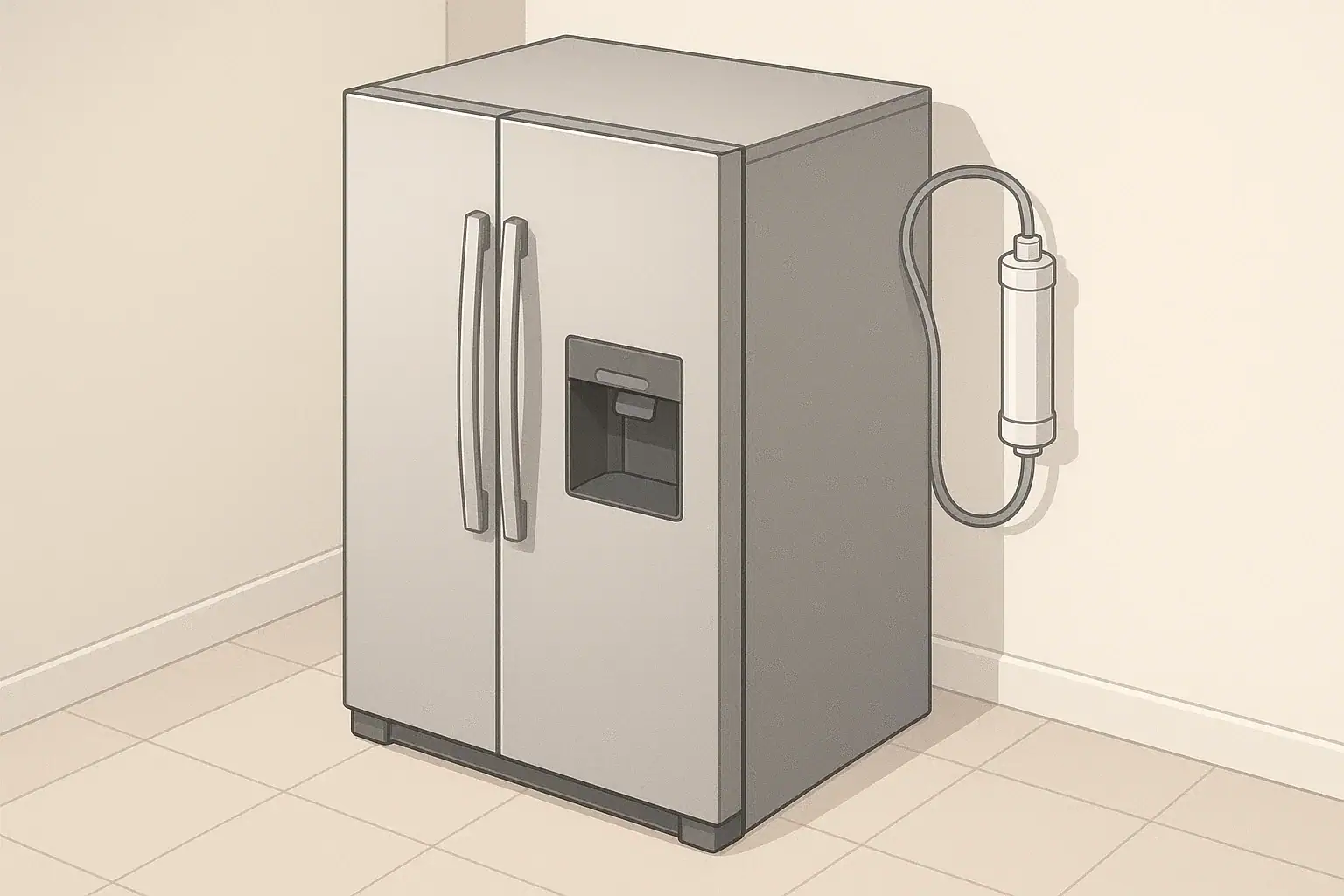
Refrigerator water filters are designed to do a specific job for a limited time and capacity. Inside the cartridge, activated carbon and sometimes additional media trap chlorine, sediment, and other common taste and odor compounds. Over months of use, the filter gradually loads with material and becomes less effective.
Most refrigerator filters are rated by both time (months) and capacity (gallons). Once you reach either limit, performance can decline. You may notice changes in taste, odor, or flow rate. Replacing the filter on a sensible schedule helps keep water and ice consistent and avoids straining your refrigerator’s dispenser system.
There is no single schedule that fits every home. The right replacement interval depends on how much water you use, what is in your local water, the size and design of the filter, and whether you are mainly filtering for taste and odor or for additional contaminants.
Why Refrigerator Water Filter Replacement Matters
Typical Replacement Guidelines: Time vs Gallons
Most refrigerator water filters list a recommended change interval such as “about every 6 months” and a maximum capacity in gallons. Manufacturers usually suggest whichever comes first: time or gallons. The time recommendation is a simple reminder, while the gallon rating is tied more directly to performance.
Common time-based guidelines
In many households, refrigerator filters are replaced on a calendar schedule. General examples include:
- 3–4 months: Heavy usage households or locations with very challenging water (for example, high sediment or noticeable chlorine taste).
- 6 months: A commonly suggested interval for average household use.
- 9–12 months: Light usage households that do not reach the rated gallon capacity quickly.
These ranges are examples only. Actual intervals depend on how much water passes through the filter and how quickly it clogs or exhausts its adsorption capacity.
Understanding gallon capacity ratings
Every refrigerator filter has a maximum capacity rating, often in the range of a few hundred gallons. This number is not a guarantee of specific removal performance; it is a general design limit for how much water the filter is intended to handle before replacement.
For example (illustrative only):
- A filter rated at 200–300 gallons might suit a low- to moderate-use household.
- A filter rated at 300–500 gallons might suit higher use, depending on water quality.
The gallon rating is especially helpful if your household uses significantly more or less water than average. By estimating daily use, you can calculate roughly how many days or months it will take to reach the rated capacity.
Example values for illustration.
| Household pattern | Water conditions | Suggested focus | Illustrative schedule approach |
|---|---|---|---|
| Single person, light use | Municipal water, mild chlorine taste | Time-based reminder | Replace every 9–12 months if taste stays stable |
| Small family, moderate use | Municipal water, noticeable chlorine | Time + basic taste monitoring | Replace about every 6 months, or sooner if taste changes |
| Large family, heavy use | Municipal water, normal sediment | Gallon-based estimate | Calculate gallons used; replace when near rated capacity |
| Frequent ice and water users | Hard water with visible scaling | Closer visual and flow monitoring | Check flow monthly; replace at first persistent slowdown |
| Seasonal occupants | Municipal or well, intermittent use | Calendar + restart check | Replace at start of each long-occupancy season |
| Well water users with pre-filtration | Pre-filtered for sediment and iron | Capacity and taste | Follow gallon rating; verify taste and clarity regularly |
How to Estimate Filter Life from Gallons and Usage
To use gallon ratings effectively, it helps to translate them into real-world time for your household. The basic approach is:
- Estimate daily gallons used for drinking water and ice.
- Compare that to the filter’s rated capacity.
- Convert total days into months to set a reminder.
Step 1: Estimate daily water dispenser use
Count how many glasses of water your household typically dispenses from the refrigerator each day.
- Assume an average drinking glass holds about 8–12 ounces.
- There are 128 ounces in a gallon.
For example (illustrative only):
- If your home uses about 16 glasses of 8 ounces each day, that is 128 ounces, or roughly 1 gallon per day.
- If your home uses about 8 glasses of 12 ounces each day, that is 96 ounces, or about 0.75 gallon per day.
Step 2: Add an estimate for ice production
Ice cubes are also made with filtered water. Estimating ice usage is less precise, but you can make a simple approximation:
- Consider how many ice-filled drinks you pour per day.
- Estimate that a full glass of ice might use about 8 ounces of water before freezing (example only).
As a rough illustration:
- 4 glasses of ice per day × 8 ounces each ≈ 32 ounces ≈ 0.25 gallon per day.
Step 3: Compare to the rated capacity
Once you have a daily gallon estimate, divide the filter’s rated gallons by your daily usage to get an approximate number of days. Then convert total days into months by dividing by 30.
Illustrative example only:
- Rated capacity: 300 gallons.
- Estimated daily use: 1.25 gallons (1 gallon drinking + 0.25 gallon for ice).
- 300 ÷ 1.25 ≈ 240 days.
- 240 ÷ 30 ≈ 8 months of use before reaching the capacity.
This type of calculation does not guarantee a particular performance level. It simply helps align your replacement interval with how much water is actually flowing through the filter.
How Water Quality and Plumbing Affect Filter Life
The same filter can last very different lengths of time in different homes. Local water quality and household plumbing influence how quickly the media clogs or becomes saturated.
Chlorine, chloramine, and organic compounds
Activated carbon is commonly used to improve taste and odor by adsorbing chlorine and many common organic compounds. The higher the levels of these substances, the faster the carbon media is consumed.
In areas with stronger chlorine or chloramine treatment, filters may reach their effective capacity sooner, even if overall water usage is moderate. Residents sometimes notice a return of disinfectant smell or flavor before their calendar reminder.
Sediment, rust, and turbidity
Filters that must capture significant sediment or rust may clog earlier than their gallon rating suggests. This is often seen as:
- A gradual drop in water dispenser flow rate.
- Occasional sputtering as trapped air and water compete through restricted pathways.
If you are on a private well or an older plumbing system, using a separate sediment pre-filter upstream of the refrigerator can help protect the internal filter and stabilize its lifespan.
Hardness and scaling
Refrigerator filters may not be designed to significantly change water hardness. However, high hardness can still influence internal components and ice makers by leading to mineral deposits. In some households, separate treatment such as a water softener or scale-control system is used on the whole house plumbing before water reaches the refrigerator. That type of upstream treatment can help keep flow steadier and reduce maintenance issues over time.
Usage Patterns: Light, Average, and Heavy Users
In practice, how often you replace a refrigerator filter is shaped as much by lifestyle as by technical ratings. Thinking about your household in terms of light, average, or heavy usage can help define an appropriate schedule.
Light-use households
Examples of light use include:
- One or two adults who primarily drink water from other sources.
- Seasonal residents who are away for part of the year.
- Homes that rely on the refrigerator mainly for ice, not drinking water.
In these situations, you might not reach the full gallon capacity in six months. It may be reasonable to stretch replacement toward the longer end of typical guidelines, such as 9–12 months, while still watching for flavor changes or flow issues.
Average-use households
Many homes fall into an average-use category:
- Two to four people regularly using the dispenser for drinking water.
- Daily ice use for beverages and occasional entertaining.
For these households, replacing the filter about every six months often aligns with typical capacity ratings and usage estimates. Simple reminders such as changing the filter at the start of every other season can keep maintenance on track.
Heavy-use households
Heavy use can occur when:
- There are many people in the home.
- The refrigerator dispenser is the main drinking water source.
- There is frequent entertaining or high ice consumption.
In such households, it is possible to reach the filter’s rated gallons before six months have passed. In these cases, it can be helpful to:
- Calculate estimated gallon usage as described earlier.
- Monitor taste, odor, and dispenser flow closely.
- Plan for more frequent replacements if you regularly hit capacity early.
Practical Signs It Is Time to Replace the Filter
Beyond calendar dates and gallon estimates, your senses and the behavior of the dispenser provide practical cues that a filter is nearing the end of its useful life.
Changes in taste or odor
One of the clearest indicators is a change in how the water or ice tastes or smells. You may notice:
- A return of chlorine-like smell or flavor.
- Stale or “flat” tasting water compared with a fresh filter.
- Off odors in ice cubes that carry over into beverages.
If the taste or odor changes noticeably, replacing the filter is a straightforward first step.
Reduced or inconsistent flow rate
A worn or clogged filter can also restrict water flow. Signs include:
- Water dispensing more slowly than usual.
- Stopping and starting during dispensing.
- Thin streams of water where there used to be a steady flow.
After installing a new filter, it is normal for the first few glasses to contain air bubbles and slightly inconsistent flow while the cartridge saturates. Persistent low flow after a reasonable flush may suggest a problem elsewhere in the system.
Filter change indicators and reminders
Many refrigerators include a change-filter light or digital reminder based on time estimates. These indicators typically do not measure actual contaminant levels or gallon usage. They are there to help you avoid forgetting routine maintenance.
You can use these reminders as a starting point, then adjust based on your own taste, odor, and flow observations. Some households choose to reset the indicator and follow their own calculated gallon-based schedule when their usage is very different from average.
NSF/ANSI Certifications and What They Mean for Filter Life
Refrigerator water filters may be tested and certified against specific NSF/ANSI standards. These certifications do not dictate how long a filter will last in your home, but they describe the types of performance that were evaluated under controlled conditions.
Common standards for refrigerator filters
Refrigerator filters frequently reference one or more of the following standards:
- NSF/ANSI 42: Typically covers aesthetic effects such as chlorine taste and odor and particulate reduction.
- NSF/ANSI 53: Typically covers reduction of certain contaminants that may be of concern, such as some heavy metals or particulates, when claimed.
- NSF/ANSI 401: Typically covers reduction of certain emerging compounds, when specifically tested and listed.
- NSF/ANSI 58: Typically applies to reverse osmosis systems rather than standard refrigerator carbon filters.
The certification documents usually specify the conditions under which testing was done, including flow rates, influent water characteristics, and rated capacity. Real-world performance can differ if your water or usage does not match test conditions.
Verifying claims and setting expectations
When you are evaluating refrigerator filters, you can look for:
- Which NSF/ANSI standards are listed.
- Which specific reduction claims are made under each standard.
- Any rated capacity associated with those claims.
This information can help you set realistic expectations: if a filter is tested for taste and odor only, you should not assume it will address other types of contaminants. Certification does not replace the need to change the filter on a sensible schedule, but it does provide some assurance of performance within stated limits.
Example values for illustration.
| Standard | Typical focus | What to verify on documentation |
|---|---|---|
| NSF/ANSI 42 | Aesthetic effects (taste, odor, some particulates) | Look for chlorine taste and odor reduction claims and rated capacity |
| NSF/ANSI 53 | Specific contaminant reduction when claimed | Check which contaminants were tested and to what capacity |
| NSF/ANSI 401 | Reduction of certain emerging compounds | Confirm which compounds apply and whether claims match your concerns |
| NSF/ANSI 58 | Reverse osmosis systems | Verify this standard only if using an RO-based refrigerator or pre-treatment |
| Additional markings | System and component identification | Ensure the certification applies to the full filter assembly you are using |
Simple Planning Tips for Staying on Schedule
Once you understand how your usage, water quality, and filter ratings interact, maintaining a consistent replacement schedule becomes much easier. A few practical habits can help keep your refrigerator water clear and consistent over time.
- Write the install date on the filter or nearby: A simple marker note or label can be more visible than a digital reminder.
- Use calendar or app reminders: Set recurring events at your chosen interval, whether that is every 6, 8, or 12 months.
- Track taste and flow changes: Make a brief note when you first notice slower flow or taste changes; compare this with your schedule.
- Keep a spare filter on hand: Storing a replacement cartridge in a cool, dry place prevents gaps when the current filter reaches its limit.
- Flush after replacement: Run water through the new filter for the time or volume specified in its instructions to remove loose carbon fines and trapped air.
By combining basic gallon estimates with observations of taste, odor, and flow, you can tailor your replacement interval to your specific household, rather than relying on a one-size-fits-all schedule.
Frequently asked questions
How often should I replace refrigerator water filters if my household uses about 1 gallon per day?
If your filter is rated at 300 gallons and you use about 1 gallon per day (including ice), you would reach the rated capacity in roughly 300 days, or about 10 months. Manufacturers often recommend replacing by time (for example, every 6 months) or when the gallon limit is reached, whichever comes first, so use the gallon estimate alongside taste and flow monitoring.
Can I rely solely on the refrigerator’s filter change indicator light?
Filter change lights are typically time-based reminders and do not measure contaminant levels or actual gallons used. They are useful as a starting point, but you should also monitor taste, odor, and dispenser flow and adjust replacement timing if your usage or water quality differs from the assumed conditions.
Does hard water cause refrigerator water filters to need replacing more often?
High water hardness does not generally consume activated carbon faster, but mineral deposits from hard water can affect ice makers and internal components. Upstream softening or scale-control systems can reduce maintenance issues and help keep dispenser flow steadier, even if they don’t directly extend the carbon media’s adsorption life.
How do sediment and well water change the recommended replacement schedule?
Significant sediment, rust, or turbidity can clog filter pathways and reduce flow well before the rated gallon capacity is reached. Using a sediment pre-filter upstream of the refrigerator or choosing a cartridge designed to handle particulates can protect the fridge filter and stabilize its lifespan.
Is it unsafe to use a refrigerator filter past its rated gallons or recommended timeframe?
Using a filter beyond its rated capacity or timeframe can reduce its effectiveness at removing taste and odor compounds and certain contaminants, and may lead to poorer-tasting water or ice. While it is not usually an immediate acute health risk, replacing the filter on a sensible schedule helps ensure consistent performance and reduces the chance of degraded water quality over time.
Recommended next:
- NSF/ANSI standards explained (42/53/401/58)
- Clear trade-offs: pitcher vs faucet vs under-sink vs RO
- Maintenance planning: cost per gallon and replacement cadence