
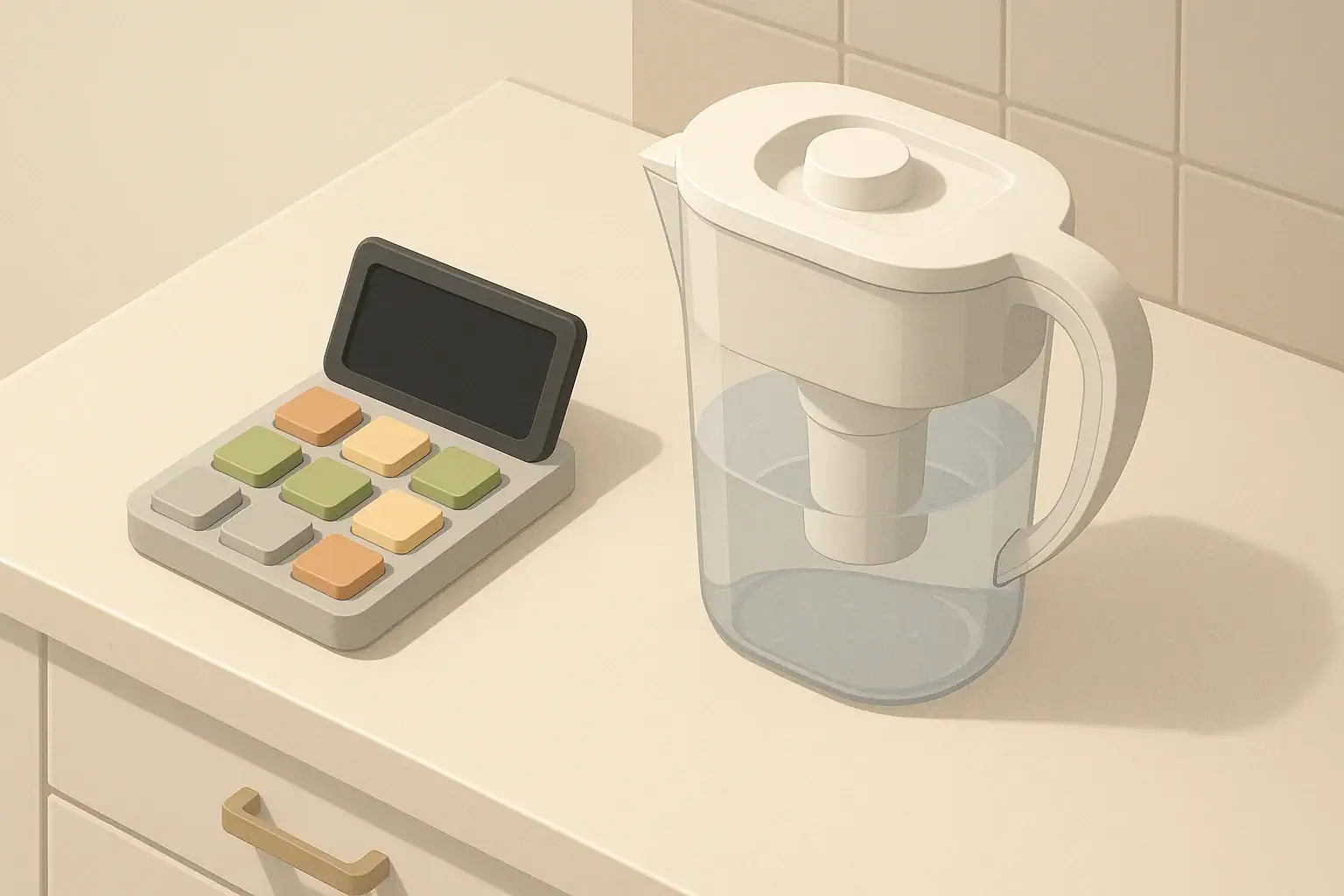
Why You Need a Replacement Planner for Water Filters
Water filters work quietly in the background, but every cartridge has a limited life. If you replace too late, taste and odor can worsen and flow may drop. If you replace too early, you spend more than necessary. A simple replacement planner tool helps you estimate the next change date based on how you actually use water at home.
Instead of relying only on generic guidelines like “change every six months,” a planner combines three main elements:
- Filter capacity (often in gallons or liters)
- Your daily water use through that filter
- Water quality factors that may shorten or extend filter life
This article walks through how to build a practical replacement schedule for common home water filtration systems in the United States, including pitcher filters, faucet-mount units, under-sink systems, reverse osmosis (RO), whole-house filters, refrigerator filters, and shower filters.
Key Inputs for a Replacement Planner Tool
A replacement planner tool starts with just a few inputs. You can gather these from your filter documentation, your household habits, and a rough sense of your water quality.
1. Filter Type and Rated Capacity
Most filters are rated by capacity and/or a suggested time interval, such as a certain number of gallons or a number of months. Typical consumer filters include:
- Pitcher filters – relatively low capacity, often measured in a few dozen to a few hundred gallons.
- Faucet-mount filters – moderate capacity, designed for drinking and cooking water at the sink.
- Under-sink and RO filters – cartridge sets with different stages (sediment, carbon, membrane, polishing filters) that may have different change intervals.
- Whole-house filters – higher capacities, designed to handle all cold water entering the home.
- Refrigerator and ice filters – moderate capacity used primarily for drinking water and ice.
- Shower filters – capacity related to total shower water used.
For planning purposes, note the stated capacity and the recommended maximum time in service. A planner usually uses whichever limit is reached first (capacity or time).
2. Daily Filtered Water Use
The most important variable is how much water you send through the filter each day. You can estimate this in three ways:
- By person: Estimate how many glasses or bottles of filtered water each person drinks per day, plus cooking use.
- By appliance or fixture: For whole-house or shower filters, use typical flow rates and time of use (for example, minutes in the shower and an estimated gallons-per-minute flow).
- By kitchen habits: Include water used for coffee, tea, cooking pasta, rinsing produce, and filling pet bowls if they use filtered water.
Even rough estimates are useful; the goal is to get within a reasonable range so your planner is more accurate than a generic guess.
3. Water Quality and Usage Intensity
Filters may clog or saturate faster when water is:
- High in sediment or turbidity (cloudy water, visible particles, rusty appearance).
- High in chlorine or chloramine, which can shorten the effective life of some carbon filters.
- Very hard (high in calcium and magnesium), which may affect some components like RO membranes or cause scale before a filter.
If you know your local water is sediment-heavy or you see filters discolor quickly, your planner can include a “heavy use” factor to shorten the estimated life.
Example values for illustration.
| Filter type | Household usage level | Starting interval (time-based) | Starting interval (capacity-based) |
|---|---|---|---|
| Pitcher | Low (1–2 people, occasional use) | Every 2–3 months | When estimated use reaches example capacity |
| Pitcher | High (3–5 people, frequent refills) | Every 1–2 months | Earlier if taste or flow changes |
| Faucet-mount | Moderate (daily cooking and drinking) | Every 2–4 months | Track approximate gallons used |
| Under-sink / RO cartridges | Average family of 3–4 | Every 6–12 months | Follow stage-specific capacities |
| Whole-house sediment | Low sediment area | Every 3–6 months | Or when pressure drop is noticeable |
| Whole-house sediment | High sediment area | Every 1–3 months | Use clear housing or gauge checks |
| Refrigerator / ice | Typical kitchen use | Every 6 months | Adjust for very high or low use |
| Shower filter | 1–2 regular users | Every 4–6 months | Based on showers per week |
How to Estimate Your Next Filter Change Date
A replacement planner tool usually follows a simple sequence: collect input, estimate how long the filter will last, then generate a target change date. You can do this with a spreadsheet, a notebook, or a digital reminder app.
Step 1: Gather Basic Filter Information
Start by writing down for each filter in your home:
- Filter location (kitchen pitcher, kitchen faucet, under-sink, whole-house, fridge, shower).
- Rated capacity in gallons or liters, if available.
- Recommended time limit (for example, change every certain number of months).
- Installation date or the date of the last change.
If you are unsure of the exact capacity, you can still plan using only a time-based schedule and your observations of taste, odor, and flow.
Step 2: Estimate Daily Use Through Each Filter
Next, estimate how much water passes through each filter per day. Some practical approximations:
- Drinking glasses: Count how many glasses or bottles of filtered water your household drinks daily and assume an average volume per glass.
- Cooking: Add a small additional amount for cooking, such as when boiling water or rinsing food with filtered water.
- Showers: Multiply an estimated flow rate by minutes in the shower and number of showers per day.
- Whole-house: Consider total household use: toilets, showers, sinks, laundry, and outdoor spigots if they are on the main line after the filter.
For a replacement planner, round to simple numbers. For example, you might estimate a pitcher is used for a certain number of gallons per day or a whole-house filter handles several hundred gallons per day.
Step 3: Calculate Estimated Filter Life in Days
Once you have a capacity estimate and a daily usage estimate, you can roughly calculate the service life:
- Estimated days of service ≈ (Rated capacity) ÷ (Estimated gallons per day).
For example, if a filter capacity is an example 300 gallons and your household uses about 5 gallons of filtered water per day, that suggests roughly 60 days of service. If the manufacturer also states “replace every 2 months,” your calculation aligns with the time guideline.
If the calculated life is longer than the stated maximum time, use the time limit. If the calculated life is shorter than the time limit and your water is known to contain sediment or heavier loads, it is reasonable to follow the capacity-based estimate and plan earlier changes.
Step 4: Adjust for Water Quality and Usage Changes
Your planner can be refined using adjustment factors. Examples include:
- Heavier sediment or discoloration: Reduce the calculated life by a portion, such as 25–50%, especially for sediment and pre-filters.
- Occasional vs. constant use: If you travel frequently or are away from home, the filter sees less water and you may extend the capacity-based estimate, while still respecting any maximum time limit.
- Seasonal use: For vacation homes, a calendar-based planner may be better than purely capacity-based planning.
Keep the adjustments simple so the planner remains easy to maintain. Over time, you can refine these factors based on your actual experience with how quickly filters show signs of exhaustion.
Step 5: Calculate the Target Next Change Date
Finally, convert your estimated days of service into a target date:
- Add the estimated service days to your last change date.
- Compare with the manufacturer’s recommended maximum service time.
- Choose the earlier of the two dates as your planned replacement date.
Many people then set a reminder on a calendar or phone at least a week before the target date so they have time to obtain a replacement cartridge.
Integrating Water Quality Metrics into Your Planner
While most households base changes on time and capacity, adding basic water quality metrics can make a replacement planner more informative. For home use, these measurements are primarily about taste, odor, appearance, and system maintenance.
TDS, Hardness, and Scale Buildup
Total dissolved solids (TDS) and hardness (calcium and magnesium) do not directly measure contaminants, but they can affect filter performance:
- High hardness: May contribute to scale buildup on components like RO membranes, which can gradually reduce flow and efficiency.
- TDS changes: For RO systems, comparing TDS before and after the membrane over time can help indicate when the membrane is less effective, even if pre- and post-filters are on different schedules.
For a basic planner, you can note whether your water is considered low, moderate, or high in hardness based on local information or simple home tests, then shorten or maintain intervals accordingly for systems sensitive to scale.
Turbidity, Sediment, and Rust
Turbidity (cloudiness) and visible particles (sediment, rust) quickly impact pre-filters and whole-house filters. In areas with higher sediment:
- Plan more frequent changes for sediment cartridges.
- Consider clear filter housings or pressure gauges to help confirm when clogging occurs.
- Track any noticeable drop in flow rate at showers or faucets, which can be a cue to adjust your planner earlier.
Because sediment load can vary seasonally, your planner might include separate “winter” and “summer” intervals if you notice patterns over time.
Chlorine, Chloramine, Taste, and Odor
Many point-of-use filters focus on improving taste and odor related to chlorine or chloramine. Over time, carbon-based media become saturated and may no longer improve taste or smell as effectively.
A practical planner can include a simple checklist:
- Noticeable return of chlorine-like smell.
- Changes in water taste compared with tap water.
- Reduction in the “fresh” taste you notice after installing a new cartridge.
When these changes appear consistently before your scheduled replacement date, you can shorten the planned interval for taste-focused filters.
Tracking Multiple Filters in One Replacement Planner
Many homes have more than one filter: a pitcher or faucet filter for drinking, an under-sink unit, a refrigerator filter, and possibly a whole-house sediment filter. A replacement planner tool can bring these into one simple view.
Create a Central Filter Log
For each filter, keep a small log with:
- Location and type (for example, “kitchen under-sink carbon block”).
- Installation or last replacement date.
- Calculated or chosen change interval in days or months.
- Target next change date.
- Notes on taste, odor, or flow at each change.
This makes it easier to see patterns, such as needing more frequent sediment filter changes during certain months or realizing that a fridge filter easily lasts through the full recommended interval without noticeable taste changes.
Synchronizing vs. Staggering Replacement Dates
You can use the planner to decide whether to align or stagger filters:
- Synchronized changes: Replacing several filters at once reduces the number of separate reminders but might replace some cartridges slightly early.
- Staggered changes: Each filter is changed only when its capacity or date comes due, which may save cost but requires tracking more dates.
A common compromise is to synchronize closely related components (such as pre- and post-filters on an under-sink system) while keeping whole-house or pitcher filters on their own schedules.
Using Simple Tools to Automate Reminders
Even a basic spreadsheet or calendar app can act as a replacement planner tool. Helpful practices include:
- Entering the last change date and your estimated interval; let the tool calculate the next date.
- Setting reminder alerts one or two weeks before the target date.
- Color-coding filters by location or type in your spreadsheet.
- Recording brief notes whenever you notice taste, odor, or flow changes.
Over time, these notes help you fine-tune intervals without relying only on generic recommendations.
Using Certifications and Standards Within Your Planner
Many water filters reference NSF/ANSI standards to describe what they are designed to reduce or improve. These certifications relate to performance claims, not directly to how long a filter lasts. However, understanding them helps you decide which filters to prioritize and monitor more closely in your planner.
Key NSF/ANSI Standards for Home Water Filters
Commonly referenced standards include:
- NSF/ANSI 42: Focuses on aesthetics such as chlorine taste and odor and particulate reduction.
- NSF/ANSI 53: Covers certain contaminants that may be associated with health-related concerns, such as some heavy metals and specific organic compounds.
- NSF/ANSI 401: Addresses certain emerging compounds, such as some pharmaceuticals and chemical residues, for filters that are tested for them.
- NSF/ANSI 58: Applies to reverse osmosis systems, including performance criteria for the RO membrane and system design.
In a replacement planner, you might label each filter by the standards it claims to meet and which types of reduction those claims cover. This helps you track which filters are responsible for taste improvement versus those targeted at specific contaminant reductions.
Verifying Claims and Matching Them to Your Needs
Before adding detailed notes to your planner about what a filter is designed to do, verify:
- Which NSF/ANSI standards are stated and what categories they cover.
- Whether the claims mention chlorine taste and odor, particulate reduction, certain metals, or other listed substances.
- Any guidance on when reduction performance begins to decline, which may be linked to capacity or time of use.
Once you understand this, you can highlight filters with broader or more specific reduction claims in your planner and prioritize timely replacement for them, especially when they address concerns that are particularly important in your home.
Example values for illustration.
| Standard | Main focus | Typical planner note |
|---|---|---|
| NSF/ANSI 42 | Aesthetic improvements (taste, odor, some particulates) | Track taste and odor changes; use as cue to replace |
| NSF/ANSI 53 | Certain contaminants associated with health-related concerns | Mark these filters as higher priority for on-time changes |
| NSF/ANSI 401 | Selected emerging compounds (for systems tested for them) | Note specific reduction claims in planner comments |
| NSF/ANSI 58 | Reverse osmosis system performance | Separate intervals for membrane vs. pre/post-filters |
| Other structural standards | Material safety and structural integrity | Record that housing and components meet structural criteria |
| Independent verification | Third-party testing of performance claims | Check documentation periodically when updating planner |
Putting Your Replacement Planner Tool into Daily Use
Once you have basic estimates, dates, and notes set up, the final step is to treat your replacement planner as a living document. Each time you change a filter, capture:
- The actual date of replacement.
- Any visible signs on the old filter, such as discoloration or sediment buildup.
- Your impressions of taste, odor, and flow just before the change.
- Any changes in your household size or water use that might affect future intervals.
These observations help you refine your next estimated change date and keep your schedule aligned with real conditions in your home. Over a few replacement cycles, your planner becomes more accurate than generic rules, helping you maintain consistent water quality while managing filter costs effectively.
Frequently asked questions
How accurate is a replacement planner tool for predicting when to change my water filters?
The accuracy depends on the quality of your inputs: rated filter capacity, realistic daily filtered-water use, and adjustments for water quality. A planner that uses measured or well-estimated values plus simple adjustment factors (for sediment, chlorine, or hardness) is usually more accurate than a generic time-only rule. Always treat planner dates as targets and watch for taste, odor, or flow signs that indicate earlier replacement.
Can I rely only on the manufacturer’s time-based recommendation in a replacement planner tool?
Yes—time-based recommendations are a valid starting point, especially when you lack capacity data or have variable use. However, if your household uses more or less water than typical, or your water has high sediment or chlorine, capacity-based estimates and adjustments can provide a better match to actual filter exhaustion. A practical planner usually selects the earlier of the capacity-based date or the manufacturer’s maximum time limit.
How should I estimate daily filtered-water use for different filter types in the planner tool?
Use simple methods: count glasses and bottles plus cooking use for pitchers and faucet filters; estimate shower minutes and gallons-per-minute for shower or whole-house filters; and add appliance use if the filter serves those lines. Round to easy numbers (for example, gallons per day) and refine them over a couple of replacement cycles based on observed behavior and notes in your log.
How do I adjust my replacement planner tool for high sediment or chlorine in the water?
Apply conservative adjustment factors—such as reducing the calculated service life by 25–50% for heavy sediment—especially for pre-filters and sediment cartridges. For carbon-based filters in areas with high chlorine or chloramine, shorten intervals if taste or odor returns sooner than expected. Use visual checks (clear housings) or pressure gauges to confirm clogging and refine the adjustment factors over time.
What is the best way to get reminders and track multiple filters with a replacement planner tool?
A simple spreadsheet or calendar app works well: record last change dates, chosen intervals, and let the tool calculate next-change dates, then set alerts 1–2 weeks before. Keep a short log of observations at each replacement to improve future estimates and decide whether to synchronize or stagger changes across multiple filters.
Recommended next:
- NSF/ANSI standards explained (42/53/401/58)
- Clear trade-offs: pitcher vs faucet vs under-sink vs RO
- Maintenance planning: cost per gallon and replacement cadence