
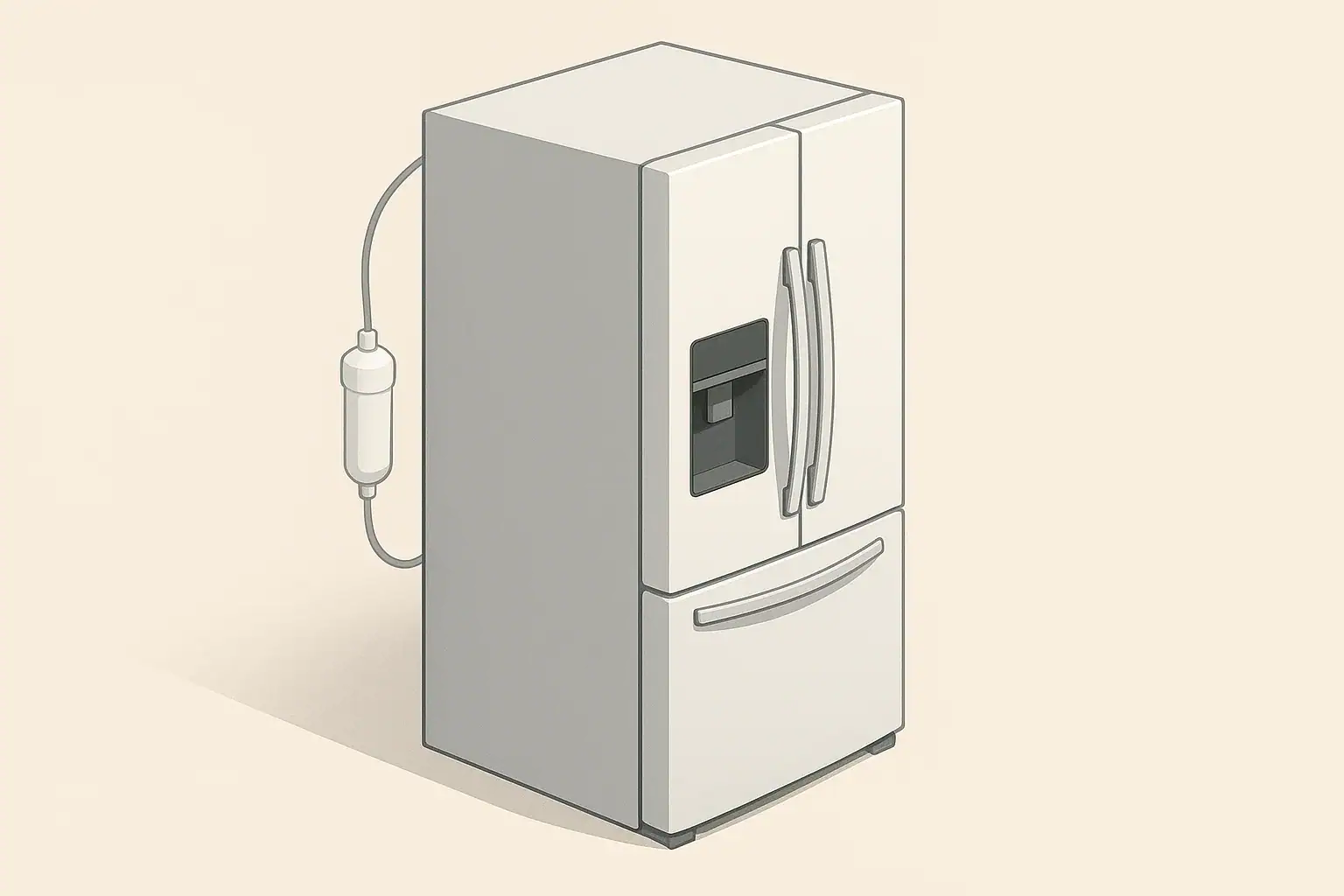
An inline fridge filter is a small cartridge installed on the water line feeding your refrigerator. Instead of using the built-in filter inside the refrigerator compartment, the inline cartridge sits externally, usually behind or below the appliance, and treats all water going to the ice maker and dispenser.
Inline filters are common in three situations:
- Older refrigerators that do not have a built-in filter
- Bypassing a built-in filter to reduce ongoing costs
- Adding extra treatment for specific concerns, such as taste, odor, or sediment
Most household inline fridge filters use activated carbon to reduce chlorine taste and odor and may also include sediment filtration. Some more advanced inline cartridges can target additional contaminants, but performance always depends on the specific media and verified certifications.
What Is an Inline Fridge Filter?
An inline fridge filter is a small cartridge installed on the water line feeding your refrigerator. Instead of using the built-in filter inside the refrigerator compartment, the inline cartridge sits externally, usually behind or below the appliance, and treats all water going to the ice maker and dispenser.
Inline filters are common in three situations:
- Older refrigerators that do not have a built-in filter
- Bypassing a built-in filter to reduce ongoing costs
- Adding extra treatment for specific concerns, such as taste, odor, or sediment
Most household inline fridge filters use activated carbon to reduce chlorine taste and odor and may also include sediment filtration. Some more advanced inline cartridges can target additional contaminants, but performance always depends on the specific media and verified certifications.
Inline vs Built-In Fridge Filters
Deciding between an external inline filter and the refrigerator’s built-in filter comes down to compatibility, performance needs, and long-term cost. Many households use only one system, but some choose to run both in series for extra protection against taste, odor, or particles.
Built-in filters are designed specifically for the refrigerator. They usually snap or twist into place and are located inside the fresh food compartment or behind a grille. Inline filters, by contrast, are universal-style cartridges that connect to the water line with compression fittings or quick-connect fittings.
Key differences to consider include:
- Installation location: Built-in filters are inside the fridge; inline filters are on the external water line.
- Water line type: Inline filters must match the water line size and connection style.
- Replacement cost: Inline cartridges are often less expensive per unit, especially over multiple years.
- Flexibility: Inline systems can be upgraded or changed without replacing the fridge.
Example values for illustration.
| Household situation | Built-in fridge filter only | External inline filter only | Both in series |
|---|---|---|---|
| Fridge has no internal filter | Not possible | Often preferred to improve taste/odor | Not applicable |
| High cost for OEM fridge filters | Higher long-term cost | May lower cost per gallon | Sometimes used during transition |
| Need extra sediment control | May clog faster | Inline used as prefilter | Inline protects built-in filter |
| Already have whole-house filtration | Simpler, one extra stage at fridge | Can be redundant in some homes | Used if taste still not acceptable |
| Limited space behind fridge | No change to space | May be harder to fit | Space constraints worsen |
| Renter needing reversible setup | Use landlord-installed filter | Inline if allowed, easily removed | Less common in rentals |
When an External Inline Filter Is a Good Idea
Not every refrigerator needs an inline filter, but in some scenarios it can be the most practical option. The best approach is to match the filter type to the water you have and the performance you expect.
Older or Unfiltered Refrigerators
Many older fridges and basic models do not include any built-in filtration. If your tap water has noticeable chlorine taste, odor, or visible particles, an inline filter on the supply line can significantly improve the water used for ice and drinking without modifying the appliance itself.
This approach is also common when a refrigerator is connected to a basement or garage line that is not otherwise filtered, such as a utility branch that bypasses under-sink treatment.
Reducing Ongoing Filter Costs
Refrigerator-specific filters can be expensive to replace on the manufacturer’s recommended schedule, especially in households with higher water use or challenging water conditions that clog cartridges quickly.
An inline cartridge with a higher capacity rating may reduce cost per gallon. Even if the cartridge price is similar, longer life between changes can be more convenient and may reduce waste.
Some homeowners permanently bypass the internal filter using a bypass plug or setting, then rely only on the inline cartridge. Others keep the internal filter but extend its life by using an inline prefilter that catches sediment upstream.
Extra Protection on Municipal Water
Municipal water systems in the United States are disinfected and monitored, but chlorine or chloramine taste and odor are common complaints. A carbon-based inline fridge filter can be targeted specifically at:
- Reducing chlorine taste and smell
- Improving the taste of ice cubes
- Reducing some types of disinfection by-products, depending on the media and certification
When used with other household filtration (such as an under-sink filter for drinking water), the inline fridge filter becomes a final polishing step for water used for cold beverages.
Supporting Well Water or Sediment-Prone Supplies
Private wells and some older distribution systems can carry fine sediment, rust, or scale. In these cases, a simple inline sediment or carbon-sediment cartridge can help:
- Protect the fridge’s internal valves and ice maker from particles
- Reduce clogging of small lines and built-in filters
- Improve clarity of ice and dispensed water
Inline filters are not a complete solution for problem well water, but they can complement whole-house or under-sink systems by handling the final stretch of the water line to the refrigerator.
When You Might Not Need an Inline Fridge Filter
There are also situations where an inline filter may not add much benefit. Installing an unnecessary cartridge can increase maintenance without clearly improving water quality.
You Already Have Robust Whole-House Filtration
If your home uses a whole-house carbon system, sediment filter, or softener, and you are satisfied with the taste and clarity of water at other taps, the refrigerator may already be receiving adequately treated water. In that case, relying on a built-in fridge filter or even a bypassed configuration might be reasonable, depending on your preferences and the water quality metrics.
Some households with comprehensive treatment install an inline fridge filter only for redundancy or for specific media (for example, to add extra carbon contact time). Others find that it is unnecessary.
Space or Access Is Very Limited
An inline cartridge requires straight sections of tubing and enough space to mount or support the filter body. Tight installations can make replacement difficult and increase the risk of pinched or kinked lines. In apartments or tight kitchens, it may be easier to rely on internal filtration or a different point-of-use system such as a pitcher or under-sink filter.
You Prefer Simpler Maintenance
Every additional cartridge is another item to track and replace. Some households prefer:
- One primary filtration system at the kitchen sink for all cooking and drinking water
- A single, easy-to-access fridge filter instead of two filters in series
- Clear, minimal maintenance schedules with fewer variables
If you already have trouble keeping up with filter changes, adding an inline fridge filter may not be the best first step. Improving your reminder system and monitoring taste and flow could be more effective.
Key Performance Metrics for Inline Fridge Filters
Regardless of brand or housing style, inline fridge filters should be evaluated on measurable performance characteristics. These same metrics apply to many other home water filters and help you compare options in a consistent way.
Capacity and Cost per Gallon
Filter capacity is usually expressed as a maximum number of gallons or a time limit, such as six months, whichever comes first. In practice, capacity depends heavily on:
- Incoming water quality (sediment load, chlorine level, etc.)
- Frequency of use (how often ice and water are dispensed)
- Plumbing layout and pressure
To estimate cost per gallon for planning purposes, you can divide the replacement cost by the rated capacity. For example, if an inline cartridge is rated for approximately 1,200 gallons and costs a moderate amount, the approximate cost per gallon is the cost divided by 1,200. Real-world cost per gallon may be higher if your water is challenging or if you change filters more frequently for taste reasons.
Flow Rate and Pressure Drop
Refrigerators usually expect a certain flow range to operate ice makers and dispensers correctly. An inline filter adds resistance to the water line and can reduce flow. If the filter is too restrictive, you may notice:
- Slow dispensing at the door
- Small or hollow ice cubes
- Noise from the inlet valve as it works harder
Look for inline filters that are suitable for typical residential water pressure and specify a flow rate compatible with your refrigerator’s requirements. As a general practice, replacing cartridges on time and using prefiltration for heavy sediment can reduce clogging and maintain better flow.
Target Contaminants and Media Type
Inline filters commonly use:
- Granular activated carbon (GAC): Good for taste and odor improvement, especially for chlorine.
- Carbon block: Provides more contact time and finer filtration; may support additional certifications.
- Sediment stages: Simple screens or fiber layers for sand, rust, and scale particles.
Some cartridges are designed to reduce specific contaminants beyond basic taste and odor, but claims should always be supported by standardized testing and certifications, not just marketing language.
Understanding Certifications for Inline Fridge Filters
Certifications help you compare filters using consistent, third-party standards. For inline fridge filters, the most relevant NSF/ANSI standards are generally the same as those used for many other point-of-use systems.
Common NSF/ANSI Standards
The following standards frequently appear in documentation for carbon-based fridge and inline filters:
- NSF/ANSI 42: Aesthetic effects, such as chlorine taste and odor and particulate reduction.
- NSF/ANSI 53: Specific contaminant reduction for certain metals and other substances, depending on the individual product.
- NSF/ANSI 401: Emerging contaminants, such as certain pharmaceuticals and chemicals, for products that have been tested for them.
- NSF/ANSI 58: Primarily applies to reverse osmosis systems rather than simple inline filters, but sometimes appears in combination systems.
When evaluating an inline fridge filter, it is important to look at both the standard number and the specific claims under that standard. A certification to a standard does not mean the filter covers every possible contaminant in that category.
How to Verify Certification Claims
Certification marks printed on packaging or housings are most useful when you can confirm them with documentation. For inline filters, this often means:
- Checking whether the model number appears in a public database maintained by the certifying body
- Reviewing performance data sheets that list test conditions and reduction claims
- Confirming that the certification is current and applies to the capacity and flow conditions relevant to your use
Verification is especially helpful if you are choosing a filter to address a specific contaminant of concern identified in your local water quality report or private water test.
Example values for illustration.
| Standard | Main focus | Typical use with fridge/inline filters | What to double-check |
|---|---|---|---|
| NSF/ANSI 42 | Aesthetic effects | Chlorine taste/odor, basic particulate reduction | Which particulate class and approximate capacity |
| NSF/ANSI 53 | Health-related contaminants | Specific metals or other substances, depending on product | Exactly which contaminants were tested |
| NSF/ANSI 401 | Emerging compounds | Certain pharmaceuticals and chemicals in some advanced filters | List of substances and test conditions |
| NSF/ANSI 58 | Reverse osmosis systems | Relevant for RO units feeding a fridge line | That the RO performance assumptions match your setup |
| NSF/ANSI 372 | Material lead content | Used on components to indicate low lead content | That the marking applies to the whole wetted assembly |
| NSF/ANSI 61 | Components in contact with drinking water | Plastic housings, tubing, and fittings | Component compatibility in your plumbing system |
Maintenance and Troubleshooting for Inline Fridge Filters
Once an inline filter is installed, consistent maintenance is the best way to keep water tasting fresh and to protect your refrigerator’s internal components. Inline systems add a small amount of complexity, but the steps are straightforward once you establish a routine.
Setting a Replacement Schedule
Most inline cartridges are designed for replacement every few months to a year, depending on capacity and usage. Because it is easy to forget about a filter hidden behind a fridge, many homeowners use one or more of these strategies:
- Marking the installation date and target replacement date on the filter body
- Keeping a simple log near the breaker panel or under the sink
- Adding reminders to a digital calendar
Pay attention to practical cues such as changes in taste, odor, and flow rate. If the filter is visibly discolored or if you notice unusual ice appearance or dispenser behavior, it may be time to replace the cartridge earlier than planned.
Basic Troubleshooting Steps
Common inline filter issues include slow flow, small ice cubes, or occasional drips. Basic checks usually involve:
- Verifying that shutoff valves are fully open
- Inspecting tubing for kinks or tight bends after the fridge is pushed back
- Ensuring fittings are fully seated and not cross-threaded
- Confirming the filter is oriented correctly if it is directional
If problems persist after checking these items and replacing the cartridge, it may be helpful to consult appliance documentation or consider whether a different type of filtration elsewhere in the house would be more appropriate.
Coordinating Inline Filters with Other Systems
Inline fridge filters are most effective when considered as one part of the overall water treatment plan. In many homes, the combination might look like:
- A sediment or carbon filter at the main entry point or under the sink
- Softening or scale control where hardness is an issue
- An inline polishing filter at the fridge for final taste and clarity
Balancing these components helps avoid redundant stages while still achieving the taste and clarity you want at the refrigerator dispenser and ice maker.
Summary
External inline fridge filters are a flexible tool for improving the taste, odor, and clarity of water and ice from your refrigerator. They are especially useful for older appliances without built-in filtration, for managing filter replacement costs, or for adding a targeted polishing step to existing whole-house or under-sink treatment.
Evaluating inline filters using capacity, flow, certifications, and compatibility with your water line will help you choose an option that fits your household. With a simple reminder system for maintenance and occasional checks of flow and taste, an inline filter can be a low-profile but effective part of your home water filtration setup.
Frequently asked questions
How do I install an inline fridge filter on my refrigerator’s water line?
Turn off the water supply, mount the filter where there is enough straight tubing and access, and connect the inlet and outlet with the matching compression or quick-connect fittings. After installation, restore water, check for leaks, and purge air by dispensing water until clear. If your plumbing uses an uncommon tubing size or tight space, consider an adapter or professional help.
How often should I replace an inline fridge filter?
Replacement depends on the cartridge’s rated capacity, your household water use, and incoming water quality; many inline filters are changed every 6 to 12 months. Watch for reduced flow, changes in taste or odor, or visible discoloration as signs to replace the cartridge sooner. Always follow the manufacturer’s stated capacity and local water conditions when planning replacements.
Can an inline fridge filter remove lead or bacteria from my water?
Most standard inline carbon cartridges are designed for chlorine taste, odor, and particulate reduction and are not guaranteed to remove bacteria. Lead removal is possible but requires a cartridge specifically tested and certified for lead reduction (for example, to NSF/ANSI 53); bacteria removal typically requires technologies such as UV, reverse osmosis, or microbiological-rated filters. Verify claims with certification documentation before relying on an inline filter for these contaminants.
Will an inline fridge filter reduce water pressure or affect my ice maker?
An inline filter adds some resistance to flow and can reduce dispensing speed or affect ice quality if it becomes clogged or is overly restrictive. Choose a filter rated for residential water pressure and maintain it on schedule; using a sediment prefilter in dirty supplies helps prevent clogging and preserves flow to the ice maker. If you notice persistent slow flow, check tubing and fittings first, then the filter cartridge.
Are inline fridge filters compatible with all refrigerators and plumbing?
Inline cartridges are broadly compatible with many refrigerators, but you must match tubing diameter, fitting type, and available space for mounting. Some installations require adapters or different fitting styles, and very tight spaces may make access or replacement difficult. Confirm dimensions and connection types before purchase and plan placement for future maintenance.
Recommended next:
- NSF/ANSI standards explained (42/53/401/58)
- Clear trade-offs: pitcher vs faucet vs under-sink vs RO
- Maintenance planning: cost per gallon and replacement cadence