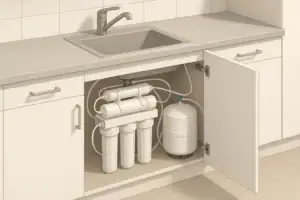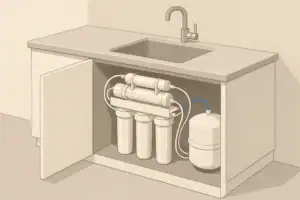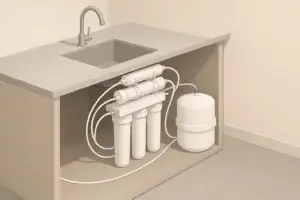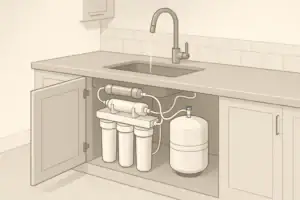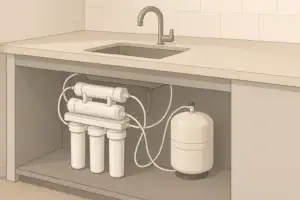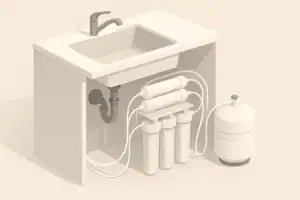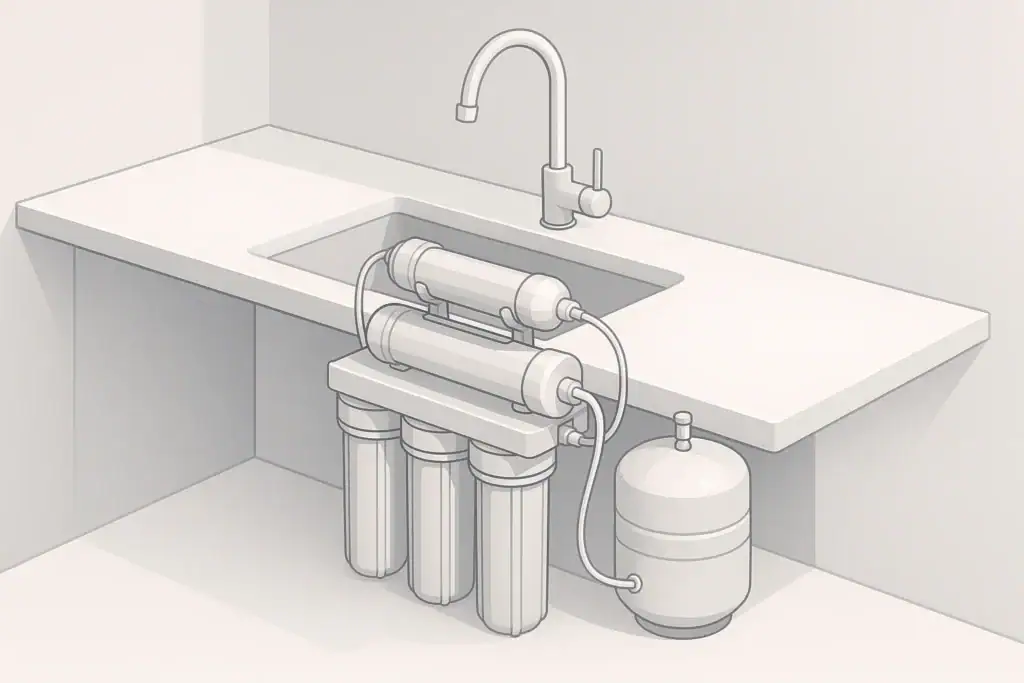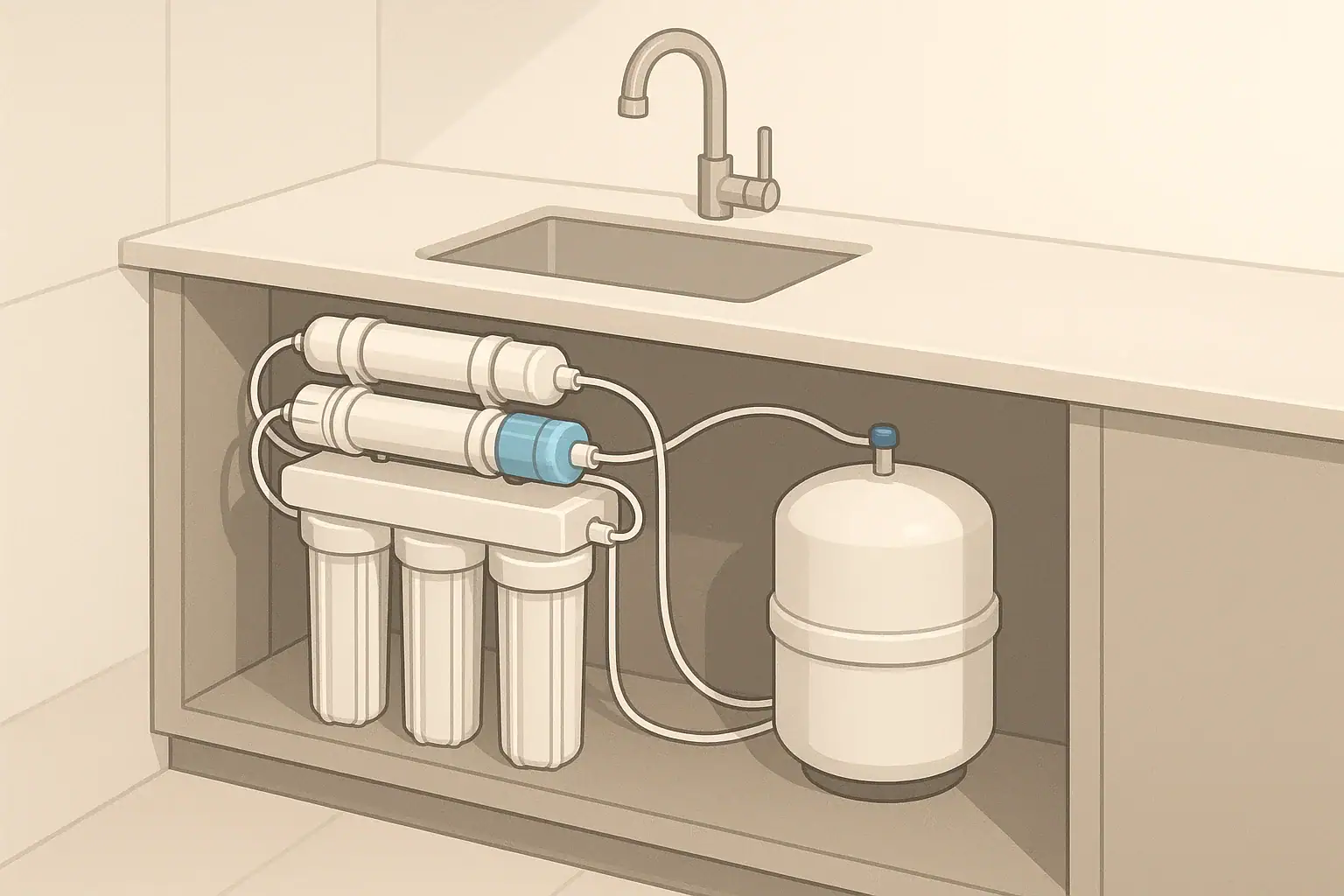
A remineralization filter is an optional stage added after a reverse osmosis (RO) system to put some minerals back into the treated water. RO membranes remove many dissolved substances, including helpful minerals like calcium and magnesium. Remineralization stages aim to adjust taste and sometimes pH by slowly dissolving mineral media as water flows through.
These cartridges are often labeled as “alkaline,” “mineral,” or “post-carbon with minerals.” They typically contain media such as:
- Calcite (calcium carbonate)
- Magnesium compounds
- Ceramic or mineral beads
- Sometimes a small amount of post-activated carbon for final polishing
The main purpose is not extra contaminant removal. Instead, they modify the finished RO water’s characteristics so it is closer to moderately mineralized tap or bottled water in taste and mouthfeel.
What Is a Remineralization Filter?
A remineralization filter is an optional stage added after a reverse osmosis (RO) system to put some minerals back into the treated water. RO membranes remove many dissolved substances, including helpful minerals like calcium and magnesium. Remineralization stages aim to adjust taste and sometimes pH by slowly dissolving mineral media as water flows through.
These cartridges are often labeled as “alkaline,” “mineral,” or “post-carbon with minerals.” They typically contain media such as:
- Calcite (calcium carbonate)
- Magnesium compounds
- Ceramic or mineral beads
- Sometimes a small amount of post-activated carbon for final polishing
The main purpose is not extra contaminant removal. Instead, they modify the finished RO water’s characteristics so it is closer to moderately mineralized tap or bottled water in taste and mouthfeel.
How RO Water Changes Taste, TDS, and pH
To understand whether you might want remineralization, it helps to know how RO affects water compared with typical U.S. tap water.
Reverse Osmosis and TDS
Total dissolved solids (TDS) is a general measure of dissolved minerals and salts. Many municipal supplies fall somewhere in a moderate range. After RO treatment, TDS drops significantly because the membrane rejects most dissolved ions.
RO water often tastes “flat” or “empty” due to this low mineral content. Some people like this very clean profile, while others miss a slight mineral taste they get from tap or bottled water.
Effect on Hardness and Scaling
Many homes have hard water, which can leave scale on fixtures and appliances. RO systems reduce hardness by removing calcium and magnesium. This helps protect coffee makers, kettles, and humidifiers from scale buildup when you use RO water in them.
Remineralization stages usually add back only a small amount of minerals. This is generally not enough to recreate hard water or significant scale, but it can slightly increase hardness and TDS compared with straight RO water.
Effect on pH
RO does not target pH directly, but by removing buffering minerals, the treated water can read slightly acidic or neutral, especially if it absorbs a bit of carbon dioxide from the air. Many home RO systems produce water in the mildly acidic to neutral range, depending on feed water chemistry.
Remineralization filters that use calcium carbonate media can nudge pH upward toward neutral or mildly alkaline, which some people prefer for taste and to reduce corrosion potential in some plumbing materials.
Example values for illustration.
| Situation | What You Notice | RO Only May Be Enough If… | RO + Remineralization May Help If… |
|---|---|---|---|
| Household taste preference | Family has mixed feelings about very “flat” water | You like very neutral, clean-tasting water | Several people describe RO water as bland or “empty” |
| Existing tap water hardness | Tap leaves scale on fixtures and kettles | You mainly care about avoiding scale and appliance buildup | You want lower scale than tap but a bit of hardness back for taste |
| Desired TDS level | TDS after RO is very low (for example, below 20 ppm) | You prefer the light feel of low-TDS water | You would like TDS modestly higher for a fuller mouthfeel |
| pH sensitivity | RO water measures slightly below neutral on basic test strips | You are not concerned with slight pH shifts for everyday use | You want water closer to neutral or mildly alkaline |
| Coffee and tea brewing | Beverages taste “thin” with straight RO | You mainly use RO water for drinking and cooking | You brew coffee or tea frequently and want better extraction balance |
| Maintenance tolerance | More filter stages add replacement tasks | You prefer the simplest system with fewer cartridges | You are comfortable tracking one additional filter change |
How Remineralization Filters Work
Although designs vary, most remineralization filters use a similar principle: water flows through a bed of slowly dissolving mineral media at the very end of the RO system. Contact time, media composition, and flow rate determine how much mineral is added.
Common Media Types
Typical media blends may include:
- Calcite (calcium carbonate): raises hardness modestly and can increase pH toward neutral.
- Magnesium compounds: contribute magnesium ions, which can influence taste and perceived smoothness.
- Ceramic or mineral beads: sometimes used as a carrier or to moderate dissolution rate.
- Post-carbon granules: included in some cartridges to further polish taste and odor.
As RO water passes through, a small amount of these minerals dissolves into the water, elevating TDS slightly and changing taste and mouthfeel.
Placement in the RO System
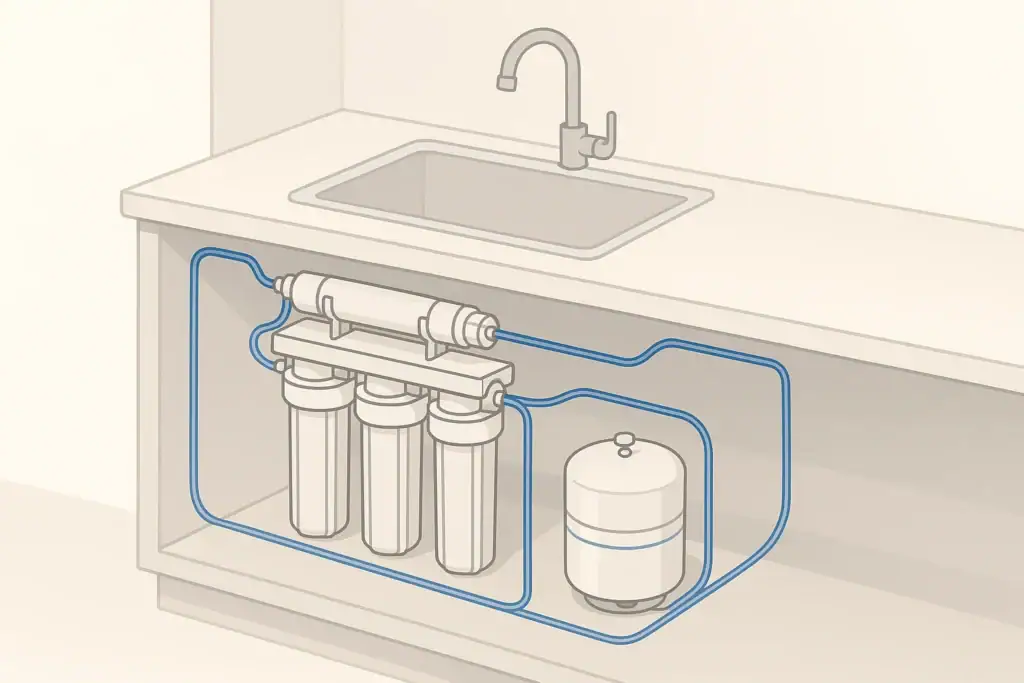
Most under-sink RO configurations follow a general flow path:
- Pre-filters (sediment, carbon)
- RO membrane
- Storage tank
- Post-filter (carbon polish)
- Remineralization filter (optional, final stage)
Some systems route water from the storage tank through the remineralization filter immediately before it reaches the faucet. Others place the remineralization cartridge just before the tank. The final placement affects how consistently minerals are added and how long the cartridges last.
Impact on Contaminant Reduction
Remineralization media is not a substitute for primary treatment stages. The main contaminant reduction still comes from:
- Carbon filters for chlorine, chloramine, and some organics
- Sediment filters for particles and turbidity
- The RO membrane for many dissolved contaminants
Because the remineralization filter is usually the last stage, it should be certified or tested, when possible, to ensure it does not add undesirable substances and that its materials are safe for contact with drinking water.
Benefits of Using a Remineralization Filter
Whether you need a remineralization stage is largely a matter of preference and how you use your RO water. Several practical benefits are commonly cited.
Improved Taste and Mouthfeel
Many people choose remineralization filters to change the way RO water tastes. Added minerals can:
- Reduce the “flat” sensation of very low-TDS water
- Introduce a subtle, familiar mineral note similar to many bottled waters
- Make water feel slightly “smoother” or fuller in the mouth
Taste is subjective, so some households prefer straight RO, while others strongly favor remineralized water.
More Consistent Coffee, Tea, and Cooking Results
Water chemistry influences extraction and flavor in coffee and tea. Very low mineral content can lead to beverages that taste weak or sharp. Slight remineralization may help achieve more balanced flavor in:
- Manual and automatic coffee brewing
- Tea and herbal infusions
- Soups and broths where water makes up a large portion
Some people reserve remineralized RO water for drinking and brewing, while still using pure RO water for equipment that is sensitive to scale.
Gentler pH for Plumbing and Fixtures
Low-mineral RO water can be more aggressive toward certain materials under some conditions. Slight remineralization and a shift toward neutral pH may be beneficial for long-term contact with specific plumbing components, especially in setups where RO water is plumbed to multiple outlets.
Potential Drawbacks and Trade-Offs
Adding a remineralization stage is not automatically better for every situation. It introduces some trade-offs in system complexity, cost, and performance characteristics.
Additional Maintenance and Cost
Every extra cartridge is another component to monitor and replace. Remineralization filters typically have a set service life based on:
- Gallons of water produced
- Time in service (often measured in months)
- Feed water chemistry and usage patterns
Over time this adds to the cost per gallon of filtered water, though usually only modestly compared with the full RO setup.
Slightly Higher TDS and Hardness
By design, remineralization filters increase TDS and hardness slightly. This is desirable for taste but may be a disadvantage if:
- You specifically want very low TDS for certain appliances
- You are trying to minimize any possibility of scale in devices like steam irons or humidifiers
- You monitor TDS to track RO membrane performance and want the lowest possible readings
If scale control is your highest priority, you may prefer to use straight RO water for equipment, and remineralized RO only for drinking and cooking.
Inconsistent Mineral Output Over Time
Because the media gradually dissolves, the amount of mineral added can change as the cartridge ages. Early in its life, the remineralization effect may be stronger; later, it may diminish. This can lead to subtle changes in taste and TDS over the filter’s service life. Following the manufacturer’s replacement intervals helps keep water characteristics more stable.
How to Decide if You Need Remineralization
There is no universal requirement to add a remineralization filter to an RO system. Many homes use RO without it and are satisfied. A few straightforward checks can help you decide.
Step 1: Evaluate Your Current RO Water
If you already have RO installed, start by assessing what you have:
- Taste: Do you or others in the home describe the water as too flat or bland?
- TDS: Use a basic handheld meter to estimate TDS before and after RO.
- Beverages: Try brewing coffee or tea with RO water and with tap water; compare results.
If you like the taste and your household is happy with beverages and cooking results, you may not need additional remineralization.
Step 2: Consider Your Usage Patterns
Think about where RO water is going:
- Dedicated drinking faucet only
- Refrigerator and ice maker feed line
- Multiple faucets or a small distribution manifold
- Appliances like coffee machines, kettles, or cooking pots
Households that use RO water widely for both drinking and cooking are more likely to notice and care about taste differences. If RO water is used mainly for one small faucet, straight RO may be adequate or you can experiment more easily.
Step 3: Decide How You Will Handle Scale-Sensitive Devices
Some devices benefit from low-scale water, while others are more about taste:
- Better with low-mineral RO: countertop steam appliances, irons, humidifiers (to reduce white dust), and some coffee equipment
- More about taste: manual brewers, tea kettles used for direct drinking, and most cooking applications
In some homes, people fill scale-sensitive devices directly from straight RO water and drink from a remineralized line. This can be done with plumbing splits or pitchers depending on layout.
What to Look For in a Remineralization Stage
If you decide to add remineralization, pay attention to how the cartridge is specified and integrated into your system.
Media Transparency and Composition
Look for clear information on what minerals are used, such as:
- Types of mineral media (for example, calcium carbonate, magnesium oxide)
- Presence of any additional carbon or ceramic media
- Any testing or certification related to material safety
Because the media is in direct contact with finished drinking water, material safety standards are important.
Flow Rate and Contact Time
Remineralization depends on adequate contact time between water and media. Extremely high flow rates may reduce mineral addition, while very slow flows can increase it. Under-sink RO systems generally operate at modest flow rates that most cartridges are designed around, but if you have unusually high demand or multiple outlets, ask how this affects remineralization performance.
Compatibility with Existing RO Systems
Before adding a cartridge:
- Verify the connection type matches your tubing or fittings
- Confirm it can be safely placed after the RO membrane and any post-carbon stage
- Ensure there is enough physical space for installation and future replacement
Some under-sink RO systems have dedicated ports for additional stages, while others require minor plumbing changes.
Certifications, Testing, and RO System Standards
Remineralization filters are often used alongside certified RO systems. While the remineralization stage itself may not always carry a specific performance claim, the overall RO setup commonly references established standards and protocols.
RO System Certifications
Reverse osmosis systems frequently reference:
- NSF/ANSI 42: aesthetic effects such as chlorine taste and odor
- NSF/ANSI 53: reduction of certain contaminants with health significance
- NSF/ANSI 58: performance criteria specific to RO systems
- NSF/ANSI 401: emerging compounds and incidental contaminants, when applicable
When you add a remineralization filter, it is helpful if the components that contact drinking water have been evaluated for material safety, even if they do not claim specific contaminant reductions.
Example values for illustration.
| Standard | Primary Focus | Typical Use in RO Context | What to Check on Documentation |
|---|---|---|---|
| NSF/ANSI 42 | Aesthetic effects (taste, odor, chlorine) | Carbon pre-filters and post-filters before/after RO | Which aesthetic contaminants are listed, and at what conditions |
| NSF/ANSI 53 | Selected contaminants with health significance | Some carbon stages in combination with RO membranes | Specific contaminants claimed and testing parameters |
| NSF/ANSI 58 | Reverse osmosis system performance | Complete under-sink RO packages and components | System capacity, recovery, and performance conditions |
| NSF/ANSI 401 | Emerging and incidental compounds | Certain specialized filters combined with RO setups | Which additional compounds were evaluated |
| Material safety and structural integrity | Contact materials and pressure durability | Filter housings, sumps, and some cartridges | Statements that wetted parts meet applicable NSF/ANSI criteria |
| Remineralization cartridges | Mineral media in contact with finished water | Add-on stages after main RO system | Any reference to tested materials or standards for drinking water contact |
Practical Tips for Living with RO and Remineralized Water
Once you have chosen whether to use remineralization, a few simple habits will help you get consistent results:
- Use a basic TDS meter occasionally to observe changes before and after the remineralization stage.
- Label the installation date on the remineralization cartridge and follow recommended replacement intervals.
- Pay attention to taste; a noticeable drop-off can signal that the cartridge is nearing the end of its useful life.
- Keep a small section of plumbing or a pitcher reserved for low-mineral RO water if you use scale-sensitive devices.
- Record filter changes alongside other home maintenance tasks so stages are replaced on schedule.
With a bit of observation, you can tune your RO setup—whether with or without remineralization—to match your household’s preferences for taste, convenience, and ongoing upkeep.
Frequently asked questions
Will a remineralization filter with RO water restore all the minerals removed by the RO membrane?
No. Remineralization filters add a modest amount of specific minerals (often calcium and magnesium) and cannot recreate the full original mineral profile removed by the membrane. Their purpose is mainly to improve taste and adjust pH, not to provide comprehensive nutritional mineral restoration.
Can adding a remineralization stage cause scaling or plumbing issues?
Remineralization slightly increases hardness and TDS, but in typical home cartridges the increase is modest and unlikely to produce significant scale. If you have very scale-sensitive devices, keep a dedicated straight-RO supply for those appliances or use plumbing splits to limit remineralized water to drinking and cooking.
Where should I place a remineralization filter in my RO system for best consistency?
For most under-sink setups, place the remineralization cartridge as the final stage after any post-carbon polish and before the faucet; some systems route it after the storage tank. Placement affects how consistently minerals are added and how long the cartridge lasts, so follow the system design and manufacturer’s guidance for your configuration.
How often should I replace a remineralization cartridge?
Replacement depends on gallons produced, feed water chemistry, and time; many cartridges are changed every 6–12 months under typical household use. Monitor taste and TDS with a basic meter and label installation dates to maintain consistent performance.
Does using a remineralization filter with RO water affect contaminant reduction or certifications?
A remineralization stage does not add contaminant-reduction capability and should not replace primary RO or carbon stages. Ensure any cartridge contacting finished water is made of safe materials and, where possible, documented or tested for drinking water contact to avoid introducing undesirable substances.
Recommended next:
- Reverse Osmosis 101: What RO Removes (and What It Doesn’t)
- NSF/ANSI 58 Explained: What It Means for RO Systems
- RO vs Carbon Under-Sink: Taste, TDS, and Maintenance Compared
- RO System Installation Guide: Space-Saving Layout Under the Sink
- RO Waste Water Ratio: What’s Normal and How to Reduce It
- RO Filter Replacement Schedule: Prefilters vs Membrane
- More in Reverse Osmosis (RO) →
- NSF/ANSI standards explained (42/53/401/58)
- Clear trade-offs: pitcher vs faucet vs under-sink vs RO
- Maintenance planning: cost per gallon and replacement cadence