Overview: Why Filter Media Type Matters
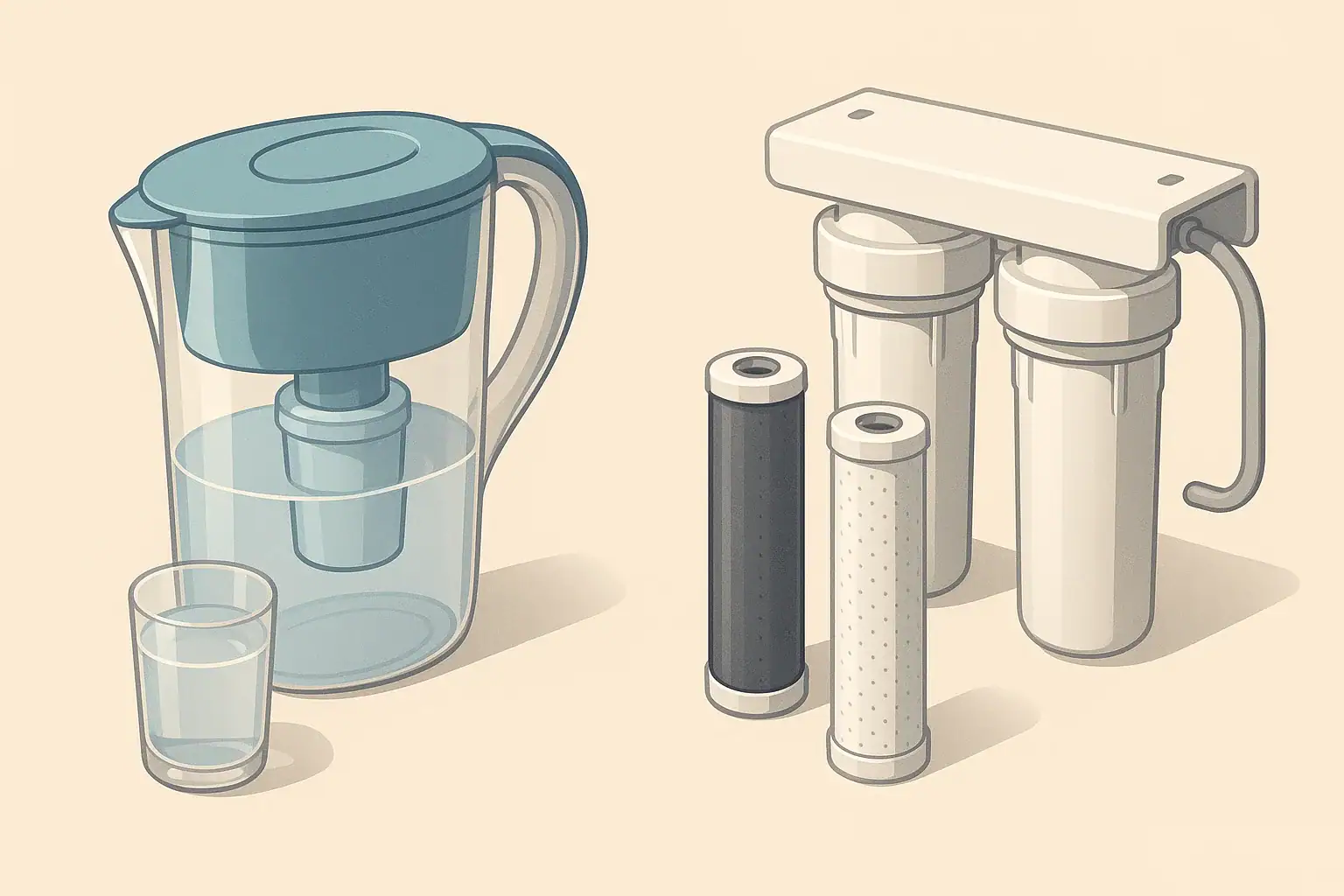
When you shop for home water filters, you will often see terms like carbon block, granular activated carbon (GAC), and ion exchange. These refer to the filter media inside the cartridge, not just the housing. The media type strongly affects:
- Which contaminants are reduced
- How fast water can flow through the filter
- How long the filter lasts before replacement
- Where the filter is best used (pitcher, faucet, under-sink, whole-house)
This guide compares carbon block, GAC, and ion exchange in practical terms so you can match them to your tap water and usage rather than guessing from product labels.
How Carbon Block Filters Work
Carbon block filters are made from finely ground activated carbon compressed into a solid, porous block. Water is forced through this dense structure, where contaminants are removed mainly by how carbon filters work (adsorption — molecules sticking to the carbon surface) and some physical screening.
Main strengths of carbon block
- High contact time: Water moves slowly through the tiny pores, giving contaminants more time to interact with the carbon surface.
- Fine particle filtration: Many carbon block cartridges are rated to 0.5–5 microns, helping reduce fine sediment and some particulate-bound contaminants.
- Chlorine and taste/odor reduction: Commonly used to improve tap water taste and smell by reducing chlorine and related byproducts.
- Good for point-of-use: Often used in under-sink, refrigerator, and some countertop systems where better polishing of water is desired.
Limitations of carbon block
- Flow rate: Denser blocks create more resistance, so they may require good water pressure and are rarely used alone for whole-house high-flow applications.
- Sediment sensitivity: Heavy sediment can plug the pores quickly; prefiltration with a sediment cartridge is often recommended.
- Not a complete solution: Carbon blocks are effective for many taste and odor issues and several organic contaminants, but they are not designed to remove everything in water.
Typical uses for carbon block
- Under-sink drinking water systems
- Refrigerator and icemaker filters
- Final polishing stage after reverse osmosis membranes
- Some shower filters focused on chlorine reduction
Example values for illustration.
| Filter media type | Typical role | Relative flow rate | Good for | Common placement |
|---|---|---|---|---|
| Carbon block | Fine polishing and adsorption | Lower | Chlorine, some organics, taste and odor | Under-sink, fridge, RO post-filter |
| Granular activated carbon (GAC) | Contact bed for adsorption | Higher | Chlorine, basic taste and odor | Whole-house, faucet filters, pitchers |
| Ion exchange resin | Ion swapping for dissolved minerals or metals | Medium | Hardness, selected metals, nitrate in some designs | Softeners, specialty cartridges |
| Carbon block + GAC | Staged adsorption | Medium | Improved taste and odor with longer life | Multi-stage under-sink systems |
| Carbon block + ion exchange | Adsorption plus ion removal | Medium | Chlorine plus hardness or metals | Pitcher and faucet cartridges |
| GAC + sediment filter | Basic whole-house conditioning | Higher | Sediment plus chlorine taste and odor | Point-of-entry systems |
How Granular Activated Carbon (GAC) Filters Work
Granular activated carbon filters use loose granules of carbon instead of a compressed block. Water flows through the bed of granules, where contaminants are adsorbed onto the surface of the carbon particles.
Main strengths of GAC
- Higher flow potential: The open bed of granules offers less resistance, making GAC suitable for higher flow rates than dense carbon blocks.
- Flexible configurations: Often used in whole-house filters, in-line cartridges, faucet-mounted filters, and pitchers.
- Chlorine and basic taste/odor improvement: Widely used on municipal water to reduce chlorine and improve taste.
Limitations of GAC
- Channeling risk: Water can form pathways through the bed, reducing contact with all of the carbon if the design or flow conditions are not ideal.
- Less fine filtration: GAC is not usually relied upon for tight micron filtration; a separate sediment filter is often paired with it.
- Variable performance: Because the bed is not solid, performance can depend more on housing design, flow control, and how the filter is used.
Typical uses for GAC
- Point-of-entry (whole-house) chlorine and odor reduction
- Pitcher filters that combine GAC with ion exchange or other media
- Faucet filters where compact size and reasonable flow are needed
- Pre-filters or polishing filters in multi-stage systems
How Ion Exchange Resins Work
Ion exchange media are typically small polymer beads that hold charged ions on their surface. As water flows through, unwanted ions in the water swap places with the ions attached to the resin. Once the resin is loaded, it must be regenerated or replaced.
Types of ion exchange used in homes
- Softening resins: Commonly used in water softeners to reduce hardness minerals such as calcium and magnesium by exchanging them for sodium or potassium ions.
- Deionization resins: Often used in laboratory or aquarium setups, usually in pairs (cation and anion resins) to reduce a wide range of dissolved ions. These are less common for general household drinking water.
- Specialty resins: Designed for selected contaminants such as certain metals or nitrate. They may appear as cartridges in under-sink or point-of-entry systems.
Main strengths of ion exchange
- Targets dissolved ions: Effective for hardness and some specific dissolved ions that carbon alone does not address well.
- Predictable capacity: Media life can often be estimated based on incoming water quality, flow, and usage patterns.
- Useful in small cartridges: Can be combined with carbon in compact formats such as pitchers or faucet filters to address both taste and selected dissolved minerals or metals.
Limitations of ion exchange
- Contaminant-specific: A resin is usually formulated for particular ions. It does not broadly remove all dissolved substances.
- Regeneration or replacement: Softeners require periodic regeneration with salt; small cartridges must be replaced when exhausted.
- Byproduct ions: The replacement ions (such as sodium) are released into the water as part of the exchange. Many households still use a separate drinking water filter or bypass line if that is a concern.
Carbon Block vs GAC: Which Carbon Media Fits Your Use?
Both carbon block and GAC rely on activated carbon, but the form factor changes how they behave in real-world systems. Choosing between them depends on your water quality, flow needs, and where you plan to install the filter.
When carbon block is often preferred
- Focused drinking water treatment: For a kitchen tap, under-sink system, or refrigerator where you want more thorough polishing at moderate flow.
- Finer particulate reduction: When you want both carbon adsorption and some fine filtration in one cartridge.
- Multi-stage systems: As a final polishing stage after sediment and sometimes after a membrane or other treatment.
When GAC may be a better fit
- Whole-house flow demands: At the main line, higher flow is needed for showers, laundry, and multiple fixtures at once. GAC beds are common in this role.
- Basic taste and odor improvement: For municipal water that mainly needs chlorine reduction and general taste improvement.
- Simple point-of-use devices: Pitchers and faucet filters often use GAC (sometimes mixed with other media) to balance performance and cost.
Design and maintenance considerations
- Pre-filtration: Both GAC and carbon block perform better when heavy sediment is removed first.
- Contact time: Slower flow can improve carbon performance, whether in block or granular form.
- Replacement intervals: Carbon media have finite capacity; following manufacturer-recommended time or volume limits helps maintain performance.
Where Ion Exchange Fits Alongside Carbon
Carbon and ion exchange do different jobs. Carbon focuses on many chlorine-related taste and odor issues and some organic contaminants, while ion exchange focuses on specific dissolved ions such as hardness minerals or certain metals.
Common combinations in home filters
- Pitcher filters: Often combine a small amount of ion exchange resin with GAC. The carbon improves taste and odor, while the resin targets selected dissolved substances.
- Faucet filters: Compact cartridges may layer carbon with ion exchange beads to broaden the range of contaminants addressed.
- Softener plus carbon: A whole-house softener using ion exchange for hardness may be paired with a separate carbon filter for chlorine and taste before water reaches fixtures.
Situations where ion exchange can help
- Noticeable scale buildup: Spots on fixtures and reduced appliance efficiency often indicate hard water; softeners with ion exchange resins are a common response.
- Specific metal concerns: Where testing shows elevated levels of particular metals, specialty ion exchange cartridges may be part of a solution, sometimes alongside other treatment stages.
- Selected anions (like nitrate): In some regions, targeted ion exchange cartridges are used for these ions, often installed at a drinking water tap.
What ion exchange does not replace
- It does not replace carbon for chlorine reduction and many taste/odor issues.
- It does not remove particulate sediment; a separate sediment filter is still needed where turbidity is high.
- It is not the same as membrane processes like reverse osmosis, which have different strengths and limitations.
Matching Media to Your Water and Fixtures
To choose between carbon block, GAC, ion exchange, or a combination, it helps to look at both your water and your fixtures.
Step 1: Understand your water
- Source type: City (municipal) water is usually treated and chlorinated; private well water varies more widely in quality.
- Basic indicators: Utility reports, well testing, or lab tests can show hardness, chlorine level, sediment, and specific contaminants of concern.
- Aesthetic issues: Taste, odor, and visible particles give clues about what type of media might help.
Step 2: Identify where you want treatment
- Point-of-entry (whole-house): Treats all water entering the home. Flow requirements are high, so GAC, sediment filters, and softeners are more common here.
- Point-of-use (single tap or appliance): Treats water at one location, such as the kitchen sink or refrigerator. Carbon block and specialty ion exchange cartridges are more common here.
Step 3: Match filter media to goals
- Chlorine taste and odor only: GAC or carbon block, depending on flow and placement.
- Hardness and scale reduction: Ion exchange softening, sometimes paired with carbon for taste.
- Broader contaminant reduction: Multi-stage systems that combine sediment, carbon (block or GAC), and possibly ion exchange or membrane filtration.
Filter Media Lifespan and Replacement Planning
All three media types—carbon block, GAC, and ion exchange—have finite lifespans. They gradually lose effectiveness as their adsorption or exchange sites fill up. Planning for regular replacement helps maintain consistent performance.
Factors that affect media life
- Incoming water quality: Higher levels of chlorine, organics, hardness, or targeted ions consume capacity faster.
- Water usage: More gallons through the filter shorten the time between replacements.
- Flow rate: Very high flow can reduce contact time and may affect how fully media sites are used.
- Filter size: Larger cartridges usually hold more media and can treat more water before replacement.
Typical example intervals
Many household filters are rated in months or gallons. For example values only, a manufacturer might suggest:
- Small pitcher cartridge: replacement every 1–2 months, depending on use
- Under-sink carbon block: replacement every 6–12 months, depending on gallons
- Whole-house GAC tank: media refresh every few years, based on service volume
- Water softener resin bed: life often measured in many years, with regular regeneration cycles
Actual intervals depend on product design and your specific water, so manufacturer instructions are the primary guide.
Example values for illustration.
| Filter media and format | Typical installation | Example service volume | Example time-based interval | Main reminder cue |
|---|---|---|---|---|
| Small carbon + ion exchange cartridge | Pitcher or faucet filter | A few dozen to a few hundred gallons | About 1–3 months | Change by calendar or taste change |
| Under-sink carbon block | Kitchen drinking tap | Several hundred to a few thousand gallons | About 6–12 months | Change by calendar or rated gallons |
| In-line GAC cartridge | Refrigerator or icemaker | Similar to under-sink range | About 6–12 months | Change by calendar |
| Whole-house GAC tank | Main line chlorine reduction | Many thousands of gallons | About 2–5 years | Change by service visit plan |
| Water softener resin bed | Whole-house softening | Regenerated repeatedly | Often several years | Monitor hardness and system function |
| Specialty ion exchange cartridge | Under-sink for specific ions | Varies by ion and design | Often 6–12 months | Change based on guidance and testing |
Related guides: Pitcher vs Under-Sink vs RO: Which Fits Your Budget and Water? • Whole House vs Under-Sink: Taste vs Whole-Home Protection • Carbon Block vs Activated Carbon Under-Sink Filters: What’s the Difference?
By understanding what carbon block, GAC, and ion exchange each do best, you can select a filter setup that fits both your water conditions and how you actually use water in your home.
Frequently asked questions
Which is better for a kitchen tap: carbon block or GAC?
For a single drinking tap, carbon block usually provides finer particulate reduction and stronger polishing for taste and odor. GAC is a good choice when you need higher flow or lower pressure drop. Choose based on your flow requirements and whether microscopic polishing is a priority.
Will ion exchange remove hardness and will it add sodium to my water?
Yes—ion exchange softeners remove hardness minerals like calcium and magnesium by exchanging them for sodium or potassium ions. This reduces scale but can slightly increase sodium in treated water; potassium-based systems are an alternative if you want to avoid added sodium.
Do I need a sediment prefilter when using carbon block or GAC?
Prefiltration is recommended. Heavy sediment can clog carbon block pores and shorten GAC life, so a sediment filter upstream helps maintain performance and extend service intervals.
How often should I replace carbon block, GAC, or ion exchange cartridges?
Replacement depends on water quality, usage, and filter size. Typical ranges: small pitcher cartridges every 1–3 months, under-sink carbon 6–12 months, and whole-house GAC or resin service every few years. Follow manufacturer guidance and monitor taste and flow for signs of exhaustion.
Recommended next:
- NSF/ANSI standards explained (42/53/401/58)
- Clear trade-offs: pitcher vs faucet vs under-sink vs RO
- Maintenance planning: cost per gallon and replacement cadence