
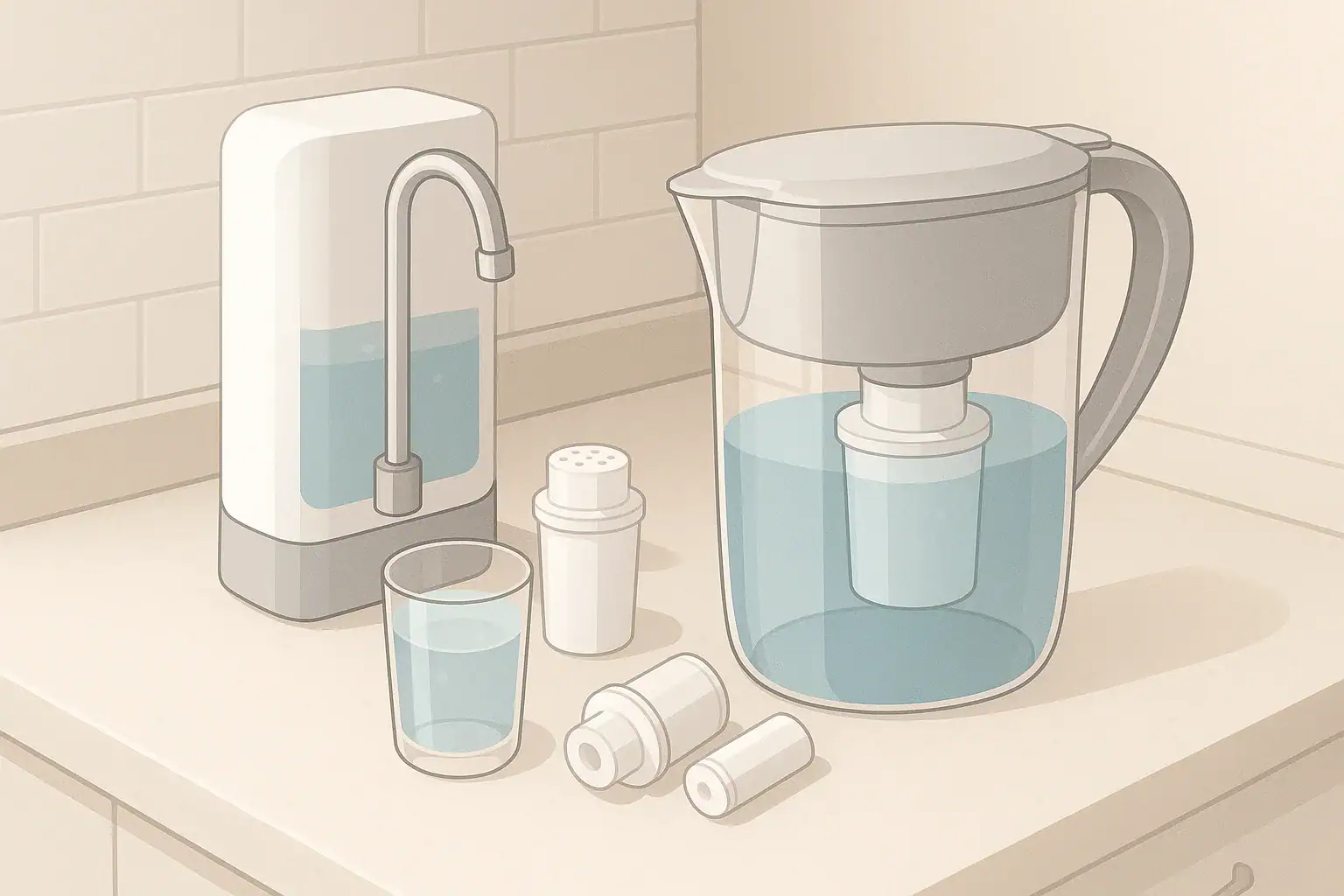
Countertop dispenser filters and pitcher filters are two of the simplest ways to keep filtered water available without installing equipment under the sink or modifying plumbing. Both typically use replaceable cartridges, both are common in apartments and rentals, and both can improve taste and odor when matched to the right water quality concern.
The main difference is not usually the basic idea of filtration. It is how much water each format holds, how often you refill it, where it sits, and how easily it fits into your daily routine. A pitcher may be easy to tuck into a refrigerator door, while a countertop dispenser may hold enough water for a household that fills bottles, brews coffee, or cooks regularly.
This comparison focuses on capacity and convenience, with practical notes on filter performance, maintenance, and choosing a format for typical U.S. home use.
How Countertop Dispenser Filters and Pitcher Filters Work
Most countertop dispenser filters and pitcher filters are gravity-fed systems. You pour tap water into an upper reservoir, and the water passes through a replaceable filter cartridge into a lower chamber. The filtered water is then poured from a pitcher spout or dispensed through a small tap.
The cartridges vary by product, but many use activated carbon to reduce chlorine taste and odor. Some include ion exchange resin, sediment screening, or specialty media intended for certain contaminants. The exact performance depends on the cartridge design, the amount of media, the water contact time, and whether the product has been tested to relevant standards.
What a Pitcher Filter Is Best Known For
A pitcher filter is compact, familiar, and easy to move. It usually fits in a refrigerator, can be lifted with one hand when full, and works well for one or two people who drink moderate amounts of filtered water.
The tradeoff is capacity. A typical pitcher holds a limited amount of filtered water, so frequent refilling is normal in a larger household.
What a Countertop Dispenser Filter Is Best Known For
A countertop dispenser filter is usually larger and designed to sit on a counter, shelf, or refrigerator shelf. Instead of pouring from the whole container, you place a glass, bottle, or pot under the dispenser tap.
The main advantage is ready volume. A dispenser can reduce the need to refill several times a day, especially when multiple people use filtered water for drinking, cooking, coffee, tea, or pet bowls.
Capacity: How Much Filtered Water Is Ready When You Need It
Capacity is the biggest practical dividing line between these two formats. A small difference in volume can change the whole experience of using a filter because gravity filtration takes time. If the container is empty when you need water, you have to refill it and wait.
Pitchers are designed around portability. Their capacity is limited partly because a full pitcher must remain easy to lift and pour. This makes them convenient for serving at a table or storing in the refrigerator, but less convenient when several bottles need filling at once.
Countertop dispensers are designed around storage. They can hold more filtered water because you do not lift the entire unit for each serving. This can be useful for families, shared housing, home offices, or anyone who wants a larger reserve of filtered water during the day.
Think in Daily Use, Not Just Container Size
A listed capacity does not always equal all-day convenience. Consider how your household actually uses water:
- How many people drink filtered water daily?
- Do you fill reusable bottles before work, school, or exercise?
- Do you use filtered water for coffee, tea, ice trays, or cooking?
- Do you prefer cold filtered water from the refrigerator?
- Is someone usually available to refill the container?
For example, a single person who drinks a few glasses per day may find a pitcher completely adequate. A household of four filling bottles each morning may find a dispenser easier because it provides a larger reserve.
Example values for illustration.
| Factor | Pitcher filter | Countertop dispenser filter |
|---|---|---|
| Filtered water capacity | Usually modest; sized for easy lifting | Usually larger; sized for storage and dispensing |
| Best household fit | One to two people or light use | Multiple people or heavier daily use |
| Refill frequency | Often more frequent | Often less frequent |
| Cold storage | Often fits in refrigerator | May fit only on larger shelves or stay on counter |
| Serving method | Lift and pour | Use a small dispensing tap |
| Counter space | Minimal if stored in refrigerator | Requires a stable counter or shelf location |
| Portability | Easy to move when full | Less portable, especially when full |
Convenience in Daily Use
Convenience depends on more than capacity. A filter that technically holds enough water may still be frustrating if it is awkward to refill, slow to dispense, or hard to fit in your kitchen.
Refilling and Waiting
Both formats need time for water to pass through the cartridge. The flow rate can slow as the filter collects particles or reaches the end of its service life. If the household often empties the reservoir, waiting becomes part of the routine.
Pitchers can be refilled quickly at the sink, but their upper reservoir may be small. You may have to fill the reservoir more than once to fully refill the pitcher. Some users do not mind this; others find it inconvenient during busy mornings or meal prep.
Countertop dispensers may take longer to refill completely because they hold more water. The benefit is that one larger refill session can create a reserve that lasts longer. This format works best when someone refills it before it is fully empty.
Pouring, Dispensing, and Accessibility
A pitcher requires lifting, tilting, and pouring. For many people this is simple. However, a full pitcher can be heavy, and repeated lifting may be inconvenient for children, older adults, or anyone with limited hand strength.
A countertop dispenser uses a tap, so it can be easier to fill glasses and bottles without lifting the container. The tradeoff is placement. The tap needs enough clearance for the containers you use, and the dispenser must sit on a stable surface close enough to the counter edge for comfortable dispensing.
Refrigerated Water Preference
If you strongly prefer cold water, a pitcher often has the advantage because it is more likely to fit in a refrigerator door or shelf. A dispenser may fit in some refrigerators, but many are too tall, too deep, or too wide for everyday access.
Some households keep a dispenser on the counter and add ice to glasses as needed. Others prefer a pitcher specifically because the filtered water stays chilled without extra steps.
Water Quality Expectations and Filter Media
Neither format should be judged by container shape alone. A pitcher and a dispenser can use similar filtration media, or they can be very different. The cartridge matters more than whether the container is tall, wide, portable, or countertop-based.
Many basic cartridges focus on reducing chlorine taste and odor from municipally treated water. Some cartridges are designed for additional concerns such as particulates, certain metals, volatile organic compounds, or other specific contaminant groups. Performance is not universal across all filters.
Read Claims Carefully
When comparing products, look for clear reduction claims tied to recognized testing methods or applicable NSF/ANSI-style standards. A general phrase such as “cleaner water” is less useful than a specific statement about what the cartridge has been tested to reduce.
A few practical points help keep expectations realistic:
- Activated carbon is widely used for chlorine taste and odor reduction.
- Some filters may reduce certain contaminants, but only if designed and tested for them.
- Gravity filters are not the same as reverse osmosis systems, UV systems, or whole-house treatment.
- Filter effectiveness can decline if cartridges are used past their rated life.
- Private well water should be tested so treatment choices match actual water conditions.
If your water has a known safety concern, use certified performance information and local water test results rather than assuming any pitcher or dispenser cartridge is suitable.
Taste, Odor, and Everyday Satisfaction
For many city water users, the top reason for choosing either format is taste. Chlorine or disinfectant-related taste can make tap water less appealing, even when the water meets applicable drinking water standards. A chlorine taste-targeted carbon-based filter may make water more pleasant for drinking, coffee, tea, and ice.
If the main complaint is hardness scale, a pitcher or dispenser may not be the best primary solution unless its cartridge is specifically designed for that purpose. Hardness is a mineral content issue, and carbon alone does not generally remove hardness minerals in a meaningful way.
Space, Storage, and Kitchen Workflow
The best filter is often the one that fits smoothly into your kitchen. A high-capacity dispenser can be inconvenient if it occupies the only prep space. A compact pitcher can be inconvenient if it is always empty.
Small Kitchens, Apartments, and Rentals
Pitcher filters are attractive in small spaces because they can live in the refrigerator and do not require permanent installation. They are also easy to take along when moving.
Countertop dispensers are also renter-friendly because they typically do not require plumbing changes. However, they need a stable place to sit. In a small apartment kitchen, that may mean giving up counter space or dedicating a refrigerator shelf.
Meal Prep and Shared Use
In households where filtered water is used for coffee makers, kettles, cooking, and multiple bottles, a dispenser can be more convenient. It provides a central water station, and users can fill containers without moving the unit.
For occasional use, a pitcher may be more flexible. It can be brought to a table, placed in a refrigerator door, or refilled quickly before a meal.
Travel and Temporary Use
Pitchers are usually easier to transport for dorms, short-term rentals, or seasonal stays. Countertop dispensers are better when you can leave the unit in one place and use it consistently.
Maintenance, Replacement, and Sanitation
Both formats need routine maintenance. The cartridge must be replaced on schedule, and the container should be washed periodically according to the manufacturer’s instructions. Filtered water containers are handled often, exposed to room air during refilling, and may sit for extended periods if not used regularly.
Filter Replacement Timing
Replacement intervals are usually based on gallons filtered, time in use, or both. A household that uses a dispenser heavily may reach the gallon rating faster than expected. A pitcher used lightly may hit the time limit before the gallon limit.
Do not rely only on taste as a replacement signal. Some performance changes may not be obvious. If the filter has an indicator, treat it as a reminder, but still understand whether it tracks time, estimated volume, or manual resets.
Cleaning the Container
Regular cleaning helps prevent stale odors, film, and residue. Pay attention to lids, spouts, dispenser taps, and reservoir corners. These areas can be easy to overlook.
Use the cleaning method recommended for the specific product. Avoid harsh chemicals or high heat unless the instructions allow them. If water has been sitting for a long time, empty the unit, clean it, and refill with fresh tap water before filtering again.
Leak Awareness for Dispensers
Countertop dispensers include a tap or valve, so they have one more part to monitor. Place the unit on a stable, level surface. Check that the tap is closed after use and that the container is not overfilled. Do not place a full dispenser where a small leak could damage electronics, papers, or unprotected surfaces.
Example values for illustration.
| Use pattern | What to watch | Practical planning tip |
|---|---|---|
| One person, light drinking use | Time limit may arrive before gallon limit | Set a calendar reminder for replacement |
| Two people, daily drinking use | Capacity may feel tight with a small pitcher | Track how often the container is empty |
| Family or shared household | Gallon rating may be reached quickly | Keep spare cartridges available |
| Coffee, tea, and cooking use | Filtered volume can add up quietly | Include kitchen use in replacement estimates |
| Seasonal or irregular use | Water may sit too long between uses | Empty, clean, and refill before returning to use |
| Slow flow through cartridge | Filter may be clogged or near end of life | Check replacement status and setup instructions |
| Dispenser kept on counter | Tap and reservoir need routine cleaning | Inspect the valve area during each wash |
Related guides: Pitcher vs Under-Sink vs RO: Which Fits Your Budget and Water? • Under-Sink vs Pitcher: Which Is Better for Families? • Best Water Filter Setup for Apartments (Renters, Space, No Drill) • Best Filters for Chlorine Taste: Pitcher vs Faucet vs Under-Sink
Which Format Is More Convenient for Your Home?
Choose a pitcher filter if you want a compact, low-commitment option that is easy to store cold, move around, and use in a small kitchen. It is often the simpler choice for one person, light daily use, dorm rooms, apartments, and households that do not need large volumes of filtered water at once.
Choose a countertop dispenser filter if ready capacity matters more than portability. It is often more convenient for families, shared kitchens, home offices, bottle filling, and routines that use filtered water throughout the day. The dispenser format reduces lifting and can make filtered water feel more available, as long as you have a stable place to keep it.
For either option, the cartridge specification is just as important as the container style. Match the filter to your water quality concerns, review tested reduction claims carefully, and replace cartridges on schedule. Capacity determines how often you interact with the filter, but the filter media determines what the system is actually designed to do.
Frequently asked questions
Which holds more filtered water, a pitcher or a countertop dispenser?
A countertop dispenser usually holds more filtered water than a pitcher. Pitchers are built to stay lightweight and easy to lift, while dispensers are built to store a larger reserve for repeated use.
Is a pitcher filter more convenient for a small kitchen?
Usually yes. A pitcher takes up less active space and can often be stored in the refrigerator, which makes it a practical choice for apartments, dorms, and compact kitchens.
Do countertop dispensers filter water faster than pitchers?
Not necessarily. Many use the same gravity-fed approach, so the speed depends more on the cartridge, the water level, and how clogged the filter is than on the container style alone.
Which option is better for families?
A countertop dispenser is often better for families because it reduces how often you need to refill and gives multiple people access to filtered water throughout the day.
How often should I replace the filter cartridge?
Follow the manufacturer’s time or gallon rating, whichever comes first. Heavy daily use can shorten the practical replacement interval, so it helps to track how quickly the reservoir empties.
Can either format improve water taste?
Yes, if the cartridge is designed to address taste and odor concerns. Many basic filters target chlorine taste, but specific performance depends on the media and testing claims for that product.
Recommended next:
- Pitcher vs Under-Sink vs RO: Which Fits Your Budget and Water?
- Whole House vs Under-Sink: Taste vs Whole-Home Protection
- Carbon Block vs GAC vs Ion Exchange: Quick Guide to Filter Media
- Best Water Filter Setup for Apartments (Renters, Space, No Drill)
- Best Filters for Hard Water Problems (Scale, Feel, Appliances)
- Best Filters for Chlorine Taste: Pitcher vs Faucet vs Under-Sink
- More in Comparisons & Buying Guides →
- NSF/ANSI standards explained (42/53/401/58)
- Clear trade-offs: pitcher vs faucet vs under-sink vs RO
- Maintenance planning: cost per gallon and replacement cadence