
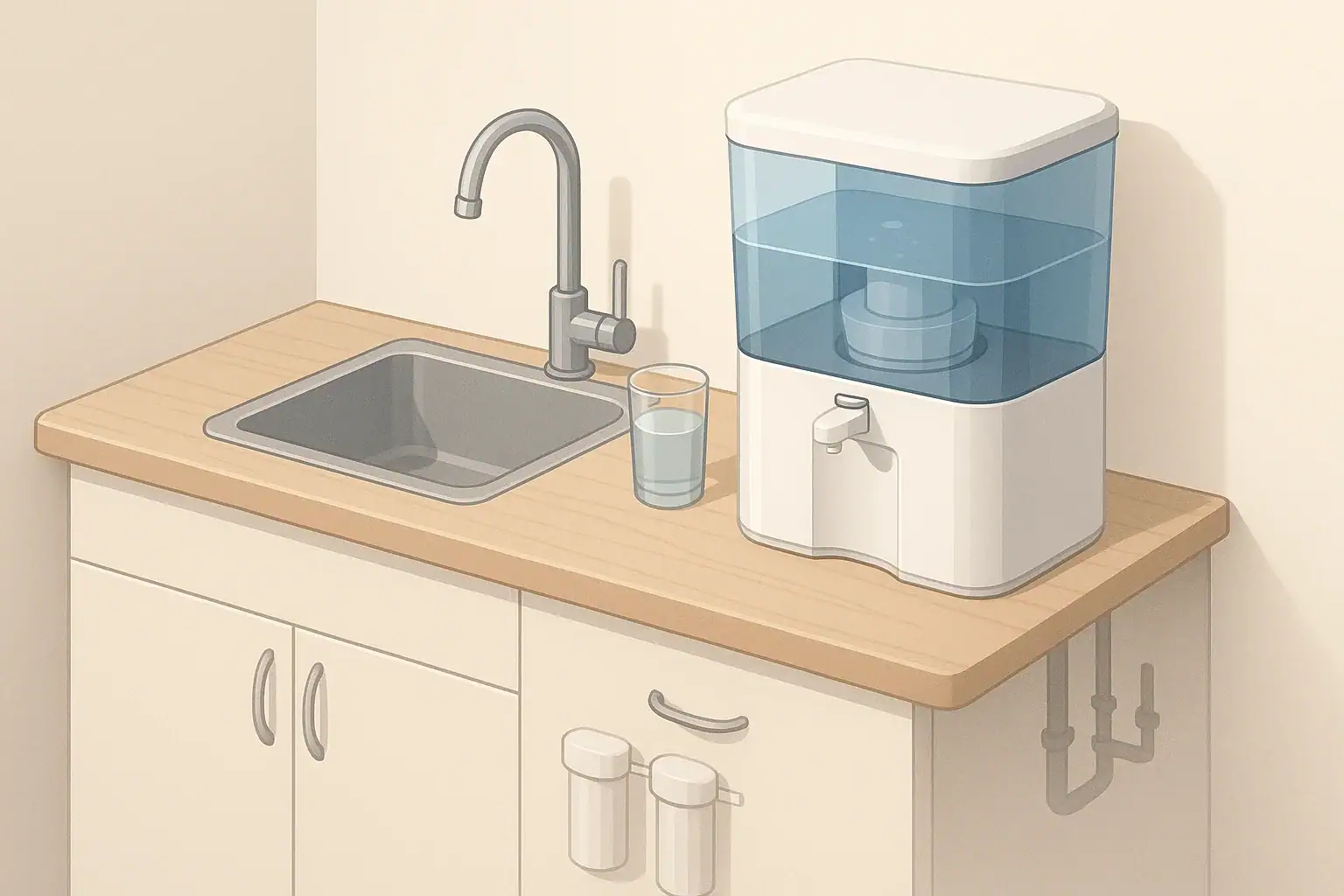
Countertop water filters can be practical in small kitchens because they usually avoid permanent under-sink space demands. They can work well in apartments, rentals, older kitchens, office kitchenettes, and compact homes where cabinet storage and plumbing access are limited.
The challenge is that countertop models still need room. Some sit beside the sink and connect to the faucet. Others are gravity-fed reservoirs that need filling space. Some countertop reverse osmosis systems need an outlet, room for a pitcher or tank, and a place for reject water or drain handling depending on the design.
Before comparing filter media, cartridge life, or certifications, measure the kitchen. A filter that fits your water goals but blocks the faucet handle, crowding the dish rack, or prevents cabinet doors from opening will be frustrating to use.
Why measuring matters in a small kitchen
Small kitchens often have multiple jobs happening in the same few square feet. The area near the sink may already hold a dish rack, soap dispenser, sponge tray, coffee maker, kettle, cutting board, or drying mat. A countertop filter adds another object to that working zone.
Measuring first helps you narrow the field before you get distracted by features. It also helps you compare different countertop filter styles fairly. A compact faucet-connected carbon unit may have a small body but require hose clearance. A gravity unit may not need faucet connections but can be tall and heavy when full. A countertop RO system may need space for water collection and filter changes.
Good pre-purchase measurements can help you answer practical questions:
- Will the filter sit on the counter without blocking prep space?
- Can you open nearby cabinets and drawers?
- Will the faucet still swivel and operate normally?
- Can you change cartridges without moving heavy appliances?
- Is there room to fill pitchers, kettles, or coffee equipment?
- Does the setup work for a renter without unsafe plumbing changes?
Measure the counter footprint and vertical clearance
Start with the exact area where the filter would sit during normal use. Do not measure the entire countertop and assume the filter can go anywhere. Measure the usable space near the sink, because many countertop systems either connect to the faucet or need convenient access for filling.
Width, depth, and landing space
Measure the width from side to side and the depth from the wall or backsplash to the front edge of the counter. Then subtract space for items that must stay, such as a dish rack or soap dispenser.
For a small kitchen, also think about landing space. If the filter dispenses into a glass, bottle, pitcher, or kettle, you need room in front of or below the spout. A filter body may technically fit but still be awkward if you must hold every container at an angle.
Height under cabinets
Measure from the countertop to the underside of upper cabinets, open shelves, or a microwave hood. Many countertop filters are taller than they look online, especially gravity units and systems with vertical cartridges.
If the lid must lift off, include hand clearance above the unit. If the cartridge unscrews upward, leave enough room to remove it without tipping the unit sideways.
Clearance around handles and doors
Check whether a filter would interfere with faucet handles, window cranks, cabinet doors, drawers, or a dishwasher door. In tight layouts, the best location may be slightly to the left or right of the sink rather than directly behind it.
| What to measure | How to check it | Why it matters |
|---|---|---|
| Counter width | Measure the open side-to-side space near the sink | Confirms the filter body will fit without crowding other items |
| Counter depth | Measure from backsplash to front counter edge | Helps avoid overhang and unstable placement |
| Vertical clearance | Measure counter to upper cabinet or shelf | Allows room for tall units, lids, and cartridges |
| Dispensing area | Place a typical glass or bottle where water would fill | Checks whether containers fit under or near the spout |
| Faucet movement | Turn handles and swivel the spout through normal use | Prevents hoses or filter bodies from blocking faucet operation |
| Door and drawer swing | Open nearby cabinets, drawers, and dishwasher door | Identifies conflicts before the filter is installed |
| Service access | Allow room to lift, twist, or slide cartridges out | Makes filter replacement easier and less messy |
Example values for illustration.
Check faucet and water source compatibility
Many countertop filters connect to the kitchen faucet with a diverter valve. This allows you to send cold water through the filter when needed and use unfiltered water for washing dishes. Compatibility depends on the faucet style and the aerator connection.
Look at the aerator
A standard faucet with a removable aerator is usually the easiest match for a faucet-connected countertop filter. The aerator is the small piece at the end of the spout. Some faucets have external threads, some have internal threads, and some use hidden or recessed aerators.
Before buying, check whether the manufacturer provides general adapter guidance for common faucet thread styles. Avoid forcing parts or using makeshift plumbing fixes. If a faucet has an unusual outlet, it may be better to choose a gravity-fed or fill-from-top design instead of trying to adapt the connection unsafely.
Be careful with pull-down and pull-out faucets
Pull-down and pull-out sprayer faucets are common in compact kitchens, but they often do not work with standard countertop diverter connections. The sprayer head may not provide a stable threaded outlet, and the hose is designed to move rather than hold extra attachments.
If your faucet is a sprayer style, confirm compatibility before purchase. If there is no clear match, consider a non-faucet-connected countertop filter, a pitcher-style filter, or another non-permanent option.
Use cold water unless the product instructions say otherwise
Most drinking water filter cartridges are intended for cold water. Hot water can affect filter media, seals, and housings. When measuring and planning, choose a location that makes cold-water use easy so the filter is not accidentally used outside its intended conditions.
Match the filter style to your space and water goals
Countertop water filters are not all the same. The right physical fit depends partly on how the filter treats water and how water moves through the unit.
Faucet-connected carbon or multi-stage filters
These units usually sit beside the sink and use a small hose connected to the faucet. Many use carbon block vs GAC vs ion exchange media, sometimes with sediment or specialty media. They are often chosen for taste, odor, chlorine reduction, and general drinking water improvement, depending on the specific cartridge and verified claims.
Measure for the filter body, hose routing, and the place where filtered water exits. Make sure the hose does not drape across a burner, sharp edge, or walkway around the sink.
Gravity-fed countertop reservoirs
Gravity systems do not need a faucet connection. Water is poured into an upper chamber and passes through cartridges into a lower chamber. These can be useful where faucet compatibility is a problem.
However, they can be tall and can become heavy when filled. Measure vertical clearance and consider whether you can comfortably lift the lid and pour water into the top chamber. Also consider whether the unit will be moved for cleaning under it.
Countertop reverse osmosis systems
Countertop reverse osmosis systems are designed for broader dissolved solids reduction than basic carbon filtration, but designs vary. Some connect to the faucet, some are filled manually, and some need electricity. RO systems also produce a concentrate stream, often called reject water or wastewater, that must be handled according to the product design.
Measure not only the machine footprint but also the room for the collection container, reject water container if applicable, power cord, and filter service access. Do not use unsafe drain modifications or bypass built-in safety features.
Measure daily water use and flow expectations
A filter can fit physically and still feel too slow if it does not match how your household uses water. Flow rate and capacity matter in a small kitchen because the sink area is often shared with cooking, dishwashing, and cleanup.
Estimate how much filtered water you use
Think through a normal day rather than an ideal day. Count water for drinking, coffee, tea, cooking, pet bowls, ice trays, and water bottles. A one-person household may only need a few glasses and a kettle. A family may fill several bottles and a coffee maker before leaving in the morning.
For gravity filters, capacity affects how often you refill the upper chamber. For faucet-connected units, flow rate affects how long you wait at the sink. For countertop RO systems, production speed and tank or pitcher size affect whether water is ready when needed. For a broader comparison of system types, see pitcher vs under-sink vs RO.
Consider peak demand
Peak demand is the busiest short period of water use. In a compact kitchen, morning routines and dinner preparation can create the most pressure on counter space and filter speed. A slow system may still be acceptable if you can fill a covered pitcher ahead of time and store it safely in the refrigerator.
Do not rely on capacity alone
Advertised capacity and cartridge life are useful, but they are not the same as daily convenience. Actual performance can be affected by water quality, incoming pressure, water temperature, cartridge condition, and the type of filter media. Treat capacity numbers as planning tools, not guarantees of identical performance in every home.
Plan for maintenance, sanitation, and storage
Maintenance access is easy to overlook until the first cartridge change. In a small kitchen, a filter that must be disassembled near the sink can interrupt cooking and cleanup. Measure the space needed to service the unit before you place it permanently.
Cartridge replacement clearance
Check whether cartridges twist off, drop down, lift out, or slide sideways. Leave enough space for your hand to grip the housing. If the filter sits under a low cabinet, avoid models that require a tall upward pull unless you have enough clearance.
Water spills and leak awareness
Any countertop water device can drip during filling, dispensing, or maintenance. The filter should sit on a stable, level surface away from paper goods, electrical strips, and items that could be damaged by moisture. If a unit uses a hose, inspect the path so it is not kinked or pulled tight.
Follow the product instructions for flushing new cartridges, cleaning reservoirs, and replacing seals or parts. Do not modify housings, pressure fittings, diverter valves, or safety shutoffs.
Off-counter storage
Some small kitchens do not have enough room to keep a larger unit out all day. If you plan to store a portable filter between uses, measure the cabinet or shelf where it will go. Consider its weight when full and whether it must remain upright.
| Use pattern | Planning question | Space or timing note |
|---|---|---|
| Single glass | Will a typical 8 to 16 ounce glass fit at the spout? | Check cup clearance and splash direction |
| Coffee or tea | Can you fill a kettle or coffee reservoir easily? | Measure container height and handle angle |
| Water bottles | Do tall bottles fit, or will you need a pitcher first? | Plan a filling spot that does not block the sink |
| Cooking water | Will filling a pot take too long during meal prep? | Consider whether filtered water is needed for every cooking task |
| Morning rush | Can the system keep up with several quick fills? | A storage pitcher may reduce waiting at the sink |
| Countertop RO | Where will product water and reject water containers sit? | Allow room for both if the design requires it |
| Filter changes | Can you service the filter without clearing the whole counter? | Leave hand clearance around cartridges and lids |
Example values for illustration.
Related guides: Faucet-Mount Filter Compatibility: How to Check Your Faucet Type • Pitcher vs Faucet-Mount: Which Is Better for Small Kitchens? • Best Water Filter Setup for Apartments (Renters, Space, No Drill) • What NSF/ANSI 58 Covers for RO Systems (and What It Doesn’t)
Pre-purchase notes for renters and tight kitchens
Renters and small-space owners should prioritize reversible setups. A countertop filter should not require drilling, cutting pipes, bypassing faucet parts, or altering building plumbing unless a qualified professional and the property owner approve the work.
If contaminant reduction is a priority, review the filter claims carefully. Look for clear information about the media used, the tested reduction claims, and any applicable NSF/ANSI-style standards or independent testing. Different filters target different concerns. A reverse osmosis system, carbon filter, sediment filter, and UV unit do not do the same job.
Also check the ongoing details before buying:
- Replacement cartridge cost and availability
- Estimated replacement interval under typical use
- Whether cartridges need soaking, flushing, or priming
- Whether the unit needs electricity
- How the system handles pressure, overflow, or shutoff
- Whether the filter can be stored safely when not in use
The best countertop water filter for a small kitchen is not only the one with the smallest footprint. It is the one that fits the sink area, works with the faucet or filling method, has enough room for maintenance, and matches the way the household actually uses drinking water.
Frequently asked questions
How much counter space do I need for a countertop water filter?
Measure the open width and depth near the sink, then leave extra room for hoses, handles, and a glass or pitcher under the spout. A filter that fits on paper can still be awkward if it blocks daily kitchen tasks.
Will a countertop water filter work with a pull-down faucet?
Sometimes, but many pull-down and pull-out faucets are not compatible with standard diverter connections. Check the faucet outlet style before buying, and choose a non-faucet-connected design if the connection is not clearly supported.
Do countertop reverse osmosis systems need extra space?
Yes. In addition to the unit itself, many countertop RO systems need room for a collection container, possible reject water handling, a power cord, and service access. They also tend to be taller than simple carbon filters.
What should I measure under the cabinets before buying?
Measure from the counter to the underside of the cabinet or shelf, and make sure there is enough room to lift the lid, remove cartridges, and fill the unit comfortably. Low clearance is one of the most common fit problems in small kitchens.
Is a gravity-fed countertop filter better for a small kitchen?
It can be, especially if your faucet is incompatible or you want a non-permanent setup. But gravity units can be tall, heavy when full, and slower to dispense, so they still need careful measurement.
Can I store a countertop water filter in a cabinet when not in use?
Often yes, if it fits upright and you can lift it safely when full or partially full. Measure the storage space first and consider weight, clearance, and the need to keep parts clean and dry.
Recommended next:
- Pitcher vs Under-Sink vs RO: Which Fits Your Budget and Water?
- Whole House vs Under-Sink: Taste vs Whole-Home Protection
- Carbon Block vs GAC vs Ion Exchange: Quick Guide to Filter Media
- Best Water Filter Setup for Apartments (Renters, Space, No Drill)
- Best Filters for Hard Water Problems (Scale, Feel, Appliances)
- Best Filters for Chlorine Taste: Pitcher vs Faucet vs Under-Sink
- More in Comparisons & Buying Guides →
- NSF/ANSI standards explained (42/53/401/58)
- Clear trade-offs: pitcher vs faucet vs under-sink vs RO
- Maintenance planning: cost per gallon and replacement cadence