
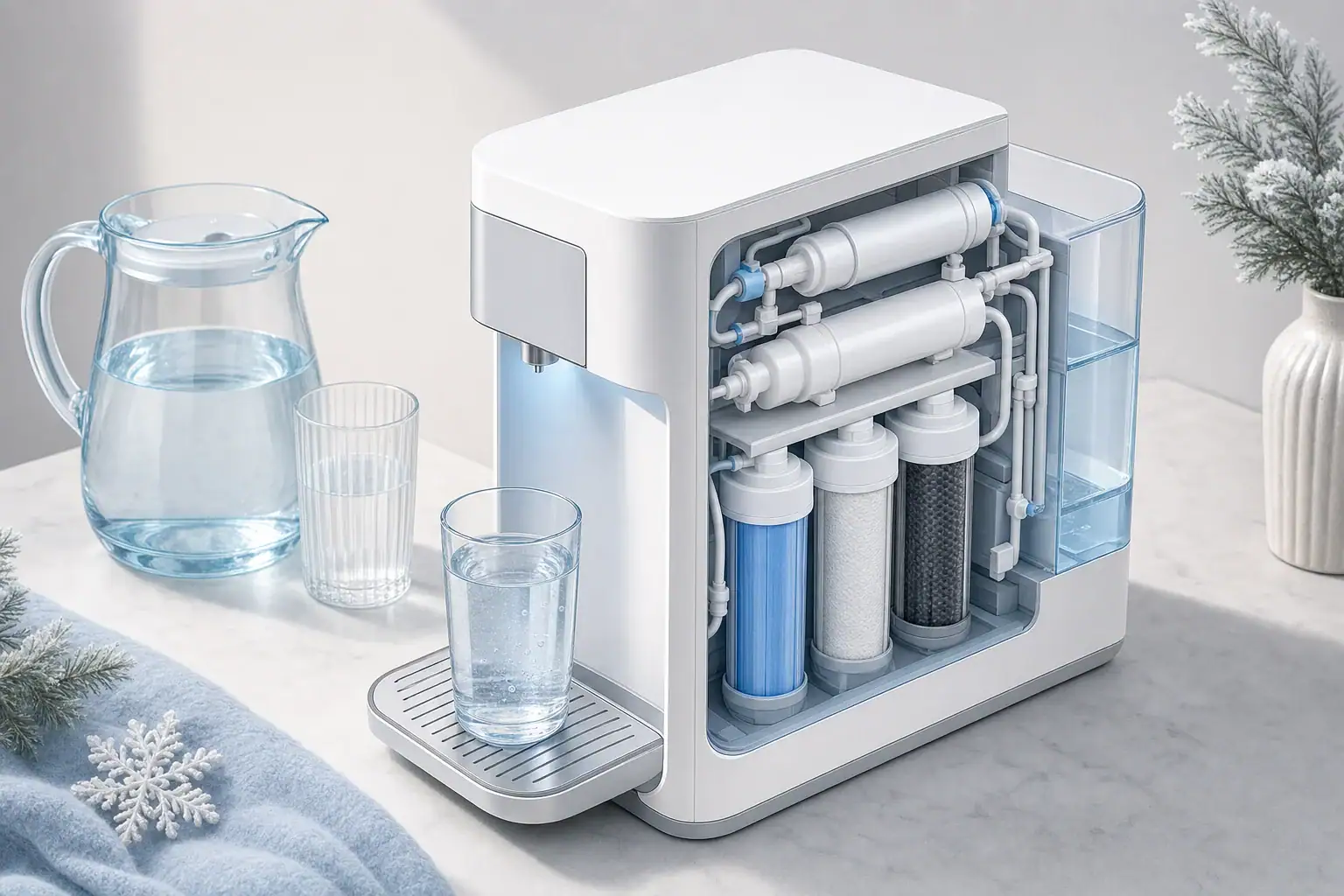
Reverse osmosis water production often slows in winter because colder feed water passes through the RO membrane less readily. As water temperature falls, its viscosity increases and membrane transport slows. The system may therefore need more time to produce the same volume of purified water.
This seasonal decline can be normal even when the membrane, filters, and water pressure have not changed. Many residential RO membrane ratings are based on feed water near 77°F, or 25°C. Winter tap water can be far colder, so actual output may be substantially lower than the rated gallons per day.
How feed temperature affects an RO membrane
An RO system uses water pressure to move part of the feed water through a semipermeable membrane. The rate of this movement depends on several conditions, including:
- Feed water temperature
- Pressure at the membrane
- Dissolved mineral concentration
- Membrane condition and size
- Backpressure from a storage tank
Cold water is more viscous than warm water. It moves through the membrane at a lower rate under the same pressure, reducing permeate production—the portion of the feed water that becomes RO water.
The membrane has not necessarily lost capacity permanently. Output commonly rises again as feed water warms during spring and summer.
How much can winter reduce RO output?
The exact reduction depends on the membrane and operating conditions. A manufacturer’s temperature correction chart is the best reference for a specific membrane.
The table below shows an illustrative range for a membrane rated at 50 gallons per day at 77°F. It assumes pressure, dissolved solids, and other conditions remain unchanged. It is not a performance guarantee.
| Feed temperature | Approximate relative production | Example daily output |
|---|---|---|
| 77°F | 100% | 50 gallons |
| 60°F | About 70%–75% | About 35–38 gallons |
| 50°F | About 55%–65% | About 28–33 gallons |
| 40°F | About 45%–50% | About 23–25 gallons |
A gallons-per-day rating describes continuous membrane production under stated test conditions. It does not mean a household can immediately draw that volume from the faucet. Storage capacity, tank pressure, automatic shutoff behavior, and daily water use also affect what the user experiences.
Why the slowdown feels different among RO systems
Systems with a storage tank
A traditional under-sink RO system slowly fills a pressurized tank. Cold feed water usually increases the tank’s recovery time after a large draw. Faucet flow may initially seem normal because stored water supplies the faucet, but the tank can run low when demand exceeds the membrane’s reduced production rate.
Tank backpressure also matters. As the tank fills, pressure opposing the membrane increases and production gradually slows. This is normal and helps explain why filling the final portion of the tank takes longer than filling the first portion.
Tankless systems
Tankless RO systems depend more heavily on real-time membrane production. A cold-water reduction may appear as lower dispensing flow or a longer wait to fill a container. Systems with an approved internal pump may compensate for some pressure-related loss, but temperature still affects membrane output.
Countertop and batch systems
A countertop RO unit may take longer to complete a cycle when its source water is cold. Because the unit processes a measured reservoir or batch, the seasonal change may be noticed as additional cycle time rather than weak faucet flow.
Temperature is not the only possible cause
A decline that begins with colder weather and reverses when the feed water warms strongly suggests a temperature effect. However, several problems can produce similar symptoms.
Lower feed pressure
RO production falls when pressure at the membrane declines. Household pressure can vary because of utility conditions, well-pump operation, simultaneous water use, partially closed valves, or plumbing restrictions. Cold temperature and low pressure can combine to create a larger production loss than either factor alone.
Clogged sediment or carbon prefilters
Prefilters protect the membrane, but accumulated sediment can restrict flow and reduce pressure reaching it. If production remains low across seasons or declined gradually before winter, overdue prefilters may be involved.
Membrane scaling or fouling
Mineral scale, sediment, or other deposits can reduce membrane output. Unlike a seasonal temperature effect, fouling generally does not disappear when the feed water warms. Membrane life varies with water quality, pretreatment, use, and maintenance.
Storage-tank issues
Incorrect air charge, a damaged tank bladder, or a tank nearing the end of its service life can reduce usable stored water. Tank pressure should be checked only with the water side empty and according to the system manufacturer’s procedure. Adding air without following that procedure can make performance worse.
Drain-flow or shutoff problems
A restricted flow control, malfunctioning automatic shutoff valve, kinked tube, or other component problem can affect production and recovery. These issues should be diagnosed using the system manual or by a qualified service provider rather than by bypassing controls.
How to tell whether cold feed water is the main cause
A simple comparison can separate a likely seasonal effect from a maintenance problem:
- Measure the cold-water temperature. Run the cold tap until its temperature stabilizes, then measure it with a suitable thermometer. Water sitting inside heated plumbing may initially be warmer than the actual supply.
- Compare with the membrane rating conditions. Check the stated test temperature and pressure. Do not compare winter output with the nameplate rating unless the operating conditions are similar.
- Track recovery consistently. Compare the time required to recover after similar water draws. Household use should be similar during each comparison.
- Check maintenance history. Confirm that prefilters have been replaced according to the applicable schedule and actual water conditions.
- Consider pressure. If pressure is unknown or appears unstable, use an appropriate gauge as directed by the system documentation or have a plumber check it.
Faucet flow alone is not a precise measure of membrane production on a tank-based system. It reflects stored-water pressure and faucet restrictions as well as membrane output. A manufacturer-specified production test provides a more useful comparison when available.
Practical ways to manage slower winter production
- Allow more recovery time. Space out large draws so the storage tank can refill.
- Replace restricted prefilters. Follow the RO filter replacement schedule, while recognizing that high sediment loads may require more frequent replacement.
- Correct verified pressure problems. Address partially closed valves or plumbing restrictions. Use a booster pump only if it is approved for the system and installed within its pressure limits.
- Keep the unit from freezing. RO components should remain in a conditioned location within their specified temperature range.
- Plan around cold-weather output. When sizing a system, use expected winter feed temperature and actual pressure rather than relying only on the membrane’s nominal rating.
Do not connect a residential RO system to a hot-water supply or intentionally heat its feed water unless the equipment documentation specifically permits it. Hot water can damage membranes, tubing, housings, and seals. Mixing hot and cold water upstream can also create unsafe or unstable operating conditions.
Related guides: Troubleshooting low RO flow • RO tank pressure • RO filter replacement schedule
When slower output points to a problem
Seasonal slowdown is usually gradual and broadly follows changes in cold-water temperature. Further troubleshooting is warranted when production drops suddenly, remains poor in warm weather, or is accompanied by leaks, unusual drain behavior, frequent pump cycling, or a major change in water quality.
The most useful comparison is actual winter performance against the membrane manufacturer’s temperature and pressure correction information. If output is reasonably consistent with those conditions, longer recovery is likely a normal cold-water effect. If production is far below the corrected expectation, pressure, prefilters, the storage tank, and membrane condition should be checked in that order according to the system documentation.
Frequently asked questions
Why does my reverse osmosis system make less water in winter?
Cold feed water is more viscous and passes through an RO membrane more slowly. Production commonly increases again when incoming water warms.
How much does cold water reduce RO production?
The reduction varies by membrane and operating conditions. A membrane rated at 77°F may produce substantially less water at typical winter temperatures; consult its temperature correction information for the best estimate.
Does slower winter RO production mean the membrane is bad?
Not necessarily. A gradual slowdown that follows colder water temperatures can be normal. Low pressure, clogged prefilters, membrane fouling, and tank problems can also reduce output.
Can I connect my RO system to hot water to increase production?
No, unless the manufacturer specifically allows it. Hot water can damage RO membranes, tubing, housings, and seals.
How can I improve RO water availability during winter?
Allow more tank recovery time, replace overdue prefilters, verify that feed-water pressure is adequate, and address confirmed plumbing restrictions. Use only system-approved pressure-boosting equipment.
- NSF/ANSI standards explained (42/53/401/58)
- Clear trade-offs: pitcher vs faucet vs under-sink vs RO
- Maintenance planning: cost per gallon and replacement cadence