
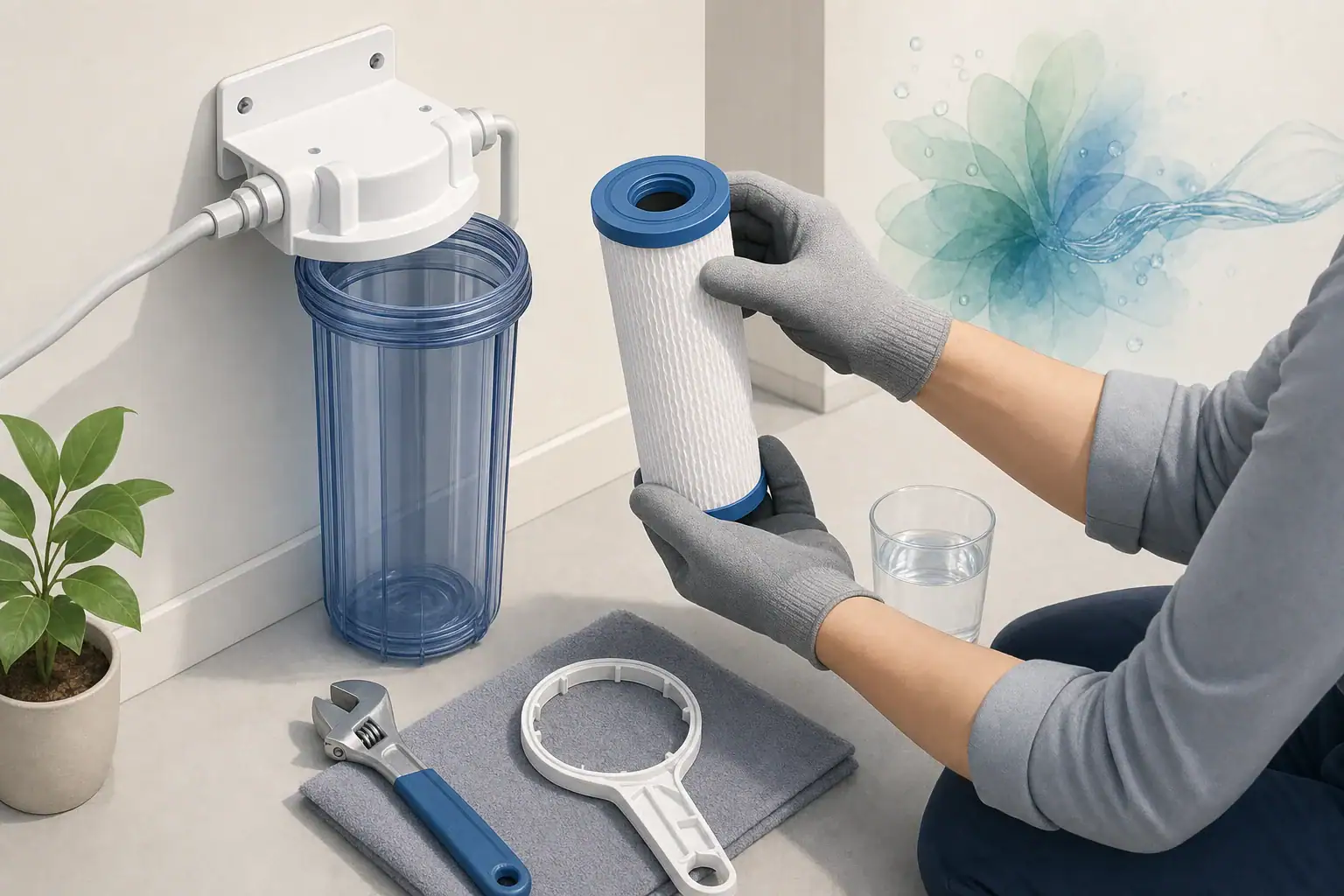
When a drinking water authority issues a cyanotoxin advisory, follow the advisory rather than relying on a home filter claim. A filter may reduce a particular toxin under defined test conditions, but that does not establish that it can make water safe during a specific bloom event.
Cyanotoxin concentrations, toxin types, water chemistry, filter condition, and exposure routes can all vary. Utilities and public health agencies base their instructions on local monitoring and treatment conditions that a homeowner generally cannot verify at the tap.
Why cyanotoxin advisories come first
Cyanobacteria, sometimes called blue-green algae, can multiply rapidly in lakes, reservoirs, and other source waters. Some blooms produce toxins, while others do not. The presence of a visible bloom alone does not confirm toxin levels, and clear-looking water does not prove that toxins are absent.
An advisory may be issued when monitoring detects a toxin, when treatment performance is uncertain, or when conditions justify precautionary action while sampling continues. The purpose is to provide immediate, location-specific instructions before every uncertainty has been resolved.
During an advisory, the issuing authority may tell affected customers not to use tap water for activities such as:
- Drinking or making beverages
- Preparing food or infant formula
- Making ice
- Brushing teeth
- Providing water to pets
Instructions for bathing, laundry, handwashing, and dishwashing can differ by event and by the toxin involved. Follow the exact notice from the water utility, health department, or other responsible authority rather than assuming that every cyanotoxin advisory has the same restrictions.
A boil-water notice is not the same type of warning
A standard boil-water notice usually addresses microorganisms that can be inactivated by sufficient boiling. Cyanotoxins are chemical contaminants, so boiling is not a dependable household remedy. It may leave toxins in the water, concentrate them as water evaporates, or release additional dissolved toxin if intact cyanobacterial cells break apart.
Do not boil advisory-affected water unless local officials specifically direct you to do so. If microbial and cyanotoxin concerns occur at the same time, follow the combined instructions from the responsible authority. One notice should not be assumed to cancel the other.
| Notice type | Primary concern | Household response |
|---|---|---|
| Boil-water notice | Potential microbial contamination | Boil as directed by the issuing authority |
| Cyanotoxin or do-not-drink advisory | Toxins associated with cyanobacteria | Use the approved alternative water source and do not assume boiling or filtering is sufficient |
| Do-not-use advisory | A condition that may make broader contact unsafe | Avoid tap-water use as specified in the notice |
Why ordinary filter claims are not enough
Home filtration performance is specific, not universal. A credible contaminant-reduction claim applies to a named contaminant, a tested system configuration, and stated operating conditions. A general claim such as “removes chemicals,” “improves water quality,” or “filters contaminants” does not demonstrate cyanotoxin reduction.
Even a system with relevant performance data has limits. Its result may depend on:
- The toxin: Microcystins are often discussed in filter literature, but cyanobacteria can produce several toxin classes. Evidence for one does not automatically apply to another.
- The toxin form: Toxins may remain inside intact cells or be dissolved in the water. A process that captures cells may not remove dissolved toxin.
- Concentration and water chemistry: Test conditions may not match the source water during a bloom.
- Contact time and flow: Water moving too quickly through adsorptive media can reduce performance.
- Cartridge age: Used media may have less remaining capacity than a new test cartridge.
- System condition: Leaks, bypass, damaged membranes, poor seals, and overdue maintenance can undermine treatment.
A certification or test report can help establish that a specific system reduces a specific toxin under defined conditions. It does not authorize continued tap-water use during a public advisory unless the issuing authority explicitly says appropriately treated water may be used.
How common treatment methods relate to cyanotoxins
Sediment and mechanical filters
Mechanical filters may capture some intact cyanobacterial cells if the filter is fine enough, but they generally are not designed to remove dissolved toxins. Captured cells can also accumulate on the filter. A sediment cartridge alone should not be treated as protection from cyanotoxins.
Activated carbon
Activated carbon can adsorb some dissolved cyanotoxins, including certain microcystins, under suitable conditions. Actual reduction depends on the carbon type, media quantity, contact time, flow rate, competing compounds, and remaining capacity.
This means a basic taste-and-odor carbon filter is not automatically a cyanotoxin filter. Look for an explicit reduction claim for the toxin of concern, supported by current third-party certification or detailed performance data. Broad carbon-media descriptions are not enough.
Reverse osmosis
Reverse osmosis may reduce some dissolved cyanotoxins when the membrane is intact and the complete system operates as specified. Performance still depends on the particular toxin, membrane condition, pressure, pretreatment, maintenance, and system design.
A generic statement about what reverse osmosis removes does not confirm performance during a local bloom. The relevant question is whether the exact system has evidence for the named cyanotoxin and whether local officials permit its use during the advisory.
Ultrafiltration and similar barriers
Fine membrane barriers may remove intact cyanobacterial cells, depending on pore size and system integrity. However, dissolved toxins can be much smaller and may pass through systems designed mainly for particles or microorganisms. Removing cells and removing released toxins are separate treatment tasks.
Ultraviolet and disinfection devices
Typical household ultraviolet systems are intended primarily for microorganisms. They should not be assumed to remove cyanotoxins. Killing or damaging cyanobacterial cells is also not the same as physically removing the toxins they may contain.
What to do while an advisory is active
Read the complete notice and confirm whether your address is within the affected service area. Use bottled water or another source specifically approved by local officials for restricted activities. Do not use appearance, taste, or odor to judge whether tap water is acceptable.
Avoid these common mistakes:
- Boiling the water without official instructions
- Assuming a refrigerator, pitcher, faucet, or whole-house filter makes the water safe
- Relying on a claim for a different contaminant or toxin
- Continuing to make or consume ice from the affected supply
- Giving the water to pets when the notice restricts drinking
- Running large volumes through a filter in an attempt to “flush out” the toxin
If filtered water was used before you saw the advisory, consult the utility or health department for event-specific guidance. For questions about the equipment, contact the system manufacturer using the exact model and cartridge information. A filter company can explain product limitations, but the public authority determines whether the water supply is under an advisory.
Evaluating a cyanotoxin reduction claim
When reviewing treatment evidence for future preparedness, look beyond the media name. Useful documentation should identify:
- The exact system and replacement cartridge
- The specific cyanotoxin covered by the claim
- Whether the claim is independently certified or based only on manufacturer testing
- The rated capacity and required replacement interval
- The permitted flow rate and operating conditions
- Whether the claim applies to dissolved toxin, intact cells, or both
- Any restrictions on source-water quality or system use
Certification directories maintained by organizations such as NSF or WQA can help verify a filter’s certification claim. Check the precise model rather than assuming every product in a series has the same claim. Certification for chlorine reduction, microbial treatment, lead reduction, or general taste improvement is not interchangeable with a cyanotoxin reduction claim.
After officials lift the advisory
Wait for an official notice that applies to your service area. Reduced bloom visibility or a social media update from an unofficial source is not enough.
The utility may provide instructions for flushing plumbing, discarding ice, cleaning ice makers, or handling point-of-use filters. Follow those directions in the stated order. Flushing too early can draw more affected water into household plumbing or consume filter capacity unnecessarily.
If the home treatment system operated during the event, determine whether its cartridge or membrane should be replaced. The answer depends on the system, its contaminant claims, how much advisory-affected water passed through it, and local guidance. Do not assume that flushing restores adsorptive media or that a cartridge remains serviceable simply because the water looks clear.
Related guides: Boil-water notice: what filters can and can’t do • How to verify a filter’s certification claim • What reverse osmosis removes
For future events, keep the system model number, cartridge number, installation date, and replacement record available. That information makes it easier to compare an advisory with the filter’s documented capabilities while keeping the public notice—not an unverified filter assumption—as the controlling safety guidance.
Frequently asked questions
Can I use a home water filter during a cyanotoxin advisory?
Do not assume a home filter makes advisory-affected water safe. Use an alternative water source approved by local officials unless the advisory specifically permits appropriately treated tap water.
Does boiling water remove cyanotoxins?
No. Cyanotoxins are chemical contaminants, and boiling is not a dependable removal method. Follow the instructions in the local advisory.
Can activated carbon filters remove cyanotoxins?
Some activated-carbon systems may reduce certain dissolved cyanotoxins under defined conditions. A general carbon-filter claim does not confirm protection for a particular toxin or bloom event.
Will reverse osmosis remove cyanotoxins?
Reverse osmosis may reduce some dissolved cyanotoxins when the complete system is operating as specified, but performance varies by toxin and system condition. It should not override an active public advisory.
What should I do with ice and filter cartridges after an advisory?
Follow utility or health department instructions for discarding ice, flushing plumbing, and replacing or servicing filters. Do not assume that flushing restores a used cartridge’s capacity.
- NSF/ANSI standards explained (42/53/401/58)
- Clear trade-offs: pitcher vs faucet vs under-sink vs RO
- Maintenance planning: cost per gallon and replacement cadence