
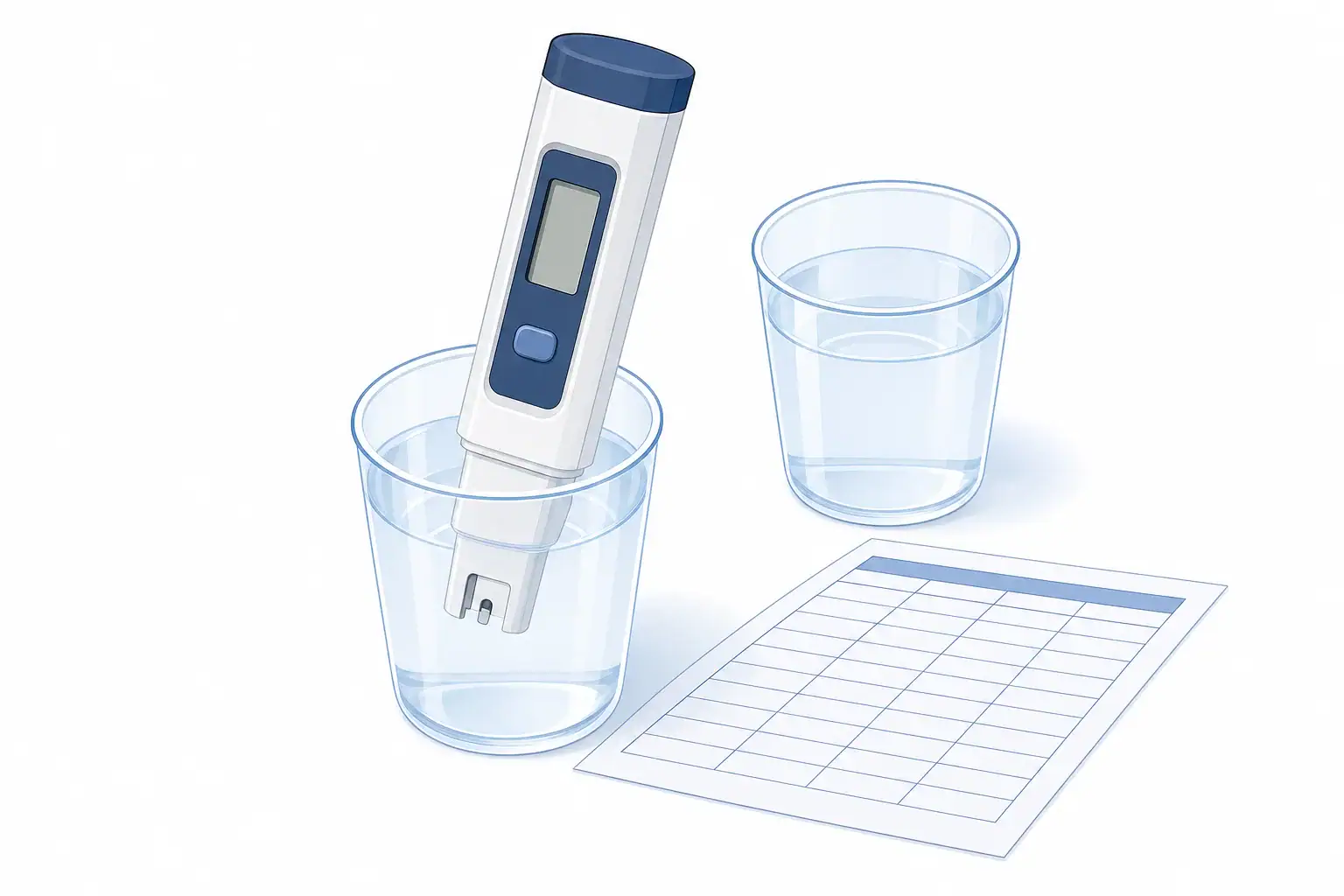
Quick answer: A TDS meter measures electrical conductivity and converts it to an estimated dissolved-solids reading. For consistent results, use a clean cup, follow the meter’s rinse and immersion instructions, remove bubbles, wait for a stable display, and log the value, unit, and temperature. It cannot identify contaminants or prove water is safe.
What a TDS meter reading means
A handheld TDS meter measures conductivity: water’s ability to carry electrical current. It then uses a built-in conversion to estimate total dissolved solids (TDS). The U.S. Geological Survey notes that specific conductance can be used to approximate dissolved solids, but it does not identify the substances responsible for the reading. USGS Water Science Glossary
Use a TDS meter for consistent comparisons, such as monitoring the same faucet or treatment outlet over time. It is not a test for lead, arsenic, PFAS, bacteria, pesticides, chlorine, or other individual contaminants. A low TDS reading, clear water, or acceptable taste does not establish that water is safe to drink.
How to use a TDS meter consistently
- Read the manual first. Confirm the maximum immersion depth, display modes, calibration procedure, permitted rinsing method, and storage instructions for your model.
- Choose a repeatable sampling point. For trend tracking, use the same faucet, treatment outlet, or other sampling location each time when practical.
- Use a clean sample container. Select a cup or beaker without soap, food residue, minerals, or water left from an earlier sample. Avoid touching the inside of the container or the sensing end of the probe.
- Check the mode and unit. Confirm whether the meter is displaying TDS, conductivity/EC, or temperature before recording a number.
- Calibrate only as the manual directs. If calibration is due, use the specified standard and procedure. Distilled water is not a substitute for a calibration standard.
- Rinse or condition the probe as directed. Rinsing between different samples helps limit carryover. Follow the meter manual, particularly if it specifies a rinse water or sample-conditioning step.
- Pour a fresh sample. Use enough water to cover the sensing area without immersing the meter beyond its marked limit.
- Immerse without touching the cup. Keep the probe off the bottom and sides. Remove visible bubbles gently if the manual permits.
- Wait for a stable result. Use a stable or ready indicator if the meter has one. Do not assume a universal wait time; the documented endpoint for your model controls.
- Record the complete reading. Log the number, unit, mode, sample temperature, sampling point, and relevant settings.
- Finish according to the manual. Rinse, dry, clean, or store the probe only in the way the manufacturer specifies.
A City of Austin field procedure illustrates why clean sampling matters: it includes rinsing the container and probe with sample water, avoiding container contact, removing bubbles, allowing the measurement to stabilize, and rinsing afterward. Its exact procedure and timing are protocol-specific, so a home meter’s manual remains the controlling instruction. City of Austin Water Quality Test Procedures
Manual checklist before measuring
| Manual item | Why check it |
|---|---|
| Immersion line and waterproof rating | Some meters should not be submerged above the probe area. |
| TDS, EC, and temperature modes | A number without its displayed unit or mode can be misleading. |
| TDS conversion factor | Different factors can produce different TDS estimates from the same conductivity. |
| Temperature compensation | Conductivity changes with temperature, and compensation methods vary by device. |
| Calibration standard and schedule | Calibration solutions, controls, and intervals are model-dependent. |
| Cleaning and storage | Unapproved cleaning or storage can affect the probe or damage the meter. |
Should you rinse the probe between samples?
Usually, yes. When comparing different samples, rinsing or conditioning the probe as directed helps reduce carryover from the prior sample. This is particularly useful when moving from a higher-conductivity sample to a lower-conductivity one.
Do not assume every meter uses the same rinse procedure. Some methods use a small portion of the next sample to condition the probe, while others specify distilled or deionized water after measurement. Do not use calibration solution as a general rinse, and do not use cleaners or wiping methods that the manufacturer does not approve.
Calibration and verification are not the same
Calibration adjusts the reading
Calibration compares the instrument with a specified conductivity standard and adjusts the meter according to its procedure. Use the standard, temperature conditions, and controls named in the manual. There is no universal calibration interval for all TDS meters.
Verification checks performance
A verification check measures a known standard to assess whether the meter performs within its stated tolerance, without necessarily changing its calibration. Whether a meter supports verification, which standard to use, and what result is acceptable depend on its documentation.
For example, the Thermo Scientific Orion guide for its named conductivity meters instructs users to select a standard near the expected conductivity, rinse the probe, stir gently, wait for a ready indication, and record the result and sample temperature. These are instructions for those models, not universal pen-meter rules. Thermo Scientific Orion conductivity meter reference guide
PPM, EC, and temperature: what to record
Conductivity or EC is commonly displayed in units such as microsiemens per centimeter (µS/cm). TDS mode converts conductivity into an estimate that may be displayed as ppm or mg/L. These values should not be treated as interchangeable without knowing the meter’s conversion method.
Two meters can show different TDS estimates for the same water if they use different conversion factors, reference temperatures, or compensation settings. A documented Hanna meter, for example, allows users to select conductivity reference temperatures and an EC-to-TDS factor; those settings are device-specific. Hanna Instruments instruction manual
For a useful trend, compare readings from the same meter, in the same mode, at the same sampling point, and with the same relevant settings. Record the displayed unit rather than writing down only the number.
Common TDS meter mistakes
| Mistake | Better practice |
|---|---|
| Using a cup with soap or old sample residue | Use a clean container and follow the documented rinse procedure. |
| Skipping the rinse between samples | Rinse or condition the probe as the manufacturer directs. |
| Leaving bubbles on the sensing area | Gently release bubbles without striking the probe, if permitted by the manual. |
| Letting the probe touch the cup wall or bottom | Hold the sensing area suspended in the sample. |
| Recording a changing display | Wait for the stable indicator or the documented measurement endpoint. |
| Comparing ppm directly with µS/cm | Record the exact unit and mode for every result. |
| Changing a selectable TDS factor unnoticed | Check and log the factor when the meter makes it available. |
| Immersing above the marked limit | Follow the model’s immersion and waterproofing limits. |
A simple TDS reading log
A short log can make a meter more useful for observing change over time. Record:
- Date and time
- Water source and exact sampling point
- Meter brand and model
- Displayed mode and unit
- Sample temperature
- Temperature-compensation setting, if selectable
- TDS conversion factor, if available
- Calibration or verification date and standard
- Stable reading and repeat reading
- Observations, such as recent filter maintenance or an unusual appearance
For a ready-to-use format, see this TDS meter reading log template. Trends are most comparable when the sampling point, meter, mode, and procedure remain consistent.
Worked comparison example
Suppose you are checking one kitchen faucet with the same meter each month. In each entry, you use a clean cup, select TDS mode, record the displayed temperature, and wait for the stability indicator. If the first reading is 180 ppm and a fresh repeat is 181 ppm, record both values with the date, unit, and settings. If a later check reads 240 ppm, first repeat the workflow with a fresh sample and confirm the mode, rinse process, temperature, and calibration status. The change may be worth investigating, but the TDS number alone cannot identify its cause.
Does 500 ppm mean water is safe?
No. EPA lists TDS at 500 mg/L under National Secondary Drinking Water Regulations. Secondary standards are non-enforceable federal guidelines that address aesthetic or cosmetic effects, not a universal safety boundary. EPA drinking water regulations and contaminants
Do not treat a handheld conductivity-derived estimate below 500 ppm as proof of safety, or a result above it as automatic proof of a health hazard. A handheld TDS estimate is also not necessarily equivalent to a laboratory TDS determination.
Related reading: TDS vs. hardness · What is a good TDS level for tap water? · What reverse osmosis removes
When to repeat a reading or use a laboratory
Repeat an unexpected reading using a fresh sample after checking the container, probe rinse, mode, unit, immersion depth, bubbles, stabilization, temperature, and calibration status. A persistent change can be a useful signal, but it cannot explain which substance changed or whether there is a health risk.
Use appropriate laboratory testing when the concern involves a named contaminant, a health or safety question, flooding, a changed private well, or a persistent unexplained result. EPA advises private-well owners to use certified drinking-water laboratories and choose tests that fit the source and concern. EPA guidance for protecting a home’s water
For public water, follow official notices and contact the water utility about unexpected changes. For a private well, consult the relevant state or local drinking-water authority about laboratory certification and analyte-specific testing.
Frequently asked questions
Can a TDS meter test for lead or bacteria?
No. A TDS meter estimates dissolved solids from electrical conductivity. It cannot identify lead, bacteria, PFAS, arsenic, pesticides, or other specific contaminants. Use an appropriate analyte-specific laboratory test for those concerns.
Why do two TDS meters give different readings?
The meters may use different conversion factors, temperature reference settings, calibration status, or measurement procedures. Compare readings most closely when using the same meter, mode, sampling point, and documented workflow.
Should I test water directly under a running faucet?
Follow the meter manual. For consistent comparison readings, collecting a fresh sample in a clean container can make it easier to avoid over-immersion, container contact, and unstable sampling conditions.
- NSF/ANSI standards explained (42/53/401/58)
- Clear trade-offs: pitcher vs faucet vs under-sink vs RO
- Maintenance planning: cost per gallon and replacement cadence