
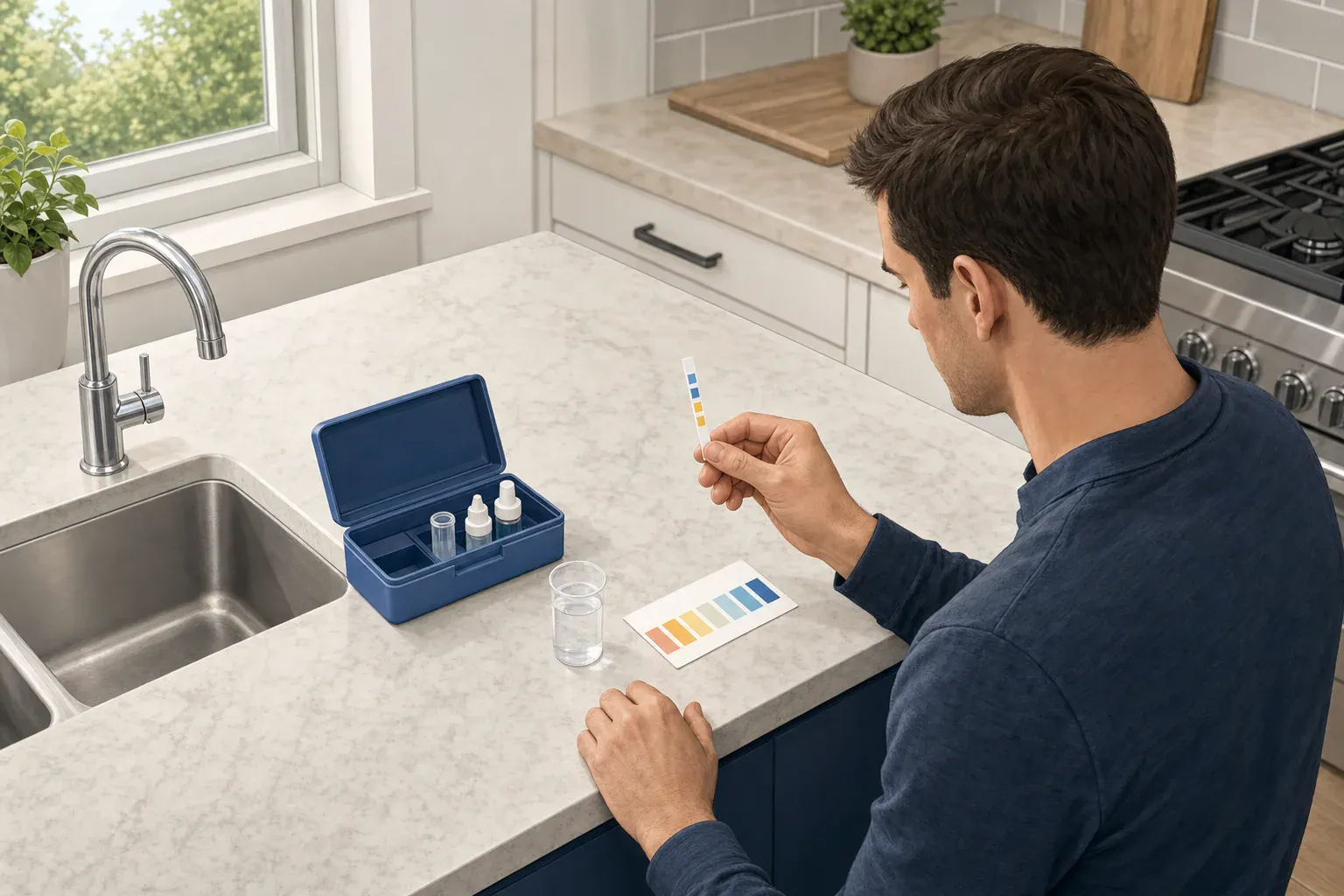
Quick answer: To test water hardness at home, use a total-hardness strip for a quick range or a drop-count titration kit for a more specific result. Sample cold water from the correct point in your plumbing, follow the kit exactly, and keep the reported units and “as CaCO₃” basis attached to the number.
What does a water hardness test measure?
A total-hardness test primarily measures dissolved calcium and magnesium. Results are commonly reported as an equivalent amount of calcium carbonate: mg/L as CaCO₃, ppm as CaCO₃, or grains per gallon (gpg). The U.S. Geological Survey (USGS) describes hardness as principally attributable to calcium and magnesium and reports it on this calcium-carbonate basis.
A hardness result identifies a hardness level; by itself, it does not establish whether water is safe to drink. It also does not measure total dissolved solids, bacteria, lead, nitrate, or other separate water-quality concerns.
How to test water hardness: choose the right method
The best method depends on the decision you need to make. A utility report can provide background for public water, but a home test better reflects water at a particular tap and time. Use a laboratory when a home result remains unclear or hardness is only one part of a broader water investigation.
| Method | Best use | Main limitation |
|---|---|---|
| Utility report | General background for a public-water supply | Hardness may not be listed, and a system value may not represent one tap at one time |
| Hardness test strip | Quick screening and approximate range | Color blocks, timing, and range are product-specific |
| Drop-count titration kit | More specific home result for repeat checks or planning | Sample volume, endpoint, range, and value per drop are kit-specific |
| Drinking-water laboratory | Resolving inconsistent results or broader testing | The laboratory’s collection, bottle, and handling instructions must be followed |
Use a utility report as context, not a tap-specific test
Check your utility website or Consumer Confidence Report to see whether hardness is listed. Hardness is not a standard required field in every Consumer Confidence Report, as shown in the EPA Consumer Confidence Report guidance.
A listed result may be an average, a range, a source-water value, or a result for a distribution area rather than your household tap. Some utilities use more than one source or see seasonal changes. For example, Denver Water reports that hardness can vary between its collection systems and with the season; that example does not establish the same pattern for every utility.
Use strips for a quick hardness screen
Choose strips labeled for total hardness, not strips intended for alkalinity, calcium alone, or another measurement. Follow the package’s dip time, wait time, and color chart exactly. Read the strip in bright, neutral lighting at the specified time.
If the color falls between blocks, record the result as a range rather than choosing an exact number. If the strip reaches the lowest or highest chart block, repeat the test if practical and recognize that the actual result may be below or above the strip’s useful range.
Use a drop-count kit for a more specific home result
A drop-count titration kit typically uses a measured sample volume, one or more reagents, and counted drops to a stated color endpoint. Use the exact fill line, hold the dropper as the manual directs, mix after each drop, and stop at the endpoint described by that kit.
Do not assume one drop always equals one gpg. For example, the Hach HA-71A manual assigns one drop per gpg only for its stated high-range procedure, which covers 1–20 gpg, or 17–342 mg/L as CaCO₃. Another kit may use a different sample volume, range, endpoint, or multiplier.
Collect a sample that answers your question
- Decide whether you need untreated or treated water. To estimate incoming hardness, use a cold-water tap known to be upstream of a softener or other hardness treatment. To check water after treatment, use a cold tap downstream of that equipment. If the plumbing path is uncertain, consult the equipment documentation or a qualified plumbing professional.
- Use a clean cold-water outlet. Do not blend hot and cold water. A mixed sample does not represent one clearly defined supply condition.
- Follow the kit or laboratory instructions first. For representative supply-water sampling, the EPA’s general drinking-water sample-collection guide describes using a clean cold-water faucet and generally flushing for two to three minutes, until temperature stabilizes. This is general guidance, not a hardness-kit protocol; your kit or laboratory instructions take priority.
- Record the conditions. Note the tap, date, whether the sample was treated or untreated, recent water use, and flushing approach. Consistent conditions make future results more comparable.
- Test promptly. Use the stated sample volume and timing. Do not dilute an out-of-range sample unless the manufacturer explicitly provides a dilution procedure.
- Run a duplicate if practical. Test two portions of the same collected sample when the kit allows. Repeat the process if the results differ enough to change how you would interpret them.
How to read water-hardness results
The USGS hardness classification uses these commonly cited descriptive categories:
| Total hardness as CaCO₃ | Description |
|---|---|
| 60 mg/L or less | Soft |
| 61–120 mg/L | Moderately hard |
| 121–180 mg/L | Hard |
| More than 180 mg/L | Very hard |
These categories are descriptive, not federal pass/fail limits and not universal instructions to install treatment. Consider the test purpose, the sample point, and whether repeat measurements tell a consistent story.
Reading mg/L, ppm, and gpg
Keep the reporting basis with every result. On typical home-test labels, ppm and mg/L are generally used as numerically equivalent when both are reported as CaCO₃. For example, 150 ppm as CaCO₃ corresponds to about 150 mg/L as CaCO₃.
One gpg is approximately 17.1 mg/L as CaCO₃, as stated in the Hach manual cited above. As an illustrative calculation, not a kit instruction:
8 gpg × 17.1 mg/L per gpg = 136.8 mg/L as CaCO₃
Rounded to 137 mg/L as CaCO₃, this example falls in the USGS “hard” category. Use the multiplier in your own kit manual when converting a drop count. For a fuller unit-conversion explanation, see water hardness: gpg vs ppm.
When should you repeat or confirm a hardness test?
Repeat a home test when:
- Duplicate results do not support the same interpretation.
- A strip color falls between chart blocks or is difficult to distinguish.
- The result reaches the lowest or highest value on the kit chart.
- The test was mistimed, the sample volume was uncertain, or drops were not formed consistently.
- You are unsure whether the sample was taken before or after treatment.
- Strips or reagents are expired, damaged, or stored outside the label directions.
Consider laboratory confirmation when careful repeat tests remain inconsistent, when the result will support a consequential equipment decision, or when hardness is part of a broader private-well or drinking-water investigation. The EPA provides contacts for state drinking-water laboratory certification programs. Confirm that the laboratory offers total hardness testing, then request its bottle, collection, and handling instructions before sampling. For broader well-water planning, see private well water testing schedules.
Hardness test and kit-label checklist
- The product measures total hardness, not TDS, alkalinity, or calcium alone.
- The units are shown as mg/L or ppm as CaCO₃, or as gpg.
- The test range includes the expected result.
- The color interval or drop multiplier is suitable for the decision you need to make.
- The sample point is recorded as untreated or treated.
- Cold-water and flushing conditions are documented.
- The stated sample volume, dip time, wait time, and endpoint are followed.
- Strips and reagents are within the labeled expiration date and stored as directed.
- Between-band and out-of-range results are reported honestly rather than assigned false precision.
- A repeat result is recorded before relying on the number for planning.
Frequently asked questions
Can a TDS meter test water hardness?
No. A TDS meter estimates total dissolved solids, while a hardness test is intended to measure hardness on a calcium-carbonate reporting basis. A TDS reading cannot be converted into a reliable hardness result without additional information.
Should I test hot or cold water for hardness?
Use cold water unless your kit or laboratory specifically instructs otherwise. Testing cold water from a clearly identified tap helps define the supply condition you are measuring.
Does hard water mean the water is unsafe to drink?
No conclusion about drinking-water safety follows from hardness alone. A hardness test does not evaluate many other possible water-quality concerns, so use an appropriate laboratory test if you need information beyond hardness.
A well-documented result is more useful than a seemingly precise number from an unclear sample. Record the tap, treatment status, date, recent water use, method, units, kit range, and duplicate result so later measurements can be compared under similar conditions.
- NSF/ANSI standards explained (42/53/401/58)
- Clear trade-offs: pitcher vs faucet vs under-sink vs RO
- Maintenance planning: cost per gallon and replacement cadence