
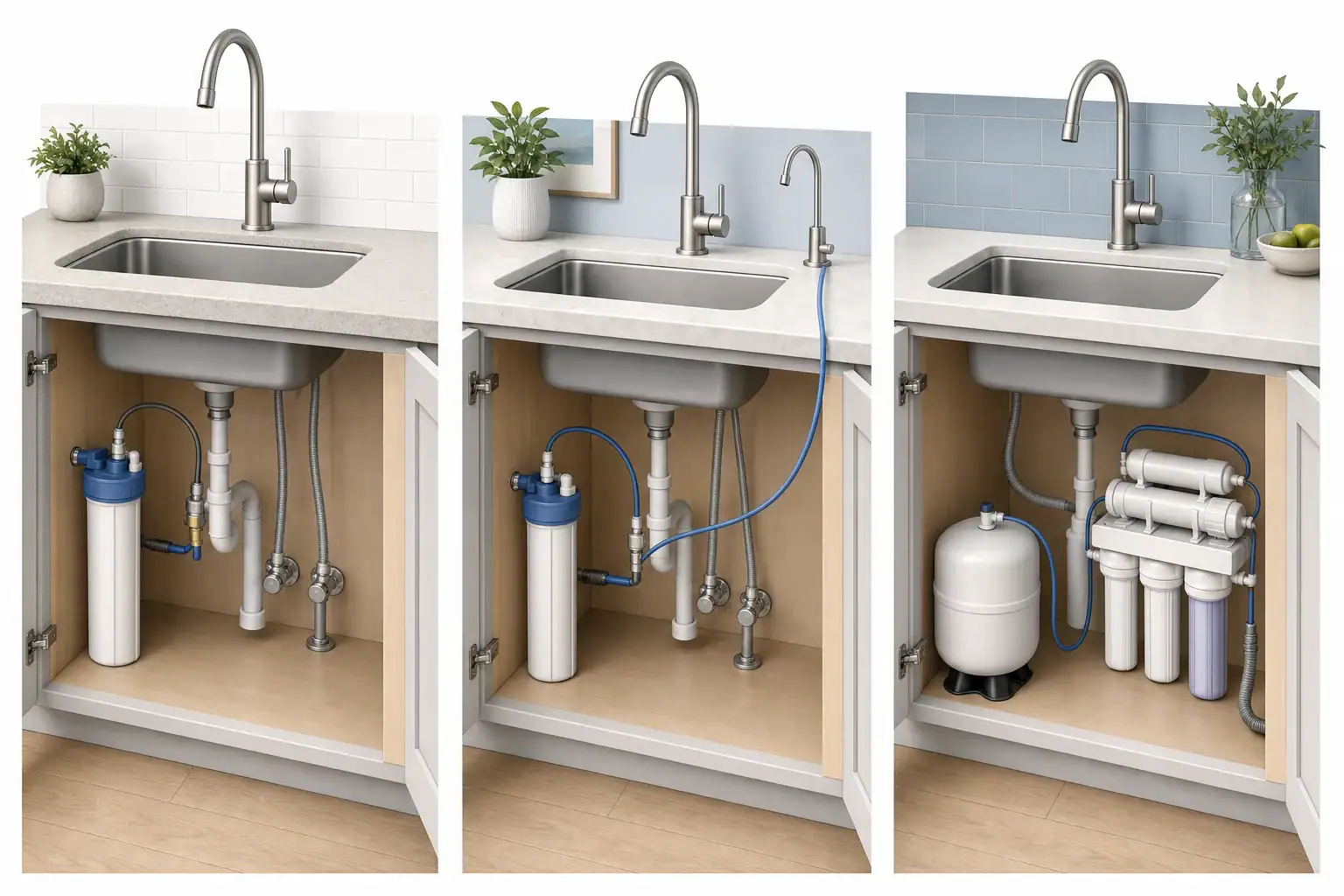
Quick answer: Choose an under-sink water filter by identifying a documented tap-water concern, then matching it to a certified claim for the exact system and replacement element. Select a direct-connect, dedicated-faucet, or RO setup based on the plumbing, treated-water volume, rated flow, capacity, and maintenance you can realistically manage.
Start with your water report or a targeted test
Choose an under-sink water filter for a defined purpose, not because it has the most stages. If you use a public water system, start with the utility’s annual Consumer Confidence Report (CCR). The CDC advises consumers to review their water-quality report or test their water when choosing a home filter.
A CCR reports monitoring for the public system; it does not necessarily describe water after it travels through a particular service line or building plumbing. If the concern is at one faucet, use a test designed for that concern and collect the sample as instructed by the laboratory. Private-well households should use testing appropriate to local conditions rather than relying on a public-system CCR.
Taste, odor, cloudiness, and a total dissolved solids (TDS) reading can help describe a water issue, but none alone proves that water is safe or identifies a particular contaminant.
Choose an under-sink water filter configuration
Under-sink systems are point-of-use options: they are generally intended for water used for drinking and cooking rather than every use in the home. The EPA’s WaterSense guide to home water treatment recommends identifying the treatment goal before buying and avoiding treatment of more water than needed.
Direct-connect filtration
A direct-connect system is installed in the cold-water line serving the main faucet. All cold water drawn from that faucet passes through the system, so rinsing and washing can use cartridge capacity as well as drinking and cooking. This setup avoids a second dispenser, but the system’s rated flow needs to suit everyday faucet use.
Before purchase, compare the manual’s connection requirements, pressure range, cold-water requirement, dimensions, and rated flow with the actual sink cabinet and plumbing. Do not assume a similar-looking fitting or adapter is compatible.
Dedicated-faucet filtration
A dedicated-faucet system sends treated water to a separate drinking-water dispenser. The main faucet can remain unfiltered, which can reserve filter capacity for drinking and cooking. It requires room for the unit and a suitable dispenser location.
A separate faucet does not, by itself, improve contaminant reduction. The reduction claim depends on the exact system, the installed replacement element, and its stated operating conditions.
Reverse osmosis
Point-of-use reverse osmosis (RO) systems commonly use a cold-water feed, a dedicated faucet, and a drain connection. Tank size, power needs, pumps, production rate, and reject-water characteristics vary by model, so use the original manual for the candidate system.
The EPA describes RO as a technology that can address some dissolved inorganic contaminants that conventional filtration does not generally remove. It also notes that RO does not remove every contaminant and produces reject water. Those are technology-level characteristics, not a reduction claim for every RO product. See what RO removes and does not remove for a fuller overview.
| Documented concern or goal | Configuration to consider | What to verify | Connection and upkeep check |
|---|---|---|---|
| Taste or odor concern | Direct-connect or dedicated faucet | A specific chlorine, chloramine, taste, or odor claim that matches the concern | Confirm faucet-line compatibility, rated flow, capacity, replacement interval, and cartridge price. |
| Lead, PFAS, or a named VOC | A non-RO or RO system with the exact claim | The named contaminant on the listing or performance data sheet, not only a standard number | A dedicated faucet may limit treated volume; verify the listed replacement element and service schedule. |
| Nitrate, fluoride, or another dissolved-contaminant objective | Often RO, but only after claim verification | An exact model-level reduction claim | Check cold feed, faucet, drain, pressure range, storage, reject water, and all replacement parts. |
| Suspected microbial contamination | Seek advice from the relevant health authority or qualified water professional | A treatment claim appropriate to the identified organism and operating conditions | Follow the required monitoring, sanitation, and maintenance instructions. |
When is RO unnecessary?
RO may be unnecessary when a verified non-RO system has the exact claim needed for the documented concern and there is no identified dissolved-contaminant objective that calls for a different process. Choosing RO solely because it has more stages adds plumbing, replacement, and reject-water considerations without demonstrating that it is a better match.
Likewise, do not assume that a general carbon filter reduces nitrate, fluoride, dissolved salts, lead, PFAS, chloramine, or microorganisms. Some products carry specific claims for some of these concerns; many do not. The model-level documentation is the deciding evidence.
Verify the exact model and reduction claim
A certification standard number alone is incomplete evidence. A product certified to NSF/ANSI 42, 53, 58, or 401 is not automatically certified for every reduction claim available under that standard. NSF explains how contaminant claims work in its contaminant-reduction claims guide; use the NSF drinking-water treatment unit database to look up a specific model and claim.
- Match the complete system model number to the certification listing or performance data sheet.
- Confirm that the replacement cartridge, membrane, or element is the one specified for that system.
- Look for the named contaminant or reduction objective, not just a standard reference.
- Compare listed flow and capacity with the current manufacturer documentation.
- Check that household pressure, temperature, and other conditions fall within the manufacturer’s limits.
- Distinguish a certification listing from vague language such as “tested to” or “designed to meet.”
For example, the NSF listing for the Everpure Residential H-300 identifies the H-300 replacement element and lists a flow of 0.5 gallons per minute and a 300-gallon capacity, alongside specified reduction claims. The corresponding Pentair specification sheet identifies a 3/8-inch quick-connect inlet, a 10–125 psi operating range, cold-water use, and replacement cartridge EV927072. This is an example of how to read documentation, not a product recommendation; those details apply only to the listed system and specified element.
Check flow, capacity, and replacement burden
Match rated flow to intended use
Use the manufacturer-rated or certified flow for the exact configuration, rather than an unrestricted faucet-flow specification. A lower-flow drinking-water faucet may be practical for filling glasses and pots but inconvenient as the source for all cold-water sink tasks. A direct-connect system should support the way the main faucet will actually be used.
Also compare your household pressure with the manual’s allowed range. Pressure and flow are related but not interchangeable; high supply pressure does not guarantee a particular treated-water flow. See water pressure versus flow rate for the distinction.
Plan replacements using gallons and time
Follow the manufacturer’s replacement instruction, including a “gallons or months, whichever comes first” limit when one is stated. Do not extend service just because water still tastes normal.
Planning formula: estimated annual replacement count = round up the larger of annual treated gallons ÷ rated gallons, or 12 ÷ rated months.
Hypothetical example: Assume a household expects to use 730 gallons of treated water in one year. A candidate cartridge is rated for 500 gallons or six months. The volume calculation is 730 ÷ 500 = 1.46 cartridges; the time calculation is 12 ÷ 6 = 2 cartridges. The planning estimate is two cartridges per year. These are assumptions for illustrating the calculation, not performance data for a product.
For a direct-connect setup, estimate treated gallons from all expected cold-water use at that faucet, not only drinking-water use. For a dedicated faucet, estimate drinking and cooking use. A practical replacement schedule can then be checked against the manufacturer’s stated limit.
Calculate ownership cost before buying
Use current prices for the exact replacement components and include the costs that apply to the configuration:
- Expected annual cartridge quantity multiplied by the current cartridge price
- For RO, prefilters, postfilters, and the averaged cost of membrane replacement
- Shipping, disposal, and any professional service
- System-specific water use and, if applicable, electricity
- Any proprietary faucet, tank, monitor, or replacement component required by the system
Capacity is not a complete cost comparison. A larger gallon rating can still have a time-based replacement limit, while a lower-cost cartridge can become expensive if a direct-connect installation sends all cold-water use through it.
Final pre-purchase checklist
- Write down the documented contaminant or aesthetic concern.
- Find the exact model and named reduction claim in a current certification listing or performance data sheet.
- Confirm the required replacement element and its current availability.
- Read the original manual before purchase.
- Confirm fittings, cold-water requirement, pressure limits, cabinet clearance, faucet requirements, and any drain or power requirement.
- Compare rated flow with the intended use.
- Estimate replacements from both gallon and time limits.
- Calculate recurring cost using current prices for every required element.
- Reject a claim based only on stage count, TDS, taste, or unclear certification language.
Related guides: Dedicated filter faucet vs. main faucet connection • Under-sink filter installation: tools and common mistakes • Under-sink filter replacement schedules
Frequently asked questions
Can I choose a filter from the NSF/ANSI standard number alone?
No. The standard identifies the type of evaluation, but it does not show every claim held by every certified product. Search the exact model and confirm that the named contaminant or reduction objective appears in its current listing or performance data sheet.
Should a direct-connect or dedicated-faucet system use fewer cartridges?
It depends on how much treated water the household uses and the manufacturer’s replacement limits. A dedicated faucet can limit treatment mainly to drinking and cooking water, while a direct-connect system treats cold water used through the main faucet. Estimate each setup using the same gallon and time limits.
Does a low TDS reading mean an under-sink filter is the right choice?
No. TDS is a broad measurement of dissolved material and does not identify a contaminant or demonstrate potability. Select a system using a CCR, an appropriately targeted test, and a matching model-specific claim.
- NSF/ANSI standards explained (42/53/401/58)
- Clear trade-offs: pitcher vs faucet vs under-sink vs RO
- Maintenance planning: cost per gallon and replacement cadence