
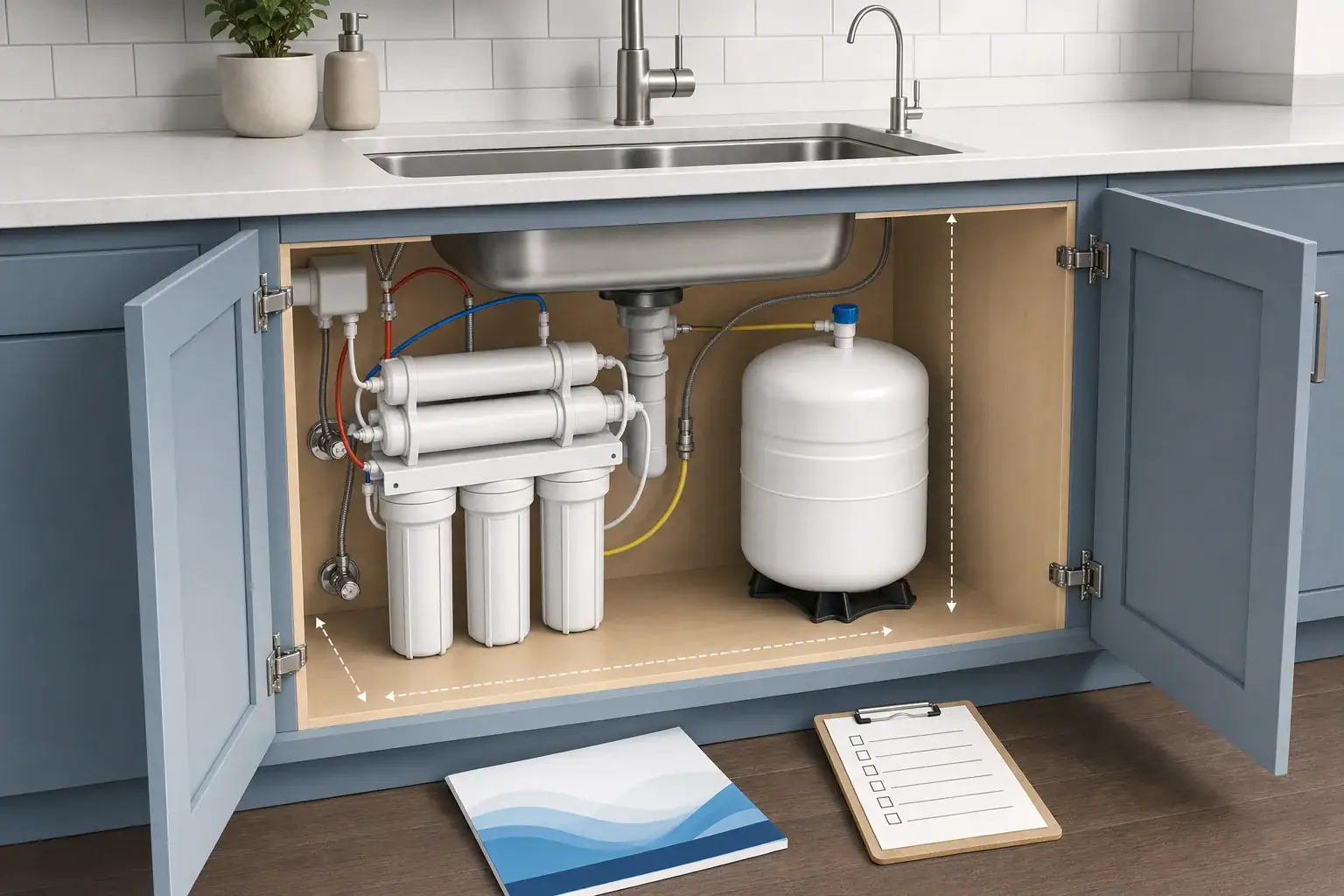
Quick answer: Choose a reverse osmosis water filter system by identifying your treatment goal, then comparing exact certified claims and the model’s permitted feed-water conditions. Measure the installation space and service clearance, estimate your busiest drinking-and-cooking draw, and confirm replacement parts, procedures, and ongoing costs before buying.
Build a reverse osmosis water filter system shortlist
Start with the treatment need and installation constraints—not the number of stages, app features, or an advertised gallons-per-day figure. A suitable system needs to address the specific concern found in your water information, operate within your home’s documented conditions, fit the available space, and provide enough water for concentrated drinking and cooking use.
The EPA guide to selecting home water treatment systems advises consumers to identify the treatment goal, consider where treatment is needed and account for the quantity of water used. For many households, treating water used for drinking and cooking at one point of use may be more appropriate than treating every fixture.
1. Match water results to documented claims
Use a current utility water-quality report, where available, or an appropriate tap-water test to identify the condition or contaminant you want to address. The CDC advises selecting a treatment system labeled for the chemicals or germs of concern.
Taste, odor, clarity, and a low total dissolved solids (TDS) reading do not establish that water is safe. If private-well water has an unknown microbiological condition, seek suitable testing and guidance from the relevant local health authority. Do not assume that an RO unit alone makes microbiologically unsafe water potable.
Require an exact certified claim
“NSF certified” is incomplete without the exact model, certifying organization, standard, and contaminant-reduction claim. NSF explains that TDS reduction is required for NSF/ANSI 58 reverse-osmosis systems, while claims for contaminants including lead, arsenic, nitrate/nitrite, fluoride, and volatile organic compounds are optional. Read NSF’s description of NSF/ANSI 58.
For each target contaminant, find the exact model in the certifier’s listing and compare the listed claim with the model’s performance data sheet. This step-by-step certification-checking guide can help. A standard number by itself does not show that a system is certified for every optional contaminant claim.
2. Check the feed-water envelope in the manual
Download the current owner’s manual and performance data sheet before buying. Compare the permitted operating conditions with your water source and plumbing. Depending on the model, the documents may specify limits or requirements for:
- Feed-water pressure and temperature
- TDS, hardness, and pH
- Sediment or turbidity conditions
- Chlorine or chloramine exposure
- Microbiological quality of the incoming water
- Private-well or untreated-water use
These limits are model-specific. For example, the Aquasana AQ-SFRO2 owner’s manual lists operating conditions for that model, including pressure, temperature, TDS, hardness, pH, chlorine, and incoming-water quality requirements. Those values are an example of information to locate; they are not universal RO limits.
When should you consider pretreatment?
Consider pretreatment when reliable water results and the candidate manual show that incoming water falls outside the permitted conditions or may shorten component life. Sediment, hardness, or disinfectant conditions may matter, but the necessary configuration depends on the system and the water source.
Do not add treatment stages solely because a generic buying guide recommends them. Identify the condition first, compare it with the manufacturer’s documentation, and ask the manufacturer or a qualified water-treatment professional whether the proposed configuration is compatible. Pretreatment does not replace a documented reduction claim for the contaminant you want to address.
3. Measure the installation area and connections
Measure the cabinet instead of relying on product photos. Record usable width, depth, and height, then allow for tubing bends, shutoff access, and the room needed to remove cartridges or a membrane housing. Check the manual for mounting orientation and service-clearance instructions.
Also verify that the planned location has:
- An accessible cold-water connection compatible with the supplied or specified hardware
- A drain connection permitted by the installation instructions and local requirements
- A suitable faucet hole or an approved alternative
- Space for the manifold, tubing, tank if included, and any leak-control components
- An electrical outlet if the exact system requires power
Do not assume an existing accessory hole, drain arrangement, or outlet is compatible. Follow the product instructions and applicable plumbing and electrical requirements. Use a qualified installer when required or when the installation is outside your comfort level.
4. Size storage and flow around peak demand
Headline production ratings do not necessarily describe the water available immediately at the faucet. Output can vary with feed pressure, water temperature, dissolved solids, tank condition, and the amount already stored. For one example model, the AQ-SFRO2 performance data sheet reports production under stated test conditions and says actual performance may vary.
Instead of relying on a universal gallons-per-person rule, note your largest short-period use. Include bottles filled close together, a kettle, cooking water, and any refrigerator or ice maker supplied by the RO system.
Illustrative peak-demand calculation
Hypothetical example: In one hour, a household fills two 0.75-gallon containers, uses 0.5 gallon for a kettle, and draws 1 gallon for cooking.
(2 × 0.75 gal) + 0.5 gal + 1 gal = 3.0 gallons
The household would compare this 3.0-gallon peak draw with each candidate’s documented usable storage, delivered faucet flow, and replenishment information. Do not treat nominal tank volume as usable water volume unless the manufacturer documents usable capacity under relevant conditions.
Track typical daily drinking and cooking use separately. Production information helps estimate replenishment capacity, while available storage and faucet delivery matter most during a concentrated draw. Compare production figures only when the definitions and test conditions are comparable.
5. Compare water-use and power information carefully
RO systems send some incoming water to the drain. Look for efficiency, recovery, or water-use information in the performance sheet, but read how the manufacturer defines the metric. Values measured under different pressures, temperatures, feed-water conditions, or test methods may not be directly comparable.
Also check whether the system uses a pump, automatic shutoff, monitoring device, or other powered component. These features can affect outlet needs, noise, servicing, and replacement requirements; they do not substitute for verified contaminant-reduction claims.
6. Check maintenance before you purchase
A system that fits on installation day must remain accessible for future service. Read the replacement procedure and make sure cartridges and membranes can be removed without dismantling cabinetry or unrelated plumbing.
- List every replacement cartridge and membrane part number.
- Record the manufacturer’s replacement interval and stated factors that may shorten it.
- Confirm that replacement parts are available from a reliable source.
- Check the required flushing, sanitizing, and restart procedures.
- Identify batteries, indicators, pumps, or leak-control parts that also need service.
- Add documented replacement quantities and current prices to estimate upkeep; do not assume all components share an interval.
Replacement timing varies by model, water quality, and use. Follow the exact manual rather than applying a generic schedule. For a cost worksheet, see the RO maintenance cost estimator.
RO system decision table
| Decision field | Home measurement or result | Candidate manual or sheet | Pass? |
|---|---|---|---|
| Water source and target concern | ___ | Exact documented claim: ___ | ___ |
| Feed pressure | ___ psi | Allowed range: ___ psi | ___ |
| TDS, hardness, pH, and disinfectant | ___ | Documented limits: ___ | ___ |
| Cabinet and service clearance | ___ | Dimensions and clearance: ___ | ___ |
| Faucet, drain, and outlet access | ___ | Requirements: ___ | ___ |
| Largest peak draw | ___ gal over ___ minutes | Usable storage and delivered flow: ___ | ___ |
| Daily drinking and cooking use | ___ gal/day | Defined production metric: ___ | ___ |
| Replacement access and schedule | Available clearance: ___ | Part numbers and intervals: ___ | ___ |
| Efficiency or drain-water data | Priority: ___ | Metric, conditions, and source: ___ | ___ |
Final document check
Before choosing between finalists, collect the current manual, performance data sheet, warranty terms, replacement-parts list, and official certification listing for the exact model. Resolve missing limits or conflicting specifications with the manufacturer or certifier rather than assuming the more favorable figure is correct.
Reject a candidate if it lacks the specific documented claim you need, falls outside your feed-water conditions, cannot meet your measured peak draw, or cannot be serviced in the available space. Features should break ties only after those requirements are met.
Frequently asked questions
Is NSF/ANSI 58 enough to prove an RO system reduces a specific contaminant?
No. NSF explains that TDS reduction is required under NSF/ANSI 58, but several contaminant-reduction claims are optional. Check the official listing and performance data sheet for the exact model and the specific contaminant of concern.
Should I choose an RO system by gallons per day?
Use gallons per day as one comparison point, not the only one. Review the stated test conditions, then compare usable storage, faucet delivery, and replenishment information with your own largest short-period drinking and cooking draw.
Do I need pretreatment before an RO system?
It depends on your source water and the candidate system’s documented limits. Use water results and the manual to identify a compatibility issue first; do not assume every home needs the same pretreatment setup.
- NSF/ANSI standards explained (42/53/401/58)
- Clear trade-offs: pitcher vs faucet vs under-sink vs RO
- Maintenance planning: cost per gallon and replacement cadence