
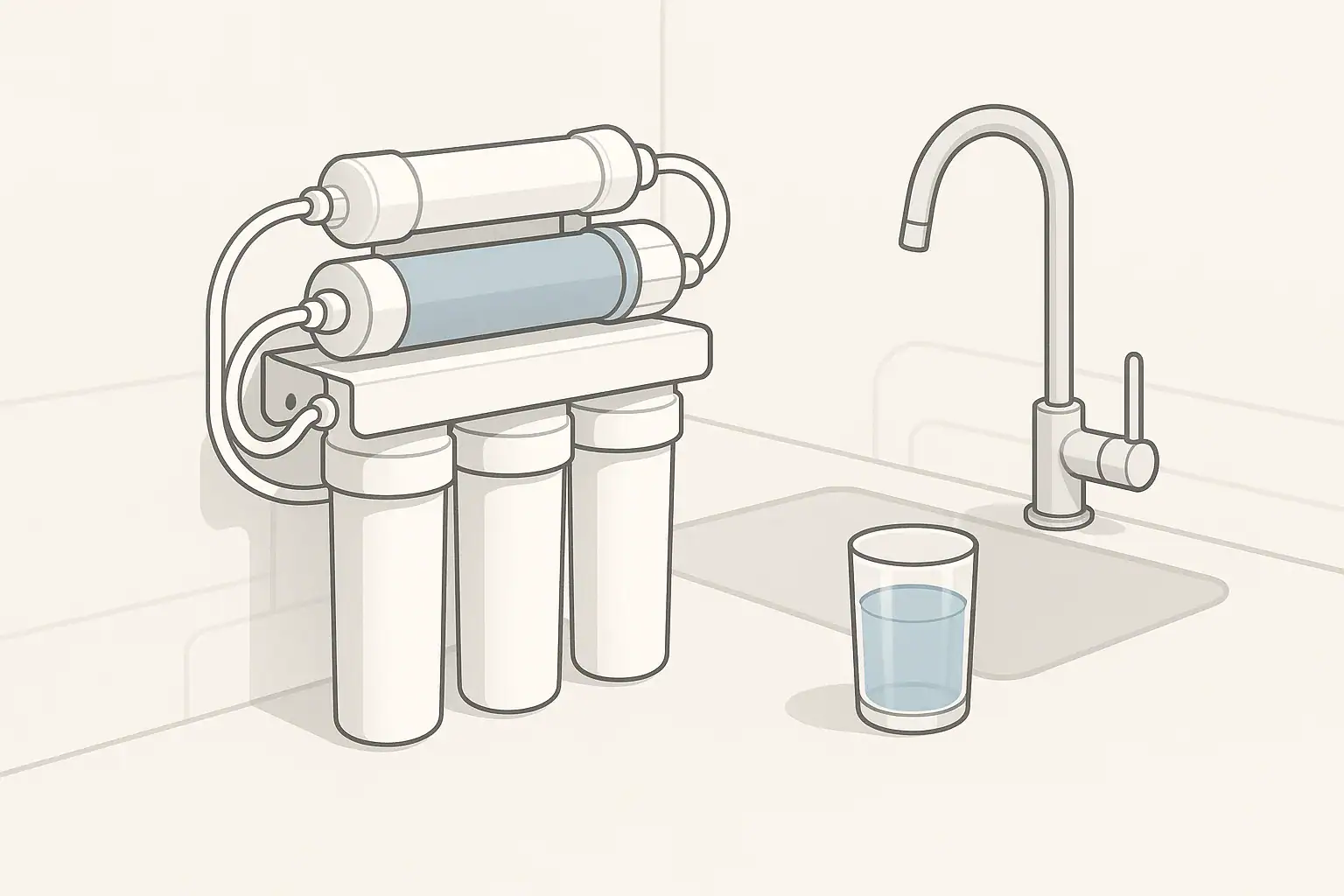
Why Estimate RO Maintenance Costs Up Front
Reverse osmosis (RO) systems can produce very low TDS drinking water, but the long-term cost is mostly in filter and membrane replacement, not the initial purchase. Planning your yearly maintenance budget helps you:
- Avoid surprise costs when multiple cartridges are due at once
- Compare RO to other filtration options more fairly
- Decide whether a specific system size or style fits your budget
- Match replacement timing to your water quality and usage
This guide walks through a simple RO maintenance cost estimator focused on two major items:
- Prefilters (sediment and carbon stages)
- RO membrane (the core semi-permeable element)
Exact prices vary by brand and location, so we will use example ranges only and show how to build your own estimate.
Key Parts That Drive RO Maintenance Cost
An under-sink RO system typically contains several standard components. Each has a different replacement interval and cost range, which together create your annual total.
Sediment Prefilter
The sediment prefilter is usually the first stage. It screens out sand, rust, and fine particles that could clog downstream filters and the RO membrane.
- Typical interval: about 6–12 months, often changed with carbon prefilters
- Function: removes physical particles only, not chemicals
- Impact on cost: generally one of the lowest-cost cartridges, but replaced frequently
Carbon Prefilters
Most RO units include one or two carbon stages before the membrane.
- Typical interval: 6–12 months (sometimes longer on low-chlorine water)
- Function: reduces chlorine, some chloramine, and taste/odor compounds that can damage the membrane or affect flavor
- Impact on cost: moderate; more stages mean more cartridges to replace
RO Membrane
The RO membrane is the main separation stage. It usually costs more than individual prefilters but is replaced less often.
- Typical interval: roughly 2–5 years, depending on water quality, chlorine control, and usage
- Function: significantly reduces dissolved solids such as salts, many metals, and some other dissolved contaminants
- Impact on cost: larger line item but averaged over several years
Postfilter (Polishing Filter)
After the storage tank, RO systems commonly use a carbon postfilter to polish taste.
- Typical interval: 12 months (often swapped together with prefilters)
- Function: improves taste and odor from the storage tank and final plumbing
- Impact on cost: small to moderate, adds to yearly cartridge set
Optional Stages
Some systems have extra stages, such as remineralization or specialized media for particular contaminants. These add replacement cost and may have different intervals.
- Remineralization cartridges for taste and alkalinity
- Additional carbon or media cartridges for specific contaminants
- Inline fridge or ice-maker polishing filters connected to the RO line
For a basic estimator focused on essentials, many households mainly track:
- One sediment prefilter
- One or two carbon prefilters
- One carbon postfilter
- One RO membrane
Example values for illustration.
| Stage | Typical role | Relative cost impact | Replacement frequency |
|---|---|---|---|
| Sediment prefilter | Captures sand, rust, fine particles | Low | 2x per year or yearly |
| Carbon prefilter #1 | Reduces chlorine, helps protect membrane | Medium | Yearly (sometimes more often) |
| Carbon prefilter #2 | Additional chlorine and organic reduction | Medium | Yearly |
| RO membrane | Main reduction of dissolved solids | High (spread over several years) | Every 2–5 years |
| Carbon postfilter | Final taste and odor polishing | Low to medium | Yearly |
| Optional remineralization | Adds minerals and adjusts taste | Low to medium | Yearly (varies) |
| Optional specialty media | Target specific contaminants | Variable | 6–24 months (varies) |
Use this checklist to see which stages your system has and how often they are typically changed.
Step-by-Step RO Maintenance Cost Estimator
You can build a simple RO maintenance cost estimator using four main inputs (see our Cost per Gallon Calculator):
- Number of prefilter and postfilter cartridges
- Replacement interval for each group of cartridges
- RO membrane cost and service life
- Water quality and usage factors that shorten or extend intervals
1. Count Your Prefilters and Postfilters
Look at the system diagram or under the sink and note how many standard cartridges you have that are changed on a similar schedule — you can also try our Replacement Planner Tool to estimate change dates.
- Sediment cartridge (usually 1)
- Carbon block or granular carbon prefilters (usually 1 or 2)
- Postfilter carbon cartridge (usually 1)
- Any optional taste, remineralization, or specialty cartridges
Group cartridges that are typically changed together, for example:
- Group A: sediment + carbon prefilters + postfilter (annual set)
- Group B: remineralization cartridge (annual)
2. Assign Example Prices to Each Group
Since actual pricing depends on brand and size, it helps to assign a reasonable example range. For many common residential RO systems, households might see:
- Prefilter + postfilter pack: a modest cost range per full set changed once per year
- Optional extras: smaller additions to the yearly total
For estimating, pick conservative mid-range numbers. If you know your exact cartridge prices, plug those in directly.
3. Spread RO Membrane Cost Over Its Service Life
The RO membrane is usually replaced far less often than prefilters. To estimate an annualized cost:
- Take the membrane replacement cost (for example, a moderate price for a typical residential membrane).
- Divide by the expected service life in years (for example, 3 years).
- This gives a per-year cost to add to your total.
For example only, if your membrane costs a moderate dollar amount and lasts 3 years, the annualized cost would be roughly one-third of that price, added to each year of your budget.
4. Adjust for Water Quality and Usage
Two homes with the same RO system can see different replacement intervals. Consider these factors when estimating costs:
- Chlorine or chloramine levels: higher levels may require more frequent carbon changes to protect the membrane.
- Hardness and scaling tendency: harder water can shorten membrane life if not controlled.
- Incoming sediment load: very turbid water can clog sediment filters faster.
- Daily water use: a large household using several gallons per day will likely replace cartridges more often than a single-person home.
If your water is relatively clean and usage is light, you may be comfortable using the upper end of recommended intervals. With heavier usage or challenging water conditions, it is safer to budget for the shorter interval side — consider our Filter Capacity Calculator to convert daily use into months.
Typical Annual RO Filter Costs in Different Situations
Because pricing varies, it is useful to think in scenarios rather than exact numbers. You can compare your home to these examples and adjust up or down.
Scenario 1: Small Household on Treated City Water
In this situation, chlorine is usually present and sediment is moderate. A 2–3 person home might use a few gallons of RO water per day for drinking and cooking.
An annual estimate might include:
- One full set of sediment and carbon prefilters
- One carbon postfilter
- Optional remineralization cartridge, if present
- Annualized share of membrane cost (for example, 1/3 or 1/4 of a replacement membrane per year)
This case often represents a moderate baseline yearly cost.
Scenario 2: Large Household with Heavy RO Use
A larger family or a home that uses RO water for cooking, coffee, tea, and possibly feeding an ice maker can draw much more water through the filters.
An estimate might include:
- One to two full prefilter sets per year
- One to two postfilters per year, depending on taste changes
- Annualized membrane cost, possibly assuming a shorter service life (for example, 2–3 years instead of 4–5)
The yearly cost is likely higher than in a small household, mainly due to more frequent prefilter changes.
Scenario 3: Well Water with Pre-Treatment
Many wells require sediment or iron reduction before RO. If pre-treatment is correctly sized and maintained, the RO system may still see reasonable filter life.
An annual estimate might include:
- One full prefilter and postfilter set per year (sometimes more if residual sediment is high)
- Annualized membrane cost based on how well hardness and iron are managed
- Separate maintenance budget for whole-house or pre-RO filters
In this case, total water treatment costs include both RO and pre-treatment equipment, so the RO portion is only part of the overall picture.
Planning a Multi-Year RO Maintenance Budget
Instead of thinking year-by-year, it can help to plan in 3–5 year cycles, especially because the membrane does not need annual replacement in typical conditions.
Build a 3-Year Cost Picture
For a simple 3-year plan, list:
- Yearly prefilter and postfilter sets
- Membrane replacement in year 3 (or 4 or 5, depending on your assumption)
- Any optional stage replacements
Sum the total and divide by 3. This gives you an average annual figure that includes the membrane. You can then compare that average to other filtration methods or to your budget comfort level.
Budget Margin for Water Changes and Surprises
Water utilities may change disinfectant types, seasonal water quality can shift, and household size can change over time. When estimating costs, it is reasonable to:
- Add a small margin above your calculated average annual cost
- Plan for at least one unexpected early cartridge change in a multi-year period
- Re-check replacement frequency after the first year based on real usage
Example values for illustration.
| Component | Year 1 | Year 2 | Year 3 | Notes |
|---|---|---|---|---|
| Sediment prefilter | Replace | Replace | Replace | Consider mid-year change if water is very cloudy |
| Carbon prefilter #1 | Replace | Replace | Replace | Protects membrane from chlorine |
| Carbon prefilter #2 (if present) | Replace | Replace | Replace | May be combined in a multi-stage cartridge |
| Carbon postfilter | Replace | Replace | Replace | Change sooner if taste or odor changes |
| RO membrane | Check | Check | Replace (example) | Use TDS or performance changes to guide timing |
| Optional remineralization | Replace | Replace | Replace | Adjust timing to taste preference |
| System sanitization | Recommended | Recommended | Recommended | Often done during annual filter change |
Use this planner as a template and fill in actual dates and costs from your system.
Related guides: Replacement Planner Tool: Estimate Your Next Filter Change Date • Cost per Gallon Calculator: How to Compare Filters Fairly • Filter Capacity Calculator: Convert Daily Use into Months • Flow Rate Calculator: Estimate GPM for Your Kitchen Faucet • Filter Selector Quiz: Find the Right Filter Type in 2 Minutes
Practical Tips to Keep RO Maintenance Costs Predictable
A few habits can keep your RO maintenance costs closer to your estimates and help avoid premature replacement.
- Track installation and change dates: write the month and year on each cartridge, or keep a simple log.
- Observe performance changes: lower flow, changing taste, or rising TDS readings can signal filters or membranes are due.
- Protect the membrane from disinfectants: ensure carbon prefilters are changed on time so chlorine or other disinfectants do not reach the membrane.
- Maintain adequate feed water pressure: RO performance and membrane life are influenced by pressure; avoid operating far below the unit’s recommended range.
- Do not stretch intervals excessively: delaying filter changes may reduce water quality and shorten membrane life, increasing long-term costs.
By combining a simple estimator with real-world observation of your system, you can keep your RO water reliable and your maintenance budget under control without guesswork.
Frequently asked questions
How often should I plan to replace prefilters and postfilters?
Most prefilters and postfilters are replaced every 6–12 months; many households use an annual full set change. Increase frequency for high sediment, high chlorine, or heavy household use.
How do I annualize the cost of an RO membrane?
Divide the membrane purchase price by its expected service life (commonly 2–5 years). Add that annualized amount to your yearly cartridge costs to get a realistic budget.
What signs show the membrane needs replacement?
Watch for rising TDS in the product water, noticeably lower production flow, or persistent taste/odor issues after changing prefilters—these indicate membrane decline.
Do households on well water need a different budget approach?
Yes. Budget for pre-treatment (sediment, iron, or water softening) and possibly more frequent prefilter changes. Treating feed-water issues often extends membrane life and can lower overall RO costs.
Recommended next:
- Cost per Gallon Calculator: How to Compare Filters Fairly
- Replacement Planner Tool: Estimate Your Next Filter Change Date
- Flow Rate Calculator: Estimate GPM for Your Kitchen Faucet
- Filter Selector Quiz: Find the Right Filter Type in 2 Minutes
- Cost per Gallon Walkthrough: Pitcher vs Under-Sink Example
- Filter Capacity Calculator: Convert Daily Use into Months
- More in Tools & Calculators →
- NSF/ANSI standards explained (42/53/401/58)
- Clear trade-offs: pitcher vs faucet vs under-sink vs RO
- Maintenance planning: cost per gallon and replacement cadence