
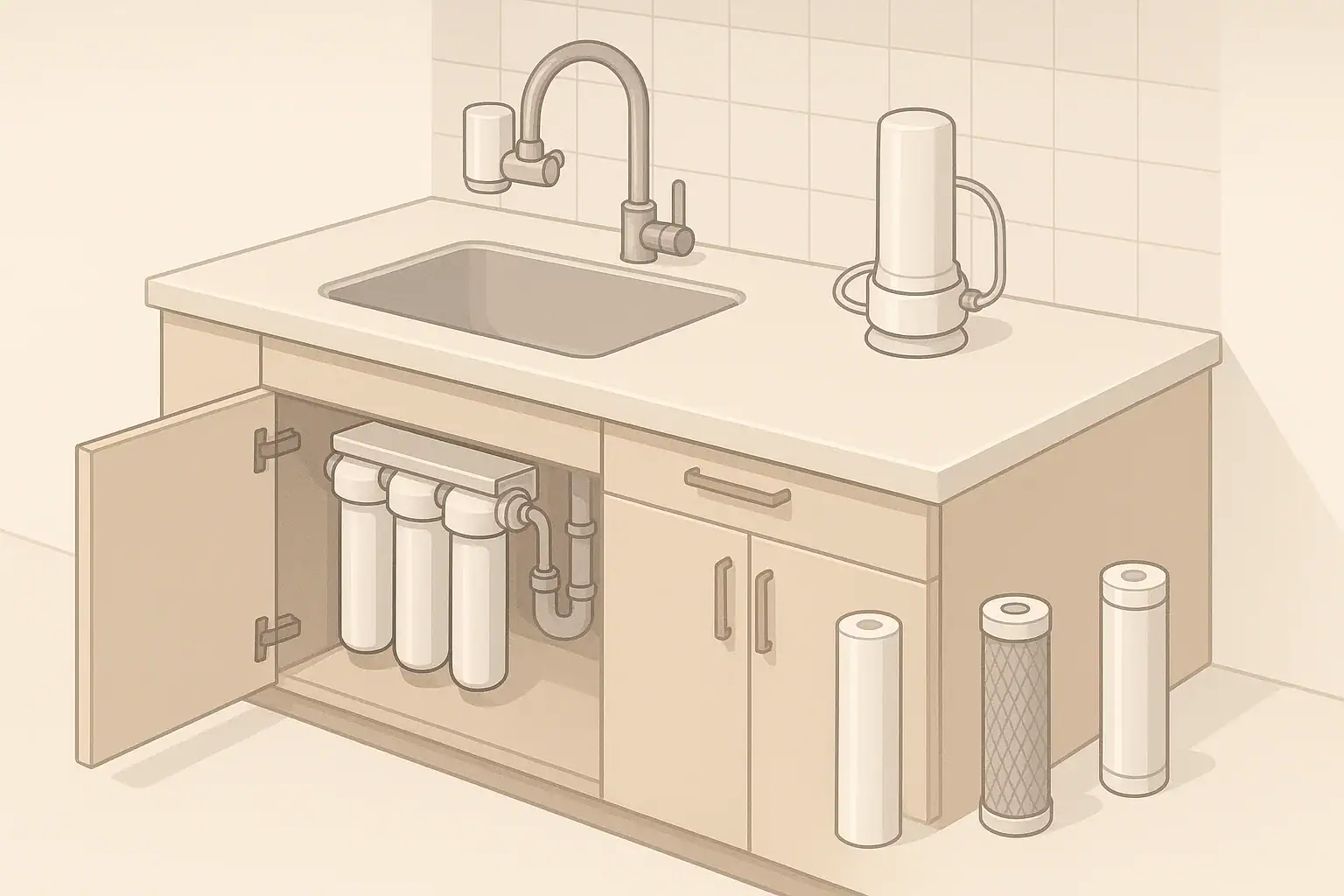
How This Filter Selector Quiz Works
Choosing a water filter can feel overwhelming. Pitcher, faucet, under-sink, reverse osmosis, whole house, UV, or just a simple sediment cartridge—each solves different problems. This filter selector quiz walks you through a few quick questions so you can narrow down realistic options instead of guessing.
Use this quiz as a planning tool, not as a diagnosis. If you have serious water quality concerns, consider professional testing or your local water report. The quiz helps you match:
- Your water source: city water vs. private well
- Your main issues: taste, sediment, hardness, specific contaminants
- Your living situation: owner vs. renter, space limits
- Your expectations: basic taste improvement vs. broader contaminant reduction
Work through the questions in order, then check the summary of filter types that typically fit your profile.
Step 1: Start With Your Water Source
The first step in any filter selector quiz is simple: where does your water come from? City water and well water usually need different approaches.
If You Use City (Municipal) Water
Most city water is disinfected and monitored. Common concerns are:
- Chlorine or chloramine taste and odor
- Discolored water from aging pipes
- Concerns about lead from plumbing components
- Interest in reducing PFAS, pesticides, or other organic chemicals
For city water, people often start with:
- Basic carbon filters (pitcher, faucet mount, or under-sink) for taste and odor
- Certified under-sink carbon systems for lead and common chemical reduction
- Reverse osmosis (RO) when they want broader contaminant reduction and are comfortable with a slower flow and some wastewater
If You Use Private Well Water
Private wells are not usually monitored by a public utility. Water quality can vary even between neighbors. Common concerns are:
- Sand, grit, or visible particles
- Staining from iron or manganese
- Hardness causing scale on fixtures and appliances
- Potential bacteria or other microorganisms
For well water, people often consider:
- Sediment pre-filters to protect plumbing and other filters
- Whole-house filtration for iron or heavy sediment
- Water softeners for hardness and scale (not a drinking-water filter, but a treatment step)
- UV disinfection units when microbial contamination is a concern
Quiz checkpoint: Note your source as “city” or “well” before moving on. It will shape your final recommendations.
Example values for illustration.
| Situation | Primary issue | Common starting filter type |
|---|---|---|
| City apartment, limited space | Chlorine taste | Pitcher or faucet-mounted carbon filter |
| City home, cooking and drinking focus | Taste + broad contaminant reduction | Under-sink carbon or RO system |
| Well water, visible particles | Sand and sediment | Whole-house or point-of-entry sediment filter |
| Well water, hardness scale | Scale on fixtures | Water softener plus drinking-water filter |
| Older home with lead concern | Potential lead from plumbing | Under-sink cartridge tested for lead reduction |
| Concern about many contaminants | Multiple dissolved substances | Reverse osmosis with pre-filters and post-filter |
| Intermittent use, vacation cabin | Uncertain well quality | Cartridge sediment + carbon, consider UV |
Step 2: Identify Your Main Water Goals
Next, clarify what you actually want the filter to do. Many people over-specify or under-specify because they skip this step. Choose the one or two goals that matter most to you.
Goal A: Better Taste and Odor Only
If you mainly dislike the smell or taste of chlorine or musty pipes, but you are otherwise comfortable with your water report, you may not need an advanced system. Typical options include:
- Pitcher filters: Simple, no installation, gravity-fed carbon cartridges.
- Faucet-mounted filters: Attach to the faucet, let you switch between filtered and unfiltered water.
- Basic under-sink carbon filters: Installed on the cold line or with a dedicated faucet, usually with higher capacity than pitchers.
Quiz path: If this is your only major goal and you are on city water, your quiz result will likely point toward carbon-based filters rather than reverse osmosis.
Goal B: Targeting Specific Contaminants
If you are aiming to reduce particular substances (such as lead, certain industrial chemicals, or some pesticides), your choices should be more focused. Look for:
- Filters that state the types of contaminants they are designed to reduce, based on recognized testing standards.
- Products with detailed performance data sheets rather than vague claims.
Carbon filters are often used for many organic chemicals and chlorine-related compounds, while specialized media and membranes are used for metals and other dissolved substances. This is where under-sink cartridge systems and some pitcher or faucet filters with specific test data become more relevant.
Goal C: Broad Reduction of Many Dissolved Substances
If you have a long list of potential contaminants, high total dissolved solids (TDS), or simply want a more comprehensive system at a single tap, reverse osmosis (RO) frequently appears in quiz results. RO typically includes:
- Pre-filtration such as sediment and carbon
- A semi-permeable membrane
- Optional post-filters or remineralization cartridges
- A storage tank or tankless design with internal controls
RO can be slower and produces a wastewater stream, but many people accept this trade-off for the wider range of dissolved substances it can reduce.
Goal D: Whole-House Protection
When your primary concern is protecting plumbing, fixtures, and appliances across the home, point-of-entry systems are more useful than a single drinking water faucet:
- Whole-house sediment filters for sand, rust, and large particles
- Whole-house carbon units for taste and odor at every tap
- Water softeners (for hardness and scale) paired with a separate drinking-water filter
Quiz path: If your main concern is protecting pipes and appliances, your result will likely combine a whole-house solution with one or two point-of-use filters for water you drink and cook with.
Step 3: Match Filter Types to Your Living Situation
Even if a filter looks ideal on paper, it has to work with your space and level of control over plumbing. The quiz considers how and where you live.
For Renters and Apartments
If you cannot modify plumbing or drill into counters, look at non-permanent options:
- Pitcher filters: No plumbing changes.
- Dispenser or countertop gravity filters: Sit on the counter or in the fridge.
- Faucet-mounted filters: Screw onto compatible faucets and can be removed when you move.
- Portable countertop RO units: Some connect with temporary adapters instead of permanent lines.
Quiz hint: If you select “renter” and “no drilling,” the quiz will favor pitchers, faucet filters, and countertop units.
For Owners and Long-Term Homes
If you can modify plumbing and plan to stay in place, more permanent options open up:
- Under-sink carbon filters with dedicated drinking faucets
- Under-sink RO systems with tanks or tankless designs
- Whole-house filters on the main water line
These systems usually cost more upfront but may have a lower cost per gallon and a more seamless daily experience.
Space and Access Considerations
As you answer quiz questions about your kitchen layout, keep these points in mind:
- Under-sink space: Measure roughly. Tanks and multiple cartridges need more room.
- Electrical outlets: Some advanced RO, UV systems, and booster pumps require nearby power.
- Drain access: Many RO systems require a drain connection for wastewater; this should be installed safely and according to plumbing codes.
Step 4: Flow Rate, Convenience, and Maintenance Preferences
This part of the quiz focuses on how the filter will feel in daily use. A great filter on paper is not useful if it is too slow or difficult to maintain.
Desired Flow Rate
Filters naturally create some resistance to flow. The more fine and complex the filtration, the more planning you need around flow rate.
- High flow expectations: Whole-house and some under-sink carbon systems are designed for higher flow at standard household pressure.
- Moderate flow expectations: Faucet-mounted filters and many under-sink carbon systems work well for drinking and cooking water.
- Lower flow acceptance: RO systems and gravity pitchers are slower by design; you often fill a tank ahead of time.
Maintenance Style
The quiz also asks how often you are willing to interact with the system.
- Low maintenance tolerance: Look for systems with longer cartridge life and clear replacement indicators.
- Okay with frequent small tasks: Pitcher filters and faucet cartridges usually have smaller capacities and need more frequent changes.
- Comfortable with occasional more involved maintenance: Whole-house systems may need periodic valve operation, cartridge changes, or media replacement.
Budget and Operating Cost
The quiz usually separates costs into:
- Upfront cost: Unit price and any professional installation.
- Ongoing cost: Replacement cartridges, media, and potential wastewater for RO.
As a rough example, a simple pitcher filter has low upfront cost but may have a higher cost per gallon if cartridges are small and changed frequently, while an under-sink cartridge with a higher capacity might have more upfront cost but a lower ongoing cost per gallon.
Step 5: Interpreting Your Quiz Result by Filter Type
After answering about source, goals, living situation, and preferences, most filter selector quizzes suggest one or two main types to consider. Use the summaries below to interpret your result.
Pitcher and Dispenser Filters
Best when:
- You rent or move often.
- Your primary concern is taste and basic odor.
- You are okay refilling and waiting for gravity filtration.
These are often an entry-level option — see our best pitcher filters for recommendations. Some models are tested for more than basic taste and odor, but capacity and flow are limited.
Faucet-Mounted Filters
Best when:
- You want on-demand filtered water without under-sink work.
- You accept some change to faucet appearance.
- You have a compatible faucet design.
These typically run tap water through a small carbon cartridge and may have a toggle for filtered vs. unfiltered water.
Under-Sink Carbon Systems
Best when:
- You own your home or have permission to modify plumbing.
- You want better taste and targeted contaminant reduction at a single tap.
- You prefer higher capacity than pitchers or faucet filters.
Under-sink cartridge systems can be simple single-stage carbon units or multi-stage setups with sediment, carbon, and specialized media.
Reverse Osmosis (RO) Systems
Best when:
- You want broad reduction of many dissolved substances at one tap.
- You accept slower production and some wastewater.
- You have under-sink space and appropriate plumbing access.
Typical household RO systems use multiple stages and may include remineralization cartridges if a particular taste or mineral profile is desired.
Whole-House Filters and Softeners
Best when:
- You have well water with sediment, iron, or hardness.
- You want to protect appliances, pipes, and fixtures.
- You are comfortable with a more complex installation.
These are usually combined with smaller point-of-use filters for drinking water, especially if you want additional treatment beyond what a whole-house unit provides.
UV Disinfection Units
Best when:
- You are on a private well with confirmed microbial issues or risk.
- You understand that UV is for disinfection, not for removing chemicals or metals.
- You can maintain pre-filtration so the UV chamber stays clear.
UV systems are commonly added after sediment and sometimes carbon filters in well setups.
Example values for illustration.
| Filter type | Typical replacement range (time) | Notes |
|---|---|---|
| Pitcher carbon cartridge | About 1–3 months | Shorter if family size or usage is high |
| Faucet-mounted cartridge | About 2–4 months | Often based on approximate gallons used |
| Under-sink carbon cartridge | About 6–12 months | Depends on water quality and capacity rating |
| RO sediment or carbon pre-filter | About 6–12 months | Protects the RO membrane from clogging |
| RO membrane | About 2–5 years | Lifetime varies with feed water and care |
| Whole-house sediment cartridge | About 3–12 months | Shorter if sediment load is heavy |
| UV lamp | About 12 months | Often replaced annually based on run hours |
Related guides: Cost per Gallon Calculator: How to Compare Filters Fairly • Replacement Planner Tool: Estimate Your Next Filter Change Date • Flow Rate Calculator: Estimate GPM for Your Kitchen Faucet
Using the Quiz Results to Plan Your Next Steps
Once you have your quiz result—for example, “city water + taste complaints + renter + low maintenance” pointing toward a pitcher or faucet filter—you can refine from there:
- Confirm your water source and check any available water quality reports.
- Write down your top two issues (for instance, “chlorine taste” and “possible lead from old plumbing”).
- Decide how permanent you want the solution to be.
- Estimate how often you are willing to change filters and what budget feels realistic.
From that point, you can compare specific product types, capacities, and test data that match your quiz outcome. The goal is not to find a perfect or extreme solution, but a practical filter that addresses your main concerns without adding unnecessary complexity.
As your situation changes—moving homes, switching between city water and a well, or adding family members—you can revisit the same basic quiz questions and adjust your filtration approach accordingly.
Frequently asked questions
Do I need a whole-house filter or just a point-of-use filter?
Choose a whole-house filter when your priority is protecting plumbing, appliances, or removing large sediment or hardness across every tap. Pick a point-of-use filter (pitcher, faucet, under-sink, or RO) when your main goal is drinking and cooking water at a single location.
Can a simple pitcher or faucet filter remove lead?
Some carbon-based pitchers and faucet filters are tested to reduce lead, but performance varies. Check the product’s performance data or independent test results to confirm lead reduction rather than assuming all basic filters will do so.
How often should I replace filter cartridges?
Replacement frequency depends on filter type, water quality, and usage. Typical ranges are months for pitchers and faucet cartridges, 6–12 months for many under-sink and pre-filters, and years for RO membranes. Use the manufacturer’s guidance and watch flow or taste changes.
Does reverse osmosis waste a lot of water?
RO systems produce a wastewater stream; the amount varies by system and water pressure. Expect some reject water, and factor that into operating cost and water use when choosing RO.
Recommended next:
- NSF/ANSI standards explained (42/53/401/58)
- Clear trade-offs: pitcher vs faucet vs under-sink vs RO
- Maintenance planning: cost per gallon and replacement cadence