
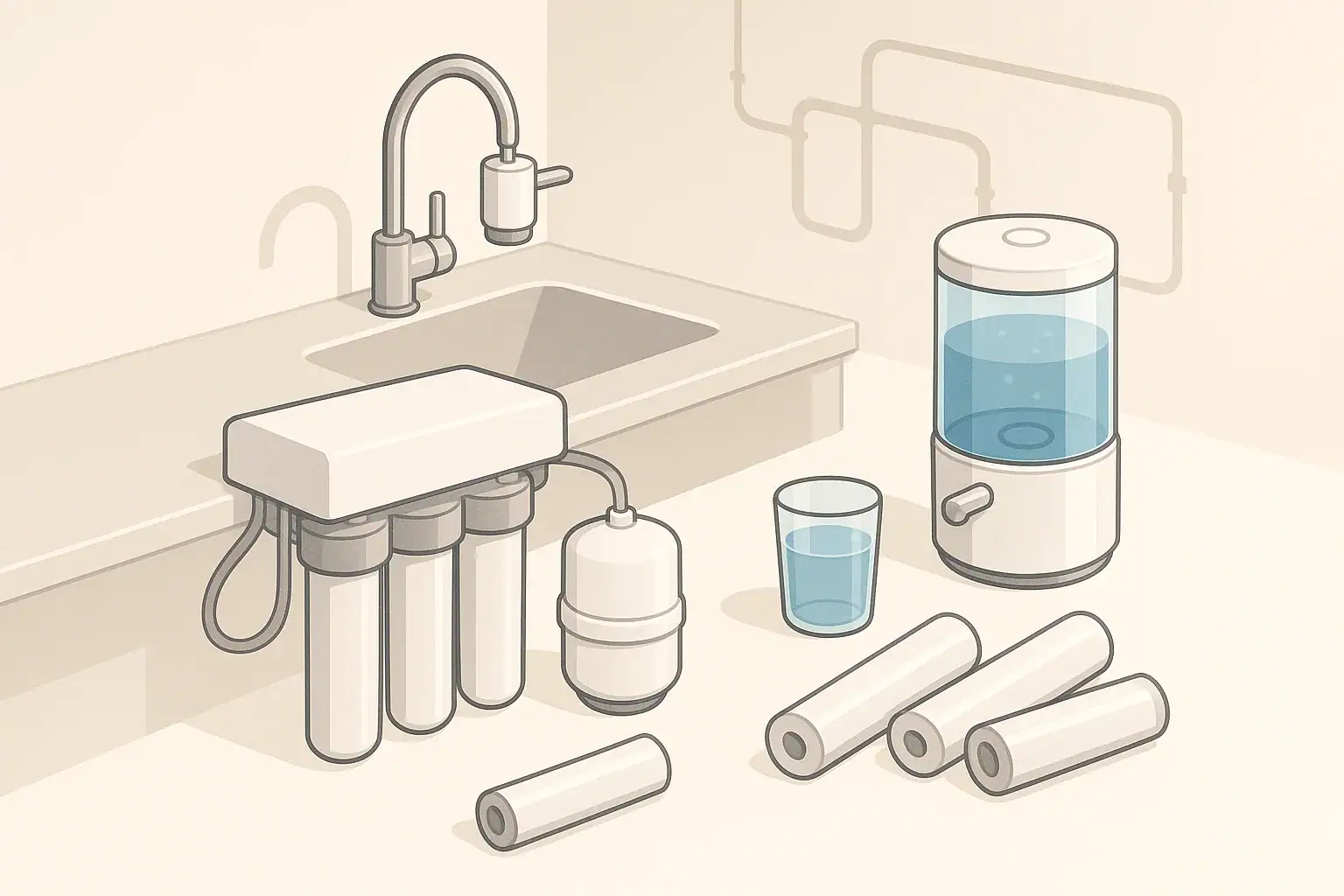
A home can have more than one water filter working at the same time. A kitchen sink may use an under-sink carbon system, the refrigerator may have its own cartridge, a reverse osmosis system may use several stages, and a well water setup may include sediment filtration ahead of other treatment equipment. Each part may have a different service interval.
A filter replacement calendar template helps turn those separate timelines into one practical maintenance plan. It is not meant to replace the instructions for a specific product. Instead, it gives you a structured way to record what exists, when it was installed, what the expected interval is, and what should trigger an earlier check.
Replacement timing matters for several ordinary reasons. A clogged sediment cartridge can reduce flow. An exhausted carbon cartridge may stop helping with taste and odor as effectively. A reverse osmosis membrane may last longer than prefilters, but only if the front-end cartridges are maintained. A UV lamp may still glow after its recommended service period, but the disinfection performance depends on the rated lamp life and clean sleeve condition.
The goal is not to change every filter early or stretch every filter as long as possible. The goal is to plan calmly, follow the applicable manual, and adjust for real household conditions.
Why a Filter Replacement Calendar Matters
A home can have more than one water filter working at the same time. A kitchen sink may use an under-sink carbon system, the refrigerator may have its own cartridge, a reverse osmosis system may use several stages, and a well water setup may include sediment filtration ahead of other treatment equipment. Each part may have a different service interval.
A filter replacement calendar template helps turn those separate timelines into one practical maintenance plan. It is not meant to replace the instructions for a specific product. Instead, it gives you a structured way to record what exists, when it was installed, what the expected interval is, and what should trigger an earlier check.
Replacement timing matters for several ordinary reasons. A clogged sediment cartridge can reduce flow. An exhausted carbon cartridge may stop helping with taste and odor as effectively. A reverse osmosis membrane may last longer than prefilters, but only if the front-end cartridges are maintained. A UV lamp may still glow after its recommended service period, but the disinfection performance depends on the rated lamp life and clean sleeve condition.
The goal is not to change every filter early or stretch every filter as long as possible. The goal is to plan calmly, follow the applicable manual, and adjust for real household conditions.
List Every Filter and Maintenance Item First
The first step is a complete inventory. Walk through the home and write down every water treatment component that has a replaceable cartridge, lamp, sleeve, membrane, or maintenance step. Include small systems that are easy to forget, such as refrigerator filters or faucet-mounted cartridges.
Include the parts that are not obvious
Many systems are described by their main technology, but the maintenance calendar usually depends on several parts. For example, a reverse osmosis system may include sediment prefiltration, carbon prefiltration, the RO membrane, a storage tank, a post-carbon filter, and sometimes a remineralization cartridge. A UV system may include a lamp and quartz sleeve. A whole-house setup may include a large sediment filter ahead of a softener or carbon tank.
For each item, record:
- System location, such as kitchen sink, refrigerator, utility room, or basement
- Filter or component type, such as sediment, carbon, membrane, UV lamp, or remineralization stage
- Installation date
- Expected service interval from the manual or supplier documentation
- Any usage limit, if provided, such as gallons treated
- Signs that service may be needed sooner, such as pressure drop or taste change
- Whether sanitation, flushing, or disposal steps are required during replacement
If a filter housing has no clear label or you inherited the system with the home, avoid guessing at compatibility. Use the documentation, a qualified service professional, or the system supplier to identify the correct replacement parts.
Example values for illustration.
| Calendar field | Why it helps | Example entry |
|---|---|---|
| System location | Prevents confusion when several filters look similar | Kitchen sink cabinet |
| Component type | Identifies the maintenance interval category | Carbon block cartridge |
| Install date | Starts the service clock | March 10 |
| Expected interval | Sets the reminder date | Six months |
| Usage basis | Accounts for gallon-rated filters where applicable | Household drinking water use |
| Early warning signs | Prompts inspection before the calendar date | Lower faucet flow |
| Service notes | Captures flushing, sanitation, or leak checks | Flush before use |
Set Intervals by System Type, Use, and Water Conditions
Most replacement calendars start with time-based reminders, but water filters are affected by both time and use. A household of two may put less demand on a drinking water cartridge than a household of five. A home with visible sediment may load a prefilter faster than a home with very low particulate levels.
Common cartridge categories
Sediment filters are commonly placed before other treatment stages to catch sand, silt, rust particles, or other suspended material. Their service life depends heavily on incoming water quality and flow demand. A noticeable pressure drop is often a practical inspection signal.
Carbon filters are commonly used for taste, odor, chlorine reduction, and as prefilters in some multi-stage systems. Their replacement timing may depend on rated capacity, water chemistry, and household use. If the water utility uses chloramine rather than free chlorine, the type and capacity of the carbon stage may matter, so the calendar should reflect the specifications for that particular system.
Reverse osmosis membranes usually have a longer service interval than prefilters, but they are not maintenance-free. Performance can be affected by feed water quality, pressure, temperature, scale, and prefilter condition. Some owners track membrane performance using product guidance and simple indicators such as changes in taste, production rate, or measured reduction trends, without assuming a single number applies to every home.
UV systems have a different maintenance pattern. The lamp and sleeve are central service items. A lamp may need replacement on a fixed schedule even if it appears to produce light. A sleeve may need cleaning or replacement depending on mineral scale, iron, manganese, or other fouling conditions. Follow the system instructions because UV performance depends on exposure conditions, water clarity, and correct operation.
Do not use the calendar as the only authority
A calendar is a planning tool. The product manual, local water conditions, and any professional service advice should set the actual requirements. If a system includes leak detectors, pressure relief features, air gaps, backflow protection, or other safety components, do not bypass them to fit a replacement schedule or simplify plumbing.
Build the Calendar Template
A useful filter replacement calendar can be built in a paper planner, spreadsheet, shared digital calendar, or home maintenance app. The format matters less than the consistency. The best template makes the next action visible before the filter is overdue.
Recommended columns
For a spreadsheet-style template, use one row per component rather than one row per system. A three-stage under-sink system should have three rows if the stages have different intervals. An RO system may need separate rows for sediment prefilter, carbon prefilter, membrane, post-filter, and any remineralization cartridge.
Helpful columns include:
- Area of home
- System name or description
- Component or stage
- Replacement part description
- Install date
- Expected interval
- Next due date
- Reminder date
- Observed condition
- Completed date
- Notes for flushing, sanitation, or leak checks
The reminder date should be earlier than the due date. For a simple household calendar, one to two weeks of lead time is often enough to order supplies, review instructions, and choose a convenient service time. For specialty systems or less common cartridges, a longer lead time may be useful.
Use color carefully
Color coding can help, but it should not be the only label. For example, you might mark items due within 30 days as upcoming and overdue items as needs attention. Still include written due dates so the calendar remains clear when printed or shared.
Coordinate Multiple Systems Without Duplicating Work
When several filters are installed, the calendar should group service tasks in a practical way. This does not mean all filters must be changed on the same day. It means you can combine inspections and avoid opening the same cabinet repeatedly.
For example, a kitchen sink might have an under-sink carbon filter and a separate refrigerator filter nearby. If both are due within a few weeks, it may be convenient to inspect both areas on the same day. For an RO system, prefilters might be replaced more often than the membrane, so the template should preserve the different intervals while still placing them on one maintenance view.
When planning multiple filter stages together, many households find it helpful to estimate the overall cost per gallon so replacement timing and budget stay aligned.
Group by location and shutoff needs
Location is often the simplest grouping method. Kitchen sink items, refrigerator items, utility room items, and whole-house items can each have their own section. If a task requires turning off a feed valve or relieving pressure according to the manual, keep those tasks together only when it is safe and appropriate.
Do not perform plumbing changes that are outside the product instructions or local code. If a housing will not open, a valve leaks, or tubing appears stressed, stop and get qualified help rather than forcing the repair.
Track supplies without stockpiling blindly
Keeping one future replacement cartridge on hand can prevent delays, especially for critical prefilters. However, filters can have storage recommendations, packaging requirements, and shelf-life considerations. Store replacement parts in a clean, dry place and keep them sealed until use unless the instructions say otherwise.
Adjust the Schedule When Conditions Change
A replacement calendar should be reviewed when household use or water conditions change. Moving from one person to four people in the home can increase filter loading. Seasonal irrigation, well disturbance, nearby construction, or plumbing work can temporarily increase sediment. A water utility change in disinfectant practice may affect taste and odor expectations.
Pressure drop is one of the most practical signs that a sediment or carbon cartridge may need attention. It can also be caused by partially closed valves, kinked tubing, or unrelated plumbing issues, so it should be investigated calmly. Taste and odor changes can also prompt a check, but they do not identify a specific contaminant by themselves.
For RO systems, slower production can result from normal membrane aging, cold water, low pressure, clogged prefilters, or tank-related issues. A calendar note describing the symptom is more useful than simply writing bad filter. If the system has a performance monitor or the manual recommends periodic testing, record the result and date.
If slow output continues, it can help to review a focused troubleshooting guide for low RO flow before deciding which part to replace.
Use water testing when decisions depend on water quality
Some maintenance decisions are best informed by water testing, especially for private wells or when treatment is used for a specific water quality concern. Testing needs vary by location and system type. Use appropriate laboratories or field tests for the question at hand, and avoid assuming that clear water is automatically problem-free or that filtered water is absolutely pure.
Example Replacement Planner for a Home with Several Systems
The example below shows how a household might convert different systems into one planning view. The intervals are not universal. They are placeholders that demonstrate how to organize the calendar around component type, location, and reminder timing.
In a real template, replace the example intervals with the instructions for your equipment and the actual conditions in your home. If your system has gallon ratings, pressure requirements, sanitation steps, or lamp-hour requirements, include those details in the notes column.
For homes using several treatment stages, an RO filter replacement schedule can help separate faster-changing prefilters from the longer-life membrane.
Example values for illustration.
| Location | Component | Example timing | Calendar note |
|---|---|---|---|
| Kitchen sink | Sediment prefilter | Every few months to one year | Check sooner if flow drops |
| Kitchen sink | Carbon drinking water cartridge | About six months to one year | Use rated capacity if listed |
| RO system | RO membrane | Longer than prefilters | Track performance trends |
| RO system | Post-carbon filter | Often annual | Flush as instructed |
| Refrigerator | Inline or internal cartridge | Often about six months | Reset indicator only after service |
| Utility room | Whole-house sediment filter | Varies widely | Watch pressure and visible sediment |
| UV system | Lamp and sleeve check | Lamp commonly scheduled by rated life | Clean sleeve if instructed |
Related guides: Replacement Planner Basics • RO Filter Replacement Schedule • Whole House Filter Maintenance Calendar
Recordkeeping and Safe Maintenance Habits
The calendar is most useful when each service visit is recorded immediately. Write down the completed date, any unusual observation, and the next due date. If a leak check is recommended after replacement, note that it was done. If a filter housing, O-ring, tubing, or valve looks worn, record the concern and address it before the next service cycle.
Use reminders in more than one place if missed maintenance has been a problem. A spreadsheet can store the detailed template, while a phone or wall calendar can provide the actual alert. Shared households may benefit from assigning a responsible person for ordering parts and another for confirming the completed date.
Keep the tone of the calendar practical. It should help you notice overdue tasks without creating alarm. Most replacement planning is ordinary home maintenance: know what you have, follow the instructions, use dates that match your conditions, and keep clear notes for the next time.
Frequently asked questions
How often should I update a filter replacement calendar?
Update it whenever a filter is installed, replaced, or inspected, and review it at least a few times a year so reminder dates stay accurate.
Should each filter stage have its own entry?
Yes. If a system has different cartridges or parts with different intervals, list each one separately so nothing gets overlooked.
What if I do not know the installation date?
Estimate only if necessary, then verify using receipts, service records, labels, or supplier documentation. If uncertainty remains, inspect the component sooner.
Can I use one calendar for all home water systems?
Yes. A single calendar works well if it tracks location, component type, due date, and notes for each system or stage.
What signs mean a filter may need attention before the due date?
Common signs include reduced flow, taste or odor changes, pressure drop, slower RO production, or visible sediment buildup.
Recommended next:
- Cost per Gallon Calculator: How to Compare Filters Fairly
- Replacement Planner Tool: Estimate Your Next Filter Change Date
- Flow Rate Calculator: Estimate GPM for Your Kitchen Faucet
- Filter Selector Quiz: Find the Right Filter Type in 2 Minutes
- Cost per Gallon Walkthrough: Pitcher vs Under-Sink Example
- Filter Capacity Calculator: Convert Daily Use into Months
- More in Tools & Calculators →
- NSF/ANSI standards explained (42/53/401/58)
- Clear trade-offs: pitcher vs faucet vs under-sink vs RO
- Maintenance planning: cost per gallon and replacement cadence