
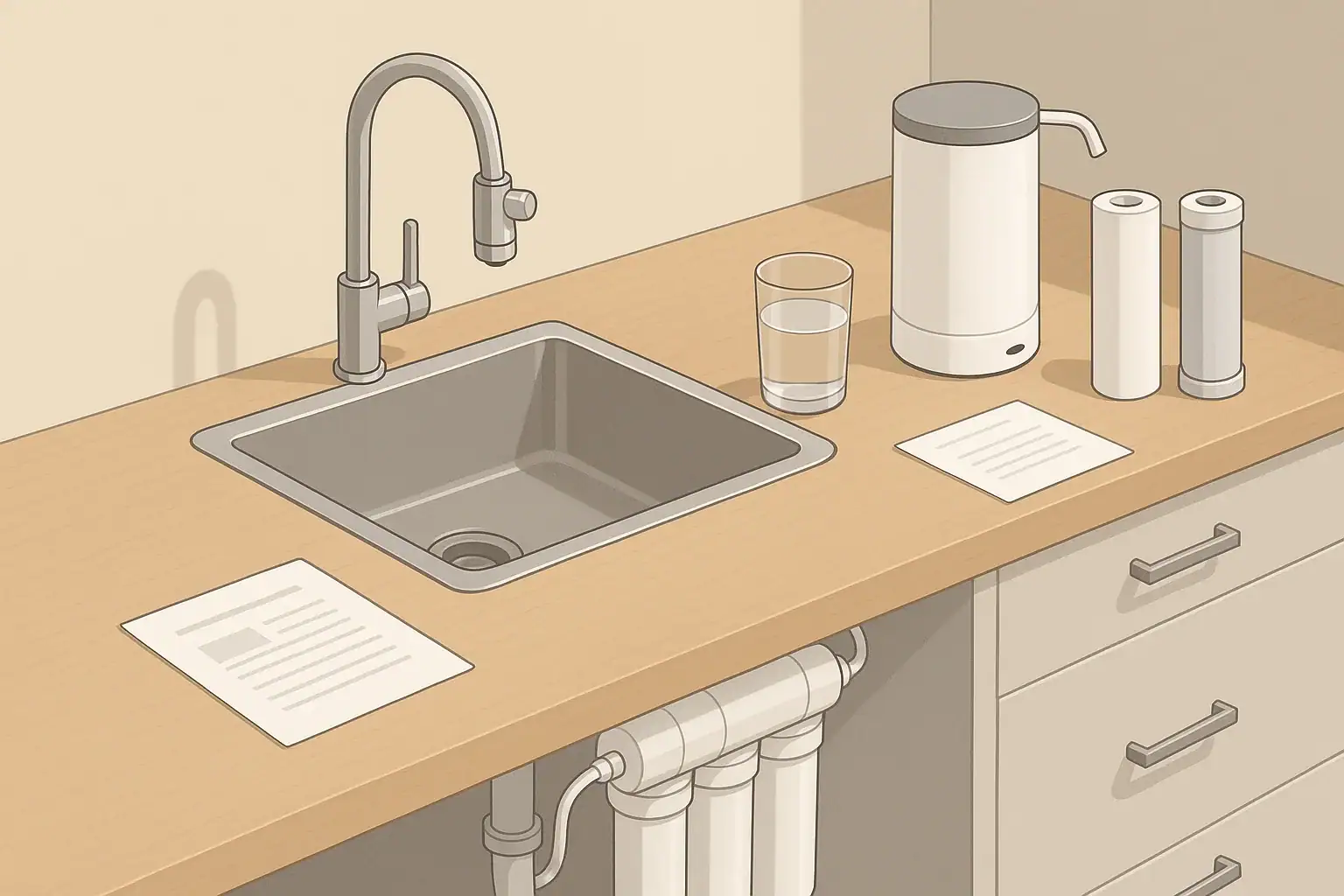
A Consumer Confidence Report, often called a CCR, is one of the most useful starting points for understanding your city water. It is not a personalized home test, and it is not a product recommendation. It is a yearly public report that summarizes regulated drinking water data for a water system.
This CCR quick checklist is designed to help you scan the report calmly and consistently. The goal is to identify the most relevant sections, understand what the data can and cannot tell you, and decide whether any practical next step makes sense for your home, such as targeted testing, simple taste-and-odor filtration, or a more comprehensive under-sink system.
What a CCR tells you—and what it does not
A CCR summarizes water quality after a utility has collected required samples and reported results under drinking water regulations. It usually includes information about the water source, detected regulated contaminants, disinfectants, compliance status, and any required notices.
For many households on city water, the CCR is the best first document to read before buying filters. It can help you avoid guessing. For example, if the report shows disinfectant use, you may have a reason to consider an activated carbon filter for taste and odor. If the report shows certain regulated contaminants were detected, you can look more carefully at reduction claims and independent testing standards when comparing filter types.
What the CCR covers well
A city report is most useful for system-wide patterns. It can show whether contaminants were detected in source water or treated water, whether the system had monitoring or compliance issues, and how results compare with regulatory benchmarks.
It may also describe treatment steps used by the utility, such as disinfection, corrosion control, filtration, or source blending. These details can explain why water quality changes by season or why taste changes after utility maintenance.
What the CCR may not answer
A CCR does not measure water from your specific kitchen faucet. Water can change as it travels through service lines, building plumbing, water heaters, and fixtures. That matters especially for plumbing-related concerns such as lead, copper, sediment from old pipes, or taste issues that only occur in one sink.
The report also may not include every substance people ask about. Some topics, such as hardness, total dissolved solids, or emerging contaminants, may appear only if the utility chooses to include them or is required to monitor them. Absence from a CCR does not always mean absence from the water.
Set up your quick scan before reading
Before reading the tables in a CCR, gather a few basics. This prevents a common mistake: reading the wrong water system report. Large metro areas can have multiple utilities, wholesale suppliers, pressure zones, and blended sources.
Confirm the correct water system
Look for the water system name, service area, and reporting year. If you rent, live in a multifamily building, or recently moved, your billing information or property manager may help confirm which system serves the address.
Do not assume the nearest city name is the same as your water provider. Some suburbs buy treated water from another system. Others operate independent wells or use a combination of sources.
Write down your household questions
Your checklist should reflect your actual concerns. Common city-water questions include:
- Does the water have a chlorine or chloramine taste?
- Is there visible sediment after plumbing work or main flushing?
- Is the home older, with possible older service lines or plumbing materials?
- Is the goal better taste for drinking, coffee, tea, or ice?
- Is the goal broader contaminant reduction at one faucet?
These questions help you interpret the CCR without treating every detected item as an emergency. Most reports contain many technical terms, and many detected substances are present at very low levels.
Example values for illustration.
| Checklist item | What to look for | Why it matters |
|---|---|---|
| Water system name | Utility or public water system serving the address | Confirms you are reading the right report |
| Reporting year | Most recent annual report available | Shows whether the data is current enough for planning |
| Source water | Groundwater, surface water, purchased water, or blended sources | Helps explain mineral content, seasonal changes, and treatment needs |
| Disinfectant | Chlorine, chloramine, or other disinfection language | Guides taste-and-odor filter expectations |
| Detected contaminants | Items listed as detected in regulated monitoring tables | Identifies which filter reduction claims may be relevant |
| Violations or notices | Monitoring issues, treatment technique notices, or exceedances | Signals when to read the utility explanation carefully |
| Lead and copper section | Sampling summary and action-level language | Highlights plumbing-related concerns that may vary by home |
| Utility contact | Phone or department contact listed in the report | Provides a direct source for clarifying local details |
CCR Quick Checklist Generator: fields to review
Once you have the right report, move through it in a repeatable order. A good CCR checklist does not require you to understand every chemistry term at once. It simply helps you sort the information into practical categories.
Source water and treatment description
Start with the source. Groundwater often has different mineral and hardness patterns than surface water. Surface water may have more seasonal changes related to rain, runoff, algae, or organic matter. Purchased water may come from another utility, so the report may mention a wholesale supplier.
Then read the treatment overview. Look for references to filtration, disinfection, corrosion control, pH adjustment, or blending. These descriptions help explain why the water is safe to distribute while also explaining why some households still prefer point-of-use filtration for taste, odor, or specific reductions.
Disinfectant and disinfection byproducts
City water is commonly disinfected to control microbes in the distribution system. The CCR may mention chlorine, chloramine, or residual disinfectant measurements. If your main concern is a swimming-pool-like taste or odor, this section is important.
Activated carbon is commonly used for chlorine taste and odor. Chloramine can be more persistent and may require more contact time or a filter specifically designed and tested for that purpose. A CCR can tell you which disinfectant is used, but the filter specifications tell you what a device is designed to reduce.
Reports may also list disinfection byproducts. These form when disinfectants react with natural organic matter. If these are listed, read the range and average values, and note whether there were any compliance notices. Avoid comparing one isolated number without reading the report context.
Detected contaminants and units
CCR tables usually include units such as parts per million, parts per billion, or other reporting formats. The same number can mean very different things depending on the unit. For a quick checklist, do not try to memorize every conversion. Instead, record the contaminant name, the reported range, and whether the report says it met applicable requirements.
Pay attention to the difference between detected and not detected. A detected result does not automatically mean a household problem. It means the substance was found at or above the reporting level used for that monitoring. The practical question is whether the level, context, and your household goals justify further attention.
Range, average, and highest result
Many reports show a range rather than a single number. This is useful because water quality can vary during the year or across sampling locations. A high end of a range may reflect a specific sample, season, or distribution point.
When scanning, write down whether the report provides an average, a range, or a highest detected level. This helps you ask better questions if you contact the utility. It also helps you avoid overreacting to one value without understanding how it was measured.
Lead and copper language
Lead and copper are different from many source-water contaminants because they often relate to plumbing materials and corrosion control. A city report may summarize sampling from selected homes, but it cannot prove what is happening at every individual tap.
If your home is older, has unknown service line materials, or has recent plumbing changes, the CCR should be treated as a starting point rather than a final answer. A certified laboratory test from your own tap is the more direct way to evaluate home-specific lead or copper questions.
PFAS, VOCs, nitrate, and other specific concerns
Some reports include PFAS, volatile organic compounds, nitrate, arsenic, or other contaminants depending on monitoring requirements and local conditions. If a contaminant appears in the detected table, record the name exactly. Filter performance varies by contaminant, so broad claims are less helpful than specific reduction information.
For example, an activated carbon filter, reverse osmosis system, or specialty media cartridge may each be designed for different reductions. The CCR tells you what to investigate. Product specifications and independent standard language help you evaluate whether a filter is relevant to that contaminant.
Secondary characteristics and comfort issues
Some water characteristics are more about aesthetics or household use than health-based regulation. Hardness, iron, manganese, sulfate, sodium, pH, and total dissolved solids may or may not be included. These can affect taste, scale, coffee brewing, tea clarity, fixtures, and appliance maintenance.
If hardness or TDS is not listed in the CCR, that is common. A simple local water test or utility fact sheet may provide more practical information for scale, softening, or reverse osmosis planning.
Translate CCR clues into practical home actions
The best use of a CCR is not to choose a filter by panic or by guesswork. It is to narrow the decision. Once you know the disinfectant, detected contaminants, and any household-specific uncertainties, you can match the concern to a reasonable next step.
When a simple carbon filter may fit
If the main issue is chlorine taste, odor, or general taste improvement at the kitchen sink, a carbon-based pitcher, faucet filter, refrigerator filter, countertop unit, or under-sink cartridge may be enough. Flow rate, cartridge life, and ease of replacement often matter as much as the filter format.
For chloramine, look more carefully. Some carbon filters are better suited than others because chloramine can be harder to reduce. The CCR helps identify the disinfectant, but the filter documentation should identify the specific reduction target.
When reverse osmosis may be worth considering
Reverse osmosis is often considered when a household wants broader dissolved solids reduction at one faucet, or when specific contaminant reduction goals align with RO performance. RO systems usually produce water more slowly than simple carbon filters, may use a storage tank or tankless pump design, and send some water to drain during operation.
RO is not necessary for every city-water home. It can be useful, but it adds maintenance, installation space, cartridge changes, and possible remineralization preferences. The CCR can help you decide whether that extra complexity is relevant to your goals.
When home testing is the next best step
Testing is most useful when the concern is specific to your home or not clearly answered by the CCR. Examples include lead at your tap, unusual sediment after plumbing work, unexplained metallic taste, or water quality differences between fixtures.
Use a qualified laboratory when you need decision-grade results. Home screening kits may be useful for basic awareness, but they are not a substitute for properly collected laboratory testing when a result will affect a major purchase or a plumbing decision.
Match the filter format to the job
After reviewing the CCR, choose a format based on the actual use point. A pitcher can be adequate for small amounts of drinking water. A faucet-mounted or countertop unit can be useful in rentals. An under-sink system can provide better convenience for a kitchen faucet. A whole-house system is usually considered for sediment, chlorine throughout the home, or scale-related planning, not just a single drinking-water glass.
Example values for illustration.
| CCR or home clue | Possible format to compare | Planning note |
|---|---|---|
| Chlorine taste or odor | Pitcher, faucet, countertop, or under-sink carbon | Check cartridge life and flow rate for daily use |
| Chloramine listed as disinfectant | Carbon system designed for chloramine reduction | Look for specific reduction language, not just general taste claims |
| Lead concern in older plumbing | Certified point-of-use filter or tap testing first | Home-specific testing may be needed because plumbing varies |
| Broad dissolved solids reduction goal | Under-sink reverse osmosis | Plan for space, drain connection, pressure needs, and maintenance |
| Visible sediment after utility work | Sediment prefilter or fixture-level troubleshooting | Identify whether the issue is temporary or recurring |
| Hardness or scale complaints | Softening, scale control, or RO for drinking water | CCR may not include enough detail; local hardness data helps |
| Rental or apartment limitations | Pitcher, countertop, or faucet-mounted filter | Avoid permanent plumbing changes without permission |
| High daily drinking-water demand | Under-sink or higher-capacity countertop system | Compare rated flow, storage, and replacement intervals |
Related guides: Chlorine Taste in Tap Water: Quick Fixes and Long-Term Options • Lead in Tap Water: Practical Steps Before Buying a Filter • What NSF/ANSI 58 Covers for RO Systems (and What It Doesn’t) • Whole House Filters vs Water Softeners: Different Jobs Explained
Keep your checklist updated without overreacting
A CCR is published annually, but water quality questions can arise at any time. Keep a simple record of the report year, disinfectant type, notable detected contaminants, and any follow-up questions you asked the utility. If your water provider changes sources or treatment, update your checklist.
Also update your notes after plumbing changes at home. Replacing a faucet, disturbing old lines, remodeling a kitchen, or moving into an older property can change what matters at the tap. The city report remains useful, but it should be combined with what you know about the building.
Common reading mistakes to avoid
- Reading a CCR for the wrong water system or year.
- Assuming not listed means not present in any amount.
- Treating every detected contaminant as an immediate household problem.
- Ignoring units, ranges, and report notes.
- Using a city-wide report as proof of lead levels at one specific faucet.
- Buying a filter before identifying the contaminant or taste issue of concern.
A practical one-page CCR checklist
For a quick generator-style worksheet, copy these headings into a note or spreadsheet: water system name, report year, source water, disinfectant, detected contaminants of interest, lead and copper notes, violations or notices, taste and odor clues, home-specific concerns, possible filter types to compare, and questions for the utility.
That simple structure turns a long technical report into a practical decision tool. It keeps the focus on evidence, household needs, and realistic filtration planning rather than assumptions or one-size-fits-all advice.
Frequently asked questions
How do I know I am reading the right CCR?
Check the water system name, reporting year, and service area. If you live in an apartment, recently moved, or are near a city boundary, confirm the provider before using the report for decisions.
What should I focus on first in a CCR?
Start with the source water, disinfectant type, detected contaminants, and any violations or notices. Those sections usually give the fastest clues about taste, odor, and possible next steps.
Does a detected contaminant mean my tap water is unsafe?
Not necessarily. A detected result means the substance was measured at or above the report’s monitoring level, but the context, units, and regulatory status matter. Read the full table before drawing conclusions.
Can a CCR tell me if I need a filter?
It can help narrow the choice, but it cannot make the decision for every home. If the issue is taste or odor, a simple carbon filter may be enough. If you have a home-specific concern, testing at your tap may be the better next step.
Why is lead handled differently from other contaminants?
Lead is often tied to plumbing materials and corrosion control, so a city report cannot show what is happening at one faucet. If lead is a concern, a sample from your own tap gives more direct information.
How often should I review my CCR?
Review the report each year when the new version is published, and again if your utility changes sources, treatment, or issues a notice. Keep notes with the report year so comparisons stay clear over time.
Recommended next:
- Cost per Gallon Calculator: How to Compare Filters Fairly
- Replacement Planner Tool: Estimate Your Next Filter Change Date
- Flow Rate Calculator: Estimate GPM for Your Kitchen Faucet
- Filter Selector Quiz: Find the Right Filter Type in 2 Minutes
- Cost per Gallon Walkthrough: Pitcher vs Under-Sink Example
- Filter Capacity Calculator: Convert Daily Use into Months
- More in Tools & Calculators →
- NSF/ANSI standards explained (42/53/401/58)
- Clear trade-offs: pitcher vs faucet vs under-sink vs RO
- Maintenance planning: cost per gallon and replacement cadence