
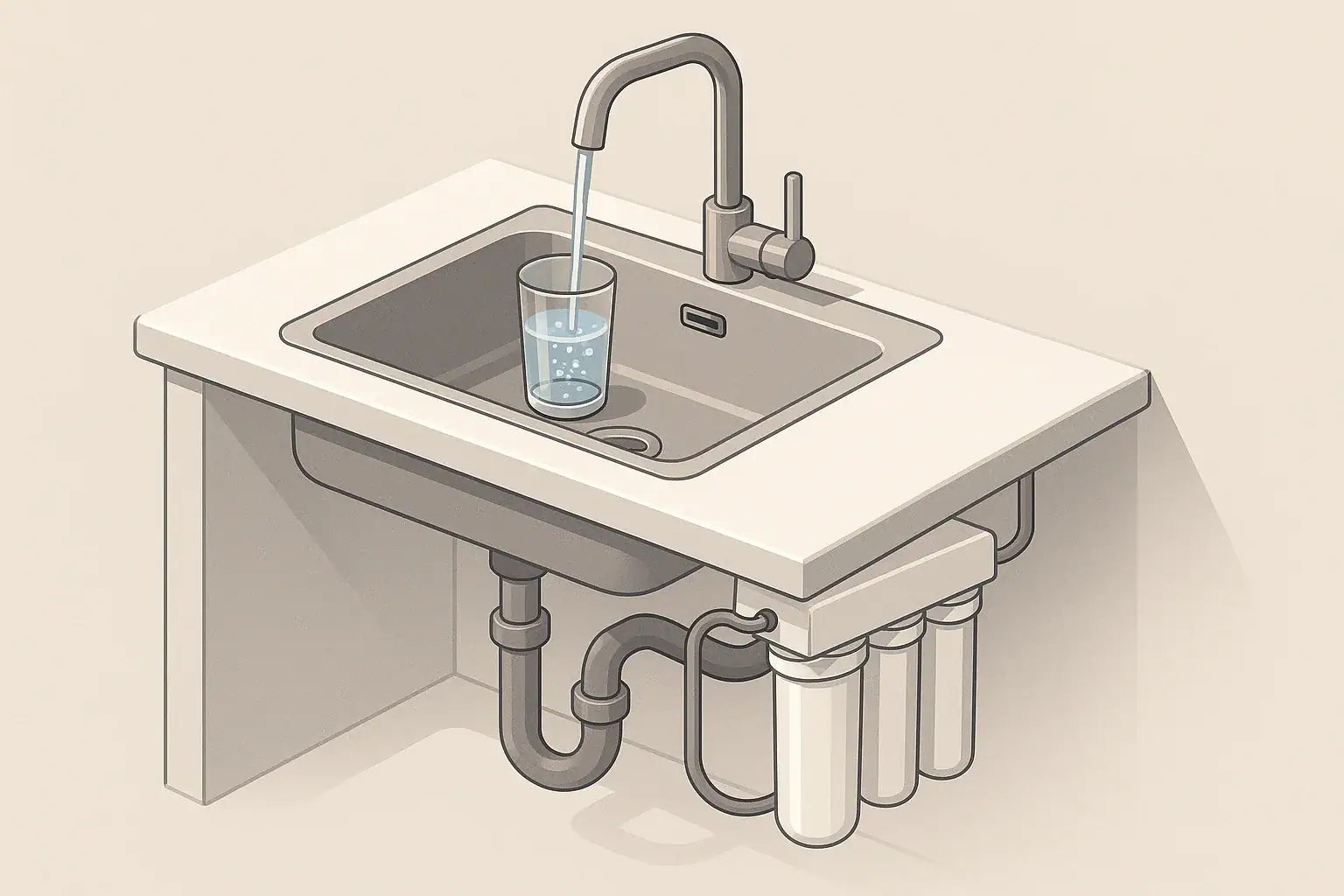
Why Kitchen Faucet Flow Rate Matters for Filtration
Flow rate is how much water moves through your faucet over time, usually measured in gallons per minute (GPM). If you are planning a kitchen water filter, understanding your faucet flow rate helps you:
- Choose a filter that can keep up with your normal water use
- Avoid very slow flow from a new filter system
- Estimate how long it takes to fill pots, pitchers, and cooking vessels
- Match filter capacity (gallons per day) with real-life kitchen needs
Most modern kitchen faucets on public water systems in the United States are designed to meet plumbing code and efficiency standards, which often limit maximum flow. However, actual flow at your sink depends on your local water pressure, plumbing layout, faucet aerator, and any filters you add.
How to Estimate Kitchen Faucet Flow Rate Without Special Tools
You can estimate your kitchen faucet flow rate using a simple container and a timer. This method gives you a practical, real-world number that is more useful than just reading a faucet label.
Step-by-step bucket-and-timer method
Use these steps with a container that has clear volume markings, such as a measuring pitcher.
- Step 1: Choose a container size. One or two quarts (about one or two liters) works well.
- Step 2: Fully open the faucet. Turn the handle to the position you normally use for filling pots or glasses.
- Step 3: Start timing. Place the container under the stream and start a timer at the same time.
- Step 4: Stop at a marked volume. Stop timing when the water reaches a known mark, such as 1 quart or 1 liter.
- Step 5: Record the fill time. Note the number of seconds it took to reach that volume.
Flow rate calculator formula (GPM)
Once you know how much water you collected and how long it took, you can calculate flow rate:
- If you measured in gallons:
GPM = (gallons collected ÷ seconds) × 60 - If you measured in quarts:
GPM = ((quarts collected ÷ 4) ÷ seconds) × 60 - If you measured in liters (approximate):
GPM ≈ ((liters collected × 0.264) ÷ seconds) × 60
For example, if you collect 1 quart in 10 seconds, that is 0.25 gallons in 10 seconds. The estimated flow rate is:
GPM = (0.25 ÷ 10) × 60 = 1.5 GPM (example only)
Repeat for different faucet settings
You may want to repeat the test with:
- Cold-only flow
- Hot-only flow
- Mixed hot and cold at your normal use setting
This gives you a better sense of how your faucet behaves across common everyday settings.
Example values for illustration.
| Step | What to Check | Notes (Example Only) |
|---|---|---|
| 1 | Use a marked container | Measuring cup or pitcher with quart or liter marks |
| 2 | Fully open faucet handle | Use the typical position for filling pots or glasses |
| 3 | Measure cold-only first | Cold side often has slightly higher flow |
| 4 | Time to a fixed volume | Common example: 1 quart or 1 liter |
| 5 | Record seconds accurately | Use a phone timer for better precision |
| 6 | Repeat for hot and mixed | Helps you plan for different everyday uses |
| 7 | Calculate GPM from each test | Use simple GPM formula for each measurement |
Use this checklist as a simple reminder before you start timing your faucet.
Typical Kitchen Faucet Flow Rates and What Affects Them
Most kitchen faucets have a built-in aerator that shapes the stream and limits flow. In many homes on city water, you might see kitchen faucet flow rates in a general range such as about 1.0 to 2.5 GPM, depending on local plumbing, pressure, and faucet design. Actual values can be higher or lower.
Main factors that change your flow rate
- Water pressure: Higher pressure tends to increase flow, while low pressure from the utility or well system can reduce flow at all fixtures.
- Faucet aerator: Aerators with smaller openings or efficiency designs reduce flow; clogged aerators can reduce it even more.
- Pipe size and layout: Long runs, many elbows, or smaller branches to the kitchen can reduce delivered flow.
- Existing filters or softeners: Any filter, cartridge, or treatment device can introduce pressure drop, lowering flow.
- Hot vs cold lines: Hot water passes through a water heater and extra piping, which may slightly reduce flow compared with cold-only.
Why flow rate matters when choosing a filter
Kitchen water filtration devices have their own flow limits. If your faucet can deliver more water than the filter is designed for, the filter will become the bottleneck and reduce flow to its rated level or lower when cartridges start to clog.
Knowing your current unfiltered flow helps you decide:
- Whether a faucet-mounted filter will feel too slow for your sink
- Whether an under-sink system provides enough GPM for cooking and drinking
- Whether you may need a dedicated filtered faucet instead of running everything through a single kitchen faucet
Using Flow Rate to Size Different Kitchen Filter Types
Different filter technologies handle flow in different ways. Flow rate planning helps you match a system to your kitchen habits and water source, whether you have city water or a private well.
Basic carbon filters (faucet, countertop, and under-sink)
Carbon filters, whether in a compact faucet attachment or a larger cartridge, typically balance:
- Flow rate (GPM)
- Contact time between water and carbon
- Filter life in gallons
Larger carbon cartridges can often support higher flow while still allowing reasonable contact time. Smaller faucet-mounted or inline cartridges may be rated for lower GPM, especially as they approach the end of their life.
Reverse osmosis (RO) systems
RO systems work differently from simple carbon filters. The membrane restricts flow, and the system is usually designed around:
- Gallons per day (GPD) rating of the membrane
- A storage tank for on-demand flow at the kitchen faucet
- Feed water pressure requirements for acceptable performance
In many homes, the faucet on a tank-based RO system delivers a modest flow rate that feels slower than the main kitchen faucet but adequate for filling glasses and small pots. Tankless RO designs may require higher feed pressure and often include a booster pump to maintain practical flow.
When a dedicated filtered faucet makes sense
Running an entire kitchen faucet through a small filter can lead to slow flow, especially if you frequently fill large pots or wash dishes with hot water. In these cases, many homeowners choose a separate drinking water faucet at the sink fed by an under-sink filter or RO system. This approach allows:
- Normal flow for cleaning and general use through the main faucet
- Filtered water at a smaller, separate faucet optimized for drinking and cooking
Estimating Flow Rate Needs for Everyday Kitchen Tasks
Once you know your current GPM, you can estimate how long everyday tasks will take and decide whether a lower-flow filter is acceptable.
Matching GPM to filling times
To estimate fill time, use this relationship:
- Time (minutes) ≈ volume (gallons) ÷ flow rate (GPM)
Some example volumes:
- Typical drinking glass: about 8–16 ounces (0.06–0.125 gallons)
- Medium cooking pot: about 1–2 gallons
- Large stockpot: about 3–4 gallons
- Pitcher filter reservoir: about 0.5–1 gallon
If a filter reduces your faucet from, for example, about 2.0 GPM to about 0.75–1.0 GPM, filling glasses will still be fairly quick, but filling large pots may take noticeably longer.
Planning for peak use
Think about the busiest times at your sink, such as cooking multiple dishes, rinsing produce, and filling pots. If your filter becomes the main restriction at the kitchen faucet, peak-time tasks may feel slower than you prefer. In that case, you may want to:
- Use a separate filtered faucet for drinking and cooking
- Select a filter model rated for a higher GPM
- Use whole-house treatment for some issues (such as overall taste or odor) and keep finer filtration just at the sink
How Flow Rate Interacts With Filter Performance and Lifespan
Flow rate does not just affect convenience; it also interacts with how effectively a filter can treat water and how long the cartridges last.
Contact time and treatment
Many filters rely on a certain amount of contact time between water and the filter media. If water moves too quickly through a cartridge, there may be less opportunity for the media to interact with certain substances in the water.
Filter manufacturers usually design cartridges to balance a target flow rate with contact time for typical household use. Operating significantly above the intended flow rate can reduce performance. Operating below that rate can increase contact time but may be inconvenient if the flow becomes too slow.
Pressure drop and clogging over time
All filters introduce some resistance to flow, known as pressure drop. As a cartridge traps particles or adsorbs substances from the water, resistance increases and flow gradually declines. Signs that flow rate is being affected by filter loading include:
- Noticeably weaker stream at the filtered faucet compared with when the cartridge was new
- Longer fill times for the same container than you measured initially
- Improved flow immediately after cartridge replacement
Checking flow rate before and after installing a new filter can help you understand how quickly performance changes in your specific water conditions.
Effect on under-sink and RO systems
In multi-stage under-sink or RO systems, multiple cartridges are arranged in series. Each stage adds a bit of resistance. As individual cartridges age, the combined effect can significantly reduce flow at the dedicated faucet. Keeping track of both time in service and noticeable flow reduction helps you decide when maintenance is due.
Example Kitchen Faucet Flow Rates and Fill Times
Every home is different, but it can be useful to look at some example ranges. These are not targets or requirements, just illustrations to help you visualize how flow rate affects daily use.
Example values for illustration.
| Flow Rate (GPM) | Glass (0.125 gal) | Pitcher (1 gal) | Medium Pot (2 gal) | Large Pot (3 gal) |
|---|---|---|---|---|
| 0.5 | ~15 sec | ~2 min | ~4 min | ~6 min |
| 0.75 | ~10 sec | ~1 min 20 sec | ~2 min 40 sec | ~4 min |
| 1.0 | ~7–8 sec | ~1 min | ~2 min | ~3 min |
| 1.5 | ~5 sec | ~40 sec | ~1 min 20 sec | ~2 min |
| 2.0 | ~4 sec | ~30 sec | ~1 min | ~1 min 30 sec |
| 2.5 | ~3 sec | ~24 sec | ~48 sec | ~1 min 12 sec |
Use this as a rough reference when deciding whether a lower-flow filter will feel acceptable at your sink.
Related guides: Cost per Gallon Calculator: How to Compare Filters Fairly • Replacement Planner Tool: Estimate Your Next Filter Change Date • Under-Sink Filter Flow Rate Explained: Why GPM Matters • Faucet-Mount vs Under-Sink Filters: Convenience vs Performance
Practical Tips for Using Your Flow Rate Number
Once you have calculated your kitchen faucet GPM, you can use it in several practical ways:
- Filter selection: Compare your unfiltered flow with the rated flow of potential filters. Expect some reduction, and decide how much is tolerable for you.
- Cartridge planning: If a filter is rated for a certain number of gallons, your GPM and typical daily use help you estimate when you might reach that volume.
- System layout: If you need both strong flow for cleaning and finer filtration for drinking, consider a dedicated filtered faucet instead of putting all flow through a restrictive cartridge.
- Maintenance checks: Repeat your simple flow test a few times per year. Noting changes can help you catch clogged cartridges or aerators early.
Keeping track of your faucet flow rate turns an abstract specification into a simple, practical number you can use to make calm, informed decisions about kitchen filtration, convenience, and long-term maintenance.
Frequently asked questions
How often should I measure my faucet flow rate?
Measure a few times per year and after any filter or aerator change. Also test when you notice slower flow or after plumbing work that might affect pressure.
Should I test with the aerator on or removed?
Test with the faucet set the way you normally use it (aerator in place) to get a realistic, everyday GPM. Removing the aerator shows raw flow but may not reflect typical performance.
How do I use my measured GPM to pick a suitable filter?
Compare your unfiltered GPM to the filter’s rated flow. If the filter’s rated flow is significantly lower than your GPM, expect slower fills or consider a dedicated filtered faucet or a higher-flow model.
Can water pressure or other fixtures affect my test results?
Yes. Household water pressure, other fixtures running, and hot versus cold settings all affect measured flow. Test under typical household conditions for the most useful number.
Recommended next:
- NSF/ANSI standards explained (42/53/401/58)
- Clear trade-offs: pitcher vs faucet vs under-sink vs RO
- Maintenance planning: cost per gallon and replacement cadence