
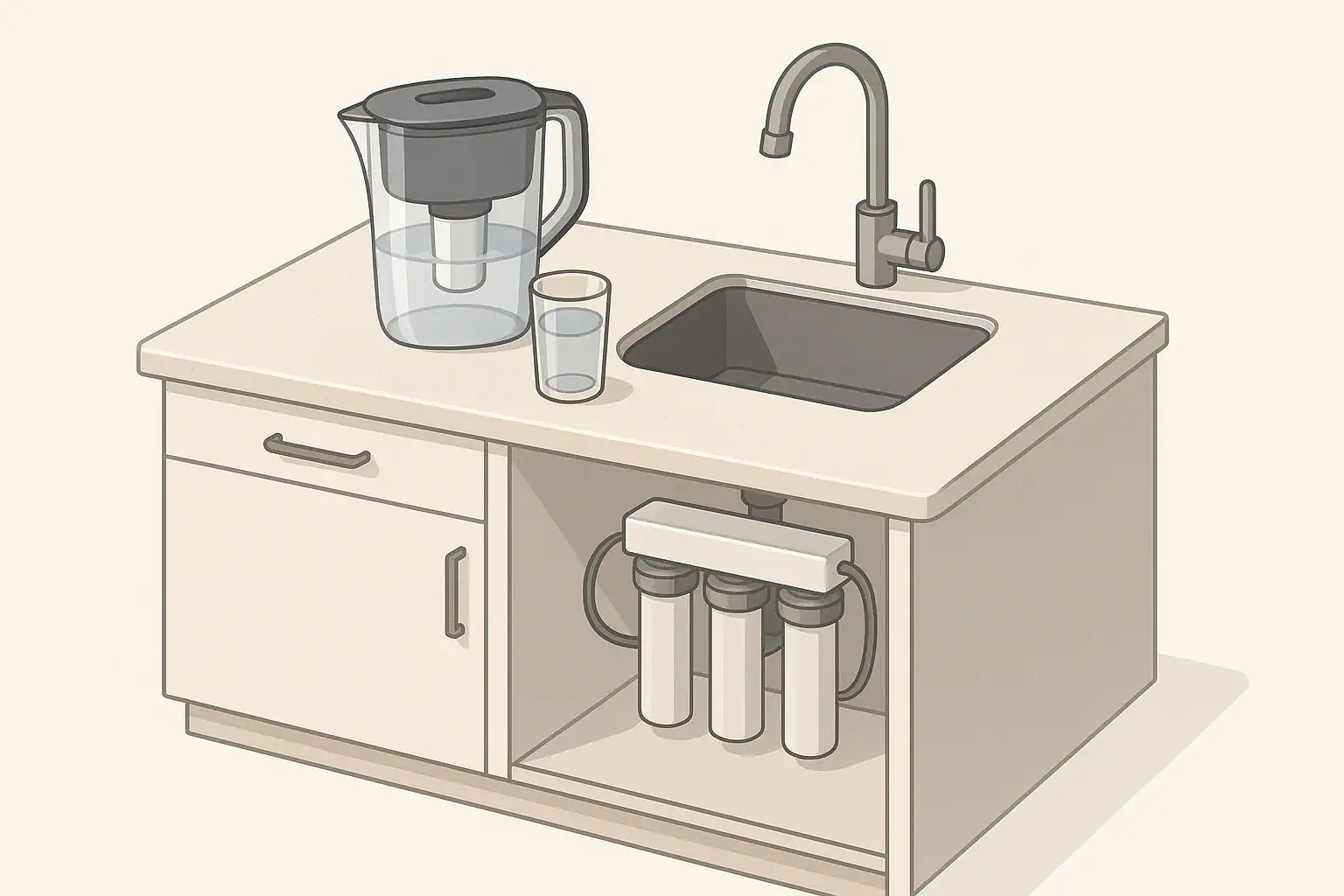
Why Compare Cost per Gallon for Pitcher and Under-Sink Filters?
Many people choose a water filter based on the upfront price of the unit on the shelf. However, the real cost of filtered water comes from how much you spend over time for replacement cartridges, and how many gallons each cartridge actually treats. Cost per gallon is a simple way to compare a basic pitcher to an under-sink system using the same yardstick.
This walkthrough uses general example numbers to show you how to do the math yourself. You can then plug in the prices and capacities that match products you are considering. The goal is not to favor any one technology, but to help you see how usage patterns and filter lifespans change the long-term cost picture.
Both pitchers and under-sink filters can improve taste and reduce common tap water concerns. The better choice for a given kitchen often depends on:
- How much filtered water you use per day
- Whether you want only drinking water filtered or also cooking water
- How much space you have on the counter and under the sink
- How comfortable you are with basic installation tasks
Step 1: Understand the Cost per Gallon Formula
The core of this comparison is a simple formula:
Cost per gallon = Total filter cost ÷ Gallons treated
You can apply this formula to a single replacement cartridge or to a whole system over a specific time period (see the Cost per Gallon Calculator). For day-to-day decisions, people often look at one cartridge at a time, because those prices are easy to find and compare.
What Costs Should You Include?
To keep the math practical, you can focus on:
- Replacement cartridge cost (most important ongoing cost)
- Cartridge capacity in gallons (from packaging or manual)
- Time-based limit (for example, “replace every 2 months or 40 gallons”)
For a longer-term picture, you can also spread the one-time system cost over its realistic lifespan. For example, if a basic under-sink housing costs a certain amount and you expect it to last 5 years, you can divide that cost across five years of expected water use. For this walkthrough, the examples keep the focus on cartridge costs because they dominate long-term spending for frequent users.
Gallons vs Time Limits
Filter cartridges usually come with both a gallon rating and a time rating. For example, a pitcher cartridge might say it is good for up to a certain number of gallons, or about two months of typical household use. In practice, one of these limits will be reached first:
- High-use households often hit the gallon limit first.
- Low-use households often hit the time limit first.
When you calculate cost per gallon, you should use the lower of the two capacities: either the gallon limit, or the average gallons you expect to use before the time limit is reached. Otherwise, your math might assume more gallons per cartridge than you will actually get.
Example values for illustration.
| Factor | Pitcher filter (example) | Under-sink filter (example) |
|---|---|---|
| Typical cartridge price (example) | $8 per cartridge | $40 per cartridge |
| Labeled capacity in gallons (example) | 40 gallons | 600 gallons |
| Time recommendation (example) | 2 months | 6 months |
| Average daily use scenario | 0.7 gallons per day | 3 gallons per day |
| Estimated gallons before time limit | ≈40 gallons in 2 months | ≈540 gallons in 6 months |
| Approximate cost per gallon (example) | $8 ÷ 40 = $0.20 | $40 ÷ 540 ≈ $0.07 |
Step 2: Pitcher Filter Cost per Gallon Example
This section walks through the math for a typical pitcher-style filter. The exact numbers you use will vary, but the process is the same.
1. Gather Pitcher Filter Numbers
From the packaging or manual, note:
- Cartridge cost (for example, a single-pack price)
- Rated capacity in gallons
- Recommended time limit between replacements
For illustration only, consider these example values:
- Cartridge cost: $8
- Rated capacity: 40 gallons
- Recommended time limit: 2 months
2. Estimate Your Pitcher Usage
Pitchers are usually used for drinking water and sometimes for coffee or tea. To estimate your household’s daily use, consider:
- Number of people regularly drinking from the pitcher
- How many glasses per person per day
- Whether you use pitcher water for cooking
Assume:
- 2 people
- Each drinks three 8-ounce glasses per day from the pitcher
Total per day: 2 × 3 × 8 ounces = 48 ounces per day. A gallon is 128 ounces, so:
Daily use = 48 ÷ 128 ≈ 0.38 gallons per day
Over two months (about 60 days), this is:
0.38 × 60 ≈ 23 gallons in two months
3. Decide Which Limit You Actually Reach
In this example, the cartridge is labeled for 40 gallons or 2 months. Your estimated use in 2 months is 23 gallons. Because the time limit arrives before you reach 40 gallons, your realistic capacity is about 23 gallons per cartridge, not 40.
4. Calculate Pitcher Cost per Gallon
Using the realistic capacity:
Cost per gallon = $8 ÷ 23 ≈ $0.35 per gallon
If your household uses more water and reaches 40 gallons before 2 months, the cost per gallon would be better:
$8 ÷ 40 = $0.20 per gallon
So pitcher cost per gallon is very sensitive to how quickly you use the cartridge. Light users often change filters on time, not at full gallon capacity, which increases cost per gallon compared to the labeled rating.
Step 3: Under-Sink Filter Cost per Gallon Example
Under-sink systems cover a wide range, from simple carbon cartridges to multi-stage setups that may include sediment filters, carbon blocks, and sometimes reverse osmosis. This walkthrough focuses on a general under-sink carbon-style cartridge feeding a dedicated faucet. The same method applies to other under-sink technologies; you just add up all cartridge costs for each stage.
1. Gather Under-Sink Filter Numbers
From the manual or product information, list:
- Replacement cartridge cost
- Rated capacity in gallons
- Recommended time limit (for example, 6 or 12 months)
For illustration only, consider these example values:
- Cartridge cost: $40
- Rated capacity: 600 gallons
- Recommended time limit: 6 months
2. Estimate Your Under-Sink Usage
Many households use under-sink water for:
- All drinking water
- Cooking water (for boiling, rinsing food, soups)
- Pet water
Assume:
- 2 people drinking filtered water
- Each drinks four 8-ounce glasses per day
- Filtered water used for cooking adds about 0.5 gallons per day
Daily drinking water: 2 × 4 × 8 ounces = 64 ounces per day.
64 ounces is 0.5 gallons. Adding 0.5 gallons for cooking gives:
Daily use ≈ 1.0 gallon per day
Over six months (about 180 days), this is:
1.0 × 180 ≈ 180 gallons in six months
3. Decide Which Limit You Actually Reach
The cartridge is labeled for 600 gallons or 6 months. Your estimated use in 6 months is 180 gallons. Because the time limit arrives before you reach 600 gallons, your realistic capacity is about 180 gallons per cartridge, not 600.
4. Calculate Under-Sink Cost per Gallon
Using the realistic capacity:
Cost per gallon = $40 ÷ 180 ≈ $0.22 per gallon
If your household uses much more filtered water and approaches the 600-gallon rating in 6 months, the cost per gallon improves:
$40 ÷ 600 ≈ $0.07 per gallon
Under-sink filters often become more cost-effective as daily usage increases, provided cartridges are replaced on schedule and the flow or taste does not indicate earlier replacement is needed.
Step 4: Comparing Pitcher vs Under-Sink in Realistic Scenarios
Now that you have example cost per gallon numbers for each technology, you can compare them under different usage patterns. The key point is that the labeled capacity often assumes heavier use than many households actually have. Time limits can reduce the effective gallons per cartridge, especially for small households.
Scenario A: Small Household, Light Use
Imagine a one-person or two-person household that:
- Mostly drinks tap water at work or elsewhere
- Uses filtered water mainly for a few glasses at home
- Rarely uses filtered water for cooking
In this case:
- A pitcher may be replaced on time (for example, every 2 months) after using far fewer gallons than the label suggests.
- An under-sink system may also be replaced based on the time recommendation, long before reaching its high gallon rating.
The result is that both systems have a higher actual cost per gallon than their labels imply, but the under-sink cartridge might still deliver more gallons in that time frame, depending on how much you use it for cooking and other tasks. In some low-use cases, the cost difference between the two can narrow, and convenience or space may matter more.
Scenario B: Family, Moderate to Heavy Use
Consider a household of four that:
- Drinks filtered water at home throughout the day
- Uses filtered water for coffee, tea, and cooking
- Fills reusable bottles with filtered water
Here, daily use may approach or exceed 1–2 gallons per day. Over several months, this kind of household is more likely to reach the gallon limit on both pitcher and under-sink filters before the time limit.
When higher usage brings you closer to the rated capacities (for example, 40 gallons for a pitcher, 600 gallons for an under-sink cartridge), the cost per gallon tends to move much closer to the simple labeled calculation. In that case:
- A pitcher might stay around an example of $0.20 per gallon.
- An under-sink cartridge might drop toward an example of $0.07 per gallon.
For heavier users, under-sink systems often have an advantage in cost per gallon, especially if the cartridges are larger and changed on schedule.
Scenario C: Comparing to Bottled Water
Many people compare filter costs to bottled water (see our Pitcher Filter vs Bottled Water: Cost per Gallon Breakdown). While prices vary by brand and container size, it is common for bottled water to cost significantly more per gallon than either pitcher or under-sink filtered water, even in light-use scenarios. For example-only estimates:
- Common single-serve bottles can amount to more than $1.00 per gallon.
- Pitcher examples above range around $0.20–$0.35 per gallon.
- Under-sink examples above range around $0.07–$0.22 per gallon.
Actual numbers vary, but working through this math often helps people see how quickly bottled water costs add up compared to filter cartridges, particularly for larger households.
Step 5: Other Practical Factors Beyond Cost per Gallon
Cost per gallon is useful, but it is not the only consideration. When comparing pitcher and under-sink filters, you can also weigh convenience, performance scope, and maintenance expectations.
Convenience and Everyday Use
- Pitcher filters
- Simple, no tools needed to start using.
- Need manual refilling and some fridge space.
- Flow rate depends on gravity; can take time to drip through.
- Under-sink filters
- Require initial installation and space under the sink.
- Provide filtered water directly from a faucet whenever you open it.
- Can be more comfortable for filling pots and larger containers.
Performance Scope and Water Quality Goals
Pitchers and under-sink systems can both use carbon filtration to reduce chlorine taste and odor and address some other common concerns. Some under-sink systems add extra stages, such as:
- Sediment pre-filters for visible particles
- Additional carbon blocks for certain organic chemicals
- Optional reverse osmosis stages for broader contaminant reduction
As you add stages, the system cost and cartridge costs can increase, but the per-gallon cost may still be acceptable for heavier users. When evaluating any system, it can be useful to review any available performance data and to consider your local water conditions, such as chlorine levels, hardness, and specific contaminants of concern.
Maintenance and Replacement Habits
Even the best system will not work as intended if cartridges are not changed on time. Think about which option fits your habits:
- Pitcher cartridges are visible and easy to swap, but small and frequent to replace.
- Under-sink cartridges last longer between changes, but are less visible and may be easier to forget unless you set reminders.
Some people prefer shorter intervals because they feel reassured by frequent changes. Others prefer longer life cartridges to reduce maintenance tasks. Legible date labels, calendar reminders, or apps such as the Replacement Planner Tool can help keep replacement schedules on track, which helps preserve both water quality and predictable cost per gallon.
Example values for illustration.
| Household type | Pitcher: est. change interval | Under-sink: est. change interval | Notes |
|---|---|---|---|
| Single person, light use | Every 2 months (time limit) | Every 6–12 months (time limit) | Time limit reached before gallon rating |
| Couple, moderate use | Every 1.5–2 months | Every 6 months | Both time and gallons influence schedule |
| Family of 4, heavy use | Every 3–4 weeks | Every 4–6 months | Gallon rating often reached first |
| Cooking and coffee focus | Every 1–2 months | Every 4–6 months | Higher daily gallons, especially under-sink |
| Occasional use only | Every 2 months (time-based) | Every 12 months (time-based) | Cartridges changed mostly by calendar |
| High-demand cooking & drinking | Every 2–3 weeks | Every 3–4 months | Tracking gallons helps manage cost |
Related guides: Cost per Gallon Calculator: How to Compare Filters Fairly • Replacement Planner Tool: Estimate Your Next Filter Change Date • Pitcher Filter vs Bottled Water: Cost per Gallon Breakdown
By running these kinds of examples with your own prices, capacities, and usage estimates, you can see how pitcher and under-sink systems line up not only on upfront cost, but also on cost per gallon, maintenance effort, and suitability for your kitchen and daily routines.
Frequently asked questions
How do I calculate cost per gallon for my household?
Use Cost per gallon = Total filter cost ÷ Gallons treated. For practical results, use whichever limit you will hit first: the cartridge gallon rating or the gallons you expect to use before the time-based replacement.
Should I replace cartridges based on time or gallons?
If your household uses little water, follow the time recommendation. If you consume many gallons quickly, replace when you reach the labeled gallon capacity. Using the lower of the two gives a realistic cost and helps protect performance.
Will an under-sink system always be cheaper than a pitcher?
Not always. Under-sink filters typically have lower cost per gallon at higher usage, but for very light users time-based replacements can narrow the difference. Compare using your actual daily use and cartridge prices.
Can I use a pitcher and an under-sink filter together?
Yes. Some people use an under-sink system for cooking and a pitcher for refrigerated or portable water. Treat each system separately when calculating cost per gallon and schedule replacements accordingly.
Recommended next:
- NSF/ANSI standards explained (42/53/401/58)
- Clear trade-offs: pitcher vs faucet vs under-sink vs RO
- Maintenance planning: cost per gallon and replacement cadence