
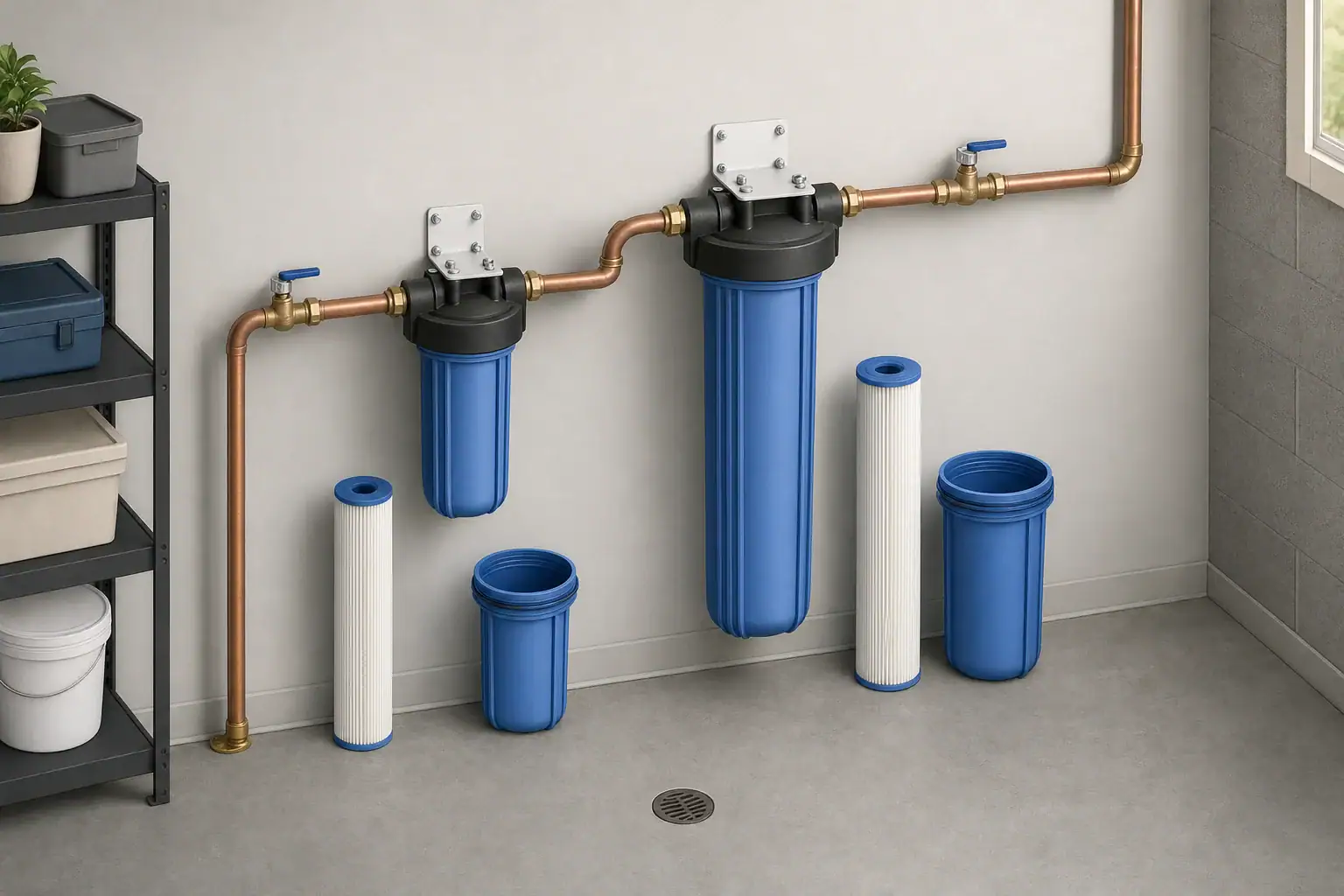
Quick answer: A 20-inch filter housing does not automatically provide more flow or a fixed longer service interval. Match the compatible cartridge’s actual length, diameter and seal style; compare cartridge-specific pressure-drop data; and use the exact housing manual to confirm pressure limits and the clearance needed for service.
10-inch vs 20-inch filter housings: what the length means
A nominal 10-inch or 20-inch designation primarily identifies the cartridge-length category a housing is designed to accept. It does not, by itself, establish cartridge diameter, end-seal style, flow rate, pressure loss, treatment capacity, port size, pressure rating, temperature rating, or service clearance.
A longer compatible cartridge may contain more media or filtration area, but the practical result depends on its construction, micron rating, media, inlet conditions, plumbing, and intended flow. Do not assume that a 20-inch model doubles flow or lasts twice as long.
Model-specific comparison: Pentair Big Blue housings
The table below compares two 1-inch-port Pentair Big Blue housing models. It is an example of why housing length is not a stand-alone performance rating. These values apply only to the identified models and should not be transferred to other housing families.
| Factor | #10 Big Blue 150237 / 150238 |
#20 Big Blue 150233 / 150234 |
|---|---|---|
| Maximum housing dimensions | 13.30 × 7.45 inches | 23.22 × 7.45 inches |
| Listed initial housing pressure drop | 1 psi at 15 GPM | 1 psi at 15 GPM |
| Maximum pressure | 100 psi | 90 psi |
| Cartridge format | Nominal 10-inch; up to 4½-inch diameter | Nominal 20-inch; up to 4½-inch diameter |
| Practical selection reason | A documented compatible cartridge meets the application and vertical space is limited. | A documented longer cartridge supports the needed performance and the service envelope fits. |
Pentair lists the dimensions, initial housing pressure drop, pressure limits, and maximum cartridge diameter for these models in its Big Blue housing specification sheet.
Does a 20-inch housing automatically improve flow?
No. Flow through an installed whole-house filter is affected by the housing, ports, pipe layout, fittings, valves, and cartridge. The Pentair example shows that two different housing lengths can carry the same listed initial housing pressure-drop figure at the stated flow.
Check cartridge or complete-system data separately. The Watts Pure Water commercial catalog says its pressure-drop charts include both housing and cartridge. Its published maximum-flow guidance varies by cartridge format, length, and micron rating. For one specified 0.35-micron standard cartridge format, the catalog lists 4 GPM for a 9¾-inch version and 8 GPM for a 20-inch version. That is a product-line example, not a universal rule for all 10- and 20-inch cartridges.
For a closer explanation of how pressure and flow differ in a plumbing system, see Water Pressure vs. Flow Rate: Why Your Filter Feels Slow.
Capacity is also cartridge-specific
“Capacity” can mean dirt-holding ability, a rated gallon value, media volume, or the point at which pressure loss becomes unacceptable. Compare the manufacturer’s definition, test conditions, and replacement endpoint for the exact cartridge. A nominal length alone does not establish an expected replacement interval.
Which housing and cartridge dimensions must match?
Do not buy a replacement cartridge from the 10-inch or 20-inch label alone. Confirm all of the following in the housing and cartridge documentation:
- Actual cartridge length: Nominal dimensions are not always literal. For example, Watts lists its WPC035-975 standard-format cartridge at 9.75 × 2.5 inches on the product page.
- Outside diameter: A slim cartridge and a large-format cartridge may share a nominal length but not fit the same housing. The cited Pentair Big Blue housings accept cartridges up to 4½ inches in diameter.
- End and seal style: Verify whether the cartridge is double-open-end (DOE), single-open-end (SOE), or proprietary, along with its gaskets, caps, and O-ring arrangement. For comparison, Watts identifies the PWCB20P as a 2.5 × 20-inch DOE cartridge and the PWMB10FFM20 as a 4.5 × 9¾-inch DOE cartridge.
- Internal seating features: Check the center bore, standpipe, locator, and the seating method shown in the manufacturer documents.
- Documented compatibility: Similar dimensions do not prove that a cartridge will seat and seal correctly.
- Housing connections: Confirm port size, thread standard, flow direction, and connection arrangement separately from cartridge fit.
How much service clearance is required?
Use the installation instructions for the exact assembled housing or system. There is no reliable universal clearance number for nominal 10-inch or 20-inch housings.
As one documented example, the Pentair FPS-10BB and FPS-20BB installation manual specifies mounting the bracket top at least 24 inches above the floor for the 10-inch system and 34 inches above the floor for the 20-inch system. The manual states that this provides 5 inches below the housing for cartridge changes. It also describes relieving pressure and removing the sump downward, with a bucket beneath it. Those measurements apply to those FPS systems only.
If a manual does not state a service envelope, do not substitute a guessed number. Before permanent plumbing is installed, verify that the sump can travel through its full removal path without hitting the floor, a drain, piping, shelves, or adjacent equipment. Also allow access for the specified wrench, shutoffs, pressure-relief control, and a bucket.
Worked planning example: checking the vertical envelope
Assumption: an installer is considering the Pentair FPS-20BB system referenced above. The manual’s mounting instruction places the bracket top at least 34 inches above the floor. If a shelf, floor drain cover, or other fixed obstruction prevents that mounting position or blocks downward sump movement, the location is unsuitable until the layout changes. This is a clearance check, not a general 20-inch-housing rule.
For a different model, replace the 34-inch figure with the exact value from that model’s manual. Compare the drawing and physical space before cutting pipe or mounting the bracket.
Pressure, temperature, and certification checks
Read maximum working pressure and temperature from the current documentation for the exact housing model. Do not apply one family’s ratings to another product, and do not assume that the longer housing has the higher pressure rating. Compare expected inlet pressure and total installed pressure loss with the manufacturer’s limits.
Certification scope also matters. NSF’s listing for Pentair models 150233, 150234, 150237, and 150238 identifies them as point-of-entry filter-housing components conforming to material and structural-integrity requirements; it is not a contaminant-reduction claim for an installed cartridge. See the NSF listing. If a reduction claim matters to the purchase, verify the exact cartridge or complete system, contaminant, and claim in the applicable certification listing. Our guide to verifying a filter certification claim explains what to compare.
Measurement and manual-reading checklist
- Record the housing manufacturer, full model number, and part number.
- Download the current specification sheet and installation manual for that exact model.
- Measure from the manual’s mounting reference point to the floor and nearest fixed obstruction.
- Check wall depth and the full downward or swing path of the sump.
- Confirm room for the specified wrench, bucket, shutoffs, pressure-relief control, and cartridge removal.
- Verify actual cartridge length, outside diameter, end style, center bore, and manufacturer-stated compatibility.
- Compare housing-only pressure-drop information with cartridge or complete-system data at the intended flow.
- Confirm maximum pressure, temperature, and installation conditions from the housing documentation.
- Read the scope of every certification listing instead of treating a standard number as proof of a particular reduction claim.
- Check permit, installer, and inspection requirements with the local authority having jurisdiction because local rules vary.
Related guides: Whole-House Filter Flow Rate · Water Filter Capacity Claims · Cartridge Change Mistakes That Cause Leaks
Choosing the practical length
Choose a nominal 10-inch housing when a documented compatible cartridge meets the required performance and the shorter service envelope is useful. Choose a nominal 20-inch housing when the longer compatible cartridge has manufacturer data supporting the needed flow, pressure drop, or capacity and the location accommodates the required service path.
Do not finalize either choice based on an assumed flow gain, a guessed cartridge fit, or an unverified clearance measurement.
Frequently asked questions
Will a 20-inch filter cartridge last twice as long as a 10-inch cartridge?
Not necessarily. Replacement timing depends on the cartridge’s media, construction, water conditions, loading, flow, and the manufacturer’s specified endpoint. Compare the exact cartridge documentation rather than applying a length-based multiplier.
Can a 4.5-inch-wide cartridge fit any large whole-house housing?
No. Diameter is only one fit requirement. Confirm the actual length, end style, gasket arrangement, center bore or standpipe arrangement, and the housing manufacturer’s compatibility information.
- NSF/ANSI standards explained (42/53/401/58)
- Clear trade-offs: pitcher vs faucet vs under-sink vs RO
- Maintenance planning: cost per gallon and replacement cadence