
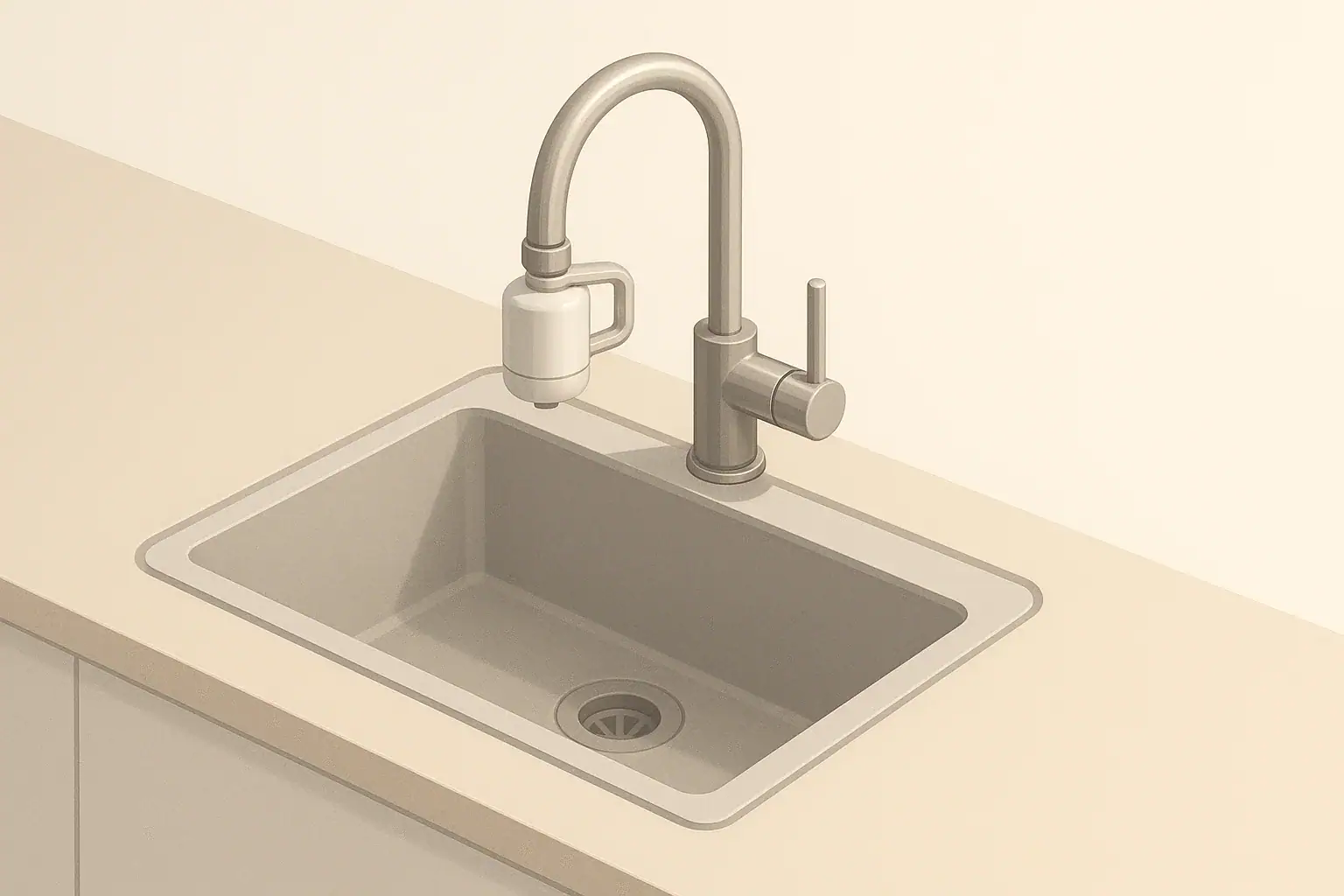
Overview: Two Popular Options for Better-Tasting Tap Water
Faucet-mount and under-sink filters are two common ways to improve tap water taste and target selected contaminants in U.S. homes. Both provide filtered water at the sink without repeatedly filling a pitcher, but they differ in installation, capacity, visibility, flow, and maintenance.
This guide explains how each type works and how to match a filter to your water, kitchen layout, and maintenance habits. The format alone does not determine contaminant reduction: the exact model, cartridge, operating conditions, and certified claims matter.
How Faucet-Mount Filters Work
Faucet-mount filters attach to the end of a compatible kitchen faucet. Most use a small housing with a replaceable cartridge and a control that switches between filtered and unfiltered water.
How Faucet-Mount Filters Operate
A faucet-mount cartridge may contain:
- Mechanical filtration: A screen or sediment layer intended to capture particles within the model’s rated range.
- Activated carbon: Porous media commonly used for claims involving chlorine taste and odor.
- Additional media: Some cartridges include media designed and tested for particular metals or other named contaminants.
In filtered mode, water passes through the cartridge before leaving the faucet. In bypass mode, water avoids the cartridge for tasks such as washing dishes. The exact media and reduction claims vary by cartridge.
Advantages of Faucet-Mount Filters
- Relatively simple installation: Compatible models usually connect at the faucet’s removable aerator threads, sometimes through a supplied adapter.
- Filtered water on demand: There is no reservoir to refill.
- Removability: The unit can generally be removed without changing under-sink plumbing, which can suit renters or temporary setups.
- Bypass control: Filtered water can be reserved for drinking and cooking instead of dishwashing.
Limitations of Faucet-Mount Filters
- Flow can be lower in filtered mode: Compare each model’s rated service flow rather than assuming it will match the unfiltered faucet.
- Limited cartridge space: Check the exact gallon or time limit because replacement schedules vary substantially.
- Visible hardware: The attachment changes the faucet’s appearance and may reduce clearance for large cookware.
- Faucet compatibility: Many pull-down, pull-out, spray-style, and nonstandard faucets do not accept conventional faucet-mount units.
| Factor | Faucet-Mount Filter | Under-Sink Filter |
|---|---|---|
| Installation | Attaches to a compatible faucet spout | Connects to the cold-water supply and an outlet faucet |
| Initial equipment | Compact housing, cartridge, and any needed faucet adapter | Housing, cartridge, tubing, fittings, and sometimes a dedicated faucet |
| Capacity and flow | Model-specific; compare published ratings | Model-specific; compare published ratings |
| Effect on sink appearance | Visible on the main faucet | Filter is hidden, although a dedicated faucet may be visible |
| Space used | Space at and below the faucet spout | Cabinet space under the sink |
| Portability | Usually easier to remove | Requires disconnection from the water line |
| Common reason to choose it | Minimal plumbing changes | Hidden installation or a dedicated filtered-water tap |
How Under-Sink Filters Work
Under-sink filters install inside the cabinet and connect to the cold-water supply. Depending on the design, they feed a dedicated filtered-water faucet or send filtered water to the main kitchen faucet.
How Under-Sink Filters Operate
An under-sink system can use one cartridge or several stages, which may include:
- Sediment media: Intended to capture particles within a stated size range.
- Activated carbon block or granular carbon: Commonly used for chlorine taste-and-odor claims and selected model-specific chemical-reduction claims.
- Specialized media: Included in some systems for named contaminants.
The cabinet provides room for configurations that would not fit on a faucet, but size and stage count do not by themselves prove better contaminant reduction. Compare the certified claims and operating specifications of the complete system and replacement cartridge.
Advantages of Under-Sink Filters
- More configuration choices: Single-cartridge, multi-cartridge, dedicated-faucet, and direct-connect designs are available.
- Model-specific capacity options: Some systems have higher published capacities than compact faucet models, but this must be checked model by model.
- Hidden equipment: The filter housing and tubing stay inside the cabinet.
- Dedicated outlet option: A separate tap can keep drinking water distinct from the main faucet supply.
Limitations of Under-Sink Filters
- More involved installation: Installation commonly requires shutting off the cold-water valve, adding a supply adapter, connecting tubing, and checking the fittings for leaks.
- Less portable: The system must be disconnected from the plumbing when removed.
- Cabinet space: Housings and tubing use storage room under the sink.
- Hidden maintenance: A calendar or other reminder may be needed because the cartridge is not in view.
Performance: Compare the Exact Models
Both formats can carry useful contaminant-reduction claims, but neither format guarantees a particular result. Performance depends on the exact system and cartridge, the contaminants present, inlet-water conditions, rated capacity, service flow, and whether the system is maintained as directed.
Taste, Odor, and Basic Aesthetic Issues
Many household filters use activated carbon and make model-specific claims for chlorine taste and odor. Some also carry claims for selected organic compounds or particles. Do not infer those additional reductions merely from the presence of carbon; check the certification listing for the complete model and cartridge combination.
NSF/ANSI 42 is associated with aesthetic claims such as chlorine taste and odor. It is not, by itself, evidence of a health-related contaminant-reduction claim.
Contaminants and Standards
Filters may be certified for particular claims beyond taste and odor:
- Lead and other health-related claims: These may appear under NSF/ANSI 53, but lead must be explicitly included in the exact product listing.
- Specified emerging compounds: Particular claims may appear under NSF/ANSI 401.
- Microorganisms: Many household filters are not designed to remove germs. Any bacteria, cyst, or virus claim must be verified for the exact product and organism or test protocol.
Under-sink systems offer more room for multiple stages, but that does not establish that a given under-sink model reduces more contaminants than a given faucet-mount model. Compare the actual certified contaminant lists.
Start With Your Input Water
Choose treatment based on what is in the incoming water, not on filter format alone. The CDC recommends reviewing water-quality information or testing the water first, then selecting a system designed for the particular germs or chemicals of concern.
- Community water: Review the utility’s annual Consumer Confidence Report. The EPA explains how to find and read this annual report.
- Private well: Well owners are responsible for testing. The EPA recommends annual testing for total coliform bacteria, nitrates, total dissolved solids, and pH, with additional testing based on local risks and changes in the water.
- Sediment or turbidity: Check the product’s inlet-water requirements and whether a compatible prefilter is required. Heavy particle loading can restrict flow or shorten usable cartridge life.
- Hard water: A conventional faucet-mount or carbon under-sink filter is not a water softener unless its documentation explicitly identifies a softening function.
- Pressure: Confirm that household pressure falls within the exact model’s published operating range.
Compare Rated Capacity, Flow, and Pressure
Published ratings can differ substantially, even though a pair of products cannot represent an entire format. For illustration, a PUR product data sheet for named faucet systems using RF3375 or RF9999 cartridges lists a 100-gallon rated capacity, 0.52-gpm service flow, and 20–100 psi pressure range. The Multipure Aquaversa/MP750 guide for the CB6 cartridge lists 750 gallons, 0.75 gpm, 30–100 psi, and cold-water use.
These are exact-model illustrations, not recommendations, market averages, or proof that every under-sink filter has higher capacity or flow. When comparing products, confirm the current manual or performance data sheet for the system and cartridge you will actually use.
Convenience: Daily Use and Kitchen Workflow
Convenience is one of the clearest practical differences between faucet-mount and under-sink filters.
Everyday Operation
A faucet-mount filter places its bypass control on the spout. This can be useful when switching between filtered water for drinking and unfiltered water for cleaning. An under-sink system with a dedicated faucet provides two separate taps, while a direct-connect system may filter all cold water from the main faucet.
If you regularly fill large pots or containers, compare service-flow ratings and the physical clearance around the outlet. Do not assume the under-sink option is faster without checking the specifications.
Space and Aesthetics
Faucet-mount units are visible and may not fit every sink setup. Under-sink units hide the filter but use cabinet space. Consider:
- Available clearance around the faucet spout.
- Whether the faucet has removable, compatible aerator threads.
- Available cabinet space and access for cartridge changes.
- Whether a dedicated faucet would require an accessory hole.
Renters vs Homeowners
Faucet-mount filters are often easier to remove because they generally do not alter under-sink plumbing. See the separate no-drill guide for renters. An under-sink system—especially one requiring a new faucet hole or changes to hard plumbing—may require the property owner’s approval. Confirm the lease requirements before installation.
Installation: What to Expect with Each Format
Every product has its own instructions, but the two formats generally involve different connection points.
Installing a Faucet-Mount Filter
Typical steps, subject to the product manual, include:
- Remove the faucet’s existing aerator.
- Select the supplied adapter that matches the faucet threads, if one is needed.
- Attach the filter body with the specified washer or seal.
- Check the connection for leaks.
- Flush the new cartridge for the time or volume stated in the manual.
Pull-down, pull-out, spray-style, or specialty faucets may not accept these attachments. Use the faucet compatibility guide before buying rather than assuming an adapter will work.
Installing an Under-Sink Filter
Typical steps, subject to the product manual and local plumbing requirements, include:
- Shut off the cold-water supply valve.
- Open the faucet to relieve pressure.
- Install the specified supply adapter.
- Mount the housing with enough clearance for future cartridge changes.
- Connect the inlet and outlet tubing as directed.
- Connect the outlet to the main faucet or a dedicated filtered-water faucet, as applicable.
- Restore the water slowly, flush the system as directed, and inspect every connection for leaks.
A dedicated faucet may use an existing accessory hole. Drilling a sink or countertop can require specialized tools and may be better handled by a qualified installer, particularly where the material or plumbing arrangement is unfamiliar.
Cost Over Time: Upfront vs Ongoing
Compare both the initial equipment and the replacement components required over the period you expect to own the system.
Upfront Costs
Include the filter housing, included cartridge, adapters, tubing, dedicated faucet, shipping, tax, and any installation charge. Do not assume that every faucet-mount system costs less than every under-sink system; compare complete setups that have the contaminant claims you need.
Cartridge Replacement and Cost Per Gallon
Use current cartridge prices and the exact model’s replacement rules:
- Estimate how many gallons your household will filter each day.
- Read the manufacturer’s gallon limit and any time limit.
- Estimate how many gallons you will actually use before reaching the first applicable limit.
- Divide the replacement cartridge price by that usable-gallon estimate.
- Add required prefilters, membranes, batteries, or service costs when applicable.
This is an estimate rather than a guarantee. Actual cartridge life may be affected by usage and inlet-water conditions, and a time-based replacement deadline can arrive before the rated gallon capacity is used. Cartridge size alone does not establish a lower cost per gallon.
Maintenance: Keeping Either System Working Well
Both formats require cartridge replacement and periodic inspection. Follow the instructions for the exact system rather than applying a generic faucet-mount or under-sink schedule.
Replacement Intervals
Use the manufacturer’s stated gallon limit, time limit, indicator, or other replacement condition. Factors that may affect how soon attention is needed include:
- Daily filtered-water use.
- Sediment and other inlet-water conditions.
- A change in filtered flow, taste, odor, or appearance.
- The system’s indicator or monitoring method, if present.
A change in taste, odor, or flow does not by itself diagnose an exhausted cartridge. Check the manual, cartridge age and usage, installation, tubing, valves, and current water-quality information. Replace the cartridge when the specified limit is reached, even if the water still tastes normal.
Simple Maintenance Habits
- Record the cartridge model, installation date, and applicable replacement limits.
- Use a calendar or usage reminder rather than relying only on taste.
- Use only replacement cartridges approved for the system.
- Flush and reset the system exactly as its instructions specify.
- Inspect under-sink tubing, housings, and fittings for moisture after installation and cartridge changes.
- Address a persistent leak promptly rather than continuing to operate the system.
| What you notice | What to check | Next step |
|---|---|---|
| Reduced filtered flow | Cartridge age and usage, valves, inlet pressure, and kinked tubing where applicable | Follow the manual’s troubleshooting steps and replace the cartridge if its limit has been reached |
| Change in taste or odor | Replacement limit, bypass position, installation, and any change reported by the water supplier | Do not treat taste alone as a contaminant test; investigate and replace the cartridge if due |
| Drip at a faucet-mount connection | Correct adapter, washer placement, thread alignment, and manual-specified tightness | Shut off the faucet and reinstall according to the instructions; replace a damaged seal |
| Moisture inside the cabinet | Housing, tubing, supply adapter, and outlet connections | Shut off the supply if necessary and correct the leak before continued use |
| Air or noise after service | The manual’s flushing and air-purging procedure | Flush as directed and recheck connections if the condition continues |
| Replacement indicator activates | What the indicator measures and the specified reset procedure | Replace and reset the cartridge according to the manual |
Certifications and Verifying Claims
NSF describes several standards commonly associated with point-of-use water treatment:
- NSF/ANSI 42: Aesthetic or non-health-related claims, including specified chlorine taste-and-odor or particulate claims.
- NSF/ANSI 53: Specified health-related contaminant-reduction claims.
- NSF/ANSI 401: Claims for specified emerging compounds or incidental contaminants.
- NSF/ANSI 58: Reverse-osmosis systems, a category distinct from ordinary carbon filtration.
As the NSF guide to drinking-water treatment standards explains, certification to one of these standards does not mean a product reduces every contaminant addressed by that standard. Verify the certifier’s current listing for the exact system and cartridge combination, then confirm that the specific contaminant—such as lead—is named.
Also check rated capacity, service flow, pressure range, water-temperature limits, required replacement interval, and any inlet-water restrictions. A certification claim applies under its stated test and operating conditions; it is not a promise that a filter will address an unidentified problem in every home.
Choose between faucet-mount and under-sink filters by matching the exact product’s verified claims to your water-quality information, then weigh installation, available space, flow, maintenance, and total replacement cost.
Frequently asked questions
Which type of filter is more effective at reducing lead in drinking water?
Neither format is automatically more effective. Look for an independent certification listing that names lead for the exact system and cartridge combination, and confirm the rated capacity and replacement conditions. Some products in both formats carry lead-reduction claims.
How often should I replace cartridges for faucet-mount vs under-sink filters?
Follow the exact model’s gallon limit, time limit, indicator, or other manufacturer-specified condition. Do not apply a generic number of months based only on the format. Record the installation date and replace the cartridge when the first applicable limit is reached.
Can I install a faucet-mount filter on a pull-down or spray-style faucet?
Many pull-down, pull-out, and spray-style faucets are incompatible with standard faucet-mount attachments. Check both the filter manufacturer’s compatibility instructions and the faucet’s aerator design before purchase. An under-sink system may be an alternative when no approved faucet adapter is available.
Which option is more cost-effective over time?
There is no universal winner. Compare the complete purchase and installation cost, current replacement-cartridge price, rated gallon and time limits, estimated household use, and any additional components. Cartridge size alone does not prove a lower cost per gallon.
Will either filter type protect against bacteria or viruses?
Do not assume so. The CDC notes that many household filters are not designed to remove germs. If microorganisms are a concern, identify the risk through appropriate water-quality information or testing and choose treatment with an explicit, independently verified claim for the organism or class of organisms involved.
Recommended next:
- Best Faucet-Mount Filters for Chlorine Taste (High Flow Picks)
- Faucet-Mount Filter Compatibility: How to Check Your Faucet Type
- How to Install a Faucet-Mount Filter Without Leaks
- Faucet-Mount Filters for Renters: No-Drill Setup Guide
- Troubleshooting a Faucet-Mount Filter with Slow Flow
- Do Faucet-Mount Filters Remove Lead? Reading the Label
- More in Faucet-Mount Filters →
- NSF/ANSI standards explained (42/53/401/58)
- Clear trade-offs: pitcher vs faucet vs under-sink vs RO
- Maintenance planning: cost per gallon and replacement cadence