
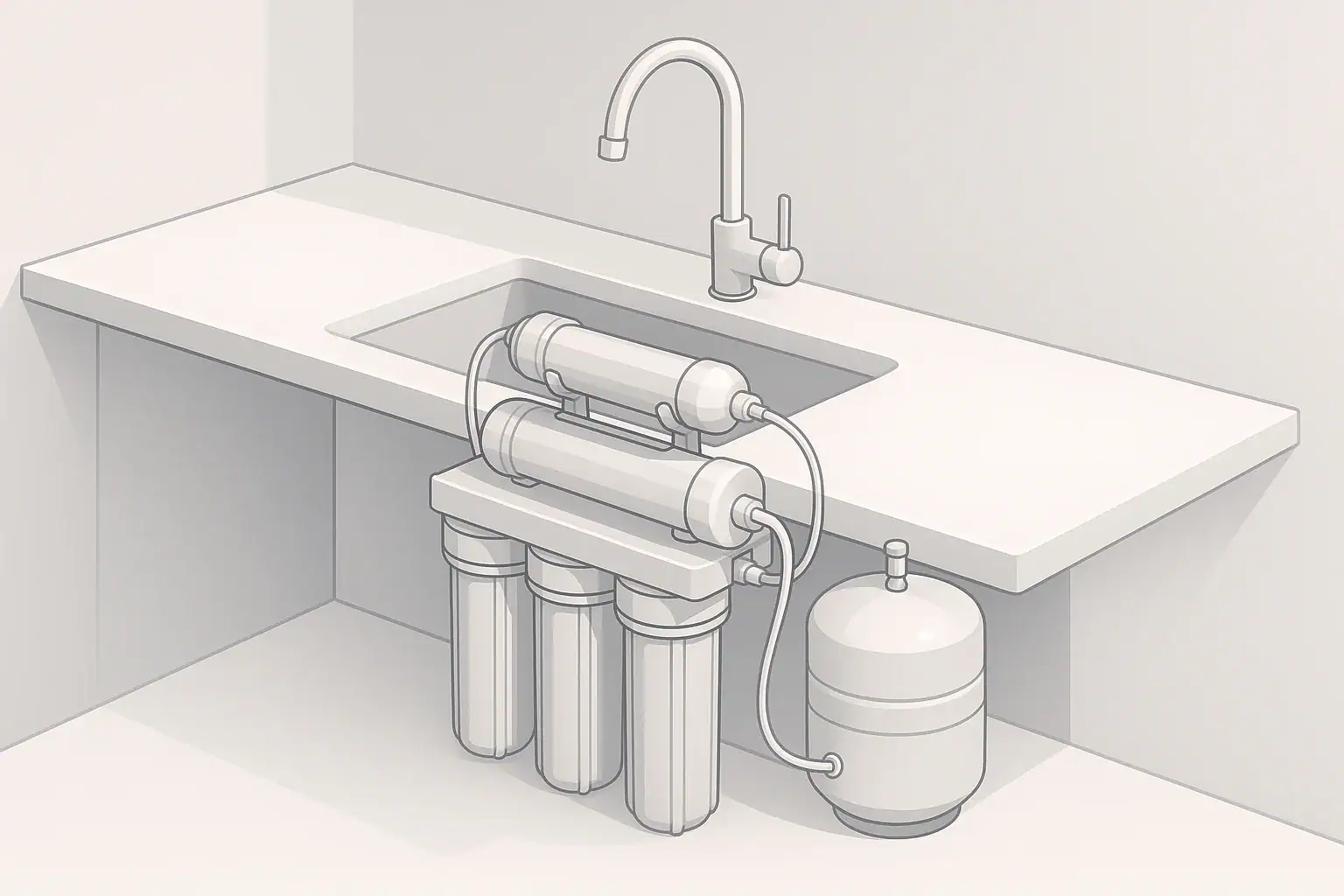
Reverse osmosis (RO) systems can produce very clean water, but they can also create tastes that people describe as “plastic,” “stale,” “flat,” or even “chemical.” This does not always mean the water is unsafe; it usually points to installation issues, new materials, or maintenance problems.
Understanding where taste and odor come from makes troubleshooting much easier. In most homes, bad-tasting RO water comes from one or more of these factors:
- New system or recent filter change – harmless manufacturing residues, carbon fines, and plastics can cause temporary off tastes.
- Storage tank and tubing materials – low-level leaching from rubber bladders and plastic lines can give a “plastic” or “rubbery” taste, especially in new or little-used systems.
- Stagnant water – water sitting for long periods in the storage tank or lines can pick up a “stale” or “musty” flavor.
- Chlorine or chloramine not fully removed – if the carbon prefilter is exhausted or undersized, a residual disinfectant taste may come through.
- Very low mineral content – RO removes most dissolved solids, which can make water taste “flat” or “empty” compared with tap or spring water.
- Incorrect or skipped maintenance – overdue filters, biofilm growth, or sediment buildup may change taste and odor over time.
Because RO systems are made from plastic housings, tanks, and tubing, some initial off taste is common. It should fade after a proper flush and a few complete tank cycles. If bad taste persists beyond that, it is a sign to inspect components and maintenance routines more closely.
Why Reverse Osmosis Water Sometimes Tastes Bad
Common RO Taste Problems and Likely Causes
RO taste issues usually fall into a few recognizable patterns. Matching the flavor to likely causes helps you decide what to do next.
“Plastic,” “Rubber,” or “Chemical” Taste
This taste is frequently reported with:
- Brand-new systems or recently replaced tanks and tubing.
- Systems that sit unused for long periods, such as in vacation homes.
- Lines or tanks installed in warm areas, which can intensify plastic-like flavors.
Common contributors include:
- New plastic components that were not fully flushed at installation.
- Storage tank bladder material imparting a rubbery or vinyl taste.
- Low-flow conditions that keep water in contact with plastics for many hours between uses.
“Stale,” “Musty,” or “Old” Taste
RO systems often include a pressurized storage tank that holds a few gallons of treated water. If the tank is not regularly emptied and refilled, water can taste stale.
Contributors to stale taste include:
- Infrequent use – water sits in the tank for days at a time.
- Warm under-sink cabinets – slightly raised temperatures accelerate changes in taste.
- Biofilm or microbial growth on surfaces – even if not harmful, these can cause earthy or musty notes.
- Old post-carbon filter – can stop polishing taste effectively and even contribute its own off flavor.
“Flat” or “Too Pure” Taste
Many people notice that RO water tastes different from mineral-rich tap or bottled water. RO membranes remove most dissolved solids, including calcium, magnesium, and many other ions that contribute to a “crisp” or slightly sweet taste.
With very low total dissolved solids (TDS), water can taste:
- Flat or bland compared with local tap water.
- More sensitive to small contaminants – any minor plastic or tank flavor stands out more in very low-TDS water.
This is usually a preference issue rather than a safety problem, and some homeowners choose to remineralize or blend to adjust taste.
Example values for illustration.
| Observed taste or issue | Most likely causes | First checks or actions |
|---|---|---|
| Strong plastic or rubber taste in new system | Unflushed tank, new tubing and housings | Flush several full tanks, check all lines are food-grade |
| Stale or musty after water sits overnight | Water stagnating in tank and faucet line | Empty tank daily for a few days, increase usage if possible |
| Flat taste but no odors | Very low mineral content from effective RO | Consider remineralization or blending with non-RO water |
| Chlorine-like smell or swimming pool taste | Exhausted carbon prefilter, high disinfectant level | Replace carbon stage, verify recommended change interval |
| Sudden change in taste after filter change | Carbon fines, trapped air, installation disturbance | Flush several gallons, recheck cartridges are seated |
| Bad taste from RO faucet, but tap water fine | RO tank or dedicated faucet components | Compare taste at RO line before tank, inspect faucet parts |
| Metallic or rusty note | House plumbing, older fixtures, sediment | Check taste at cold tap, inspect sediment prefilter |
Step-by-Step Fixes for Plastic or Stale RO Taste
Most taste problems can be improved with a sequence of simple checks and maintenance tasks. Working from easiest to more involved steps keeps troubleshooting efficient.
1. Fully Flush a New or Recently Serviced System
Any time a new RO system is installed or major components are replaced, a thorough flush is essential. If this step was skipped or shortened, plastic and carbon tastes are more likely.
Typical flushing steps include:
- Letting the RO unit fill the storage tank completely.
- Opening the RO faucet and draining the tank completely.
- Repeating this process several times (for example, two to four full tank cycles) until taste improves.
This process removes carbon fines from new filters, air from the lines, and initial residues from the tank bladder. You may also notice cloudy water at first due to tiny air bubbles; this is normal and usually clears quickly.
2. Compare Taste Before and After the Storage Tank
To find out if the storage tank is the main source of bad flavor, it helps to compare water:
- Directly from the RO line (before the tank), and
- From the regular RO faucet (after the tank and post-filter).
Depending on your plumbing layout, you may be able to temporarily disconnect the tank and briefly run the RO line to a container to collect water. If the water tastes clean before the tank but not after, the tank or post-filter is the likely source.
3. Increase Turnover: Avoid Stagnant Water
If the RO system is used only occasionally, water can sit in the tank and faucet line for days. To reduce stale flavors:
- Empty the storage tank completely at least once per day for several days.
- Use RO water for cooking, coffee, tea, and ice to boost daily turnover.
- If the system serves only one person, consider a smaller tank size to increase cycling frequency.
Regular turnover limits the time water is in contact with plastic and rubber components, which typically reduces off tastes.
4. Check Pre-Filters, Post-Filters, and Change Intervals
RO systems usually include several stages:
- Sediment prefilter – traps rust, sand, and particles.
- Carbon prefilter – reduces chlorine and some organic compounds that can damage the membrane and affect taste.
- RO membrane – removes most dissolved solids.
- Post-carbon filter – “polishes” taste from the tank to the faucet.
When these components age, taste can change gradually or suddenly. To keep taste consistent:
- Follow the manufacturer’s recommended time-based changes (for example, every 6 or 12 months for prefilters).
- Also pay attention to usage-based cues such as lower flow, cloudiness, or stronger tap-water smell.
- Replace the post-carbon filter on schedule; it is the last stage that shapes flavor.
If you do not know when filters were last changed, starting fresh with new cartridges and membrane (if due) gives you a known baseline.
5. Inspect Tubing and Faucet Components
Occasionally, specific pieces of tubing or faucet components contribute a strong plastic taste. Under-sink spaces can also be warmer, which can intensify these flavors.
Steps to consider:
- Confirm that all tubing and fittings in contact with RO water are rated for potable water.
- Shorten unnecessarily long tubing runs to reduce water contact time with plastic surfaces.
- Check that no chemical storage (cleaners, solvents, paints) is venting fumes in the same cabinet that could potentially influence odors around the faucet or vent slots.
- If the dedicated RO faucet has rubber or plastic inserts, inspect them if accessible and compatible with replacement parts.
6. Sanitize the System and Tank (If Needed)
If stale or musty taste persists despite good turnover and fresh filters, a system sanitization may help. Many manufacturers recommend periodic sanitizing during cartridge changes.
General sanitizing approaches often include:
- Shutting off feed water and relieving pressure.
- Removing old filters (and sometimes the membrane, per manufacturer guidance).
- Using a sanitizer compatible with drinking water systems at the recommended dilution.
- Filling housings and the tank with the sanitizing solution for a specified contact time.
- Flushing thoroughly until the sanitizer is fully removed and taste is neutral.
Always follow the instructions for your specific system. Sanitizing too aggressively or with the wrong chemicals can damage components or membranes.
Improving Taste from Very Low-Mineral RO Water
Even when there is no plastic or stale flavor, some people simply do not like the taste of very low-TDS water. Adjusting mineral content or blending can help without compromising clarity.
Remineralization Cartridges
Many RO setups include or can add a remineralization stage after the membrane and tank. These cartridges are usually filled with media that slowly dissolves minerals into the water.
Benefits of remineralization for taste include:
- More familiar flavor for those used to mineral-rich municipal or well water.
- Slight increase in TDS, which can make the water seem less “thin.”
- Reduced sensitivity to faint plastic or tank flavors, since the water is not completely stripped of dissolved solids.
Remineralization cartridges, like other filters, require periodic replacement to maintain consistent taste.
Blending with Non-RO Water
Another option is blending a portion of non-RO tap water with RO water to restore some minerals. How people do this varies widely:
- Mixing RO water and filtered (non-RO) water in a pitcher.
- Using RO for most uses but tap or other filtered water for plain drinking.
Blending is a manual method and may not be as consistent as a dedicated remineralization cartridge, but it is simple and adjustable to personal taste.
Checking Basic Water Metrics
Two easy-to-measure metrics can help you understand why your RO water tastes the way it does:
- Total dissolved solids (TDS) – a handheld meter can give an approximate reading in parts per million (ppm). Tap water might read in the low hundreds, while RO water might be in the single digits or low tens.
- Hardness – test strips or kits can show how much calcium and magnesium remain. RO water is typically very soft.
These readings do not directly indicate safety, but they help explain taste differences and let you track whether the RO membrane is performing consistently over time.
When to Suspect a Performance or Safety Problem
While most taste issues are related to materials and stagnation, some changes can indicate that the system is not working as intended and should be checked more carefully.
Sudden, Strong Change in Taste or Odor
A sudden shift from neutral to strong chlorine, sulfur, or chemical odors may mean:
- The carbon prefilter is exhausted sooner than expected, especially if the municipal water has high disinfectant levels.
- The RO membrane has failed or is bypassing more water.
- There is a cross-connection or mis-plumbed line allowing untreated water to reach the RO faucet.
If a rapid change occurs, many homeowners choose to:
- Stop using the RO water until the cause is identified.
- Check that all valves and tubing are still in the correct positions.
- Test TDS before and after the RO unit to see if rejection has decreased.
Visible Particles, Discoloration, or Cloudiness
Temporary cloudiness from air bubbles during flushing is common. Other visible changes may be more concerning:
- Persistent particles may come from deteriorating filter media or sediment bypassing the prefilter.
- Yellow, brown, or green tints could be related to upstream plumbing, rust, or other issues.
- Slime or growth in or around the RO faucet suggests the need for cleaning and possibly system sanitization.
Very Slow Flow or Noisy Operation
Flow and noise are not directly taste-related, but they indicate system condition:
- Slow flow can mean clogged prefilters, low feed water pressure, or a failing membrane.
- Gurgling or hissing may be normal during operation, but new or loud sounds can point to air in the system or a partially closed valve.
Addressing these performance issues often improves taste indirectly by ensuring each stage functions properly.
Example values for illustration.
| Symptom | Likely cause | Safe checks you can do |
|---|---|---|
| New system, strong plastic taste | System not fully flushed | Run and discard several full tanks, recheck instructions |
| Bad taste only after water sits | Stagnant water in tank and lines | Empty tank daily, note if taste improves over a week |
| Chlorine smell from RO faucet | Expired carbon prefilter | Inspect filter dates, replace carbon stage, compare to tap smell |
| Flat taste, low TDS reading | Effective RO removing minerals | Measure tap vs RO TDS, consider remineralization |
| Taste fine before tank, bad after tank | Tank bladder or post-filter issues | Bypass tank if possible, compare samples, plan tank/service check |
| Gradual worsening taste over months | Filters at end of life | Review maintenance log, replace due stages, retaste after flushing |
| Sudden strong off odor | System upset, mis-plumbing, or failure | Stop using RO water, verify tubing layout, consider professional inspection |
Planning Long-Term RO Maintenance for Consistent Taste
Keeping RO water tasting good over the long term is mostly a matter of consistent, documented maintenance. A simple schedule can prevent most taste complaints before they start.
Track Filter and Membrane Changes
To avoid guessing when components were last replaced:
- Write the installation date directly on each housing or cartridge with a permanent marker, if allowed.
- Keep a small log sheet or digital note listing each change date and any observed taste differences.
- Note changes in water source quality (for example, municipal notices about main repairs or treatment changes).
Periodically Check Taste, Smell, and Simple Metrics
Once or twice a year, many homeowners find it useful to:
- Compare tap vs RO taste and odor side by side.
- Measure TDS before and after RO to confirm the membrane is still rejecting most dissolved solids.
- Observe flow rates from the RO faucet to catch slow-clogging filters.
Use Certifications as a Guide to System Capabilities
Some RO systems and replacement elements are evaluated against standards for structural integrity, reduction of certain contaminants, and performance claims. Depending on your priorities (taste, aesthetics, or specific contaminants), you may want to check which standards a system is designed to meet, and verify that replacement parts are compatible with those expectations.
Combined with good installation and regular maintenance, these steps help ensure that RO water is not only clear but also pleasant to drink, without persistent plastic or stale flavors.
Frequently asked questions
Why does my RO water taste like plastic even after I flushed it?
New plastic components, carbon fines, or a fresh tank bladder can impart a faint plastic or chemical taste that persists until residues are removed. Try flushing two to four full tank cycles, then compare water before and after the storage tank; if the taste remains after the tank, check post-filters and faucet components for contamination or replacement needs.
How long should a new RO system take to stop tasting stale or plastic?
Most off tastes from new systems fade after several complete tank fills and drains (commonly two to four cycles) and within a few days of normal use. If the taste persists beyond a week, inspect the tank bladder, post-carbon filter, and tubing, and consider sanitizing the system.
Will sanitizing the RO system remove musty or stale flavors?
Sanitizing can remove biofilm and surface contaminants that cause musty or stale tastes when turnover and filter replacement have not fixed the issue. Use a sanitizer that is compatible with drinking-water systems, follow the system instructions, and flush thoroughly afterward to remove any residual sanitizer taste.
Does very low mineral content make RO water taste bad and how can I fix it?
Very low TDS can make water taste flat or less flavorful, which some people perceive as bad taste. Options to improve flavor include adding a remineralization stage, using adjustable mineral drops, or blending a portion of non-RO filtered water to restore a more familiar mouthfeel.
When should a bad taste make me worry about system performance or safety?
Be concerned if you notice a sudden strong change (chlorine, sulfur, or chemical odor), visible particles, discoloration, or a drop in RO rejection measured by TDS testing. In those cases stop using the RO water until you check filter condition, tubing layout, valve positions, and membrane performance, or seek professional inspection.
Recommended next:
- Reverse Osmosis 101: What RO Removes (and What It Doesn’t)
- NSF/ANSI 58 Explained: What It Means for RO Systems
- RO vs Carbon Under-Sink: Taste, TDS, and Maintenance Compared
- RO System Installation Guide: Space-Saving Layout Under the Sink
- RO Waste Water Ratio: What’s Normal and How to Reduce It
- RO Filter Replacement Schedule: Prefilters vs Membrane
- More in Reverse Osmosis (RO) →
- NSF/ANSI standards explained (42/53/401/58)
- Clear trade-offs: pitcher vs faucet vs under-sink vs RO
- Maintenance planning: cost per gallon and replacement cadence