
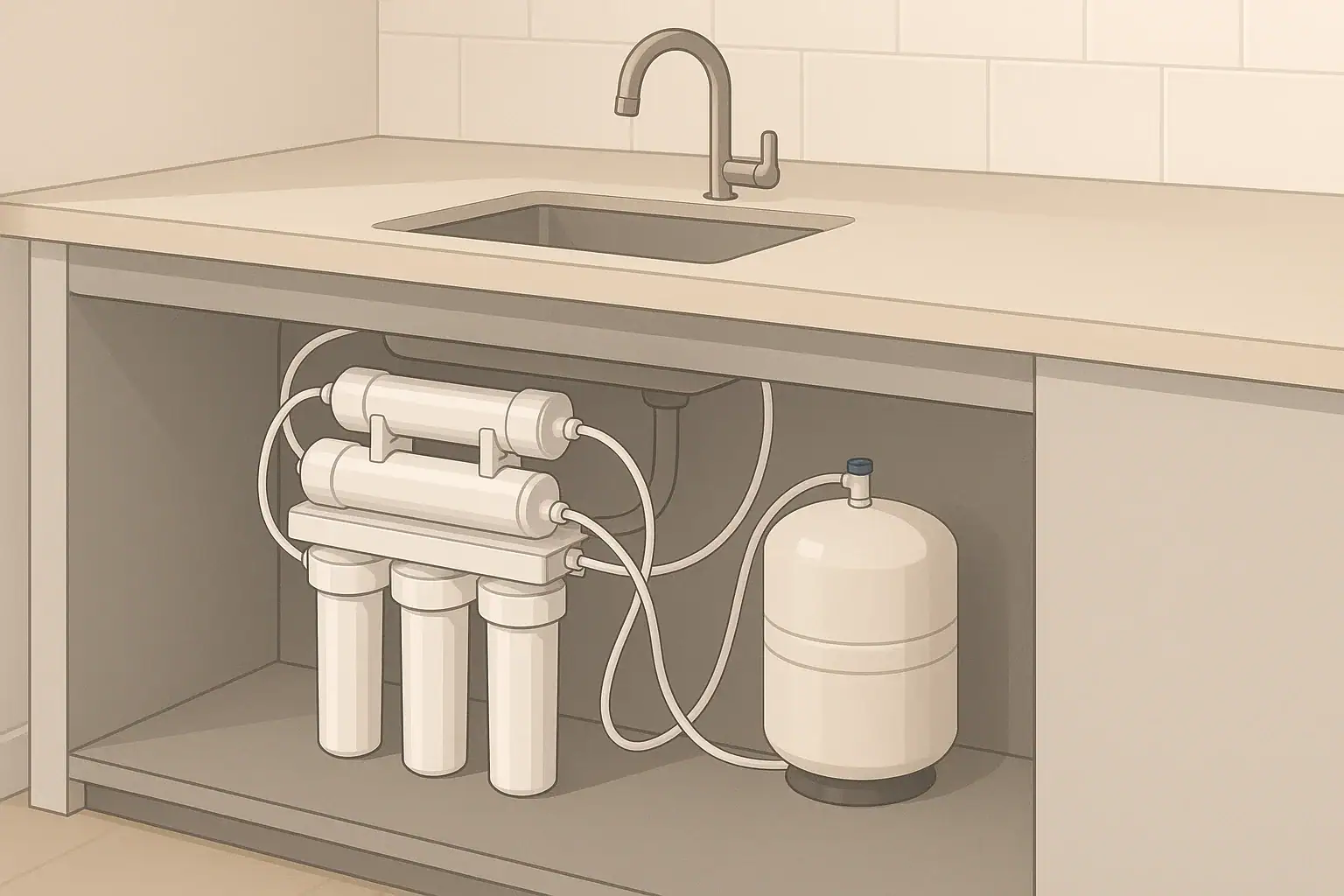
Why Reverse Osmosis Is Often Recommended for PFAS
Reverse osmosis (RO) is widely discussed as a strong option for reducing PFAS (per- and polyfluoroalkyl substances) in home drinking water. PFAS chemicals are persistent in the environment and can be difficult to remove with basic filtration. RO systems use a semi-permeable membrane and multiple pre- and post-filters to physically separate many dissolved substances from water.
In a typical under-sink RO system, water passes through:
- Pre-filtration (sediment and carbon) to remove particles, chlorine, and improve taste and odor
- The RO membrane, which rejects many dissolved ions and organic compounds
- Post-filtration (often carbon) to polish taste and remove residual odors
For PFAS, the RO membrane and carbon stages are especially important. However, not every RO system is tested for PFAS, and not every claim is equally reliable. That is where certifications and verified test data matter.
How PFAS Claims Are Made for Home RO Systems
When you see PFAS-related language on an RO product page or manual, it may be based on several types of support:
- Independent certification to NSF/ANSI standards (most robust, but not always PFAS-specific)
- Third-party lab reports using recognized PFAS test methods
- Internal testing from the manufacturer (less transparent if details are limited)
- General performance assumptions based on RO technology, without PFAS-specific testing
Because PFAS is a broad chemical family and test methods continue to evolve, you may see different terms, such as "PFOA", "PFOS", or "select PFAS compounds." Matching those labels to actual data and certifications will help you understand what the system has been shown to reduce.
Example values for illustration.
| What you see on the box or spec sheet | What it usually means | How to respond as a buyer |
|---|---|---|
| NSF/ANSI Standard 58 listed, PFAS explicitly mentioned | RO system has been evaluated to a standard that can include PFAS; documentation may show PFAS test data | Ask or look for a performance data sheet listing which PFAS were tested and under what conditions |
| NSF/ANSI 58 certified, PFAS not mentioned | System is certified for RO performance, but PFAS reduction may not have been part of the test scope | Do not assume PFAS reduction; request clarification or test reports if PFAS is a priority |
| "Tested to reduce PFOA and PFOS" with third-party lab named | Independent lab testing likely performed for specific PFAS compounds | Check the report for starting levels, final levels, and number of test cycles |
| "Reduces PFAS" with no details or test method | General marketing claim, may be based on internal assumptions | Be cautious; seek more detailed documentation before relying on PFAS reduction |
| "Removes chemicals" or "advanced filtration" with no PFAS mention | Broad language that does not specifically address PFAS | Do not treat as PFAS evidence; focus on systems with explicit PFAS information |
| Performance data sheet listing several PFAS with example reductions | Manufacturer is providing compound-specific information, possibly from lab testing | Review the test conditions, replacement intervals, and limitations before deciding |
Key Certifications Relevant to RO and PFAS
In the United States, third-party certifications help verify that a water treatment product has been tested to an established standard. For RO systems, the most relevant drinking water standards are typically:
- NSF/ANSI 42 – aesthetic effects (taste, odor, chlorine, particulates)
- NSF/ANSI 53 – health-related contaminants (such as certain heavy metals and organic chemicals)
- NSF/ANSI 401 – emerging compounds and incidental contaminants (including some pharmaceuticals and chemicals)
- NSF/ANSI 58 – reverse osmosis drinking water treatment systems
For PFAS, there is growing interest in adding more explicit and detailed coverage in these standards. Some standards can already include testing for specific PFAS compounds, such as PFOA and PFOS, under their existing frameworks. However, you should not assume that any system certified to these standards automatically reduces PFAS unless the certification or performance data clearly states it.
When evaluating a PFAS claim for an RO system, focus on:
- Which NSF/ANSI standard number is listed
- Whether the certification applies to the entire system or only specific components
- Whether PFAS or individual PFAS compounds are explicitly named in the certification or supporting documents
- Whether you can obtain a performance data sheet that shows contaminant names and example reduction levels
How to Read PFAS Performance Data for RO Systems
Beyond the certification logo, the most useful information for a homeowner is the performance data sheet or lab report. This document may go by several names (performance data sheet, test report summary, contaminant reduction list), but it typically contains similar elements.
Typical elements of a performance data sheet
When reviewing PFAS-related information, look for:
- Contaminant name – for example, PFOA, PFOS, or other PFAS listed individually
- Influent (incoming) level – the concentration used in testing
- Treated water level – the concentration after filtration
- Test method – analytical method used to measure PFAS, if listed
- Test conditions – water pressure, temperature range, and system flow rate during testing
- Filter life assumptions – how long the filter or membrane was operated during the test (for example, new vs. near end-of-life)
PFAS testing is often performed with specific compounds at defined concentrations. A system tested on a small set of PFAS does not necessarily cover the entire PFAS family, but it does provide insight into how the system performs for the compounds tested.
Questions to ask when claims are unclear
If the PFAS performance data is not immediately obvious, you can look for or ask about:
- Which PFAS compounds were included in testing
- Whether the testing was performed on a complete system or on individual components only
- Whether results represent initial performance or performance over time
- How filter replacement intervals were determined in relation to PFAS reduction
For many homeowners, PFAS is one of several concerns. In that case, it can be helpful to consider the full contaminant list the system is tested for, including chlorine, sediment, and metals that influence taste, odor, and overall water quality.
Practical Considerations: RO System Design and PFAS
System design and maintenance have a direct impact on how well an RO setup can handle PFAS and other contaminants over time. Even with strong lab performance, household conditions can vary.
Pre-filtration and carbon stages
Most under-sink RO systems use carbon filters before and after the membrane. These stages help manage chlorine, chloramine, and organic compounds that can affect taste and odor. They can also play a role in reducing some PFAS compounds, especially when contact time with carbon is sufficient.
When examining specifications and manuals, pay attention to:
- The presence of at least one activated carbon stage
- Recommended replacement intervals for carbon filters
- Any notes on chlorine/chloramine capacity, since protecting the RO membrane can indirectly support consistent performance
Membrane performance and operating conditions
RO membrane is the core of the system. Its performance depends on factors such as water pressure, temperature, and overall dissolved solids.
For PFAS and general contaminant reduction, typical considerations include:
- Feed water pressure within the recommended range for the system
- Stable flow without frequent pressure drops
- Regular replacement of pre-filters so the membrane does not clog prematurely
- Monitoring taste and flow for gradual changes that could signal membrane aging
RO systems often specify a typical membrane lifespan, but the real-world interval can vary depending on water quality and usage patterns. A system that maintains good overall performance is more likely to remain effective for PFAS and other contaminants within its tested capabilities.
Cost, Wastewater, and Capacity Considerations
PFAS concerns often prompt people to install RO even if they have not previously used any under-sink filtration. When planning, it helps to think through overall costs and trade-offs.
Cost per gallon for PFAS-focused RO use
To estimate cost per gallon, you can consider:
- Upfront system cost (spread over its expected lifespan)
- Replacement filters and membrane on their recommended schedule
- Estimated daily drinking and cooking water use
For example, if the total annual spending on RO filters and membrane averages a certain dollar amount, and your household uses several hundred gallons of RO water per year, you can calculate a rough cost per gallon. This helps you compare RO with other options like pitcher filters or under-sink carbon systems.
Wastewater and storage tank sizing
Most under-sink RO systems generate a waste stream as part of the membrane separation process. The ratio of treated water to wastewater varies by design and operating conditions. While this is a consideration for water use, it is also part of how the membrane maintains performance.
Storage tank size affects how easily the system can handle peak use, such as filling pots for cooking. If PFAS is a concern for all drinking and cooking water, consider whether:
- The tank capacity matches your daily patterns (for example, morning and evening use)
- You may want to connect the RO output to a refrigerator or ice maker for convenience
- Flow and refill times remain acceptable as filters age
Stable flow and capacity not only improve convenience but also encourage consistent use of the RO tap for the water you intend to treat for PFAS.
Maintenance and Monitoring for Consistent PFAS Reduction
For any filtration technology, the performance that appears in lab testing depends on filters and membranes being replaced as specified. PFAS and other contaminants can break through once media becomes saturated or membranes degrade.
Sticking to filter and membrane replacement intervals
Manufacturers usually specify replacement intervals such as:
- Sediment and carbon pre-filters: every several months to a year
- RO membrane: every couple of years under typical use
- Post-filter (polishing carbon): every year or according to taste/odor changes
These replacement intervals are often tied to both time and gallons treated. To manage this without guesswork, you can:
- Mark replacement dates on the system or on a calendar
- Track approximate daily or weekly use for a rough gallon estimate
- Watch for changes in taste, odor, or flow that suggest earlier replacement
Optional water testing at home or through a lab
Some homeowners choose to test their water periodically to see how overall water quality changes before and after treatment. For PFAS, this typically requires sending samples to a laboratory that offers PFAS testing. While this is not necessary for every home, it can provide added insight when PFAS is a primary concern and you want to verify the performance of your chosen system.
Basic at-home tests for general water parameters (such as hardness, pH, or total dissolved solids) do not directly measure PFAS, but they can help you understand broader system performance and whether operating conditions are close to what was used in lab testing.
Example values for illustration.
| Standard | General focus | How it relates to PFAS and RO | What to verify on documentation |
|---|---|---|---|
| NSF/ANSI 42 | Taste, odor, chlorine, and particulates | Improves water aesthetics; not primarily aimed at PFAS | Confirm which aesthetic contaminants are listed and whether certification is system-wide |
| NSF/ANSI 53 | Health-related contaminants | Can include some organic chemicals; PFAS may be covered if explicitly listed | Look for named contaminants; do not assume PFAS unless listed |
| NSF/ANSI 401 | Emerging and incidental compounds | Designed for newer contaminants; certain PFAS may appear as tested compounds | Check whether any specific PFAS compounds are shown on the performance data sheet |
| NSF/ANSI 58 | Reverse osmosis systems | Applies to RO performance; PFAS testing may be included for some systems | Verify that the RO system model is listed and see whether PFAS appears among tested contaminants |
| Component-only listings | Individual filters or housings | Show that parts meet aspects of a standard but not necessarily as a complete system | Check whether the entire assembled system is certified, not just separate components |
| System-level listings | Complete RO unit with all stages | Gives a clearer picture of how the installed system behaves | Confirm model numbers match and that performance sheets align with your configuration |
Bringing It All Together for Home PFAS Decisions
When you are considering RO for PFAS, the most useful step is to match your specific water concerns with documented performance. For many households, that means confirming local water quality information, identifying whether PFAS has been detected or is suspected, and then selecting an RO system whose claims are backed by clear test data and recognized standards.
By focusing on transparent certifications, detailed performance data sheets, and realistic maintenance planning, you can better understand how an RO system is likely to perform in your home, not just in a laboratory. This approach helps you align expectations, budget, and day-to-day use with the goal of improving the quality, taste, and consistency of your drinking and cooking water.
Frequently asked questions
Does reverse osmosis remove all PFAS compounds from drinking water?
Reverse osmosis can reduce many PFAS compounds, particularly when combined with carbon stages, but it does not guarantee removal of every PFAS species. Effectiveness depends on the specific PFAS, system design, and whether the system has been tested for those compounds.
Is an NSF/ANSI 58 certification sufficient proof that an RO system reduces PFAS?
NSF/ANSI 58 certifies RO performance generally but does not automatically prove PFAS reduction unless PFAS are explicitly listed in the certification or supporting performance data. Look for a performance data sheet or specific test reports showing PFAS results.
What should I look for in a PFAS performance data sheet?
A useful data sheet lists individual PFAS compounds tested, influent and treated concentrations, analytical test methods, test conditions (pressure, temperature, flow), and whether the whole system or components were tested. This information lets you judge how closely lab conditions match your household use.
How often should RO membranes and carbon filters be replaced to maintain PFAS reduction?
Manufacturers typically recommend replacing sediment and carbon pre-filters every several months, post-filter carbon yearly, and the RO membrane every couple of years under normal use; actual intervals depend on your water quality and usage. Staying on the replacement schedule and monitoring taste and flow are important to prevent PFAS breakthrough.
Can the carbon stages in an RO system remove PFAS on their own?
Activated carbon can reduce certain PFAS, particularly longer-chain compounds, when contact time and carbon capacity are sufficient. However, carbon performance varies by compound and is often more effective when paired with the RO membrane to address a broader range of PFAS.
Recommended next:
- Reverse Osmosis 101: What RO Removes (and What It Doesn’t)
- NSF/ANSI 58 Explained: What It Means for RO Systems
- RO vs Carbon Under-Sink: Taste, TDS, and Maintenance Compared
- RO System Installation Guide: Space-Saving Layout Under the Sink
- RO Waste Water Ratio: What’s Normal and How to Reduce It
- RO Filter Replacement Schedule: Prefilters vs Membrane
- More in Reverse Osmosis (RO) →
- NSF/ANSI standards explained (42/53/401/58)
- Clear trade-offs: pitcher vs faucet vs under-sink vs RO
- Maintenance planning: cost per gallon and replacement cadence