
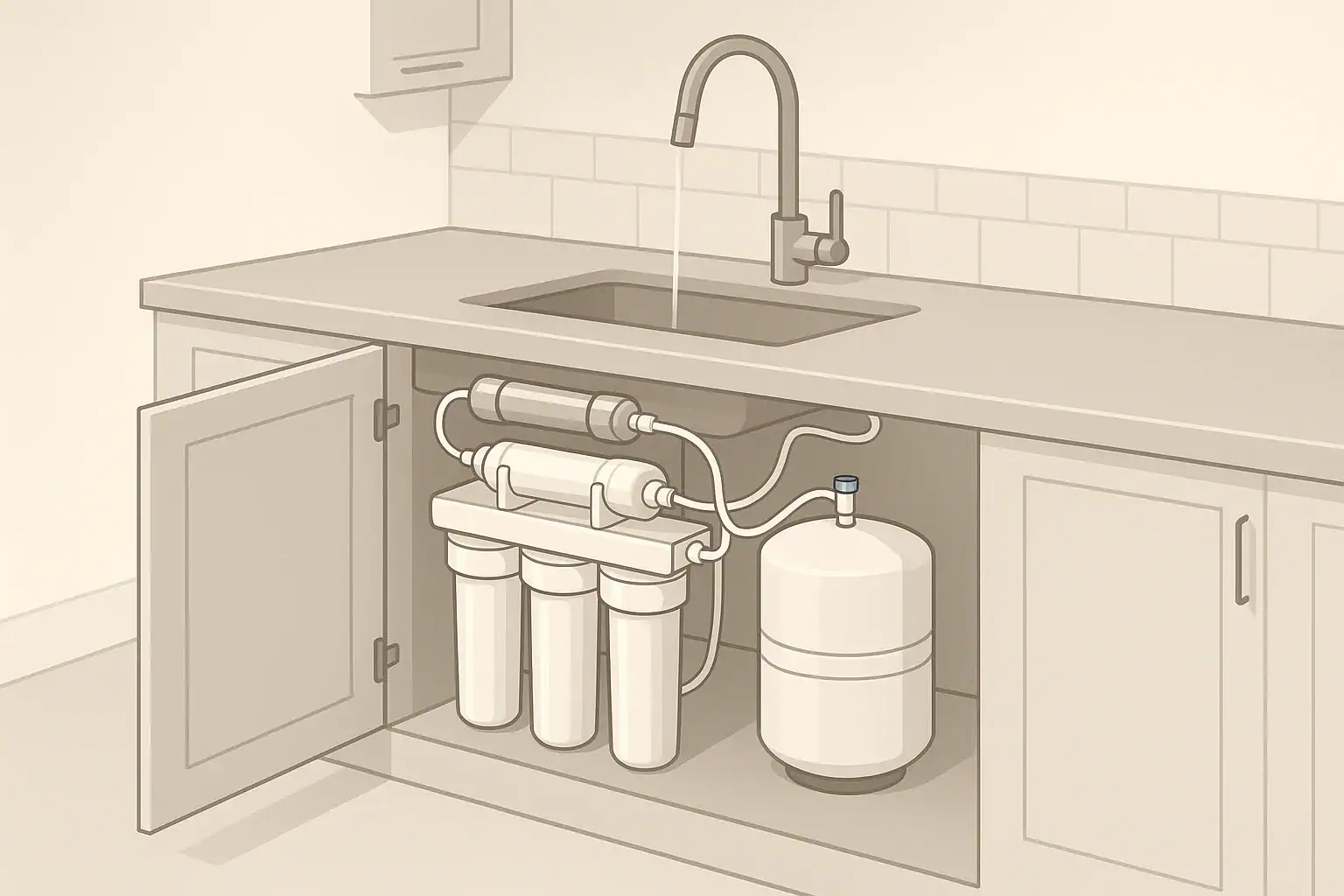
Reverse osmosis (RO) and ultraviolet (UV) disinfection address different aspects of water quality. RO focuses on dissolved contaminants and fine particles, while UV targets microorganisms. In a combined system, RO and UV are usually installed in series to improve both taste/odor and microbiological safety margins for household use.
RO uses a semipermeable membrane to separate water from many dissolved solids and contaminants. Under household water pressure, water is forced across the membrane, leaving much of the dissolved material in the reject stream. An RO system typically includes several stages:
- Sediment prefilter (for sand, rust, and other particles)
- Carbon prefilter (for chlorine, chloramine, and many taste/odor compounds)
- RO membrane (for many dissolved salts, metals, and some organics)
- Postfilter, often carbon (for polishing taste and remaining odors)
How UV and RO Filtration Work Together
UV disinfection, by contrast, uses ultraviolet light (usually in the UV-C range) to inactivate microorganisms by damaging their genetic material. Water flows in a thin layer around a UV lamp protected by a quartz sleeve. When properly sized and maintained, UV can significantly reduce the ability of microorganisms such as bacteria and viruses to reproduce.
When combined, UV is most often placed after the RO storage tank as a final disinfection step. The RO stages improve clarity and remove many substances that could shield microorganisms or foul the UV chamber, while UV provides an additional layer of defense against microbes that might be present downstream of the RO membrane or introduced in the faucet and lines.
When a UV + RO Combo System Makes Sense
Not every home needs a UV + RO combination. In many municipal systems with stable disinfection and good distribution infrastructure, a standard RO setup without UV may be adequate for taste, odor, and common chemical contaminants. A UV stage becomes more relevant in certain water quality and plumbing situations.
Typical Situations Where UV with RO Is Worth Considering
- Private well water with unknown or variable microbiological quality
Wells can be affected by surface runoff, septic systems, and seasonal changes. If testing shows the presence of coliform bacteria or other microbial indicators, adding UV to a point-of-use RO system can offer an extra disinfection step at the tap, alongside any whole-house treatment you may use. - Homes with intermittent supply or storage tanks
Where water is stored in home tanks or pressure vessels for long periods, there is more opportunity for microbial regrowth. UV after the RO tank can help inactivate microorganisms that may have entered or grown within the storage and distribution lines. - Situations with low or inconsistent residual disinfectant
In some systems, disinfectant residuals may be low at the tap, especially at the ends of long distribution lines or in older plumbing with dead legs where water sits for long periods. UV at the point of use provides disinfection independent of the municipal residual. - Users wanting an added margin of protection against microbes
Some households choose UV with RO simply to add redundancy. RO membranes may reduce some microbes, but membranes and housings can develop imperfections over time. UV downstream can help inactivate microorganisms that bypass the membrane or are introduced after it. - Homes with complex plumbing or cross-connection concerns
In buildings with older or modified plumbing, there may be a higher risk of contamination from backflows or cross-connections. A UV stage at the RO faucet adds localized disinfection at the point where water is consumed.
On the other hand, if your tap water comes from a well-maintained municipal system with consistent disinfectant levels, and you primarily care about taste, odor, and some chemical contaminants, an RO system alone may meet your goals. As always, periodic water testing and reviewing local water quality reports can help inform whether a UV addition is appropriate.
Example values for illustration.
| Situation | Microbial risk context | UV with RO typically… |
|---|---|---|
| Municipal water, recent main breaks | Short-term uncertainty about distribution system | May be worth considering during higher-risk periods |
| Municipal water, stable supply, good residual | Generally low microbial risk at tap | Often optional; RO alone may suffice for many users |
| Private well, limited or infrequent testing | Uncertain microbial quality over time | Often recommended as an added disinfection barrier |
| Home with large storage tank or cistern | Potential for microbial regrowth in stored water | Frequently helpful as a final disinfection step |
| Seasonal property with long stagnation periods | Water may sit in pipes for weeks or months | Can be valuable when reopening the system |
| Complex or older plumbing with dead ends | Higher chance of localized stagnation | Can add a margin of safety at the RO faucet |
| Users focused mainly on taste and odor | Chemical concerns outweigh microbial concerns | UV is often optional; RO plus carbon is the priority |
How UV Fits into a Typical RO System Layout
In a common under-sink RO installation, cold water enters a prefilter assembly, passes through the RO membrane, and is stored in a small pressure tank. When the faucet is opened, water flows from the tank through a postfilter and then to the tap. UV can be added near the end of this line.
A typical sequence looks like this:
- Feed water line from cold supply
- Sediment prefilter (and sometimes multiple sediment grades)
- Carbon prefilter for chlorine and taste/odor
- RO membrane housing
- Storage tank for RO water
- Postfilter (often carbon) for final polishing
- UV disinfection chamber near the faucet line
- Dedicated RO faucet at the sink
Installing UV after the tank is common because it treats water as it is dispensed, taking into account any possible contamination or regrowth inside the storage tank and tubing. Some configurations place UV before the tank as well, but that can require more careful flow and exposure-time calculations, especially if flow rates vary.
Because UV’s effectiveness can be influenced by water clarity, prefiltration is important. Sediment and carbon stages ahead of the UV chamber reduce turbidity and particles that may shield microorganisms from UV light. Many RO systems already provide this degree of prefiltration, which is one reason UV integrates well with RO.
Key Water Quality Considerations for UV + RO Systems
Before adding UV to an RO setup, it helps to understand how water quality metrics affect both technologies. Some factors influence the long-term performance and maintenance schedule for the system.
Turbidity and Sediment
Turbidity refers to how cloudy water appears due to suspended particles such as silt, clay, or organic matter. High turbidity can:
- Clog sediment and carbon prefilters more quickly
- Reduce UV exposure to microorganisms by providing physical shielding
- Potentially foul the RO membrane, reducing flow and performance
For most UV systems, low turbidity is preferred. Many households use one or more sediment filters upstream of RO and UV to help keep turbidity under control.
TDS, Hardness, and Scaling
Total dissolved solids (TDS) is a general indicator of dissolved minerals, salts, and some organics. RO is particularly useful when TDS is moderate to high, because it can reduce many dissolved constituents that affect taste and scale formation. Hardness (primarily calcium and magnesium) can contribute to scale on the RO membrane and in the UV quartz sleeve.
In homes with hard water, pretreatment such as a water softener or anti-scale device may be helpful to reduce maintenance on both the RO membrane and UV sleeve. Otherwise, scale may gradually reduce flow and UV exposure, requiring more frequent cleaning or part replacement.
Chlorine, Chloramine, and UV
Chlorine and chloramine are commonly used disinfectants in municipal systems. Carbon prefilters ahead of RO typically reduce these to help protect the membrane and improve taste and odor. UV does not replace these disinfectants in the distribution system but can provide additional disinfection at the point of use.
Because RO and carbon often reduce chlorine and chloramine significantly, the UV chamber usually treats water with little remaining disinfectant. This means that microbial regrowth downstream of the UV chamber is possible if water is stored or sits in pipes for extended periods. Using UV as close as possible to the dispensing faucet helps address this concern.
Certifications, Standards, and What to Look For
Certifications can help you compare UV + RO combination systems or separate components in a more standardized way. While not all systems carry every possible certification, understanding the common NSF/ANSI standards for drinking water treatment makes it easier to evaluate claims and documentation.
NSF/ANSI Standards Relevant to RO and UV
Several NSF/ANSI standards apply to household drinking water treatment units, including point-of-use RO systems and UV devices. The standards focus on different performance claims, such as aesthetic improvements, reduction of specific contaminants, or structural integrity. Many systems also undergo tests related to materials safety to help ensure that components in contact with water do not leach unacceptable amounts of substances into the treated water.
For UV + RO combinations, you might see standards related to RO performance, standards for UV microbiological treatment, and general material and structural requirements. It is useful to check that claims about contaminant reduction or microbial treatment are supported by a recognized standard and that you can locate the related documentation.
Example values for illustration.
| Standard | Typical application | What a homeowner can verify |
|---|---|---|
| NSF/ANSI 42 | Aesthetic effects (chlorine taste and odor, particulate) | Check if claims about taste, odor, or visible clarity refer to this standard |
| NSF/ANSI 53 | Health-related contaminant reduction (e.g., some metals or VOCs) | Confirm which specific contaminants are listed and the test conditions used |
| NSF/ANSI 58 | Reverse osmosis drinking water treatment systems | Look for documentation on TDS performance and structural/ material testing |
| NSF/ANSI 401 | Emerging compounds and incidental contaminants | Review whether any additional compounds of interest were tested |
| Microbiological treatment standards | UV or combination systems claiming microbial reduction | Check that microbial reduction claims specify a relevant standard or test protocol |
| Material and structural integrity requirements | Applies across many standards for system durability | Verify that housings, tanks, and fittings were tested for pressure and material safety |
Maintenance, Monitoring, and Cost Considerations
Adding UV to an RO system introduces some extra maintenance tasks and operating costs, but these are usually manageable with a simple schedule. Planning for lamp changes, sleeve cleaning, and routine RO filter replacements helps keep performance consistent over time.
RO Filter and Membrane Replacement
A typical under-sink RO system includes multiple cartridges and a membrane, each with its own replacement interval. In many homes:
- Sediment and carbon prefilters may be replaced roughly every 6–12 months, depending on water quality and usage.
- Postfilters are often changed on a similar or slightly longer schedule.
- The RO membrane may last several years under typical use, though high TDS or very hard water can shorten its service life.
Monitoring flow rate, taste, and a general TDS reading at the faucet can help you estimate when the membrane and filters are nearing the end of their useful life. Some households track filter changes on a simple calendar or label on the system itself.
UV Lamp, Sleeve, and Power Use
UV systems rely on a lamp that gradually loses output over time, even if it still lights visibly. For this reason, most UV devices have recommended lamp replacement intervals, often around once per year in continuous operation, though schedules vary by design. Following the manufacturer’s interval helps ensure that the UV dose remains at the intended level.
The quartz sleeve surrounding the lamp can accumulate mineral deposits or films, especially in areas with hard water. Gentle cleaning according to the device instructions is sometimes needed during lamp changes. If scaling is persistent, addressing hardness or prefiltration may reduce buildup.
UV systems also require electricity. Power consumption is typically modest, similar to a small household appliance, but it does add to operating costs. Some UV units run continuously, while others incorporate flow sensors or timers. Any control system should be used in a way that ensures water receives sufficient UV exposure whenever the tap is in use.
Estimating Cost per Gallon
The cost per gallon for a UV + RO system depends on local water conditions, the size of the system, and how much water you use. To get a rough sense of cost, many homeowners:
- Sum annual costs for replacement filters, RO membrane (amortized over its service life), UV lamp, and any cleaning chemicals or parts.
- Add estimated annual electricity cost for the UV lamp, based on power rating and local rates.
- Estimate total gallons of treated water consumed per year from the system (for example, by considering daily drinking and cooking volumes).
- Divide total annual cost by annual treated gallons for an approximate cost per gallon.
Even with UV added, many households find that the cost per gallon of RO-treated water for drinking and cooking remains low compared to purchasing packaged water, especially over several years of operation.
Monitoring Performance Over Time
To keep a UV + RO system working reliably, simple periodic checks are helpful:
- Visual inspections of housings, connections, and the area under the sink for any signs of leaks or corrosion.
- Flow rate observation at the RO faucet; gradual decreases can indicate filter clogging, membrane fouling, or pressure issues.
- Basic TDS readings at intervals to track RO performance trends; an increase over time may signal that filters or the membrane need service.
- Lamp status indicators or timers on UV units, if present, to ensure the lamp is operating and replaced at the recommended interval.
For households on private wells or systems with variable microbiological quality, periodic water testing from a reputable laboratory can help you understand whether your overall treatment setup, including UV, is working as intended. Combining these checks with a clear maintenance schedule gives a more complete picture of system performance.
Frequently asked questions
Do I need a UV RO combo system if my water comes from a municipal supply?
If your municipal supply has a stable disinfectant residual and recent water quality reports show low microbial risk, an RO system alone often meets taste and chemical-contaminant goals. Consider adding UV if you experience distribution issues (for example, recent main breaks), have low residual disinfectant at the tap, or want an added layer of protection at the point of use.
Where is the best place to install a UV chamber in an under-sink RO system?
The UV chamber is commonly installed after the RO storage tank and postfilter, just before the dedicated RO faucet, so it treats water as it is dispensed and addresses any regrowth in the tank or lines. Installing UV before the tank is possible but requires careful sizing and flow/exposure considerations.
Can RO membranes eliminate bacteria and viruses, or is UV required for microbial safety?
RO membranes can reduce many microorganisms, but they are not an absolute safeguard because of potential membrane imperfections and the risk of post-membrane contamination. UV provides an additional inactivation step at the point of use and is particularly useful when microbial risk is a concern.
How often should I replace the UV lamp and clean the quartz sleeve?
Most UV lamps are recommended to be replaced roughly once per year under continuous operation because lamp output declines over time even if the lamp still glows. The quartz sleeve should be inspected and cleaned (or replaced if damaged) during lamp changes or more frequently in hard-water areas where scaling is evident.
How does turbidity affect UV performance in a UV + RO system?
High turbidity or suspended particles can shield microorganisms from UV light and reduce disinfection effectiveness, so prefiltration (sediment/carbon and the RO stages) is important to lower turbidity before UV. Maintaining low turbidity helps ensure the intended UV dose reaches microorganisms.
Recommended next:
- Reverse Osmosis 101: What RO Removes (and What It Doesn’t)
- NSF/ANSI 58 Explained: What It Means for RO Systems
- RO vs Carbon Under-Sink: Taste, TDS, and Maintenance Compared
- RO System Installation Guide: Space-Saving Layout Under the Sink
- RO Waste Water Ratio: What’s Normal and How to Reduce It
- RO Filter Replacement Schedule: Prefilters vs Membrane
- More in Reverse Osmosis (RO) →
- NSF/ANSI standards explained (42/53/401/58)
- Clear trade-offs: pitcher vs faucet vs under-sink vs RO
- Maintenance planning: cost per gallon and replacement cadence