
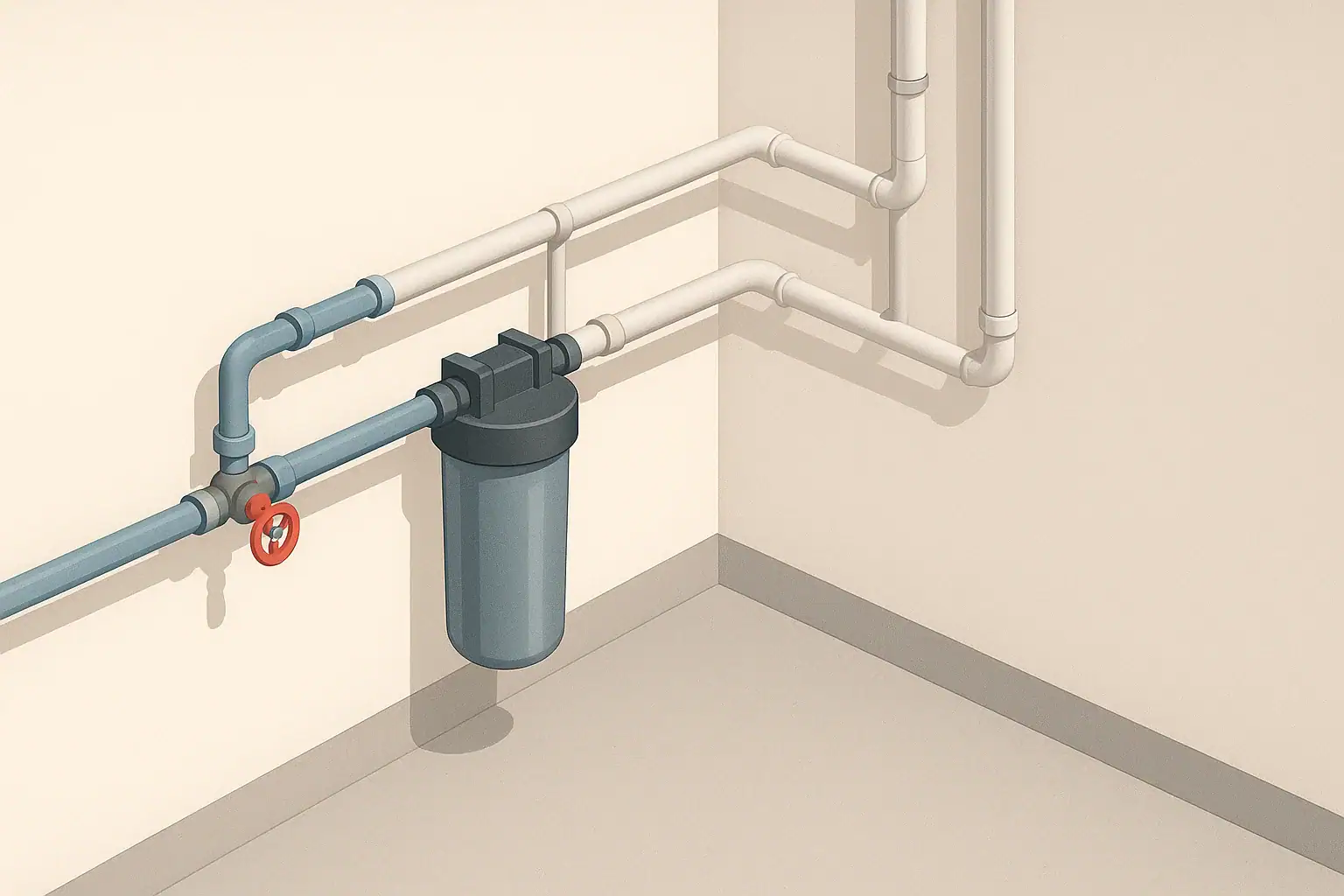
Why Whole House Filter Flow Rate Matters
Whole house water filters handle all the water entering a home, so their flow rate has a direct impact on everyday tasks. If the filter is undersized, you may notice low water pressure when several fixtures run at once. If it is oversized, you may pay more than needed and replace larger cartridges without using their full capacity.
Flow rate is typically expressed as gallons per minute (GPM). To choose an appropriate whole house filter, you need to match expected peak household demand to the filter’s rated GPM while considering plumbing size, local pressure, and how much pressure drop you can tolerate.
This article explains how GPM works, how to estimate peak demand from typical fixture use, and how household count, bathrooms, and appliance types guide whole house filter sizing.
Key Terms: GPM, Pressure, and Pressure Drop
Before sizing a whole house filter, it helps to understand a few basic terms used in plumbing and filtration specifications.
Gallons per Minute (GPM)
GPM describes the volume of water flowing through a pipe or filter each minute. A whole house filter’s rated flow might be listed as, for example, 10 GPM or 15 GPM. This rating is usually measured at a specific inlet pressure and at a specified pressure drop across the filter.
Common household fixtures have typical flow rates, often limited by plumbing codes and efficiency standards. For example, many modern showerheads and faucets are designed to use fewer gallons per minute than older fixtures. These individual fixture flows add up during peak use times, such as busy mornings.
Water Pressure (psi)
Residential water pressure is commonly measured in pounds per square inch (psi). Typical municipal supplies are often somewhere in the range of about 40–80 psi at the main entry point, though this can vary. Higher starting pressure generally allows more flow through your plumbing before pressure at fixtures feels weak.
Pressure Drop (psi across the filter)
Pressure drop is the reduction in pressure as water passes through the filter media and housing. All filters introduce some resistance to flow. Manufacturers usually rate filters at a certain flow with a corresponding pressure drop, such as a specific GPM at a specified psi drop. The higher the flow through the same filter, the larger the pressure drop tends to be.
For comfortable everyday use, many homeowners prefer that the pressure drop at typical usage levels stays moderate so that showers and faucets do not feel noticeably weaker during peak demand.
Example values for illustration.
| Household situation | Typical fixtures in use at once | Illustrative combined peak flow (GPM) | Suggested filter sizing approach |
|---|---|---|---|
| 1–2 people, 1 bathroom | 1 shower or 1 faucet at a time | 4–6 GPM | Size for at least one shower plus a small safety margin. |
| 2–3 people, 1–2 bathrooms | 1 shower + 1 faucet or appliance | 6–8 GPM | Plan for a shower plus another concurrent use during busy times. |
| 3–4 people, 2 bathrooms | 2 showers or 1 shower + washer | 8–12 GPM | Size for two major fixtures running together. |
| 4–5 people, 2–3 bathrooms | 2 showers + faucet or appliance | 10–14 GPM | Allow for multiple overlapping showers and sink use. |
| 5+ people, 3+ bathrooms | 2–3 showers + laundry or dishwasher | 12–16+ GPM | Consider higher-flow or multi-filter setups for peak times. |
| Frequent irrigation from house supply | Outdoor hose or sprinklers + indoor use | Wide range depending on layout | Evaluate outdoor flows separately to avoid undersizing. |
How Many GPM Do You Really Need?
Sizing a whole house filter starts with understanding how much water your household uses at the same time during its busiest periods. Instead of guessing, you can estimate peak flow by adding typical fixture flows and then comparing that total to filter ratings.
Typical Fixture Flow Rates (Illustrative)
Actual fixture flows depend on model, age, and local codes, but the following ranges are common for many U.S. homes:
- Standard showerhead: often around 1.5–2.5 GPM
- Bathroom faucet: often around 0.5–1.5 GPM
- Kitchen faucet: often around 1.5–2.5 GPM
- Clothes washer (filling): effective draw often around 2–4 GPM
- Dishwasher: lower continuous flow, but may coincide with other uses
- Outdoor hose bib: can be 4 GPM or more depending on pressure and hose
These numbers are examples for planning, not exact values for every home. To be more precise, you can measure flow by timing how long it takes to fill a known volume container from a faucet or hose and converting that to GPM.
Estimating Peak Demand from Household Count
Peak demand usually happens when several high-flow fixtures run at once, such as:
- Two people showering at the same time
- A shower plus a clothes washer filling
- A shower plus kitchen sink and dishwasher use
For many homes, a whole house filter sized around 8–12 GPM at a moderate pressure drop is often considered a reasonable target, but your needs may be lower or higher depending on household size and habits. Larger households, homes with multiple full bathrooms, or high-flow fixtures may need higher GPM capacity.
Considering Bathrooms vs. Bedrooms
Some sizing guidelines focus on the number of bathrooms rather than total occupants. That can be useful because bathrooms directly affect how many showers, tubs, and sinks might be used simultaneously. For example:
- 1 full bathroom: often compatible with filters around the lower end of common residential GPM ranges, if other uses are modest.
- 2 bathrooms: plan for at least two showers or one shower plus other uses at the same time.
- 3+ bathrooms: especially in homes where multiple full baths may be active in the morning or evening, a higher-flow filter or multiple filter housings in parallel may be appropriate.
Bedrooms matter too, because they hint at maximum occupancy. A three-bedroom home with one bathroom may have different needs than a three-bedroom home with three bathrooms.
Balancing Flow Rate with Filtration Performance
Higher flow capacity is not the only factor in choosing a whole house filter. You also need to consider how flow rate affects filtration performance, contact time, and pressure drop.
Contact Time and Contaminant Reduction
In many whole house systems, water passes through media such as activated carbon, sediment cartridges, or specialty resins. The time water spends in contact with these media can influence taste and odor improvement and the degree of reduction for certain contaminants.
If water moves too quickly through the media (high flow), contact time decreases. The filter may still function, but it might not provide the same level of reduction as at the rated flow. Many certifications and performance claims are based on specific test flow rates, so operating well above those flows can change real-world performance.
Pressure Drop vs. Comfort
Every filter will reduce pressure to some extent. A larger filter housing, wider diameter cartridges, or multiple housings in parallel often reduce pressure drop at a given flow. When looking at specifications, note:
- Tested flow rate (GPM) used to determine performance
- Associated pressure drop at that flow
- Recommended maximum flow to maintain reasonable performance and comfort
If your home has low incoming pressure, you may be more sensitive to additional pressure drop from a filter and might favor a larger or lower-restriction setup. If your incoming pressure is high, you may tolerate more drop without noticing changes at fixtures.
Filter Media Type and Flow Sensitivity
Different filter types respond differently to higher flow:
- Sediment filters: Often more about physical screening or depth filtration. Their main flow limitation is pressure drop as they capture particles.
- Granular or block carbon filters: Often tested at specific flows. Very high flows may reduce contact time and may also increase pressure drop.
- Specialty media (for example, scale or iron reduction): Often have recommended service flow ranges to maintain effectiveness and to avoid channeling or media movement issues.
Always compare the intended use in your home with the tested or recommended conditions in the product documentation, especially if you have specific treatment goals such as taste and odor improvement or reduction of particular contaminants.
Household Size Scenarios and Example GPM Planning
Using household count and bathroom count together gives a more practical sense of flow needs. The following examples show how you might plan filter sizing in common scenarios, using generalized numbers for illustration.
Small Household: 1–2 People, 1 Bathroom
Daily use may involve one shower at a time, occasional washing machine cycles, and moderate kitchen use. In many cases:
- Peak flow might be a shower plus a sink or washer starting up.
- Example combined peak could be in the range of about 4–6 GPM.
- A whole house filter that comfortably handles a bit above this estimate at reasonable pressure drop is often adequate.
Medium Household: 3–4 People, 2 Bathrooms
Busy times may see two showers operating simultaneously, sometimes with laundry or kitchen use at the same time. In these homes:
- Peak flow might involve two showers plus a faucet or appliance.
- Example combined peak could fall around 8–12 GPM.
- Look for filters with flow ratings aligned with these peaks at tolerable pressure drops, considering media type and contact time.
Large Household or High-Use Home
Homes with 5 or more occupants and 3 or more bathrooms can have overlapping showers, frequent laundry loads, more dishwashing, and higher overall water use. Some may also irrigate gardens or lawns through the same main supply line.
- Peak flow might reach or exceed the mid-teens in GPM when several high-flow fixtures run at once.
- Larger filter housings or parallel filter setups may be used to reduce pressure drop.
- You may need to evaluate whether outdoor irrigation should be filtered at all, or whether a bypass for yard watering is acceptable, depending on your water quality goals.
Pipe Size, Plumbing Layout, and Whole House Filter GPM
Whole house filter flow rate is also constrained by the plumbing it connects to. Main supply pipe size, layout complexity, and elevation changes all influence how much water can move comfortably through the system.
Matching Filter Ports to Main Pipe Size
Residential main lines are commonly around 3/4 inch or 1 inch, though this varies by home and region. Using a filter with port sizes that match or are compatible with the main line helps avoid unnecessary bottlenecks. For example:
- If your main is 3/4 inch, a filter with 3/4 inch ports is typically a straightforward match.
- If your main is 1 inch, you may prefer 1 inch filter ports to minimize flow restrictions, especially in larger homes.
Reducers and fittings can adapt different sizes, but each transition adds some friction. Oversized filter housings with adequate port size may help maintain higher flows with lower pressure drop.
Branching, Elevation, and Distance
Homes with long pipe runs, many elbows, or multiple stories experience more friction and elevation-related pressure losses. In such layouts:
- Filters that already introduce a significant pressure drop may be more noticeable at distant or upper-level fixtures.
- Larger or lower-resistance filters can help preserve comfort at farthest points.
- Measuring actual pressure at fixtures, if possible, provides a clearer picture than relying only on the pressure at the main entry.
Understanding Certifications, Capacity, and Flow Ratings
Whole house filters may carry various NSF/ANSI certifications that relate to aesthetic effects (such as taste and odor) or reduction of specific contaminants. Capacity and flow are both important parts of these standards.
NSF/ANSI Standards and Flow Conditions
Selected standards relevant to point-of-use and some point-of-entry systems include:
- NSF/ANSI 42: Typically covers aesthetic effects such as chlorine taste and odor reduction and particulate reduction.
- NSF/ANSI 53: Typically relates to reduction of certain contaminants of health concern, such as some heavy metals or volatile organic compounds.
- NSF/ANSI 401: Covers reduction of certain emerging compounds, such as some pharmaceuticals and personal care products.
- NSF/ANSI 58: Applies primarily to reverse osmosis systems, more common at the point of use rather than whole house.
Certification reports usually specify the flow rate at which testing was conducted. Operating the filter significantly above this flow could change performance compared with the certified conditions. When evaluating a filter:
- Check which standards it is certified to.
- Review which contaminants or aesthetic effects are covered.
- Note the test flow rates and pressures, and compare these to your expected peak use.
Capacity vs. Flow: How They Interact
Capacity refers to how much water a filter can process before the media is considered exhausted or before replacement is recommended. Higher flow does not change total rated capacity, but it can affect how quickly you reach it. For example, a household using more water per day will reach the filter’s capacity sooner than a smaller household using the same filter.
As filters load with sediment or other materials, pressure drop tends to increase. You may notice diminishing flow or uneven pressure at fixtures as the cartridge nears the end of its service life, signaling it is time for replacement even if you have not precisely tracked gallons.
Example values for illustration.
| What to track | Typical cues | Planning method |
|---|---|---|
| Cartridge replacement interval | Noted months of service or estimated gallons | Record installation date and set calendar reminders. |
| Pressure and flow changes | Showers feel weaker, faucets fill containers more slowly | Occasionally time how long it takes to fill a known container. |
| Sediment buildup | Visible discoloration on clear housings or cartridges | Inspect housings during scheduled maintenance checks. |
| Taste and odor | Return of chlorine smell or other noticeable tastes | Note any changes and compare to your replacement schedule. |
| Seasonal water changes | Different turbidity or color during certain times of year | Adjust replacement frequency if seasonal loads increase. |
| System leaks or drips | Moisture at fittings or on floor near filter | Inspect joints and housings while system is pressurized. |
Practical Tips for Matching Filter Flow to Your Home
When finalizing a whole house filter choice, it helps to combine estimated flow needs with practical observations and simple checks.
- Measure, do not only guess: Time how long it takes to fill a bucket from a hose or faucet at full open to estimate real GPM.
- Consider your busiest hour: Think about the time of day when the most fixtures are used and add up flows for that period.
- Check existing pressure: If possible, measure pressure at a hose bib with a simple gauge to understand your baseline.
- Allow a safety margin: Choose a filter whose rated flow exceeds your estimated peak by a reasonable amount rather than matching it exactly.
- Plan for aging filters: Realize that flow will gradually decline as cartridges load with sediment and other materials; size so that performance remains acceptable near the end of the service life.
- Review certification details: If you rely on claimed reduction of specific contaminants or on taste and odor improvement, check the flow rates at which those results were tested.
By understanding GPM, household demand, and how filters behave at different flows, you can choose a whole house system that maintains comfortable water pressure, supports consistent taste and odor improvement, and aligns with your maintenance preferences.
Frequently asked questions
How can I measure my actual household GPM to size a whole house filter?
Measure flow by timing how long it takes to fill a container of known volume from a fully open faucet or hose, then divide gallons by minutes to get GPM. Do this for fixtures likely to run during peak times and add their flows to estimate combined peak demand.
What GPM rating is typically recommended for a 3–4 person home with two bathrooms?
Many 3–4 person homes with two bathrooms plan for a peak flow around 8–12 GPM; selecting a filter rated at or above that range with a reasonable pressure drop and safety margin is common. Also consider fixture efficiencies and whether laundry or dishwashing overlaps with shower use.
Will increasing filter flow rate always improve water pressure at fixtures?
No. A higher-rated filter can reduce pressure drop at a given household flow, but actual fixture pressure also depends on incoming municipal pressure, pipe size, and layout. If incoming pressure is low or piping is restrictive, a higher-flow filter alone may not fully restore fixture pressure.
Does running water faster through the media reduce contaminant removal?
Yes, higher flow reduces contact time with media and can diminish removal efficiency for some contaminants compared with certified test conditions. Check manufacturer test flow rates and performance data, and avoid consistently operating well above those conditions for treatment-critical applications.
Should I filter outdoor irrigation water through the same whole house system?
Outdoor irrigation can add substantial peak flow and may cause undersizing or more frequent cartridge changes if routed through the same filter. Consider a bypass or separate unfiltered line for irrigation unless garden water quality requires the same level of treatment.
Recommended next:
- NSF/ANSI standards explained (42/53/401/58)
- Clear trade-offs: pitcher vs faucet vs under-sink vs RO
- Maintenance planning: cost per gallon and replacement cadence