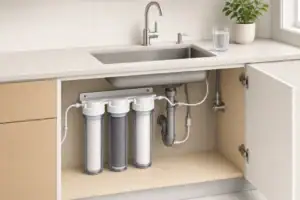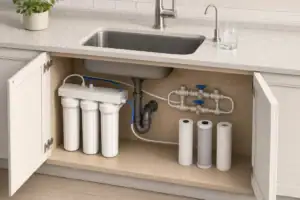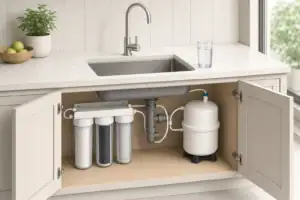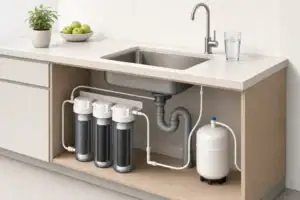
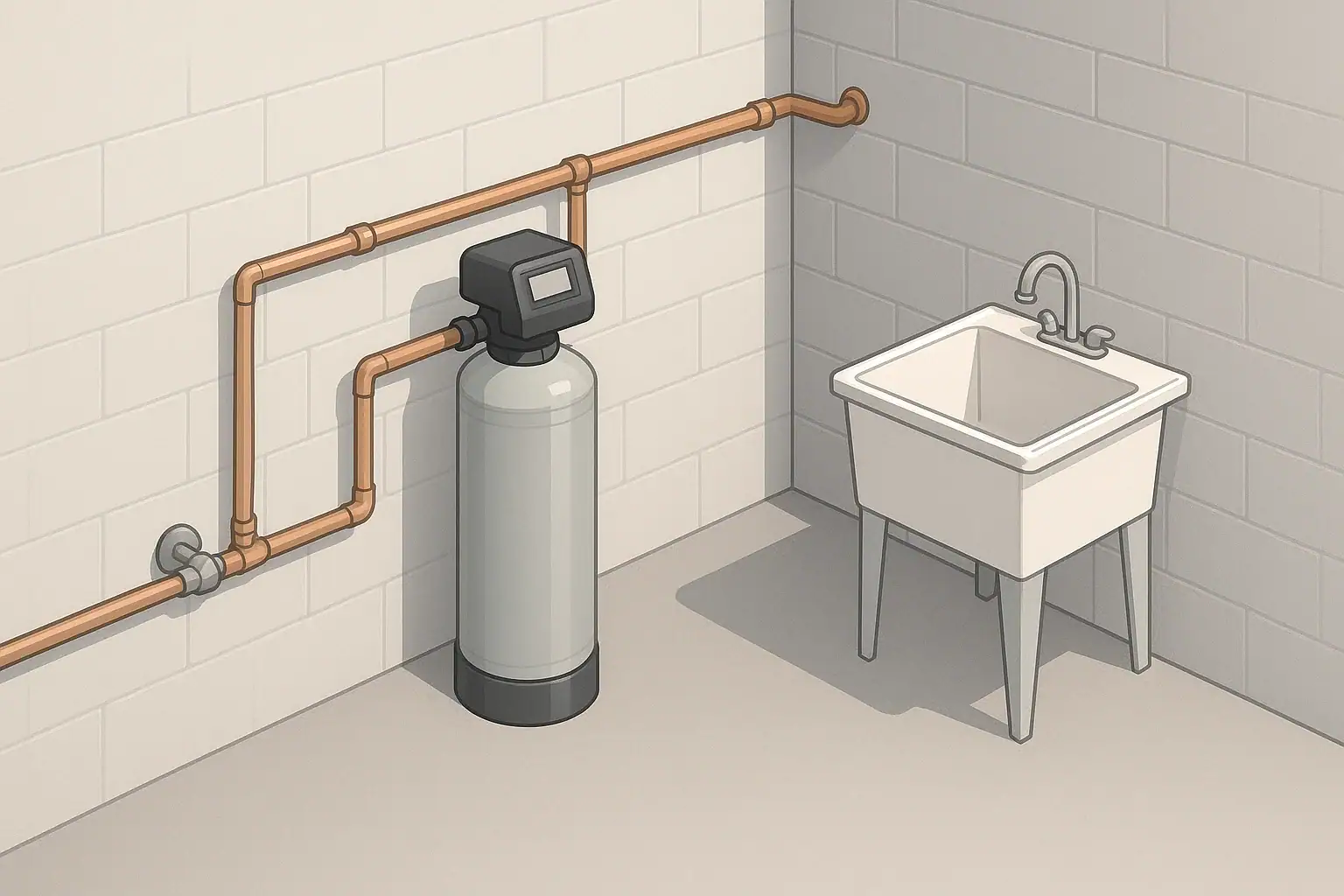
What Is a Backwashing Filter?
A backwashing filter is a type of whole-house water filter that periodically cleans itself by reversing the flow of water. Instead of replacing a small cartridge, the system uses a larger tank filled with filter media. During normal operation, water flows downward (or upward, depending on design) through the media, where sediment and other particles are trapped. During backwash, the control valve reverses the water flow to lift and agitate the media, flushing trapped material to a drain.
Backwashing filters are most common on the main water line where they treat all the water entering a home. They are often used for issues such as sediment, turbidity, certain nuisance minerals, and taste or odor problems. Because they can clean themselves, they are suited to higher flow rates and longer service life than small point-of-use filters.
How Backwashing Filters Work
Although designs vary, most backwashing filters follow a similar cycle controlled by an automatic valve. The valve is usually set to backwash based on time (for example, every few days) or on water volume if a meter is included.
Main Components
Typical backwashing filters include:
- Mineral tank: A vertical tank that holds the filter media and internal distributor.
- Filter media: Granular or structured material that traps particles or promotes specific reactions.
- Control valve: Directs water flow between service, backwash, and rinse modes.
- Drain connection: A line that carries waste water and dislodged material to a suitable drain.
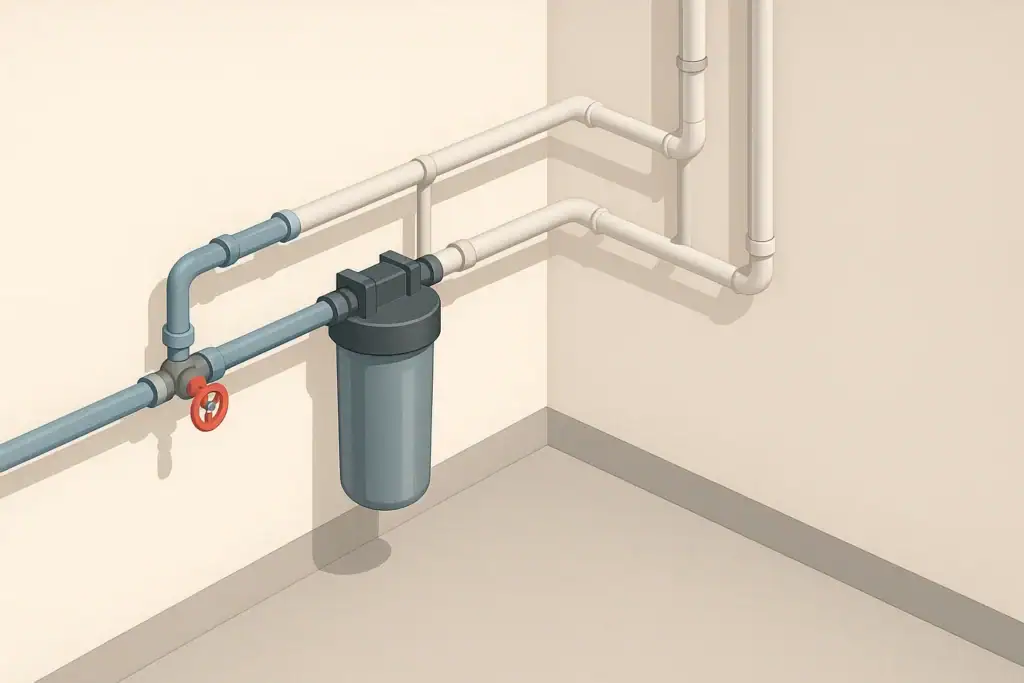
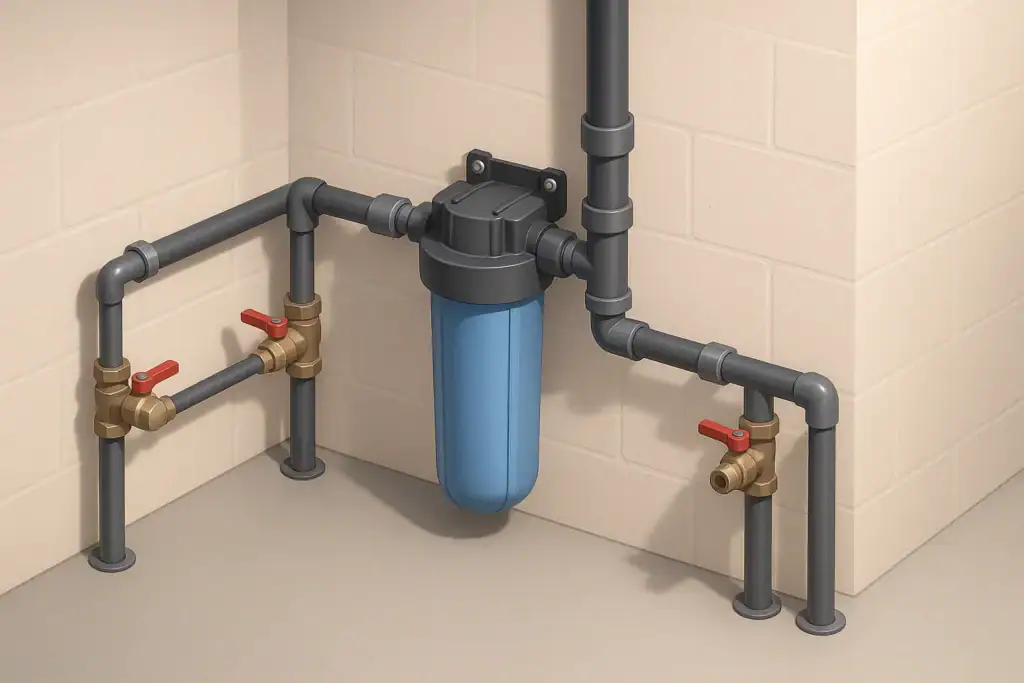
- Bypass or shutoff valves: Allow isolation of the filter for service.
Typical Operating Cycle
Most systems use a multi-step cycle:
- Service: Normal filtration. Water passes through the media, and filtered water leaves the tank for household use.
- Backwash: Flow reverses and increases in velocity, lifting and expanding the media bed to release trapped particles and accumulated fines.
- Rinse: Flow returns to the normal direction at a controlled rate, resettling the media and flushing remaining debris to the drain before service resumes.
Backwash and rinse times are set on the control valve. They must be long enough for an effective clean but not so long that they waste excess water. The required backwash rate depends on the media type, water temperature, and tank diameter, so manufacturer guidance is important.
Example values for illustration.
| Situation | Backwashing Filter Typically Better | Cartridge Filter Typically Better |
|---|---|---|
| Whole-house treatment for all fixtures | Yes — designed for main line use | More common for point-of-use taps |
| Very high daily water use | Good — self-cleaning, large media volume | May require frequent cartridge changes |
| Limited space near main shutoff | Tank may be too tall or bulky | Compact housings fit tight spaces |
| Desire to minimize filter replacements | Media may last years when sized correctly | Regular manual cartridge changes needed |
| No suitable drain nearby | Drain needed for backwash water | No drain needed for standard housings |
| Simple, low-maintenance operation | Automatic backwash after setup | Manual changes but simple hardware |
| Initial budget constraints | Higher upfront equipment cost | Lower upfront; higher ongoing cartridge cost |
Common Types of Backwashing Filter Media
Backwashing filters are defined less by the tank itself and more by the media inside. Different media target different water quality issues. A water test and local water utility reports can help determine which type, if any, is appropriate.
Sediment and Turbidity Media
Sediment-focused backwashing filters are designed to remove suspended particles that cause cloudiness, such as sand, silt, and rust flakes. They often use:
- Granular filter media: Coarse to fine layers that trap particles as water passes through.
- Multi-media beds: Several layers of materials of different densities to improve depth filtration and reduce pressure drop.
These systems can reduce the load on downstream filters, protect plumbing fixtures, and help maintain flow. They do not typically address dissolved substances such as salts, metals in solution, or organic chemicals.
Media for Iron, Manganese, and Sulfur Odor
Some backwashing filters use specialized media designed to oxidize and capture dissolved iron and manganese or to manage hydrogen sulfide (often associated with “rotten egg” odors). These systems may rely on:
- Oxidizing media: Materials that convert dissolved iron and manganese into solid particles that can be filtered out.
- Catalytic media: Materials that speed up oxidation when used with an oxidant.
- Feed of oxidant: In some designs, air, chlorine, or another oxidant is introduced ahead of the filter to improve performance.
These filters can be effective for nuisance metals and odors within their design limits, but sizing and water chemistry matter. Excess iron, low pH, or high levels of competing substances can affect performance and maintenance frequency.
Activated Carbon Backwashing Filters
Granular activated carbon (GAC) backwashing filters are often used for taste and odor improvement, especially in homes with strong chlorine or chlorinous smells. Carbon can also adsorb various organic compounds and some disinfection byproducts, depending on contact time and media characteristics.
Key points about GAC backwashing filters include:
- Backwashing primarily removes trapped particles and redistributes the bed; it does not regenerate the adsorption capacity of the carbon.
- Media still requires periodic replacement once adsorption sites are used.
- Flow rate, bed depth, and water temperature affect how long the carbon remains effective.
For households concerned about specific contaminants, it is useful to look for systems tested to applicable NSF/ANSI standards. These standards address chlorine taste and odor, selected organic compounds, and other performance claims under defined conditions.
Pros of Backwashing Filters
Backwashing filters offer several advantages compared with smaller, manually changed filters, particularly for whole-house applications.
Lower Manual Maintenance
Because a backwashing filter cleans itself automatically, there is no frequent cartridge change to manage. This can be appealing in homes with:
- High sediment loads that would clog cartridges quickly.
- Limited time or ability for regular filter changes.
- Utility areas where access is inconvenient.
Routine tasks focus more on occasional inspection, checking settings, and periodic media replacement, which may be years apart depending on conditions and system design.
High Flow Capacity
Backwashing filters are better suited to handle flow rates needed for showers, laundry, dishwashers, and outdoor faucets running at the same time. The larger media bed and tank diameter allow for:
- Lower pressure drop at typical whole-house flow rates.
- Reduced risk of noticeable pressure loss at multiple fixtures.
- Compatibility with larger homes when sized properly.
Correct sizing still matters. Oversized tanks may backwash poorly; undersized tanks may restrict flow or exhaust media capacity too quickly.
Continuous Service (With Proper Scheduling)
Backwash cycles are usually set for low-demand times, such as late at night. During these short periods, the system may temporarily take itself offline or send water to drain. In many households, this has little practical impact because demand is low when the system cycles.
Some setups include bypass capability or multiple tanks, allowing uninterrupted filtered service even during cleaning. This level of redundancy is more common in commercial or high-demand residential installations.
Cons and Limitations of Backwashing Filters
Backwashing filters are not ideal for every home. They have limitations that should be weighed against alternatives such as cartridge-based systems, under-sink filters, or reverse osmosis units.
Water Use for Backwashing
Each backwash cycle discharges water to a drain. The amount depends on tank size, media type, and backwash duration. Over time this adds up and may be a consideration for:
- Homes on private wells with limited yield.
- Homes where wastewater disposal capacity is constrained.
- Regions with water-use restrictions.
Some households choose to route this water to a location where discharge is acceptable under local regulations, such as a dedicated seepage area. Local plumbing and environmental rules should always be checked before making changes.
Need for a Drain and Power
Most backwashing filters require:
- A reliable drain: Floor drain, standpipe, or other plumbing connection capable of handling the backwash flow.
- Electrical power: For the control valve timer or metering system.
In spaces without a practical drain path or outlets, installing a backwashing filter can be more complex than mounting a simple cartridge housing.
More Complex Hardware
The control head of a backwashing filter has multiple moving parts, seals, and internal channels. While many systems operate for years with routine checks, more complexity can mean:
- More detailed installation requirements.
- Need to protect the valve from debris, freezing, and pressure spikes.
- Potential servicing of seals, injectors, or pistons if problems arise.
For homeowners who prefer minimalist plumbing with few moving parts, a basic cartridge housing may feel simpler to understand and maintain.
Not a Universal Solution for All Contaminants
Backwashing filters are not a substitute for every type of water treatment. Depending on the media, they may not address:
- Dissolved salts and hardness.
- Fluoride.
- Certain metals in dissolved form.
- All types of organic chemicals or emerging contaminants.
- Microorganisms without specific disinfection steps.
They are often used as one component in a broader system, for example paired with a softener, point-of-use filter, or reverse osmosis unit where needed.
Where Backwashing Filters Fit in a Home Filtration Strategy
Because this type of filter sits on the main water line, it influences the performance of downstream equipment and the experience at every tap.
Comparison With Other Whole-House Options
In a typical U.S. home, the main choices for treating all incoming water include:
- Backwashing media filters: Good for sediment, nuisance metals, and taste/odor depending on media.
- Whole-house cartridge systems: Use large cartridges that must be replaced manually but do not require a drain.
- Water softeners: Designed primarily for hardness reduction; some models combine softening with limited filtration.
Backwashing filters often complement these systems. For example, a sediment backwashing filter ahead of a softener can protect the softener resin from fouling, and a carbon backwashing filter can improve taste and odor before water reaches kitchen and bathroom fixtures.
Point-of-Use Filters Still Have a Role
Even when a backwashing filter is installed, many households still use point-of-use devices such as pitcher filters, faucet-mount filters, or under-sink systems. Reasons include:
- Extra polishing of taste and odor for drinking water.
- Targeting specific contaminants (for example, via certified under-sink filters or RO systems).
- Providing redundancy for areas of particular concern, such as the kitchen tap used for cooking.
A thoughtful combination of whole-house and point-of-use filtration can balance cost, convenience, and targeted performance.
Sizing and Installation Considerations
Choosing and installing a backwashing filter involves more than simply matching pipe size. Proper sizing helps ensure that the media bed is adequately backwashed and that the system meets household flow demands.
Key Sizing Factors
Before selecting a system, it is useful to know:
- Peak household flow: Estimated gallons per minute when multiple fixtures run at once.
- Daily water use: Typical usage for all occupants.
- Water source: Municipal or private well, with recent test results.
- Targeted water issues: Sediment, iron, manganese, taste/odor, or other concerns.
The tank size and media volume must support adequate contact time at peak flows while still being capable of lifting and expanding during backwash at the available water pressure and drain capacity.
Plumbing Layout
Good installation practice usually includes:
- A bypass valve arrangement so the home can still receive water if the filter needs service.
- Unions or other disconnects for easier removal of the tank or valve.
- Isolation valves before and after the filter.
- A properly sized and secured drain line with an air gap or backflow protection where required.
On private wells, the pump, pressure tank, and switch must all be considered to ensure they can supply the backwash flow rate without frequent short cycling.
Routine Maintenance of Backwashing Filters
Although these systems are often described as “set and forget,” periodic checks help maintain performance and extend service life.
Check Backwash Scheduling
Most control valves offer time-based or meter-based scheduling:
- Time-based: The system backwashes at a set interval (for example, every 2–7 days) regardless of actual usage.
- Meter-based: The system tracks water volume and triggers backwash after a programmed number of gallons.
Settings can be adjusted if the household size changes, if new fixtures are added, or if water conditions shift seasonally. If the water appears cloudy or flow declines between scheduled backwashes, shorter intervals or higher backwash rates may be needed within the system’s design limits.
Monitor Pressure and Flow
Gradual pressure loss at fixtures can indicate that the media is loading faster than it is being cleaned. Useful checks include:
- Comparing pressure before and after the filter, if gauges are installed.
- Noting shower performance, especially during high-use times.
- Observing whether performance improves right after a backwash cycle.
Persistent pressure issues may point to undersizing, media fouling, or problems with the control valve or drain line.
Media Replacement
Even with regular backwashing, filter media eventually becomes exhausted or physically degraded. Typical service life ranges can span several years under moderate conditions, but this depends on:
- Water quality and incoming contaminant levels.
- Daily water use.
- Media type (sediment, carbon, iron-specific, etc.).
Signs that media may need replacement include persistent taste or odor issues, diminished effectiveness at removing specific nuisance contaminants, or difficulty restoring flow after backwash. Replacement usually involves depressurizing the system, removing the control head, extracting old media, and refilling with new media and support gravel if used.
Basic Troubleshooting Tips
Most issues with backwashing filters fall into several common patterns. Many checks are visual or involve simple observations. Any work on pressurized plumbing should follow safety practices and, when needed, be handled by a qualified professional.
When Water Looks Cloudy or Unchanged
If water remains cloudy or does not improve after installation:
- Confirm that the system is actually in service and not left in bypass.
- Verify the direction of flow matches the valve’s service orientation.
- Check that the backwash schedule is active and not disabled.
- Review recent water tests to ensure the media matches the problem.
For new installations, some cloudiness may be normal temporarily as fine particles rinse out of fresh media. This should diminish after thorough flushing and a complete backwash and rinse cycle.
When Backwash Does Not Occur
If you do not hear or observe backwash cycles at the programmed times:
- Verify power to the control valve and check for tripped circuits.
- Ensure the time of day and programming are set correctly.
- Look for error codes or status indicators on the valve display, if present.
- Confirm the drain line is not kinked, frozen, or blocked.
If the valve appears to attempt a cycle but water does not discharge to the drain, shut off the system and investigate further or consult a professional, as operation without proper backwash can damage media and reduce effectiveness.
When You Hear Unusual Sounds
Backwashing filters normally produce some noise during backwash and rinse, such as rushing water in the drain line. Sounds that may warrant inspection include:
- Repeated rapid cycling noises from the valve.
- Loud hammering in the pipes (indicating potential water hammer).
- Continuous flow to the drain when the system should be in service mode.
These symptoms can be related to valve issues, trapped air, or plumbing layout. Addressing them early can reduce wear on the system and connected plumbing.
Example values for illustration.
| Item to Track | Typical Cue | How to Plan |
|---|---|---|
| Backwash frequency | Cloudy water or pressure drop before next cycle | Review settings seasonally and after household changes |
| Drain line condition | Slow or no flow to drain during backwash | Visually inspect line and termination a few times per year |
| Media performance | Return of taste, odor, or nuisance staining | Record installation date and schedule periodic water checks |
| System pressure | Noticeable drop at showers or faucets | Compare before/after gauges if installed; log notable changes |
| Valve programming | Incorrect time of day or lost settings after power loss | Keep a written record of preferred settings for quick re-entry |
| Leak checks | Moisture around fittings or on floor | Inspect joints, unions, and tank base during other maintenance |
| Media replacement interval | Performance decline despite proper backwashing | Estimate replacement window and budget ahead of time |
Using Standards and Testing to Evaluate Performance
When considering any filtration system, including backwashing filters, it is helpful to review both independent test data and local water quality information.
NSF/ANSI Standards Overview
For residential water treatment products, several NSF/ANSI standards are commonly referenced:
- NSF/ANSI 42: Covers claims related to aesthetic effects such as chlorine taste and odor and particulate reduction.
- NSF/ANSI 53: Addresses systems designed for specific contaminant reduction claims, such as certain metals and organic compounds.
- NSF/ANSI 401: Focuses on a selection of emerging compounds such as some pharmaceuticals and chemical residues.
- NSF/ANSI 58: Applies specifically to reverse osmosis systems.
Backwashing filters may be evaluated under some of these standards depending on their design and intended claims. When available, documentation from testing organizations can help understand the conditions under which performance was evaluated, such as flow rate, influent water quality, and capacity.
Using Local Water Data
Combining certified performance data with local information can help determine whether a backwashing filter, another technology, or a combination makes the most sense. Sources of information include:
- Annual water quality reports for municipal supplies.
- Well testing through certified laboratories for private sources.
- Periodic retesting after significant system changes or major weather events.
Recording baseline water quality before installation and checking again at reasonable intervals can document how well a system is functioning over time and whether adjustments or additional treatment steps are warranted.
Summary
Backwashing filters provide an automatic way to manage sediment, nuisance metals, and taste or odor concerns at the whole-house level. They rely on a tank of specialized media that is periodically cleaned by reversing the water flow to a drain. These systems can reduce manual maintenance and support higher flow rates than many cartridge-based filters, but they require a suitable drain, power for the control valve, and attention to proper sizing and programming.
For households considering a backwashing filter, a clear understanding of local water quality, household water use, and installation constraints will help determine whether this approach should be part of a broader home water filtration strategy.
Frequently asked questions
How much water does a backwashing filter typically use for each backwash cycle?
Backwash volume varies widely by tank size, media, and cycle length, but residential systems commonly use anywhere from about 20 to 200 gallons per cycle. Larger tanks or longer backwash/rinse steps increase that volume, while compact systems use less. Consider cumulative annual water use and well yield or local restrictions when planning settings and frequency.
Can backwashing filters remove dissolved iron and manganese from well water?
They can when fitted with appropriate oxidizing or catalytic media that convert dissolved iron and manganese into particulate form, which the media then filters out. Some systems also introduce an oxidant (air, chlorine, or similar) ahead of the media to improve conversion. Effectiveness depends on concentration, pH, and competing chemistry, so a water test and proper sizing are important.
Do backwashing filters require electricity and a dedicated drain?
Most automatic backwashing filters require both a reliable drain for waste discharge and electrical power for the control valve or metering system. Manual or non-electric control heads exist but still need an appropriate drain for backwash water. Lack of a nearby drain or power source may limit options or make installation more complex.
How often does the filter media need to be replaced?
Media replacement intervals vary by media type, incoming water quality, and household use; many media last several years under moderate conditions. Signs that replacement is needed include persistent taste or odor issues, reduced removal of targeted contaminants, or ongoing pressure loss that backwashing does not correct. Replacement generally requires depressurizing the tank and refilling per manufacturer instructions.
Can I install a backwashing filter on a private well with a low-yield pump?
Yes, but you must ensure the well pump and pressure tank can deliver the higher flow needed for backwash without causing frequent short cycling. Options include meter- or time-based scheduling at low-demand periods, adding a holding tank, or adjusting backwash duration to match pump capability. Consult a well professional to verify pump capacity and to plan a suitable drain arrangement.
Recommended next:
- NSF/ANSI standards explained (42/53/401/58)
- Clear trade-offs: pitcher vs faucet vs under-sink vs RO
- Maintenance planning: cost per gallon and replacement cadence