Water filters can look affordable at first glance, but the real cost shows up over months and years. A compact pitcher or faucet-mount filter might have a low purchase price but frequent cartridge changes. A larger under-sink or reverse osmosis (RO) system might cost more upfront but less per gallon over time.
Cost per gallon is a simple way to compare very different types of filters on fair terms. Instead of only looking at purchase price or replacement cartridge cost, you divide the total cost by how many gallons the filter can reasonably treat. This gives you a number that lets you compare:
- Pitcher filters vs faucet-mount filters
- Under-sink carbon filters vs RO systems
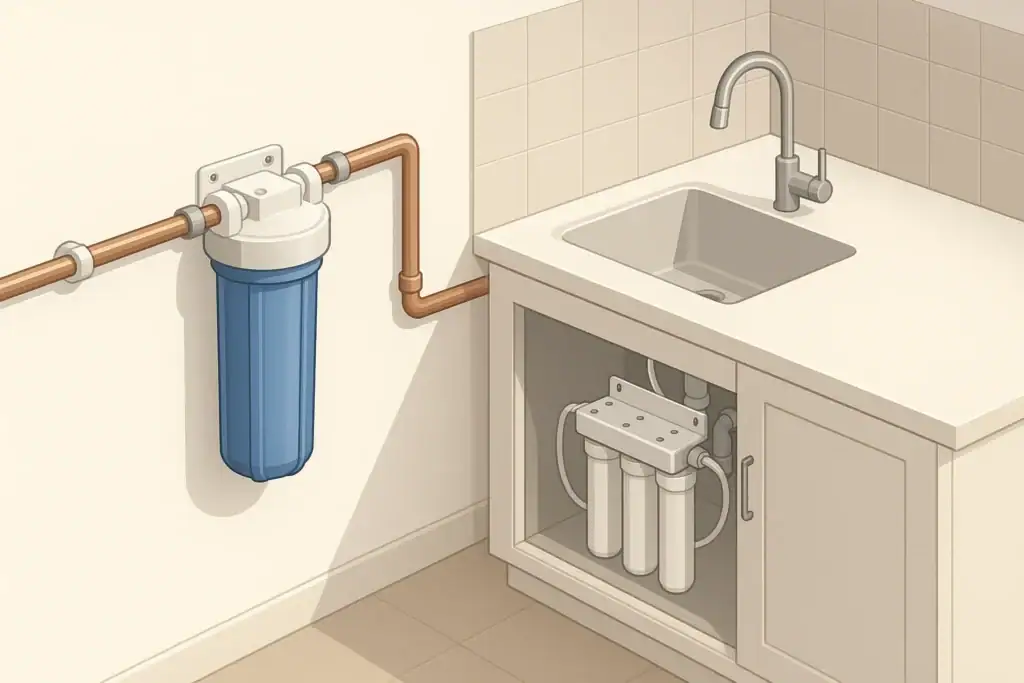
- Point-of-use filters (at one faucet) vs whole-house systems
This approach helps you budget for long-term maintenance and avoid unexpected filter expenses, especially if your household uses a lot of water for drinking and cooking.
Why Cost per Gallon Matters for Water Filters
Water filters can look affordable at first glance, but the real cost shows up over months and years. A compact pitcher or faucet-mount filter might have a low purchase price but frequent cartridge changes. A larger under-sink or reverse osmosis (RO) system might cost more upfront but less per gallon over time.
Cost per gallon is a simple way to compare very different types of filters on fair terms. Instead of only looking at purchase price or replacement cartridge cost, you divide the total cost by how many gallons the filter can reasonably treat. This gives you a number that lets you compare:
- Pitcher filters vs faucet-mount filters
- Under-sink carbon filters vs RO systems
- Point-of-use filters (at one faucet) vs whole-house systems
This approach helps you budget for long-term maintenance and avoid unexpected filter expenses, especially if your household uses a lot of water for drinking and cooking.
Basic Cost per Gallon Formula
The basic idea is straightforward: total cost divided by total gallons. For a single filter cartridge, the formula looks like this:
Cost per gallon = (Filter cost) ÷ (Rated capacity in gallons)
For example, if a replacement cartridge costs an example value of $20 and is rated for an example value of 100 gallons, the cost per gallon is an example value of $0.20. That means every gallon of filtered water effectively costs about twenty cents in filter media alone, not counting the initial housing or system hardware.
For a full system with its own housing or tank, you can either:
- Include part of the system cost (amortized over several years), or
- Look only at cartridge costs for a quick comparison
For most everyday decisions, people compare the cost per gallon of replacement filters, assuming the hardware cost is a one-time expense that is spread out over a long period.
| Filter type | Typical use point | Example cartridge cost | Example rated capacity | Example cost per gallon |
|---|---|---|---|---|
| Pitcher | Countertop | Example $10 | Example 40 gallons | Example $0.25/gal |
| Faucet-mount | Kitchen faucet | Example $18 | Example 100 gallons | Example $0.18/gal |
| Under-sink carbon | Single tap | Example $40 | Example 500 gallons | Example $0.08/gal |
| RO pre/post filters | RO faucet | Example $70 (set) | Example 600 gallons | Example $0.12/gal |
| Whole-house sediment/carbon | Main supply line | Example $50 | Example 15,000 gallons | Example $0.003/gal |
| Refrigerator inline | Fridge dispenser/ice | Example $40 | Example 300 gallons | Example $0.13/gal |
How to Build a Cost per Gallon Calculator
You can set up a simple cost per gallon calculator using a spreadsheet or even a basic calculator. The goal is to compare multiple filter options side by side using consistent assumptions.
Step 1: Gather the Key Numbers
For each filter you want to compare, collect:
- Replacement filter cost (per cartridge or set)
- Rated capacity in gallons from the manufacturer
- Recommended time limit (for example, 2 or 6 months)
- NSF/ANSI certifications, if any, to ensure the rating is credible
Some filters list capacity in liters; you can convert to gallons by dividing liters by an example factor of 3.8 (approximate conversion used for planning).
Step 2: Calculate Cost per Gallon for Each Filter
Use the basic formula for each option:
Cost per gallon = Filter cost ÷ Rated capacity
Enter this as a formula in your spreadsheet so you can easily change the inputs later. For example, if cost is in cell B2 and capacity is in C2, the formula in D2 would be =B2/C2.
Repeat for each filter type you want to compare. This gives you a quick snapshot of how expensive each option is on a per gallon basis.
Step 3: Adjust for Time Limits
Many filters have both a gallon rating and a time rating, such as “100 gallons or 3 months, whichever comes first.” If your household does not use enough water to reach the gallon limit before the time limit, the effective cost per gallon will be higher than the rated figure.
You can account for this by estimating your monthly usage and calculating the smaller of:
- Rated capacity, or
- Estimated gallons used during the time limit
Then use that smaller number in your cost per gallon calculation.
Estimating Your Household’s Filtered Water Use
To make your calculator realistic, you need a reasonable estimate of how much filtered water your household actually uses. This depends on filter location and habits.
Drinking and Cooking Only
For pitcher, faucet-mount, under-sink, RO, and refrigerator filters, most people filter water for:
- Drinking water
- Coffee and tea
- Cooking water (boiling pasta, rinsing grains, soups)
- Ice from the refrigerator
An easy starting point is to assume an example range of 0.5–1 gallon per person per day for drinking and light cooking, then adjust based on your actual habits. You can refine this by:
- Filling all filtered water from a marked container and tracking daily use
- Monitoring how quickly your pitcher or storage tank empties
Whole-House and Shower Filters
Whole-house and shower filters treat more than drinking water. They may cover:
- Showers and baths
- Laundry
- Dishwashers
- All cold taps in the house
In this case, household water bills can help. Many utilities report total monthly usage in gallons. You can approximate how much of that water passes through your whole-house filter and use that value in your calculator. Not all of that water is for drinking, but it is still filtered water that consumes filter capacity.
Comparing Different Filter Types Fairly
Cost per gallon is most useful when you use it to compare filters that do the same job. For example, comparing a shower filter to a drinking water pitcher is less helpful than comparing two drinking water options. When you compare, consider both economics and performance.
Pitcher vs Faucet-Mount vs Under-Sink
For point-of-use drinking water filters, cost per gallon often decreases as you move from pitcher to faucet-mount to under-sink systems, while convenience and capacity increase. When comparing these options, consider:
- Space on your counter, in your fridge, or under your sink
- Flow rate and how quickly you can fill a pot or bottle
- NSF/ANSI certifications for chlorine taste and odor, and for specific contaminants like lead or certain organic chemicals
- How often you are willing to change cartridges
A slightly higher cost per gallon might still be acceptable if the system is much easier to use or better suited to your kitchen layout.
RO Systems vs Carbon-Only Systems
Reverse osmosis systems typically include several stages: sediment pre-filter, one or more carbon filters, the RO membrane, and often a post-filter. When you build a cost per gallon calculator for these systems, you can treat the pre/post filters and the membrane separately because they have different replacement schedules and capacities.
Carbon-only under-sink filters are usually simpler and may have lower cost per gallon for the contaminants they are designed to address. However, RO systems can target a broader range of dissolved substances. Use cost per gallon as one factor alongside:
- Contaminants you are most concerned about (for example, certain metals, some dissolved solids, or specific organic chemicals)
- Available pressure and space for a storage tank
- Acceptable flow rate and storage volume
Whole-House vs Point-of-Use
Whole-house filters often look extremely inexpensive per gallon because they handle large volumes of water. However, they are usually optimized for sediment, chlorine, or general taste and odor control, not necessarily for every contaminant of concern in drinking water.
When you compare a whole-house system to kitchen-only filters, keep in mind that:
- Whole-house filters improve water for bathing, laundering, and plumbing protection
- Point-of-use filters focus on drinking and cooking quality
- Some homes use both: a whole-house filter followed by one or more kitchen filters
In your calculator, you might treat whole-house filters as part of general household water quality and point-of-use filters as your drinking water cost.
Including Replacement Schedules and Practical Cues
Manufacturers provide recommended replacement intervals, but real-world conditions affect how long filters actually last. Settling on a realistic cost per gallon means paying attention to both rated capacity and practical cues.
Rated Capacity vs Real-World Use
Several factors can lower a filter’s effective capacity compared with its official rating:
- High sediment levels that clog cartridges prematurely
- High usage that pushes filters to their capacity limits sooner
- Contaminant levels that are higher than assumed in test conditions
To refine your calculator, you can track how long each filter actually lasts in your home and adjust your estimated capacity downward if you consistently need to change filters early.
Non-Numeric Signs a Filter Needs Replacement
Even without a meter, you can watch for cues that your filter is nearing the end of its useful life:
- Noticeable change in taste or odor of the filtered water
- Significant drop in flow rate at the filtered tap or shower
- Visible discoloration in transparent housings or cartridges
- Manufacturer-recommended time limit has passed, even if usage seems low
When your observations suggest a shorter life than the rated capacity, you can recalculate cost per gallon using the lower, observed capacity instead of the label value.
| Item to track | Typical cue | How to plan |
|---|---|---|
| Pitcher filter | Weeks since last change | Note date on a calendar or container |
| Faucet-mount filter | Flow slows or taste changes | Log last change and check monthly |
| Under-sink cartridge | Months of use or pressure drop | Set reminders based on rated lifespan |
| RO pre/post filters | Months since install | Plan annual or semiannual replacement |
| RO membrane | Several years of service | Track installation year and monitor performance |
| Whole-house cartridges | Noticeable pressure drop | Check monthly and log pressure readings if available |
| Shower filter | Reduced flow or aesthetic changes | Replace on a fixed month schedule |
Using Certifications and Water Quality Metrics with Cost per Gallon
Cost per gallon is only part of the picture. To compare filters fairly, you also need to know what each filter is designed to handle and how its performance has been evaluated.
NSF/ANSI Standards Overview
Common NSF/ANSI standards for residential drinking water treatment units include:
- NSF/ANSI 42: Aesthetic effects such as chlorine taste and odor, and particulate reduction
- NSF/ANSI 53: Certain health-related contaminants such as some metals and specific organic chemicals
- NSF/ANSI 401: Selected emerging compounds and incidental contaminants such as some pharmaceuticals and chemicals
- NSF/ANSI 58: RO systems, including performance and structural integrity requirements
If a manufacturer claims a certain contaminant reduction, look for the specific standard and contaminant listing, and check whether the performance claims correspond to your home’s water conditions.
Linking Cost per Gallon to Water Goals
Once you have cost per gallon figures and an understanding of certifications, you can decide whether a more capable filter is worth a higher cost per gallon for your situation. Consider:
- Which contaminants are relevant based on your water source and local reports
- Whether you primarily want to improve taste and odor or also target specific substances
- How much filtered water you realistically use per day or month
This way, your cost per gallon calculator becomes a planning tool rather than just a price comparison. It helps you match your budget, your water quality targets, and your maintenance habits in a realistic way.
Frequently asked questions
How do I include the initial system or housing cost in a cost per gallon calculation?
Divide the one-time hardware cost by the expected total gallons the system will treat over its service life to get an amortized per-gallon hardware charge, then add that to the cartridge or consumable cost per gallon. This spreads the upfront expense across many gallons and gives a more complete per-gallon figure for long-lived systems.
How should I handle filters that list both a gallon rating and a time limit (for example, “100 gallons or 3 months”)?
Use the smaller of the rated capacity or the estimated gallons used during the time limit when calculating cost per gallon, because time-based replacement can limit real-world capacity. Estimate your household usage over the specified period and recalculate using that observed or expected volume.
Do I need to account for wastewater when calculating cost per gallon for reverse osmosis systems?
Yes. Reverse osmosis units produce some reject water, so calculate cost per usable (product) gallon by dividing total costs by the amount of purified water delivered, not the feed water volume. If you want to include the cost of waste disposal or water used by the system, add those volumes or costs into your total before dividing.
How do I convert a filter capacity listed in liters to gallons accurately?
Convert liters to US gallons by dividing by 3.785 (1 US gallon = 3.785 liters). Use the resulting gallon value in your cost-per-gallon calculation for consistent comparisons.
Should I compare whole-house and point-of-use systems solely by cost per gallon?
No. While whole-house systems often show a much lower cost per gallon, they serve different purposes and may not address the same contaminants as point-of-use drinking filters. Use cost per gallon alongside performance, certifications, and the intended use (bathing vs drinking) to decide which combination of systems best meets your goals.
Recommended next:
- NSF/ANSI standards explained (42/53/401/58)
- Clear trade-offs: pitcher vs faucet vs under-sink vs RO
- Maintenance planning: cost per gallon and replacement cadence