Why Lead in Tap Water Is a Concern for Homeowners
Lead can enter household water mainly from older plumbing materials, including service lines, solder, and some fixtures. Even if the municipal water leaving a treatment plant is carefully managed, the water can pick up lead as it sits in pipes and household plumbing.
Many people turn to pitcher filters as a simple step they can take at home. However, not every pitcher is designed or tested to reduce lead. Some are only intended for taste and odor improvement. Understanding what a pitcher can and cannot do starts with how it is designed and how it is certified.
Because lead is not visible, and water with lead usually looks and smells normal, you cannot rely on appearance, taste, or smell to judge whether a pitcher is working for lead reduction. Instead, you have to rely on standardized testing, certifications, and, ideally, periodic water testing.
How Pitcher Filters Work and When They Can Reduce Lead
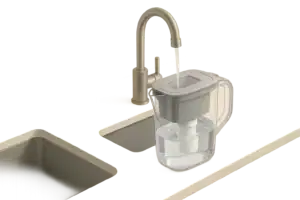
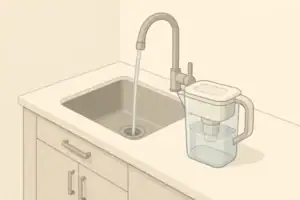
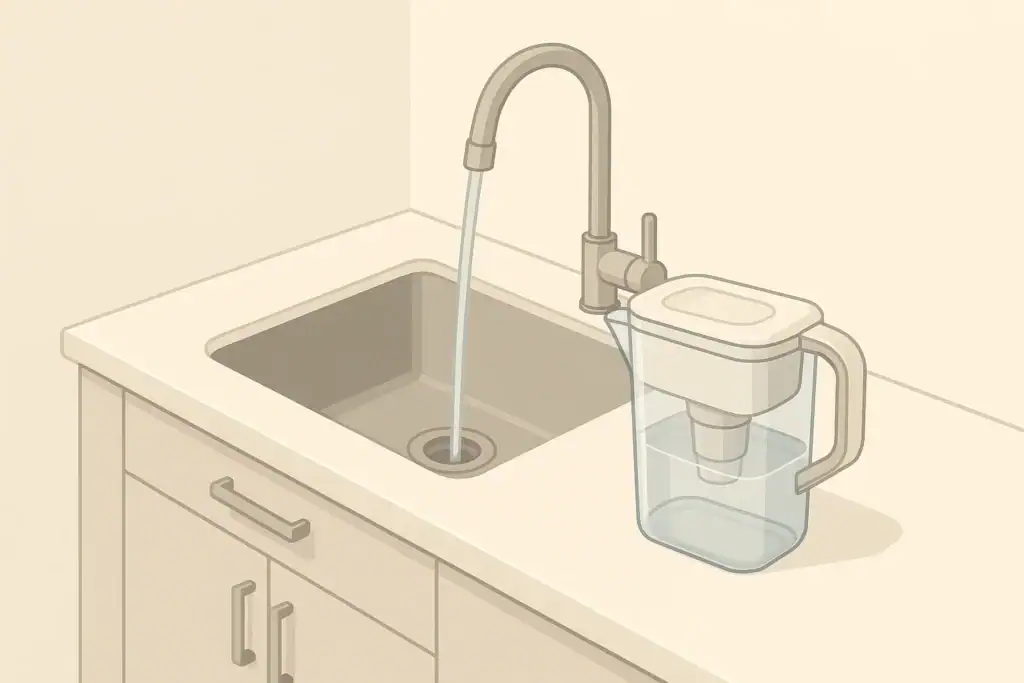
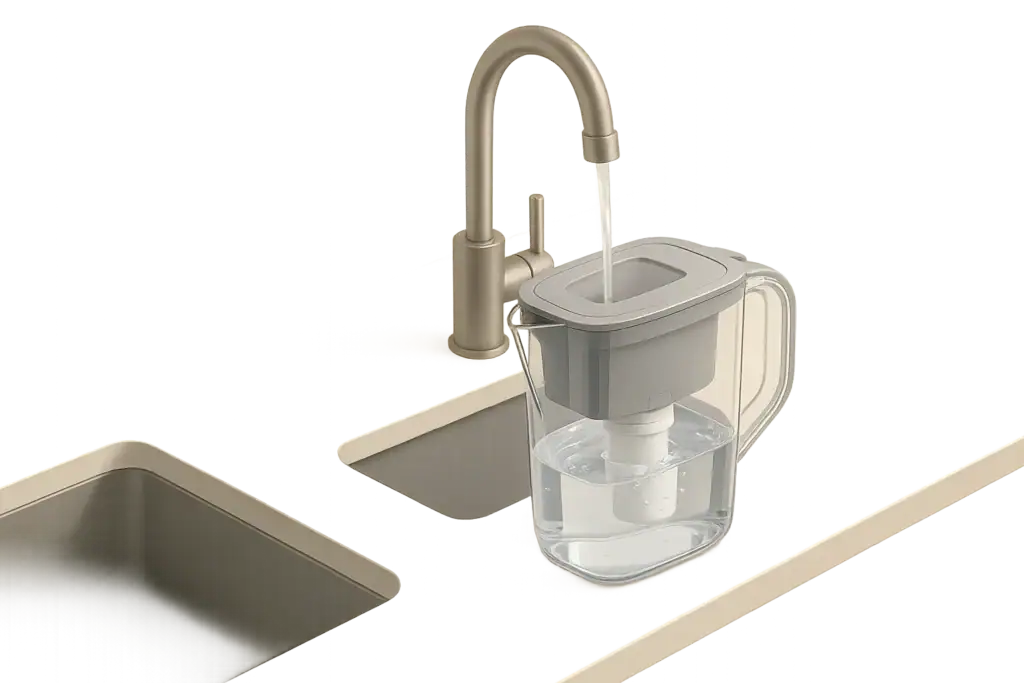
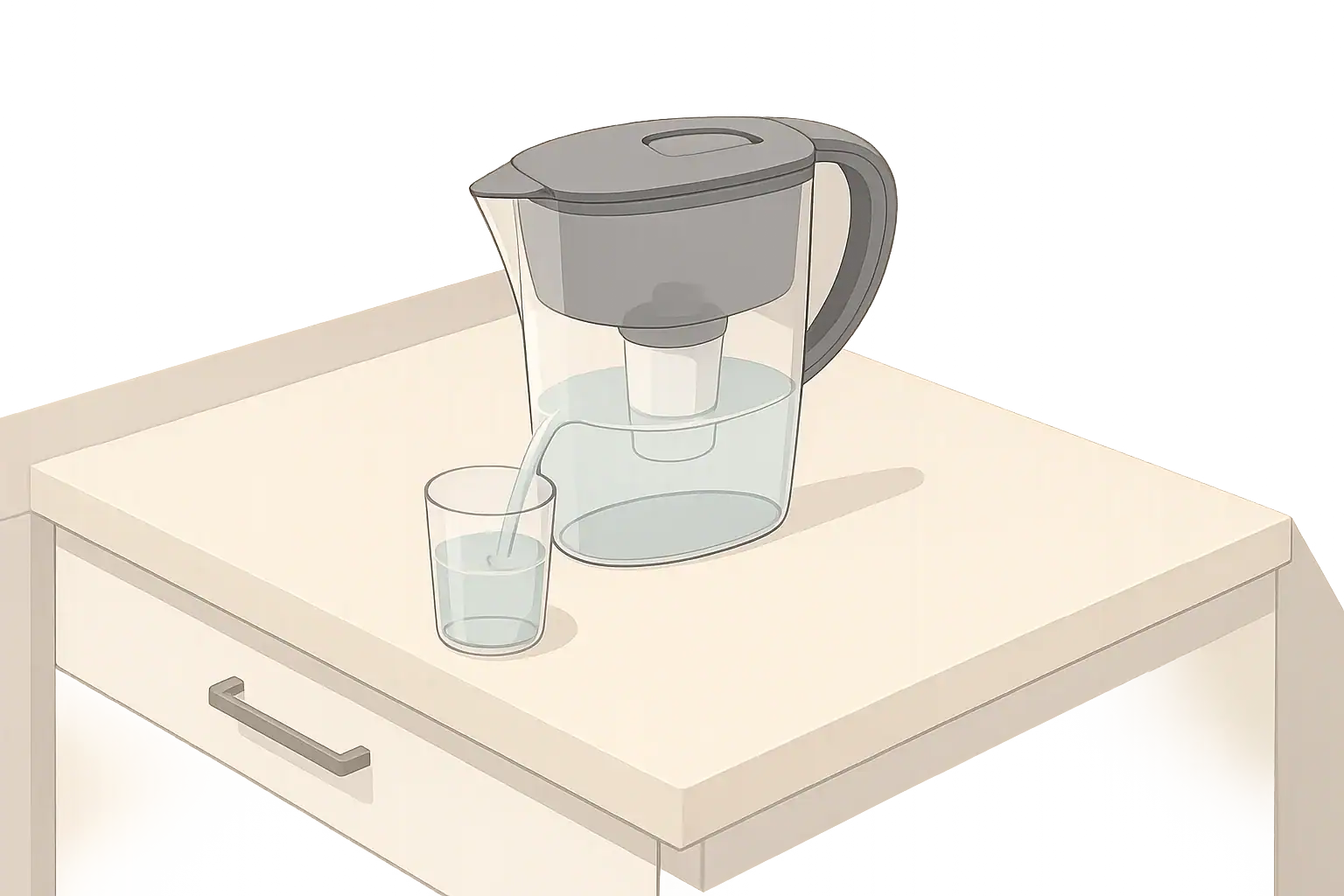
Pitcher filters are gravity-fed devices: you pour tap water into a top reservoir, water flows through a replaceable cartridge, and filtered water collects in the bottom. Their basic job is to pass water through filter media that can trap particles or adsorb dissolved substances.
Common Filter Media in Pitcher Cartridges
Most pitcher filters use one or more of these general media types:
- Granular activated carbon (GAC): Helps reduce chlorine taste and odor and some organic compounds.
- Carbon block: A more densely packed carbon form that can remove smaller particles and some dissolved contaminants.
- Ion-exchange resins: Materials that swap ions with dissolved metals in water, which can reduce certain metals, including lead, in some designs.
- Mechanical filtration layers: Fine mesh or fiber layers that physically strain out particles like rust and sediment.
Lead in water can be present as fine particles or as dissolved ions. Effective lead reduction typically requires a combination of media, often a dense carbon block and specialized ion-exchange components, designed and tested specifically for that purpose.
Pitchers for Taste vs. Pitchers for Lead Reduction
Not all pitcher filters target lead. Many are designed primarily for:
- Chlorine taste and odor
- Some sediment or rust particles
- General aesthetic improvements
Pitchers that are engineered for lead reduction typically state this on their packaging and product literature and are tested under standards that cover lead. The key is to distinguish:
- Aesthetic-only pitchers: Often tested under standards for taste, odor, and appearance.
- Health-related reduction pitchers: Tested for specific contaminants like lead under separate standards.
To know which type you have, you need to look at the specific certification language, not just general marketing claims.
Example values for illustration.
| Feature | Basic Taste/Odor Pitcher | Lead-Reduction-Focused Pitcher |
|---|---|---|
| Primary design goal | Improve taste and smell | Reduce specific contaminants including lead |
| Typical media | Granular activated carbon only | Carbon block plus ion-exchange components |
| Relevant certification type | Aesthetic effects standard | Health-related contaminant reduction standard |
| Label wording | “Reduces chlorine taste and odor” | “Certified to reduce lead” with specific standard listed |
| Typical filter life (example) | About 1–2 months of use | Shorter or similar; must follow certified capacity |
| Performance monitoring | Mostly taste-based impressions | Should follow certified capacity and consider periodic water tests |
NSF/ANSI Certifications That Matter for Lead Reduction
Independent certifications help consumers understand whether a pitcher has been tested to reduce lead under controlled conditions. The most commonly referenced standards for residential drinking water treatment units include a family of NSF/ANSI standards.
NSF/ANSI 53: The Key Standard for Lead Reduction
For pitcher filters, lead reduction is typically associated with NSF/ANSI 53, which covers systems designed to reduce certain health-related contaminants. When a pitcher is certified under this standard for lead, it means an independent organization has tested it according to defined protocols and acceptance criteria for lead reduction.
Important points about NSF/ANSI 53 and lead:
- Certification is contaminant-specific. A pitcher might be certified for lead, or for other contaminants, or both.
- Testing is done up to a stated capacity, such as a certain number of gallons, beyond which performance is not guaranteed.
- Certification applies only when the filter is used and maintained according to the manufacturer’s instructions.
How NSF/ANSI 42 and 401 Fit In
Other standards you might see on pitcher packaging include:
- NSF/ANSI 42: Focuses on aesthetic effects such as chlorine taste and odor and some particles. This alone does not indicate lead reduction.
- NSF/ANSI 401: Covers selected emerging compounds like some pharmaceuticals and chemicals at trace levels.
These standards can be useful for other concerns, but they are not substitutes for NSF/ANSI 53 certification specifically listing lead. If lead reduction is your goal, NSF/ANSI 42 or 401 on their own are not enough.
NSF/ANSI 58 and Why It Is Different
NSF/ANSI 58 applies mainly to reverse osmosis (RO) systems, which usually are under-sink units, not pitchers. RO systems often have a broader contaminant reduction range, including lead, but they work very differently and have different installation requirements.
For a gravity-fed pitcher, lead reduction claims normally relate back to NSF/ANSI 53, sometimes alongside 42 or 401.
How to Read and Verify a Pitcher Filter’s Lead-Reduction Claim
Lead-related wording on packaging can be confusing. To understand what a pitcher can really do, you need to look beyond prominent marketing phrases and find the exact standard and contaminant listing.
Step 1: Find the Certification Statement
Start by looking on the pitcher’s box, manual, or product information sheet for phrases such as:
- “Certified by an independent organization”
- “Certified to NSF/ANSI 53 for lead reduction”
- “Tested and certified against NSF/ANSI standards”
A clear claim usually includes:
- The name of the standard (for example, NSF/ANSI 53)
- The specific contaminant (lead)
- Sometimes the certifying body’s name or mark
General wording like “helps reduce metals” or “improves water quality” without a standard is not the same as an independently verified lead-reduction certification.
Step 2: Check the Certified Capacity and Replacement Interval
Lead reduction performance is tied to the cartridge’s certified capacity. Over time, media can become exhausted, and lead reduction can decline. The manufacturer usually lists:
- A recommended maximum volume of water per cartridge (for example, a certain number of gallons)
- A time-based replacement guideline (for example, monthly or every few months)
When a pitcher is certified, the lead reduction claim is typically valid only up to that volume or time, assuming typical household conditions. Using the cartridge longer than recommended may mean it no longer performs as tested.
Step 3: Verify Certification Through an Independent Database
Many certifiers maintain online databases where you can search for a model to verify its certification status. While you should follow the certifier’s instructions, a general process looks like this:
- Locate the brand and model number on your pitcher or cartridge.
- Visit the certifier’s website and find their product listings or database section.
- Search by brand/model and confirm the NSF/ANSI standard number and that lead is listed under contaminants.
This step helps ensure that the claim on the package reflects a current, independently verified listing and not just internal testing or outdated information.
Step 4: Understand the Scope and Limits of the Claim
Certification means a pitcher was tested under specific conditions. That does not guarantee identical performance in every home. Factors that can influence real-world results include:
- Incoming water chemistry and pH
- Presence of other particles that may clog the filter
- Water temperature and flow rate through the media
- Whether cartridges are replaced on time
Certification is still a valuable guide, but it should be combined with responsible use and, if you need confirmation, laboratory water testing.
When Is a Pitcher Filter Enough for Lead Concerns?
A certified lead-reducing pitcher can be a practical choice for many households, especially renters or those who cannot modify plumbing. However, it is important to consider your specific situation and whether a pitcher aligns with your needs and habits.
Situations Where a Lead-Reducing Pitcher Can Be a Good Fit
A pitcher may be reasonably suitable when:
- You mainly need filtered water for drinking and light cooking.
- You are prepared to replace cartridges on schedule.
- You have limited space or budget for larger systems.
- You want a non-permanent solution that does not require plumbing changes.
In these cases, a certified pitcher can provide a simple way to reduce lead in the water you actually consume, as long as you use it consistently for drinking and food preparation.
Situations Where You Might Need More Than a Pitcher
Some circumstances call for a broader approach:
- If your water testing shows consistently elevated lead levels at multiple taps.
- If you need filtered water at multiple points of use, such as the kitchen sink, ice maker, or bathroom sinks.
- If you have concerns about other contaminants not addressed by your pitcher.
- If your household uses large volumes of filtered water, making pitchers inconvenient.
In these situations, under-sink, faucet-mount, or whole-house options (some of which may use different standards, such as NSF/ANSI 58 for RO systems) could be worth considering alongside a pitcher.
Example values for illustration.
| If this describes your situation… | Then consider… |
|---|---|
| You rent and cannot alter plumbing | A certified lead-reduction pitcher as a primary option |
| You want filtered water only for drinking | Pitcher filter used consistently for all beverages |
| You need filtered water from multiple taps | Under-sink or faucet-mount systems in addition to or instead of a pitcher |
| Laboratory tests show very high lead levels | Consulting local resources and considering point-of-use systems with broader coverage |
| You frequently forget to replace filters | Systems with clear replacement reminders or a simple replacement schedule |
| You want minimal daily effort | A plumbed-in solution that does not require filling a pitcher |
Using and Maintaining a Lead-Reducing Pitcher Effectively
Even the best pitcher design depends on proper daily use and maintenance to function as tested. Lead reduction is closely tied to cartridge condition, contact time, and overall hygiene.
Follow the Replacement Schedule Closely
Cartridges gradually lose effectiveness as they adsorb contaminants and become physically clogged. To keep performance in line with certification testing:
- Track either the calendar time (weeks or months) or the approximate volume filtered.
- Replace the cartridge on or before the manufacturer’s recommended interval.
- Consider setting reminders on a calendar or device, especially if your pitcher lacks a built-in indicator.
If your household uses more water than what was assumed for the example schedule, you may need to replace cartridges more often to stay within the certified capacity.
If your household uses more water than what was assumed for the example schedule, you may need to replace cartridges more often to stay within the certified capacity.
Keep the Pitcher Clean
Regular cleaning supports consistent flow and helps prevent unwanted buildup in the pitcher itself. Typical guidance often includes:
- Hand-washing the reservoir and lid periodically with mild dish soap and rinsing thoroughly.
- Avoiding hot water on parts that are not rated for high temperatures.
- Keeping the lid closed when not in use to limit dust and debris.
Check your product’s instructions for any parts that may be dishwasher-safe or for specific cleaning cautions.
Use Proper Filling Practices
How you fill and store the pitcher affects performance:
- Fill from the cold water tap, since cold water is generally recommended for drinking and cooking use.
- Allow water to fully pass through the filter before pouring.
- Avoid topping off the upper reservoir so often that the lower chamber never fully empties; this can make it harder to track usage.
Some households also choose to discard the first filtered batch after installing a new cartridge, following the instructions, to flush any loose carbon fines or air from the media.
Testing Your Water Before and After Using a Pitcher
Certification tells you what a pitcher achieved under test conditions. If you want to understand how it performs with your actual tap water, water testing can give additional insight.
Initial Testing to Understand Your Baseline
Before relying on any filter for lead reduction, it can be helpful to know your unfiltered water levels at the tap you use most for drinking and cooking. You can consider:
- Contacting your water utility for any available testing programs or reports related to lead at the tap.
- Using a certified laboratory that offers lead testing for household samples.
Initial results provide a baseline and help you evaluate whether the scope of your filtration approach is appropriate.
Follow-Up Testing After Installing a Lead-Reducing Pitcher
Some homeowners choose to test again after using a certified pitcher for a time. This might involve:
- Collecting samples directly from the pitcher’s filtered water according to laboratory instructions.
- Testing at various points in the filter’s life, for example shortly after installing a new cartridge and again closer to the replacement date.
If test results show that lead levels remain similar to your unfiltered levels, that can signal an issue such as:
- The pitcher is not certified for lead reduction.
- The filter cartridge is past its recommended capacity.
- The sampling method did not follow the lab’s procedure.
In that situation, reviewing the certification details, maintenance practices, and sampling approach can help you decide next steps.
Certification Shortcuts: What the NSF/ANSI Numbers Tell You
Many people see NSF/ANSI numbers on packaging but are not sure how they relate to their specific concern about lead. A simple way to think about it is to connect each standard to the kind of performance it represents.
Example values for illustration.
| Standard | Main focus | What to look for on a pitcher |
|---|---|---|
| NSF/ANSI 42 | Aesthetic effects (taste, odor, some particles) | Claims about chlorine taste and odor, but not lead |
| NSF/ANSI 53 | Health-related contaminant reduction | Lead specifically listed under contaminants for your model |
| NSF/ANSI 401 | Selected emerging compounds | Optional; useful if you care about certain trace chemicals |
| NSF/ANSI 58 | Reverse osmosis systems | Generally applies to under-sink RO, not pitchers |
| Multiple listings | Combination of the above | Check each standard to see whether lead is included |
| No listed standard | Unclear or internal testing only | Consider independent verification if lead reduction is a priority |
Key Takeaways for Checking Lead-Reduction Claims
Pitcher filters can play a useful role in managing lead in household water when they are specifically designed and certified for that purpose. To evaluate a pitcher for lead reduction, focus on these practical steps:
- Look for NSF/ANSI 53 certification and confirm that lead is listed as a contaminant for your exact model.
- Verify the product’s listing through an independent certifier’s database when possible.
- Use the pitcher consistently for all water you drink or use in food preparation if lead reduction is the goal.
- Replace cartridges on schedule and keep the pitcher clean to maintain performance similar to test conditions.
- Consider water testing before and after filtration if you want confirmation of how the system performs in your home.
By focusing on clear certification information and careful everyday use, you can better understand what your pitcher filter can realistically do to help manage lead in your tap water.
Frequently asked questions
How can I verify a pitcher filter is certified to reduce lead?
Check the product literature or packaging for a specific reference to NSF/ANSI 53 and that lead is listed for the exact brand and model, then confirm that listing in the certifier’s online database using the model number. Avoid relying on vague marketing claims that do not name the standard and contaminant.
Does NSF/ANSI 42 certification mean a pitcher reduces lead?
No. NSF/ANSI 42 covers aesthetic effects such as taste and odor and does not address health-based lead reduction; a lead-reduction claim needs NSF/ANSI 53 or another health-related standard that explicitly lists lead.
How often should I replace the cartridge to ensure lead reduction?
Follow the manufacturer’s recommended time interval or the certified capacity (gallons) because the media’s ability to remove lead declines as it becomes exhausted. If your household uses more water than typical, replace cartridges more frequently to stay within certified performance limits.
Can a pitcher remove all lead from my tap water?
No pitcher can guarantee complete removal in every situation; certified pitchers are tested under specific conditions and up to a stated capacity, so real-world effectiveness depends on incoming lead levels, water chemistry, and proper maintenance. If tests show high lead at multiple taps, consider broader point-of-use or whole-house solutions.
Should I test my water before and after using a lead-reducing pitcher?
Yes. Initial testing establishes a baseline for unfiltered tap water, and follow-up testing of filtered water can confirm the pitcher’s performance in your home; use a certified laboratory and follow their sampling instructions for reliable results.
Recommended next:
- Best Pitcher Water Filters for Better-Tasting Tap Water (Chlorine Focus)
- Pitcher Filter vs Bottled Water: Cost per Gallon Breakdown
- How Often Should You Replace Pitcher Filters? (By Household Size)
- TDS in Pitcher-Filtered Water: What Changes and What Doesn’t
- Pitcher Filters for Renters: What to Look For (Capacity + Fridge Fit)
- Pitcher Filter Maintenance: Cleaning & Sanitizing Without Off-Flavors
- More in Pitcher Filters →
- NSF/ANSI standards explained (42/53/401/58)
- Clear trade-offs: pitcher vs faucet vs under-sink vs RO
- Maintenance planning: cost per gallon and replacement cadence