
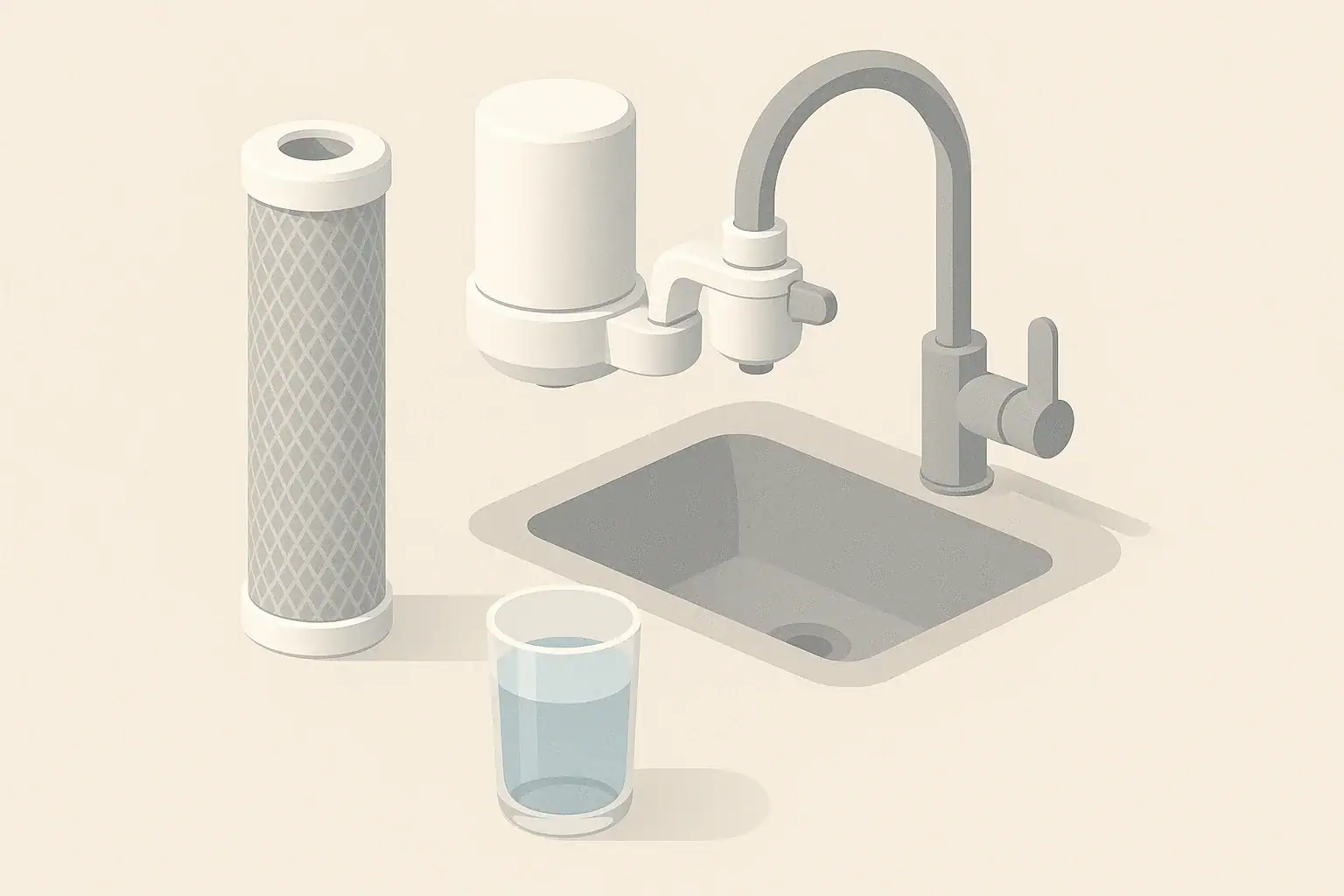
A faucet-mount water filter can be a practical option for a kitchen, apartment, dorm, or rental because it attaches at the faucet and usually does not require permanent plumbing changes. But the filter body also takes up space exactly where you wash dishes, fill pots, rinse produce, and use tall bottles. That is why faucet filter height clearance is worth measuring before you buy.
Clearance is not only about whether the filter physically fits. A filter that hangs too low can interfere with a deep pot, block the sink basin, or make the faucet awkward to swivel. A unit that extends too far sideways can hit a backsplash, window ledge, soap dispenser, or sprayer hose. A few simple measurements can prevent a poor fit and help you decide whether a faucet-mounted filter, countertop filter, pitcher, or under-sink system makes more sense. If you’re comparing formats, see pitcher vs faucet-mount and faucet-mount vs under-sink filters.
Why Faucet Filter Height Clearance Matters
Most faucet-mount filters include a diverter and a filter housing. Depending on the design, the housing may hang below the faucet, sit to one side, or rotate around the spout. Even compact models can reduce the usable space between the faucet outlet and the bottom of the sink basin.
This matters most in kitchens where the existing faucet is already low. If you have a shallow sink or a low-arc faucet, the added filter body may leave little room for everyday tasks. A tall stockpot, water bottle, French press, or humidifier tank may no longer fit under the faucet easily. For more on faucet compatibility, check faucet-mount filter compatibility.
Clearance also affects comfort. If the filter blocks your normal hand position, you may bump it during dishwashing. If it sits too close to the backsplash, you may not be able to rotate the faucet or switch between filtered and unfiltered water easily.
Measuring first is especially important for:
- Low-arc kitchen faucets
- Small apartment sinks
- Bar or prep sinks
- Faucets close to a backsplash or window sill
- Sinks used for large cookware or tall bottles
- Households with pull-down or pull-out sprayers
The Measurements to Take Before You Buy
You do not need special tools. A tape measure, a ruler, and a few minutes at the sink are usually enough. Take measurements while the faucet is in the position you use most often, and note whether the spout swivels over one basin or two.
Measure from the Faucet Outlet to the Sink Bottom
This is the main height clearance measurement. Measure from the bottom of the aerator, where water exits the faucet, straight down to the sink basin. If your sink has a center divider, also measure the clearance above the divider if you often use that area.
Then imagine the filter body extending below the faucet. Product listings often provide approximate dimensions, but the important practical question is how much usable space remains after the attachment is installed.
Measure the Faucet-to-Backsplash Distance
Some faucet filters extend backward or need room to rotate. Measure from the center of the faucet spout to the backsplash, wall, window ledge, or any object behind the faucet. Include soap dispensers, drinking water faucets, side sprayers, and handles in your mental layout.
Measure Side Clearance
Many faucet-mount filters sit to the left or right of the spout. Measure from the faucet outlet to nearby obstructions on both sides. If you have a double-basin sink, check whether the filter could hit the divider or limit the faucet’s swing.
Check the Aerator and Faucet Type
Faucet-mount filters generally attach where the aerator is located. Many standard round faucets can accept adapters, but not all faucet styles are compatible. Pull-down sprayers, pull-out sprayers, unusual rectangular spouts, and some designer faucets often do not work with standard faucet-mount attachments.
Do not force an adapter, cross-thread fittings, or attempt unsafe faucet modifications. If the filter cannot attach securely using the intended parts, consider another filtration format.
Example values for illustration.
| Measurement | How to Measure | Why It Matters |
|---|---|---|
| Outlet to sink bottom | Measure straight down from the aerator | Shows remaining space for pots and bottles |
| Outlet to basin divider | Measure to the top of the divider if present | Helps with double-basin sinks |
| Faucet to backsplash | Measure from spout center toward the wall | Checks rear clearance and rotation space |
| Left-side clearance | Measure from outlet to nearby objects | Allows for side-mounted filter bodies |
| Right-side clearance | Measure from outlet to nearby objects | Helps choose a practical orientation |
| Spout shape | Note round, pull-down, pull-out, or specialty style | Indicates likely adapter compatibility |
| Sink task height | Test with a tall bottle or pot | Shows real-world usability after installation |
| Handle movement | Move hot and cold handles fully | Prevents interference with controls |
How to Estimate the Space a Faucet Filter Will Use
Once you have sink measurements, compare them with the filter’s published dimensions. Look for overall height, width, depth, and the position of the connector relative to the housing. A filter that is six inches tall does not always reduce vertical clearance by six inches, because part of the housing may sit beside the faucet rather than directly below the outlet.
Use general dimensions as a planning tool, not a guarantee. Mounting angle, adapter length, faucet shape, and the direction the filter faces can all change the installed footprint.
Make a Simple Clearance Mockup
A low-tech mockup can help. Cut a piece of cardboard to the approximate filter size or use a small box with similar dimensions. Hold it where the filter would sit, then try normal sink tasks. This can reveal issues that a tape measure alone might miss.
Check whether you can still:
- Fill a tall water bottle
- Rinse a large bowl
- Wash a stockpot
- Move the faucet from one basin to the other
- Reach the faucet handle comfortably
- Use the sprayer, if present
Leave Room for Hands, Not Just Objects
Clearance should include working space for your hands. If a pot barely fits under the filter, it may still be inconvenient to wash or fill. A filter that technically fits but makes daily tasks frustrating is not a good match for that sink.
Faucet Styles That Often Need Extra Attention
Faucet-mount filters are easiest to plan for when the faucet has a simple round spout and removable aerator. Other styles may require more careful evaluation.
Low-Arc Faucets
Low-arc faucets often have limited outlet-to-basin clearance even before a filter is attached. A side-mounted filter may still work if the connection does not hang too low, but usability can be tight. Test with your tallest frequently used item before deciding.
High-Arc Faucets
High-arc faucets usually offer more vertical clearance, but they can introduce other concerns. The filter may swing farther from side to side, and a large side-mounted housing may feel off-balance. Check the faucet’s stability and do not use a filter if it causes the spout to sag or loosen.
Pull-Down and Pull-Out Sprayers
Many faucet-mount filters are not designed for pull-down or pull-out sprayer faucets. These faucets often have nonstandard spray heads, flexible hoses, or integrated modes that do not provide a stable attachment point.
If your faucet has a sprayer head that pulls out from the spout, assume compatibility may be limited unless the filter instructions specifically allow that faucet type. Do not attach a filter in a way that strains the hose or disables the sprayer’s normal function.
Side Sprayers and Soap Dispensers
A separate side sprayer or soap dispenser may not affect the spout connection, but it can reduce side clearance. If the filter body will sit near these accessories, make sure you can still grab and return the sprayer without hitting the filter.
Height Clearance Versus Flow and Filter Size
Clearance is only one part of the buying decision. Faucet-mount filters commonly use activated carbon or carbon-based media to improve taste and odor and reduce certain substances when designed and certified for those purposes. Larger housings may contain more media or support longer filter life, but they also take up more space at the sink. For a broader comparison of format tradeoffs, see best faucet-mount filters for chlorine taste.
A very compact filter may fit neatly but require more frequent cartridge changes or have a slower filtered flow. A larger filter may be more comfortable for maintenance intervals but more intrusive during dishwashing. The right balance depends on how you use the sink.
Filtered Flow Is Usually Slower
When water is routed through a cartridge, flow is typically slower than unfiltered tap flow. That is normal. Many faucet filters include a selector that lets you switch between filtered water for drinking and unfiltered water for washing. Using the unfiltered setting for hot water and general washing can help preserve cartridge life, if the filter instructions recommend that approach.
Cartridge Changes Need Working Room
Do not measure only for the installed filter. Also consider how you will remove and replace the cartridge. If the housing sits too close to a wall, cabinet edge, or window ledge, maintenance can be awkward. Leave enough space to grip the housing, twist or release the cartridge, and inspect for drips after installation. If replacement access is a concern, this faucet-mount cartridge change guide can help you plan ahead.
Common Fit Problems and Practical Solutions
Some clearance issues can be solved by choosing a different filter shape or a different filtration method. Others indicate that a faucet-mounted filter is simply not the best fit for that sink.
The Filter Hangs Too Low
If vertical clearance is the main issue, look for a design that places the filter body mostly to the side instead of directly under the spout. If that still leaves too little room, a pitcher, countertop unit, refrigerator filter, or under-sink system may be more practical.
The Filter Hits the Backsplash
If rear clearance is tight, a filter that projects forward or sideways may work better than one that extends behind the faucet. Also check whether the faucet can still rotate and whether the selector lever remains accessible.
The Adapter Does Not Fit Securely
Adapter fit is a safety and leak-prevention issue. Threads should engage smoothly and seat properly without excessive force. If the connector leaks, sits crooked, or requires makeshift parts, stop and choose a compatible option. Avoid improvised modifications that could damage the faucet or create a leak.
The Filter Blocks Routine Sink Tasks
If the filter makes it difficult to wash dishes or fill cookware, the inconvenience may outweigh the benefit. In small kitchens, preserving sink workspace can be just as important as filter capacity.
When a Faucet-Mount Filter May Not Be the Best Fit
A faucet-mounted filter is convenient when compatibility and clearance are favorable. It may be less suitable when the household uses a sprayer faucet, fills large containers often, or needs filtered water at a higher flow rate. It may also be a poor fit where the faucet is loose, delicate, or difficult to access.
Renters often like faucet filters because they are removable, but that does not mean they are the only renter-friendly option. A pitcher filter for renters or countertop dispenser can avoid faucet compatibility problems. An under-sink filter may be possible in some rentals only with permission and with standard, reversible installation. Permanent changes should not be made without approval.
Water quality goals also matter. A carbon faucet filter may be useful for taste and odor concerns, depending on the cartridge design. Other concerns may require different treatment technologies, and no single faucet-mounted product should be assumed to address every issue. Review the filter’s specifications and independent standard information carefully, and match the system to your actual water goals.
Example values for illustration.
| Situation | Potential Option | Planning Note |
|---|---|---|
| Low faucet height | Side-mounted faucet filter | Check if the body avoids the basin area |
| Very small sink | Pitcher or dispenser | Keeps the faucet area open |
| Pull-down sprayer faucet | Countertop or under-sink filter | Standard faucet mounts may not attach properly |
| Need more sink workspace | Under-sink filter | Moves the cartridge out of the wash area |
| Rental with no plumbing changes | Pitcher, dispenser, or compatible faucet mount | Choose removable options |
| Frequent large pot filling | Higher-clearance faucet setup or under-sink filter | Preserve vertical space at the basin |
| Tight backsplash clearance | Compact side orientation or non-faucet option | Confirm selector access and rotation |
Related guides: Faucet-Mount Filter Compatibility: How to Check Your Faucet Type • Faucet-Mount vs Under-Sink Filters: Convenience vs Performance • How to Install a Faucet-Mount Filter Without Leaks • Faucet-Mount Cartridge Change: Step-by-Step Replacement Guide
Final Pre-Purchase Checklist
Before choosing a faucet-mounted filter, write down your measurements and compare them with the product dimensions and compatibility notes. A simple checklist can reduce the chance of ordering a filter that does not fit your faucet or daily routine.
- Measure from the aerator to the sink bottom.
- Check clearance to the backsplash, window ledge, and nearby accessories.
- Confirm whether the filter body hangs below, beside, or behind the spout.
- Verify that your faucet has a compatible removable aerator.
- Be cautious with pull-down, pull-out, and specialty faucets.
- Test everyday tasks with a basic size mockup.
- Leave room for cartridge replacement and leak checks.
- Avoid forced adapters, improvised fittings, or unsafe modifications.
The best faucet filter fit is the one that matches both your water-use goals and the physical space around your sink. Careful measuring helps keep the filter useful, accessible, and out of the way during normal kitchen work.
Frequently asked questions
How much clearance do I need for a faucet-mount filter?
There is no single standard measurement, because filter designs vary. Measure the space under and around your faucet, then compare it with the product’s installed dimensions and your tallest everyday items.
Will a faucet filter fit a low-arc kitchen faucet?
Sometimes, but low-arc faucets often leave less working room. A compact side-mounted design may fit better, but you should test the space with the filter’s dimensions or a simple mockup first.
Can I use a faucet-mount filter with a pull-down sprayer?
Usually not unless the manufacturer specifically says it is compatible. Pull-down and pull-out sprayers often use nonstandard parts that do not provide a stable attachment point.
What if the filter hits my backsplash?
Choose a model with a smaller rear footprint or a side-oriented housing. If rotation or handle access is still blocked, a pitcher, countertop unit, or under-sink filter may be a better choice.
Do I need to measure more than just height?
Yes. Also check side clearance, backsplash distance, faucet type, and room for cartridge replacement, because any of those can affect whether the filter works well at your sink.
Recommended next:
- Best Faucet-Mount Filters for Chlorine Taste (High Flow Picks)
- Faucet-Mount Filter Compatibility: How to Check Your Faucet Type
- Faucet-Mount vs Under-Sink Filters: Convenience vs Performance
- How to Install a Faucet-Mount Filter Without Leaks
- Faucet-Mount Filters for Renters: No-Drill Setup Guide
- Troubleshooting a Faucet-Mount Filter with Slow Flow
- More in Faucet-Mount Filters →
- NSF/ANSI standards explained (42/53/401/58)
- Clear trade-offs: pitcher vs faucet vs under-sink vs RO
- Maintenance planning: cost per gallon and replacement cadence