
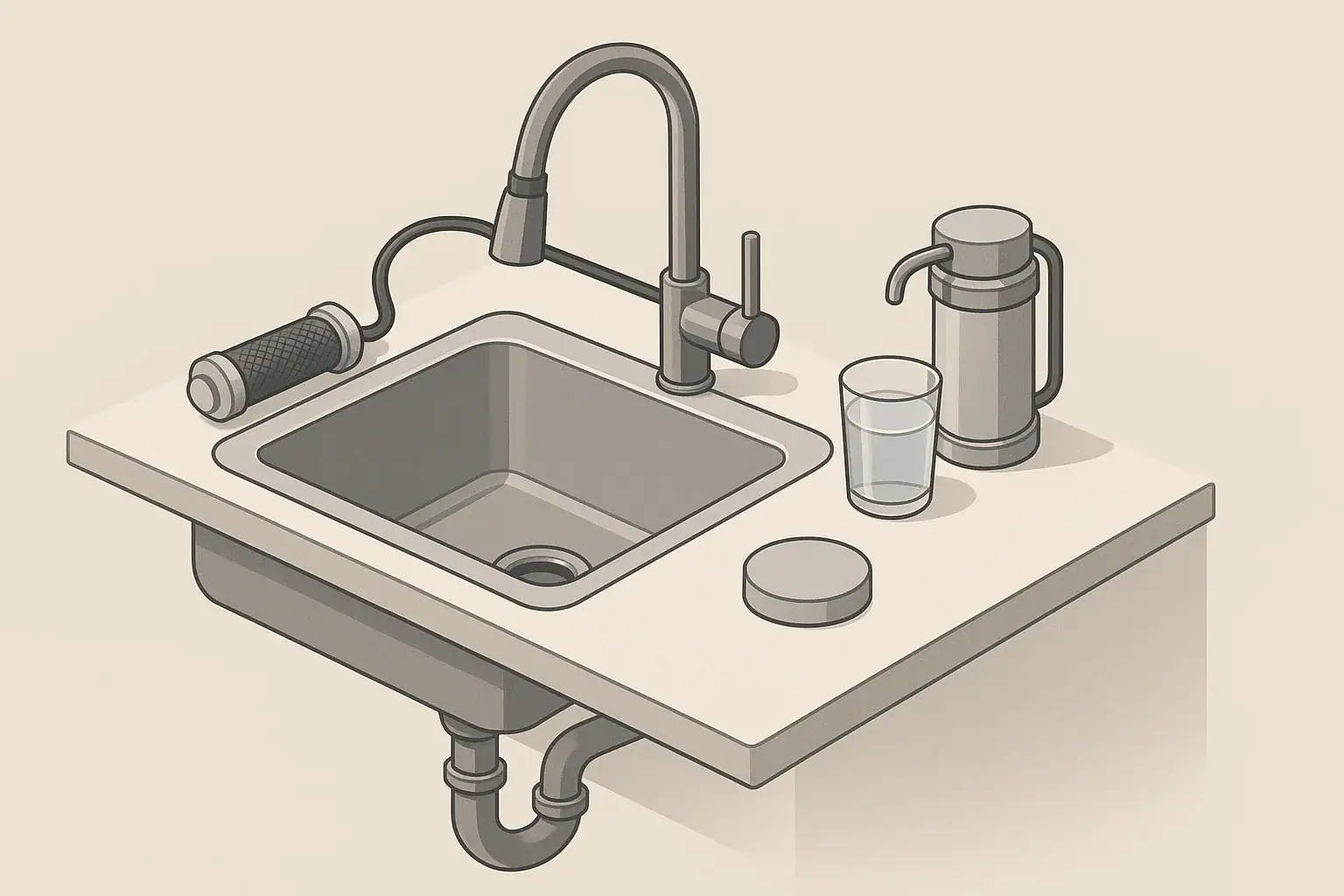
Faucet-mount filters are popular because they are simple, visible, and usually do not require permanent plumbing changes. For many standard kitchen faucets, they attach where the aerator normally sits and let you switch between filtered and unfiltered water.
Pull-out and pull-down faucets are different. Their spray heads, hoses, docking systems, and internal connections often make them incompatible with typical faucet-mount filters. The issue is usually not the filter cartridge itself. It is the shape and mechanics of the faucet.
This article explains why many faucet-mount filters do not fit pull-out faucets, what to check before buying, and which filtration options are usually more practical for kitchens with sprayer-style faucets.
Why pull-out faucets are different
A standard faucet usually has a fixed spout with a removable aerator at the end. The aerator is commonly threaded, and many faucet-mount filters are designed to attach to those threads using included adapters. If you are comparing styles, a faucet-mount filter compatibility check is the first step.
A pull-out or pull-down faucet uses a detachable spray head connected to a flexible hose. The head may contain the aerator, spray selector, check valve, flow restrictor, docking magnet, or other small components. It is designed to be light enough to move, retract cleanly, and seal reliably when docked.
That design creates several fit problems for external faucet filters. The filter body adds weight, changes the center of gravity, and may interfere with the docking point. The sprayer head may also lack the exposed threads that a faucet-mount filter needs.
Pull-out and pull-down are similar for filter fit
The terms are often used differently, but both styles usually involve a moving spray head attached to a hose. A pull-out faucet often has a shorter spout and pulls forward. A pull-down faucet often has a taller arc and pulls downward.
For faucet-mount filter compatibility, the important point is the same: the filter would need to attach to a movable sprayer head rather than a fixed faucet spout. That is where most fit concerns begin.
The main reasons faucet-mount filters often do not fit
Most faucet-mount filters are designed around a simple assumption: the faucet end is rigid, round, accessible, and threaded. Pull-out faucets often fail one or more of those assumptions.
The spray head may not have standard threads
Many pull-out spray heads do not have a standard removable aerator with common internal or external threads. Some have recessed aerators, hidden aerators, or proprietary inserts. Even when an aerator can be removed, the exposed opening may not match common filter adapters.
The hose and docking system are not meant to carry extra weight
A faucet-mount filter can add noticeable weight to the end of the spray head. That weight may cause the head to sag, fail to dock fully, or pull the hose out of position. Over time, extra strain can increase the chance of nuisance leaks or poor retraction.
The filter can block spray controls
Pull-out faucet heads often include buttons or toggles for stream and spray modes. A filter housing or adapter may cover these controls, press against them, or prevent the head from being used comfortably. For that reason, some homeowners choose alternatives like an under-sink option versus a pitcher instead of forcing a tip-mounted setup.
Clearance can be too tight
Even if the threads match, the filter body may hit the sink basin, backsplash, window sill, soap dispenser, or countertop items. Pull-out faucets are often chosen for flexibility, and a rigid filter on the end can reduce that flexibility.
Seals and flow paths may not match
Sprayer heads may rely on specific seals, flow restrictors, and internal pathways. Adding adapters that were not designed for that head can create drips, uneven flow, or spray pattern problems. It is not a good idea to force parts together or modify the spray head to make a filter fit.
Example values for illustration.
| Faucet feature | Why it matters | Fit outlook |
|---|---|---|
| Movable pull-out spray head | Adds weight to a hose-supported part | Usually not recommended |
| No visible removable aerator | Filter adapters need a threaded attachment point | Usually will not fit |
| Recessed or hidden aerator | Threads may be inaccessible or nonstandard | Uncertain |
| Spray button near faucet tip | Filter body may block controls | Often impractical |
| Magnetic or weighted docking | Extra weight can affect retraction and seating | Often impractical |
| Low sink or backsplash clearance | Filter may hit surrounding surfaces | Check carefully |
| Separate fixed main faucet with side sprayer | Filter may attach to fixed spout instead | Sometimes possible |
What to check before buying a faucet-mount filter
Before choosing any faucet-mounted unit, look closely at the faucet end. The goal is to confirm whether the faucet has a stable, threaded, fixed attachment point that matches the filter’s adapter system.
Check whether the aerator is removable
If the faucet has a removable aerator, it may unscrew from the tip. On many pull-out faucets, the aerator is hidden or requires a small tool. A removable aerator does not automatically mean a faucet-mount filter will fit, but it is the first basic requirement.
Avoid using excessive force. If the aerator does not move easily or appears integrated into the spray head, forcing it can scratch finishes or damage internal parts.
Look for standard internal or external threads
Faucet-mount filters usually include a limited set of adapters for common aerator thread patterns. Pull-out faucets often use less common formats. If the threads are recessed, plastic, unusually shaped, or shallow, the connection may be unreliable.
Consider the faucet material and shape
Some sprayer heads have curved, tapered, flat-sided, or plastic housings that do not provide enough support for a filter. A filter should not be held in place with tape, improvised clamps, sealants, or other makeshift supports.
Confirm the manufacturer’s compatibility limits
Many faucet-mounted filters exclude pull-out, pull-down, hand-held, or sprayer-style faucets in their general compatibility notes. That warning is usually based on mechanical fit, leak prevention, and user safety rather than filtration performance.
Filtration performance is separate from faucet compatibility
A faucet-mount filter may use activated carbon, carbon block media, sediment screens, ion exchange media, or other components depending on its design. These media can help address common aesthetic concerns such as chlorine taste and odor when the filter is used within its rated conditions. If tastes and odors are your main concern, a dedicated guide on faucet-mount filters for chlorine taste can help you compare options.
However, a filter that performs well in a lab or on a compatible faucet still needs a secure installation. Poor fit can cause bypass, leaks, low flow, or inconsistent operation. Compatibility is a plumbing and mechanical question; contaminant reduction is a filter performance question.
Look for clear performance information
When comparing filters, look for performance data that lists what the filter is designed to reduce, the testing standard used, and the expected cartridge life under stated conditions. In the United States, many consumers look for NSF/ANSI-style standards as a way to compare claims, but the exact standard depends on the contaminant or water quality concern. For a broader look at claims, see how to verify a water filter’s certification claim.
No small point-of-use filter should be assumed to make all water “pure.” Filters have specific capabilities and limits. For example, a carbon-focused filter may be useful for taste and odor, while different technologies may be needed for other concerns. If your water issue is based on a known contaminant, start with a recent water report or appropriate water test.
Flow rate and pressure still matter
Faucet-mounted filters restrict flow because water must pass through filter media. If the faucet connection is marginal, added pressure and movement can worsen leaks. A secure, fixed spout is better suited to the on-off cycling and back pressure that a faucet filter can create.
Safer alternatives for kitchens with pull-out faucets
If a faucet-mount filter does not fit your pull-out faucet, the best alternative depends on whether you rent, own, need filtered water only for drinking, or want filtered water for cooking as well.
Pitcher or dispenser filters
Pitchers and countertop dispensers require no faucet connection. They are often practical for apartments, dorms, and rentals. The tradeoff is slower filtration, limited capacity, and the need to refill them. If you are deciding between no-install options, pitcher vs faucet-mount is a useful comparison.
Countertop filters with a diverter
Some countertop filters connect to a faucet aerator with a diverter valve. These still often require a compatible fixed faucet and may not work with pull-out sprayers. They can be useful for some sinks, but they do not solve the pull-out compatibility issue unless the faucet has a suitable fixed threaded outlet.
Under-sink filters with a dedicated faucet
An under-sink drinking water filter can feed a small separate faucet mounted at the sink or countertop. This avoids hanging weight from the pull-out sprayer. It can also provide a cleaner everyday setup, though installation is more involved and may not suit all rentals.
Under-sink inline filters
Some under-sink filters connect to the cold water line and send filtered water through the existing faucet. This approach keeps the pull-out faucet’s appearance, but it may filter all cold water used at that faucet and can affect flow. Installation should follow the filter’s instructions and local plumbing expectations.
Refrigerator filters
If your refrigerator has a water dispenser or ice maker, its filter may already cover some drinking water uses. It will not filter water from the kitchen sink, but it may reduce the need for a faucet-mounted option.
Installation and leak considerations
Water filters deal with pressurized water, so fit matters. A small drip at the faucet may seem minor, but repeated wetting around counters, cabinets, or sink decks can create maintenance problems.
Do not drill, cut, glue, tape, clamp, or otherwise modify a pull-out spray head to accept a faucet-mount filter. Do not bypass check valves, flow restrictors, backflow prevention features, or other safety-related parts to make a filter fit. If a filter does not attach using its intended parts, choose a different filtration style. If you are troubleshooting an existing setup, faucet adapter compatibility problems are often the real cause.
Watch for common warning signs
After any filter installation, watch for slow drips, pulsing flow, unusual hose movement, poor docking, or water around the sink base. Stop using the setup if it leaks or if the spray head no longer retracts properly.
Renters should be especially cautious
Renters often prefer no-drill filtration options. A pitcher, dispenser, or freestanding countertop system may be easier to remove when moving out. If an under-sink system is allowed, written permission and a reversible installation may be important.
Example values for illustration.
| Option | Typical fit with pull-out faucet | Main tradeoff |
|---|---|---|
| Pitcher filter | No faucet connection needed | Limited volume and refill time |
| Countertop dispenser | No faucet connection needed | Uses counter or refrigerator space |
| Countertop diverter filter | Often needs a fixed threaded faucet | May still be incompatible |
| Under-sink dedicated faucet | Works independently of sprayer head | Requires installation space |
| Under-sink inline filter | Can feed existing cold line | May affect cold water flow |
| Refrigerator filter | Separate from kitchen faucet | Only serves fridge water or ice |
Related guides: Faucet-Mount Filter Compatibility: How to Check Your Faucet Type • Faucet-Mount vs Under-Sink Filters: Convenience vs Performance • How to Install a Faucet-Mount Filter Without Leaks • Faucet-Mount Filters for Renters: No-Drill Setup Guide • Faucet Compatibility Problems: When Adapters Don’t Fit
Key takeaways for choosing the right setup
Many faucet-mount filters do not fit pull-out faucets because the faucet head is movable, often nonstandard, and not designed to support a filter housing. The most common barriers are missing threads, recessed aerators, added weight, blocked spray controls, and poor clearance.
If you want filtered water at a sink with a pull-out faucet, start by separating two questions: what water quality issue you want to address, and what installation style your faucet can safely support. A filter can only work as intended when it is installed on a compatible connection.
For many households, the practical answer is not to force a faucet-mounted filter onto a sprayer head. A pitcher, dispenser, refrigerator filter, or under-sink system may provide a more reliable path, depending on your space, budget, rental situation, and filtration goals.
Frequently asked questions
Can a faucet-mount filter work on a pull-out faucet?
Sometimes, but often not. It depends on whether the spray head has a removable, standard-thread aerator and enough clearance to support the filter safely.
Why do pull-out faucet filters leak more often?
Pull-out faucets move on a hose and are not built to carry extra weight at the tip. That movement can loosen a marginal connection and make drips more likely.
How can I tell if my faucet has the right threads?
Remove the aerator if it is designed to come off, then compare the connection to the adapter types listed by the filter maker. If the aerator is hidden or proprietary, compatibility is less likely.
Is a countertop diverter a better option for a pull-out faucet?
Only if the faucet has a compatible fixed threaded outlet. Many pull-out faucets still have the same compatibility problem at the spray head.
What is the simplest alternative if my pull-out faucet will not fit a filter?
A pitcher or dispenser filter is usually the easiest no-installation option. Under-sink systems are better if you want filtered water at the sink and can support a more permanent setup.
Recommended next:
- Best Faucet-Mount Filters for Chlorine Taste (High Flow Picks)
- Faucet-Mount Filter Compatibility: How to Check Your Faucet Type
- Faucet-Mount vs Under-Sink Filters: Convenience vs Performance
- How to Install a Faucet-Mount Filter Without Leaks
- Faucet-Mount Filters for Renters: No-Drill Setup Guide
- Troubleshooting a Faucet-Mount Filter with Slow Flow
- More in Faucet-Mount Filters →
- NSF/ANSI standards explained (42/53/401/58)
- Clear trade-offs: pitcher vs faucet vs under-sink vs RO
- Maintenance planning: cost per gallon and replacement cadence