
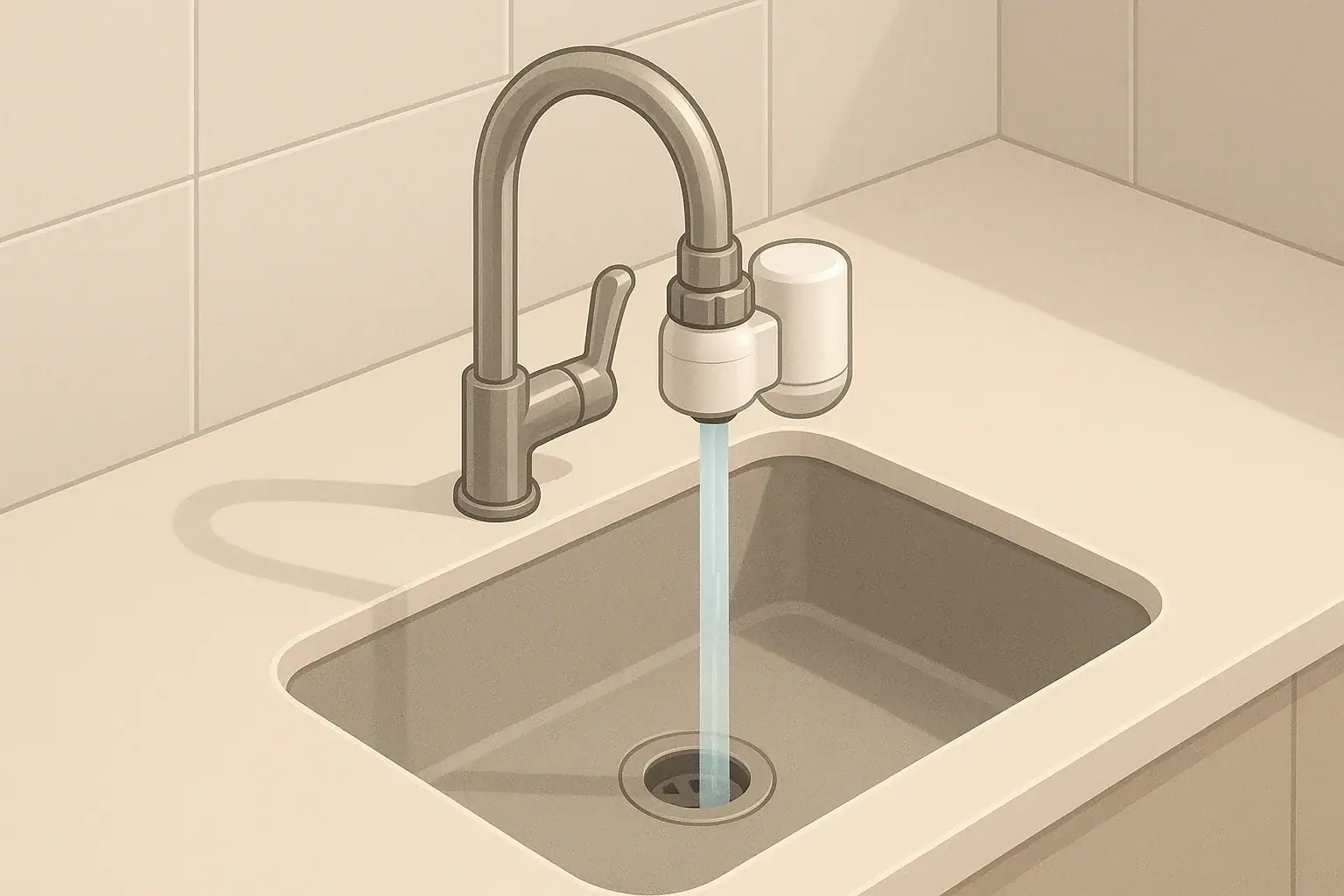
A faucet-mount water filter attaches at the end of a faucet after the aerator is removed. Compatibility depends on the filter model, the faucet’s exposed threads, the available adapters and the space around the spout. Major manufacturer instructions commonly require accessible internal or external threads, and they exclude some faucet designs.
Check the filter manufacturer’s compatibility instructions before buying. For example, PUR says its faucet systems fit most standard faucets but not pull-out or handheld faucets. Brita’s FF-100/SAFF-100 instructions exclude faucets with a built-in spray feature at the outlet. These restrictions are product-specific rather than universal rules for every filter. PUR faucet-system compatibility guidance and Brita FF-100/SAFF-100 instructions provide examples.
Why Faucet Type Matters for Faucet-Mount Filters
A threaded connection must match closely enough to seat the washer and hold the filter securely. A connection that is cross-threaded, forced or paired with the wrong adapter may leak or fail to tighten. Brita’s instructions specifically tell users to install its system by hand without forcing or overtightening it and note that damaged faucet threading can cause fit problems.
Physical fit is only part of the check. The filter housing also needs room to hang and operate without hitting the sink, backsplash, faucet handle or nearby accessories.
Step-by-Step: How to Check Your Faucet for Compatibility
Step 1: Check the Faucet Design
Start by looking at the outlet where the water exits. A conventional fixed spout with a removable aerator is the usual candidate for a faucet-mount filter. Before proceeding, look for features that the filter manufacturer excludes, such as:
- A pull-out or pull-down head
- A handheld faucet head
- A spray selector or built-in spray feature at the outlet
- A concealed, recessed or proprietary aerator for which the filter maker does not provide a compatible fitting
- No removable outlet fitting or accessible threads
Do not assume that an adapter makes every faucet compatible. PUR supplies three adapters with its current faucet systems but still excludes pull-out and handheld faucets. Brita’s cited manual uses supplied adapters for certain inside-threaded faucets but excludes end-mounted built-in spray features.
Step 2: Remove the Aerator Safely
Turn off the water and remove the existing aerator according to the faucet manufacturer’s instructions. If a tool is permitted, protect the faucet finish with a cloth and avoid crushing or scratching the aerator. Keep the aerator, screens and washers together so they can be reinstalled later.
Do not force a recessed or unfamiliar aerator. Some faucets require a dedicated aerator key, and damage to the faucet threads can prevent the filter from sealing correctly.
Step 3: Identify External or Internal Threads
After removing the aerator, inspect the faucet outlet:
- External, or male, threads: The threads are on the outside of the faucet outlet.
- Internal, or female, threads: The threads are recessed inside the faucet outlet.
Some common systems support both arrangements, but their installation methods differ. PUR directs users to identify internal or external threading and select an included adapter as needed. Brita’s cited instructions show direct attachment for one thread arrangement and supplied adapters for compatible inside-threaded faucets. Follow the instructions for the exact filter model rather than assuming that adapters are interchangeable between brands.
Step 4: Match the Filter Model and Adapter
Record the faucet brand and model if available, photograph the exposed outlet and compare it with the filter’s official compatibility guide. A diameter measurement can help describe the opening to customer support, but diameter alone may not establish compatibility because thread pitch, recessed fittings and proprietary aerators can also matter.
Use only an adapter that the filter manufacturer identifies as compatible, or obtain written specifications for both connections before buying a third-party fitting. The adapter should engage smoothly by hand. Stop if it tilts, binds immediately or requires force, because those are signs of a mismatched or cross-threaded connection.
Step 5: Check Faucet Clearance and Reach
Compare the filter’s published dimensions with the space around the faucet. Check:
- Vertical clearance: The housing should not hit the sink basin, dishes or a sink rack.
- Backsplash clearance: The unit and selector should operate without striking the wall.
- Side clearance: Soap dispensers, side sprayers and handles should remain usable.
- Outlet position: The filtered stream should land inside the basin without excessive splash.
If the manufacturer does not publish enough dimensions, make a cardboard template using the available measurements or ask the company for a dimensional drawing.
| What to inspect | What to do |
|---|---|
| Removable aerator | Remove it according to the faucet instructions and inspect the exposed outlet. |
| External or internal threads | Match the thread arrangement to the exact filter manual and its supplied adapters. |
| Pull-out, pull-down or handheld head | Check the manufacturer’s exclusions; PUR states that these faucet types are incompatible with its systems. |
| Built-in spray feature at the outlet | Check the manual; Brita excludes this design for the system covered by its cited instructions. |
| Recessed or proprietary aerator | Confirm an approved fitting with the faucet and filter manufacturers rather than relying only on diameter. |
| Space around the spout | Compare the filter dimensions with basin, backsplash, handle and accessory clearance. |
Faucets Commonly Excluded by Manufacturers
Pull-Out, Pull-Down and Handheld Faucets
PUR’s current support guidance states that its faucet filtration systems are not compatible with pull-out or handheld faucets. Other brands may define their exclusions differently, so verify the exact model rather than treating this as a universal statement. For a closer look at the practical fit questions, see faucet-mount filters on pull-out faucets.
Faucets With an End-Mounted Spray Feature
Brita’s FF-100/SAFF-100 manual says not to attach that system to a faucet with a built-in spray feature at the end of the faucet. A separate model should not be assumed compatible unless its own instructions say so.
Non-Threaded, Recessed or Specialty Outlets
A smooth outlet without a compatible attachment point cannot accept a conventional screw-on filter. Recessed aerators and specialty fittings require model-specific confirmation. Avoid improvised clamping or forced adapters that are not approved for the filter and faucet.
Flow Rate, Capacity and Everyday Use
A compatible thread does not establish that a filter will meet your household’s flow or capacity needs. Review the performance data sheet for the exact housing-and-cartridge combination, including rated service flow, capacity, pressure range, temperature range and replacement instructions.
Filtered flow can decline as a cartridge collects material. Brita’s cited manual states that its indicator is based on filtered-water use and assumes average water quality; it also notes that high sediment can clog a cartridge prematurely, reduce flow and require earlier replacement. Follow the model’s replacement instructions rather than relying only on elapsed time.
A Model-Specific Example
As one documented example—not a category-wide specification—the NSF listing for the PUR FM-2000B used with the RF-3375 or RF-9999 cartridge lists chlorine reduction, taste-and-odor reduction and Class I particulate reduction under NSF/ANSI 42, along with a 100-gallon service cycle and a 0.52-gpm flow rating. See the current NSF listing.
PUR’s performance data sheet dated September 4, 2025, reports greater than 97.4% chlorine taste-and-odor reduction under a 2.0 mg/L challenge, a 100-gallon rated capacity, a 0.52-gpm rated service flow, an operating pressure range of 20–100 psig and a water-temperature range of 34–82°F. Those figures apply only to the named unit/cartridge combinations and stated test conditions; they should not be generalized to other faucet filters. Read the PUR performance data sheet.
How to Verify Contaminant-Reduction Claims
Certification to an NSF/ANSI standard does not mean that a filter reduces every contaminant addressed by that standard. NSF advises consumers to check the specific contaminant claims for the exact certified product. Its overview describes NSF/ANSI 42 as covering aesthetic claims such as chlorine and taste or odor, NSF/ANSI 53 as covering specified health-related claims, NSF/ANSI 401 as covering specified emerging compounds and NSF/ANSI 58 as applying to reverse-osmosis systems. See NSF’s guide to drinking-water treatment standards.
When comparing faucet filters:
- Identify the exact filter housing and replacement cartridge.
- Search an independent certifier’s official database for that exact combination.
- Open the performance data sheet and check the named contaminant, capacity, rated flow and operating conditions.
- Do not infer a lead, chemical or microbial reduction claim from a standard number alone.
- Replace the cartridge under the manufacturer’s conditions, including earlier replacement when instructed because of clogging or reduced flow.
Start With Information About Your Input Water
Customers of a community water system receive an annual Consumer Confidence Report describing the water source and detected regulated contaminants. The report is a useful starting point, but it describes the public water system and does not by itself establish conditions at one household faucet. Building plumbing can introduce additional site-specific concerns. EPA explains how to find and read a Consumer Confidence Report.
If you use a private well, have a specific concern or need to evaluate conditions at an individual tap, use an appropriate water test rather than choosing a cartridge solely from general marketing claims. Match any result to a certified claim for the exact product configuration.
| Standard | General scope | What to verify |
|---|---|---|
| NSF/ANSI 42 | Aesthetic effects, including specified chlorine, taste, odor or particulate claims | The exact certified claim and product combination |
| NSF/ANSI 53 | Specified health-related contaminant claims | The named contaminant; the standard number alone is insufficient |
| NSF/ANSI 401 | Specified emerging-compound claims | Which compounds are listed for the exact model |
| NSF/ANSI 58 | Reverse-osmosis systems | Relevant to RO systems rather than a typical non-RO faucet-mount filter |
When a Faucet-Mount Filter Is Not the Best Fit
Consider another format if the manufacturer excludes your faucet, no approved adapter matches the outlet, the housing lacks clearance or the published flow and capacity do not meet your needs. Alternatives include:
- Under-sink filters: These connect below the sink and may feed the existing cold-water faucet or a dedicated drinking-water tap, depending on the system. See this guide to under-sink filters for chlorine taste and odor.
- Countertop systems: Some connect to a compatible faucet through a diverter, while others use a refillable reservoir. Check their faucet restrictions separately.
- Pitcher or dispenser filters: These avoid faucet attachment but have their own capacity, flow and certified-claim limits. Compare under-sink and pitcher filters.
- Reverse-osmosis systems: These may be appropriate when their specific certified claims match the water concern, but they have different installation and maintenance requirements. Read what reverse osmosis removes and what it does not.
Frequently Asked Questions
How do I tell whether my faucet has male or female threads?
Remove the aerator according to the faucet instructions. Threads on the outside of the exposed outlet are external or male threads; threads recessed inside the outlet are internal or female threads. Then compare that arrangement with the instructions for the exact filter model.
Should I measure the faucet threads with a ruler?
A measurement can help when describing the outlet, but diameter alone does not confirm a match. Thread pitch, recessed aerators and proprietary fittings may also affect compatibility. Use the filter’s official adapter guide or contact the manufacturer with the faucet model and a photograph.
Can I install a faucet-mount filter on a pull-out or pull-down faucet?
Do not assume so. PUR explicitly excludes pull-out and handheld faucets from its faucet-system compatibility guidance. Check the exact filter manual because restrictions are model-specific.
Can I use an adapter for an inside-threaded faucet?
Possibly. The reviewed PUR and Brita systems include adapters for certain compatible thread arrangements, but this does not establish that every inside-threaded faucet will fit. Use the adapter specified for the exact filter and stop if it does not engage smoothly by hand.
Why did filtered flow become slower?
Check the model’s maintenance instructions. A cartridge can become restricted before its nominal interval when the input water contains more sediment; Brita’s cited manual identifies premature clogging and reduced flow as reasons an earlier replacement may be needed.
Recommended next:
- NSF/ANSI standards explained (42/53/401/58)
- Clear trade-offs: pitcher vs faucet vs under-sink vs RO
- Maintenance planning: cost per gallon and replacement cadence