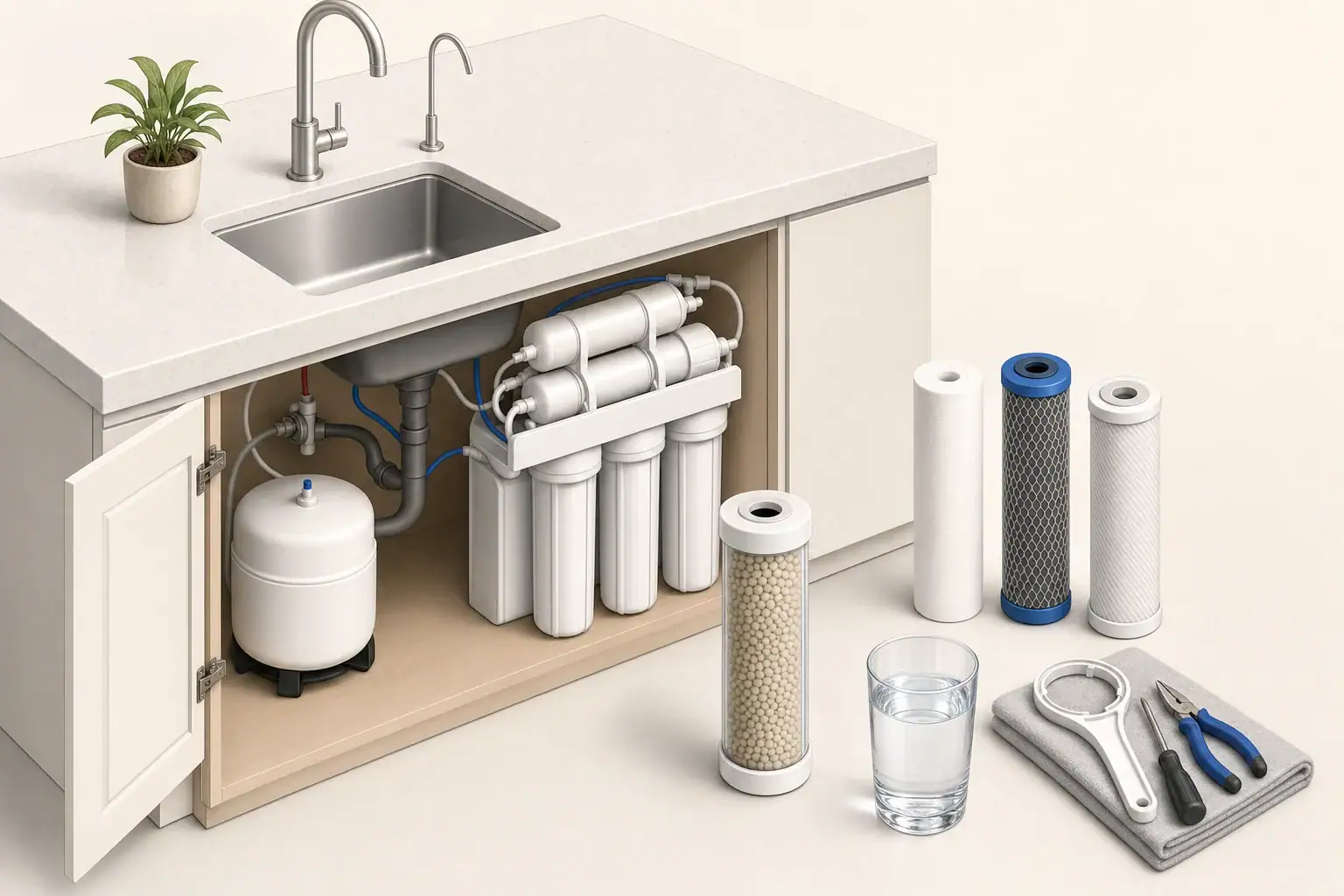
Fluoride reduction requires a more specific treatment approach than improving taste or reducing chlorine. Reverse osmosis and activated alumina are two established options, but their performance depends on water chemistry, system design, operating conditions, and maintenance.
Ordinary activated carbon is useful for many household water concerns, but fluoride is generally not one of its dependable targets. Choosing a system therefore starts with identifying the treatment technology, reviewing evidence for the complete product, and planning how performance will be checked over time.
Why Fluoride Requires a Targeted Filter
Fluoride is a dissolved ion. It does not behave like sediment that can be screened out, and it is not readily captured by the standard activated carbon used for chlorine, many odors, and some organic compounds.
Fluoride may occur naturally in source water or be adjusted by a public water system. Concentrations vary by location, source, and operating conditions. A current utility water-quality report can provide a useful starting point for public water, while a laboratory test is more appropriate for a private well or when a household needs a result from its own tap.
The practical question is not whether a unit is described broadly as a purifier. It is whether the exact system has credible evidence of fluoride reduction under relevant conditions. Useful documentation identifies the treatment method, challenge concentration, reduction achieved, rated capacity, flow conditions, and replacement requirements.
How Reverse Osmosis, Activated Alumina, and Carbon Compare
Reverse osmosis
Reverse osmosis, commonly shortened to RO, uses pressure to move water across a semipermeable membrane. Fluoride and many other dissolved substances are largely directed to the concentrate stream, while treated water passes through the membrane. Learn more about what reverse osmosis removes.
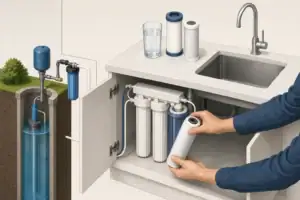
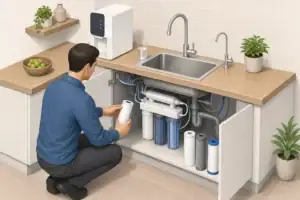
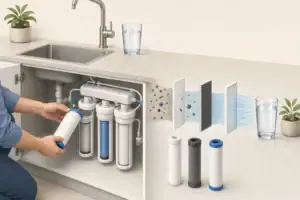
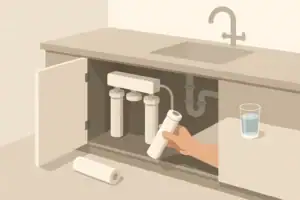
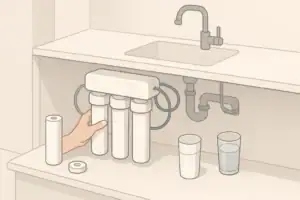
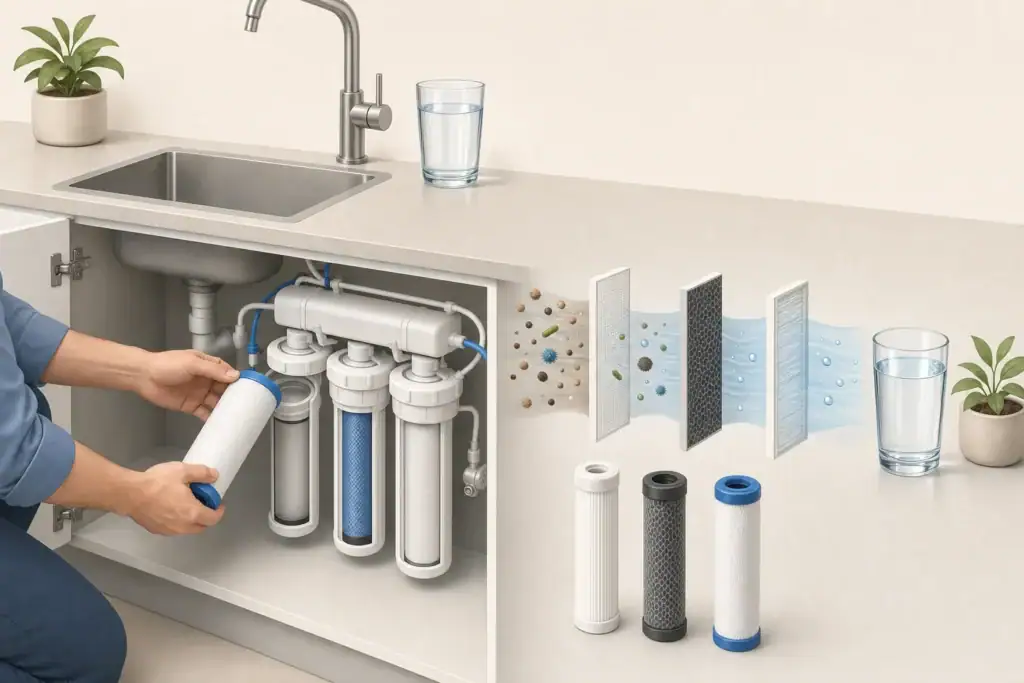
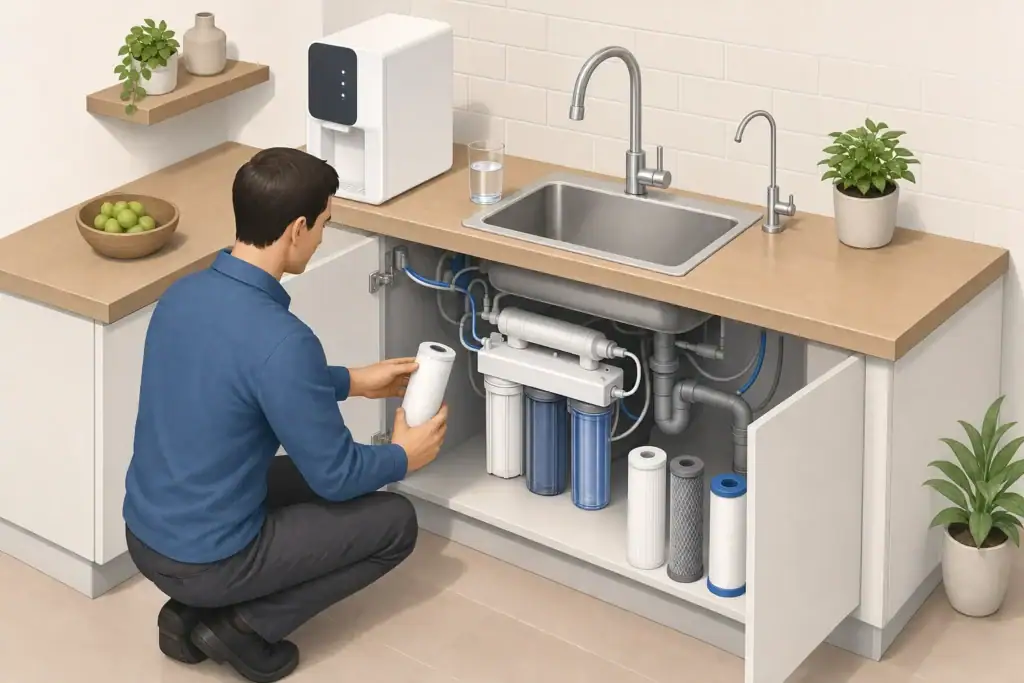
RO is commonly installed at one drinking-water faucet rather than as whole-house treatment. A typical system includes sediment and carbon prefilters, the RO membrane, a storage tank or tankless controls, and sometimes a postfilter or remineralization stage.
Activated alumina
Activated alumina is a porous aluminum oxide medium that adsorbs fluoride onto its surface. It can be used in a point-of-use cartridge or a larger treatment vessel. Its useful capacity is strongly influenced by pH, competing ions, contact time, and the starting fluoride concentration.
Unlike an RO membrane, activated alumina does not create a continuous concentrate stream. However, the medium eventually becomes exhausted and must be replaced or professionally regenerated according to the system design.
Standard activated carbon
Conventional activated carbon should not be assumed to reduce fluoride. Carbon may still be included in a fluoride treatment system to address chlorine, tastes, odors, or compounds that could affect downstream components, but that does not make the carbon stage the fluoride-removal mechanism.
Example values for illustration.
| Factor | Reverse osmosis | Activated alumina | Standard activated carbon |
|---|---|---|---|
| Primary mechanism | Membrane separation | Adsorption onto specialty media | Adsorption mainly for chlorine and organics |
| Fluoride role | Established reduction method | Established reduction method | Not generally dependable |
| Water chemistry sensitivity | Pressure, temperature, salinity, and membrane condition matter | pH and competing ions can strongly affect capacity | Not a suitable basis for fluoride planning |
| Water sent to drain | Yes, during production | Usually none during normal service | Usually none during normal service |
| Typical household scale | Point-of-use drinking-water system | Point-of-use or larger treatment vessel | Pitcher, faucet, under-sink, or whole-house stage |
| Main maintenance need | Prefilters, membrane, sanitation, and performance checks | Media replacement and performance checks | Routine cartridge replacement for listed targets |
| Verification priority | Complete-system reduction claim | Rated capacity under stated conditions | Do not infer fluoride reduction from carbon alone |
When Reverse Osmosis Is the Practical Choice
RO is often practical when a household wants point-of-use fluoride reduction along with treatment for a broader range of dissolved contaminants. It can serve drinking and cooking water from a dedicated faucet while leaving bathroom, laundry, and outdoor water untreated.
Performance is not fixed under every condition. Important variables include:
- Feed pressure: Low pressure can reduce production and separation performance. A booster pump should be part of an approved system design rather than an improvised modification.
- Water temperature: Colder water generally passes through a membrane more slowly.
- Dissolved solids: Higher mineral content increases the pressure the membrane must overcome.
- Membrane condition: Scale, fouling, oxidation, or age can reduce performance.
- Recovery and drain flow: RO produces both treated water and a concentrate stream. The ratio varies with design and operating conditions.
A storage-tank system produces water gradually and holds it for later use. A tankless design can offer higher on-demand production but may require electricity and adequate feed pressure. The advertised gallons-per-day figure is usually based on defined test conditions, so actual household output may be lower.
Buyers should look for a fluoride reduction claim applying to the complete configuration, not merely a generic membrane specification. If a remineralization cartridge is included, its purpose is usually to adjust taste or mineral content after the membrane. Its composition and maintenance requirements should also be documented.
When Activated Alumina May Fit Better
Activated alumina can be useful when fluoride is the primary treatment target and avoiding routine RO concentrate water is important. It may also fit locations where a media cartridge is easier to accommodate than an RO membrane, storage tank, and drain connection.
Capacity estimates require caution. Activated alumina performance can change substantially with the pH of the water. Other dissolved ions may compete for adsorption sites, shortening the useful life of the media. A capacity measured under controlled test water may not predict the exact capacity in a particular home.
Flow rate also matters. Water needs sufficient contact time with the media. Sending water through a small cartridge faster than its rated service flow can reduce treatment effectiveness even when the cartridge is relatively new.
Fluoride does not create a dependable taste, odor, or color warning when activated alumina is exhausted. Replacement should therefore be based on validated capacity, water use, and periodic testing rather than sensory changes.
Some large activated alumina systems can be regenerated using specialized chemicals. That process involves chemical handling, waste management, and careful conditioning. It is generally not an appropriate do-it-yourself task unless the equipment and service procedure are specifically designed for safe professional operation. Replaceable media cartridges are simpler for many households.
The Activated Carbon Reality Check
Labels such as carbon, charcoal, coconut-shell carbon, carbon block, and granular activated carbon describe useful filtration media, but they do not establish fluoride reduction. These materials are commonly selected for chlorine, taste, odor, and certain organic compounds.
A specialty cartridge may combine carbon with activated alumina, ion-exchange material, or another fluoride-targeting medium. In that case, any fluoride performance comes from the complete engineered combination and should be supported by testing for that exact cartridge.
Product descriptions can also blur the distinction between reducing a contaminant and merely improving water aesthetics. A long list of materials used in a filter is not equivalent to a tested reduction claim. Check which contaminant was tested, how much water was processed, and whether the claim applies through the full rated life.
Boiling is not a fluoride reduction method. Because water evaporates while dissolved fluoride remains, extended boiling can increase its concentration in the remaining water. Total dissolved solids readings are also not a fluoride-specific test. A TDS meter may help monitor broad RO performance trends, but it cannot identify how much fluoride is present.
Testing and Verifying Fluoride Reduction
Begin with the untreated concentration. Public water customers can review a recent utility report, but a tap sample provides location-specific information. Private well users should use a qualified laboratory because well chemistry can change and may affect treatment selection.
For a meaningful before-and-after comparison, collect untreated and treated samples using the laboratory’s instructions. The treated sample should be taken after the system has been installed, flushed, and conditioned as directed. Sampling too early may not represent normal operation.
Third-party certification or independent performance testing can simplify product evaluation. Confirm that the listing covers fluoride reduction for the complete model and configuration being considered. General certification of materials, structural safety, or another contaminant does not automatically establish a fluoride claim. Learn how to verify a filter’s certification claim.
Verification should continue after installation. A reasonable schedule depends on starting concentration, household water use, cartridge capacity, and how close the treated result must remain to the household’s goal. Activated alumina often warrants testing before its estimated exhaustion point. RO should be retested if membrane performance indicators change or after significant service work.
Planning Installation, Capacity, and Maintenance
Point-of-use treatment is usually the most manageable option when fluoride reduction is needed only for drinking, cooking, ice, coffee, or tea. Whole-house treatment requires substantially more media or membrane capacity, higher flow, and more involved waste or media management.
Before choosing equipment, estimate daily treated-water demand. Include drinking water, cooking water, pet water, and any refrigerator or ice-maker connection. Compare that demand with the system’s rated flow and capacity under realistic pressure and temperature conditions.
RO installation requires an approved drain connection, appropriate backflow protection, leak-resistant fittings, and access for service. Any air gap, shutoff, pressure control, or safety feature supplied with the system should remain in place. Local plumbing requirements and manufacturer instructions take priority, and professional installation may be appropriate where a drain, electrical connection, or pressure issue is involved.
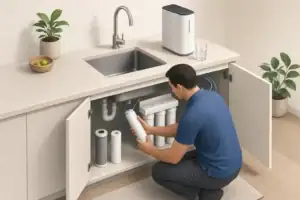
Keep a maintenance log showing installation dates, cartridge changes, sanitation, test results, and unusual changes in flow or taste. Replace components using time, volume, pressure drop, and test results together rather than relying on a single indicator. A filter replacement planner can help estimate upcoming change dates.
Example values for illustration.
| Component or task | What to monitor | Practical response |
|---|---|---|
| Sediment prefilter | Pressure drop, discoloration, or rated interval | Replace before restricted flow affects downstream stages |
| Carbon prefilter | Rated volume, service time, and disinfectant breakthrough | Replace on schedule to help protect an RO membrane |
| RO membrane | Production rate and verified rejection trend | Test and replace when performance no longer meets the system specification |
| Activated alumina cartridge | Gallons used, starting fluoride, pH, and test results | Replace before estimated exhaustion |
| Postfilter | Rated service life or taste change | Replace without treating taste as a fluoride indicator |
| Storage tank and tubing | Low delivery, leaks, or sanitation schedule | Inspect and sanitize according to approved instructions |
| Fluoride verification | Laboratory result and time since media or membrane service | Retest periodically and after significant performance changes |
Related guides:
Fluoride and Home Filtration: Common Options Explained •
What NSF/ANSI 58 Covers for RO Systems •
RO Waste Water Ratio: What’s Normal and How to Reduce It •
RO Filter Replacement Schedule: Prefilters vs Membrane
A Practical Selection Checklist
For most households, the choice comes down to treatment scope and operating preferences. RO is often suitable when multiple dissolved contaminants are targets and a drain connection is acceptable. Activated alumina may suit fluoride-focused treatment when its chemistry-dependent capacity and testing needs are understood.
- Confirm the untreated fluoride concentration.
- Review pH, hardness, and other water-quality information relevant to the treatment method.
- Verify a fluoride claim for the complete system rather than the media category alone.
- Check rated flow, capacity, pressure requirements, and expected water use.
- Account for RO concentrate water or activated alumina replacement media.
- Plan access for cartridge changes, sanitation, leak inspection, and sampling.
- Use fluoride-specific testing rather than taste or TDS as proof of performance.
No household filter produces universally pure water, and no cartridge performs indefinitely. A defensible fluoride reduction plan combines an appropriate technology with realistic sizing, documented maintenance, and periodic verification.
Frequently asked questions
Does a standard carbon filter remove fluoride?
Standard activated carbon is not generally a dependable fluoride-reduction method. A cartridge that contains carbon may reduce fluoride only if the complete product includes a fluoride-targeting medium and has a documented fluoride performance claim.
Is reverse osmosis or activated alumina better for fluoride reduction?
Neither option is automatically better for every home. RO may suit point-of-use treatment for several dissolved contaminants, while activated alumina may fit fluoride-focused treatment where avoiding RO concentrate water is important. Water chemistry, capacity, installation, and testing should guide the choice.
Can I use a TDS meter to check fluoride removal?
No. A TDS meter measures a broad conductivity-related trend and cannot identify fluoride specifically. Use a fluoride-specific laboratory test or another appropriate fluoride test method to verify treatment performance.
How often should a fluoride filter be tested?
Testing frequency depends on the untreated fluoride level, water use, rated capacity, and treatment method. Test after installation and periodically thereafter, with additional testing before activated alumina is expected to be exhausted or when RO performance changes.
- NSF/ANSI standards explained (42/53/401/58)
- Clear trade-offs: pitcher vs faucet vs under-sink vs RO
- Maintenance planning: cost per gallon and replacement cadence