
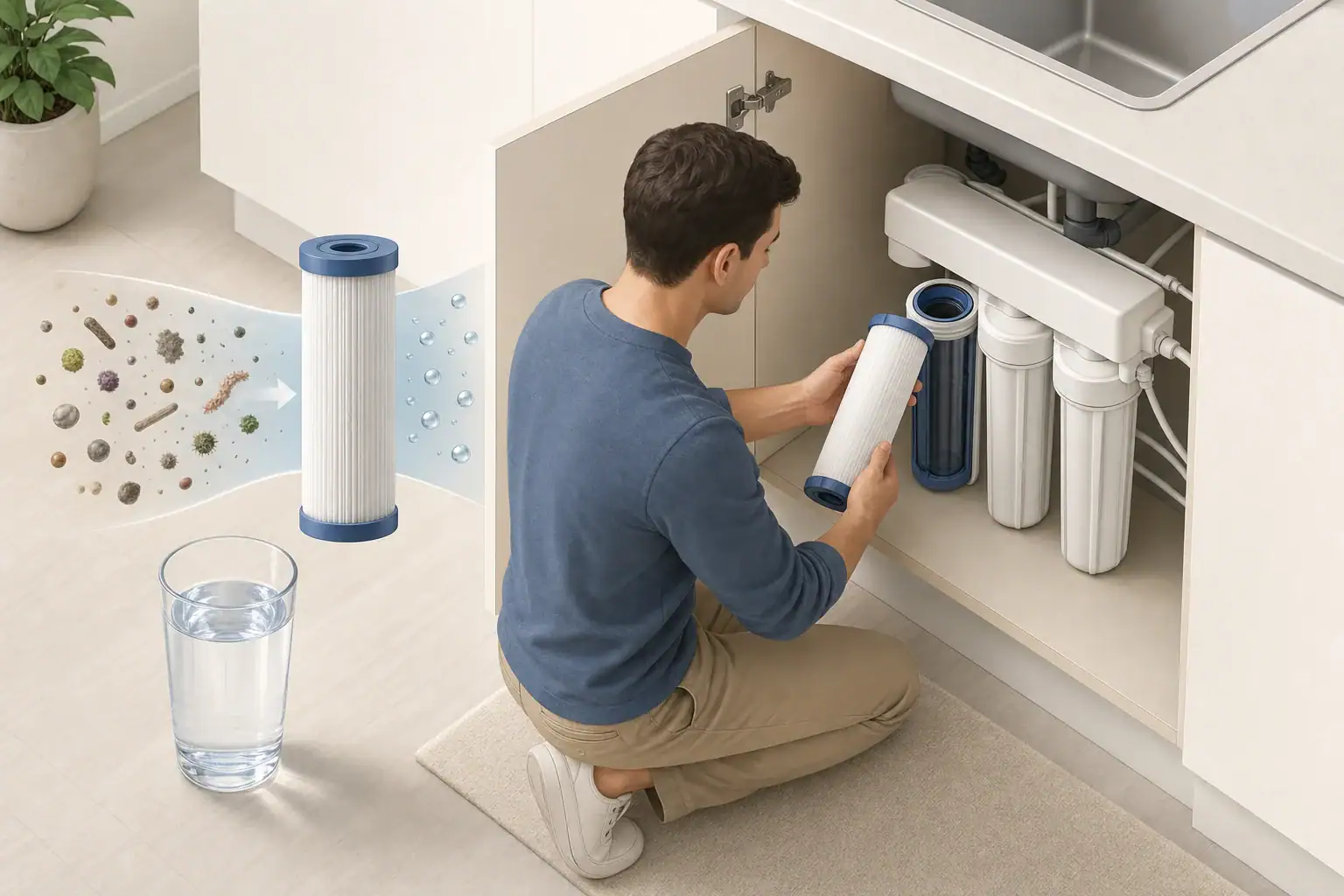
A cyst reduction claim indicates that a water treatment device has been designed or tested to reduce hardy protozoan parasites such as Giardia and Cryptosporidium. The strongest evidence is a model-specific certification for cyst reduction, not a general statement about fine filtration or contaminant removal.
For a practical selection, look for an explicit cyst reduction claim under an applicable standard, verify the exact model in the certifier’s directory, and follow its flow-rate and replacement requirements. A filter described only as carbon, sediment, nominal one micron, or bacteria reducing should not automatically be assumed to reduce these parasites.
Why Giardia and Cryptosporidium Are Grouped as Cysts
Giardia and Cryptosporidium are microscopic parasites that can spread through contaminated water. Giardia forms cysts, while Cryptosporidium forms oocysts. Water treatment literature and certification claims often use “cyst reduction” as a broad category covering both forms.
These protective forms can survive outside a host and are more resistant to some disinfection methods than many bacteria and viruses. Cryptosporidium, in particular, is highly resistant to chlorine at concentrations and contact times commonly used for drinking-water treatment. That is why physical removal, properly designed ultraviolet treatment, or boiling may be relevant when these organisms are a concern.
A cyst reduction claim does not mean the water is sterile or that every type of microorganism has been addressed. Viruses and many bacteria are smaller, and they require separate treatment claims.
What a Cyst Reduction Claim Actually Means
“Reduction” means that a device lowers the concentration of a specified contaminant under defined test conditions. It does not promise that every organism will be removed in every home or that the treated water contains zero cysts.
Test conditions may control factors such as flow rate, pressure, water quality, filter age, and the concentration of the challenge organism or an accepted surrogate. Actual performance can be affected by improper installation, damaged seals, excessive flow, overdue cartridge replacement, freezing, or internal bypass.
| Wording | What it supports | Main limitation |
|---|---|---|
| Certified for cyst reduction | Model-specific performance under an applicable standard | Other microorganisms are not covered unless separately listed |
| One micron absolute | A defined maximum pore-size rating and a useful cyst-filtration benchmark | Not automatically equivalent to third-party cyst certification |
| One micron nominal | Removal of some particles near the stated size | Some larger pores may remain, and efficiency may be unclear |
| Reverse osmosis | A membrane process capable of rejecting cyst-sized organisms when intact | The system still needs a specific claim, sound installation, and maintenance |
| UV inactivation | Microorganisms may be inactivated at a validated UV dose | UV does not physically remove them and depends on water clarity and lamp output |
Certification Matters More Than General Filter Language
NSF/ANSI 53 covers health-effects claims for applicable drinking-water filters, including cyst reduction. NSF/ANSI 58 applies to reverse osmosis systems and may also include a cyst reduction claim. Certification can be provided by NSF or another accredited certification body, such as WQA.
The standard number alone is not enough. Standards contain multiple optional performance claims, and a device certified under one of these standards may be certified for a different contaminant. The product’s official performance data or certification listing must specifically identify cyst reduction.
How to verify a claim
- Match the complete model number, including any relevant suffixes, to the certification listing.
- Confirm that “cyst reduction” appears among the certified claims.
- Check whether the listing applies to the entire system or only to a replacement cartridge.
- Note the rated capacity, service flow, pressure range, and replacement interval.
- Use only the cartridge specified for the certified configuration.
Statements such as “tested to NSF standards,” “uses NSF-certified materials,” or “designed to meet” are not the same as current third-party certification for cyst reduction. Material-safety certification also does not establish contaminant-reduction performance.
Absolute and Nominal Micron Ratings Are Not Interchangeable
A micron is one-millionth of a meter. Because cysts and oocysts are larger than many other microorganisms, a sufficiently fine physical barrier can capture them. Public-health guidance commonly identifies an absolute pore size of one micron or smaller as a useful criterion for filtering these parasites.
An absolute rating is intended to describe the largest opening allowed under the manufacturer’s specified test method. A nominal rating usually means that the filter captures a stated portion of particles near that size, but the percentage and test conditions can vary.
For example, a nominal one-micron sediment cartridge may capture much of a particle load while still allowing some particles near or above one micron to pass. Without an explicit cyst claim, its rating alone does not establish reliable protection against Cryptosporidium or Giardia.
Micron ratings also do not reveal whether water can travel around the filter. Housing cracks, poorly seated O-rings, incompatible cartridges, and loose connections can defeat an otherwise suitable filter medium.
How Different Treatment Methods Fit the Claim
Mechanical filtration
Fine membrane and depth filters can physically retain cysts. Their suitability depends on the absolute pore rating, verified cyst performance, flow rate, and system integrity. Ordinary sediment filters and many activated carbon filters are not cyst filters unless their documentation specifically says so.
Reverse osmosis
An intact reverse osmosis membrane has a much finer barrier than needed for cyst-sized organisms. Even so, buyers should verify a system-specific cyst reduction claim rather than relying only on the words “reverse osmosis.” Membrane damage, incorrect connections, failed seals, and neglected maintenance can affect performance.
Ultraviolet treatment
UV systems inactivate microorganisms rather than straining them from water. Performance depends on delivering a validated UV dose, which requires adequate lamp output, controlled flow, clean sleeves, and sufficiently clear water. Sediment, color, or scale can interfere with UV transmission.
A generic UV lamp or wattage specification is not proof of protozoan inactivation. Look for a relevant, model-specific microbiological treatment claim and follow all pretreatment and lamp-maintenance requirements.
Chemical disinfection and boiling
Routine chlorine treatment should not be treated as dependable control for Cryptosporidium. Boiling is a separate treatment method rather than a filtration claim and is generally effective against both parasites when performed according to current public-health guidance.
During a boil-water advisory, follow the instructions from the local water utility or health department. Do not assume that a household filter replaces boiling unless the issuing authority explicitly says the device is suitable for that event. CDC guidance generally calls for bringing clear water to a rolling boil for one minute, or three minutes at elevations above 6,500 feet.
Maintenance Is Part of Cyst Reduction Performance
A certified claim applies to a particular system operated within its rated conditions. Maintenance is therefore part of the treatment barrier, not merely a convenience issue.
- Replace cartridges on schedule: Use the rated capacity, elapsed time, or the manufacturer’s approved performance indicator. Reduced flow can signal loading, but normal flow does not prove that a cartridge remains effective.
- Do not exceed the rated flow: Excessive flow can reduce contact time or alter filter performance.
- Inspect seals during service: O-rings should be present, clean, undamaged, and seated as directed. Water bypassing the cartridge is untreated.
- Protect equipment from damage: Freezing, pressure surges, and incompatible cleaning chemicals can damage housings or membranes.
- Sanitize as directed: Follow the system instructions after cartridge changes or a known contamination event. Replacing a cartridge alone may not address contamination elsewhere in the plumbing.
- Maintain UV components: Replace lamps on schedule, clean sleeves as required, and respond promptly to alarms or failed intensity indicators.
If the system treats a private well, cyst filtration should be considered within a broader water-safety plan. Surface-water intrusion, flooding, damaged well caps, and nearby sewage sources may introduce multiple microbial hazards. A private-well water testing schedule can help identify other concerns, although a test for indicator bacteria does not directly confirm the presence or absence of Giardia or Cryptosporidium.
A Practical Way to Compare Cyst Claims
Start with the water source and the reason for concern. A temporary utility advisory, a private well affected by flooding, and routine treatment of surface water are different situations and may require different responses.
- Determine whether local health or utility officials have issued specific treatment instructions.
- Look for an explicit, current cyst reduction or appropriate microbiological treatment claim.
- Verify the exact model and replacement element with the certification body.
- Prefer a certified claim over an unsupported micron or marketing statement.
- Confirm that household pressure and required flow fall within the system’s ratings.
- Account for cartridge cost, replacement frequency, sanitation steps, and any required pretreatment.
- Check whether separate claims are needed for bacteria, viruses, chemicals, or other contaminants.
Related guides: NSF/ANSI 53 vs 401 vs 58 • Boil water notices and filters • Private well water testing schedule
The Key Distinction
The most useful distinction is between a general filtration description and verified cyst performance. “Fine filter,” “one micron,” and “purifies water” can be incomplete or ambiguous. A model-specific cyst reduction certification, supported by correct installation and timely maintenance, provides a clearer basis for evaluating protection against Giardia cysts and Cryptosporidium oocysts.
Frequently asked questions
What does a cyst reduction claim mean on a water filter?
It means the device has been tested or certified to reduce cyst-sized protozoa under specified conditions. It does not mean the water is sterile or that the device addresses every microorganism.
Is a one-micron filter enough for Giardia and Cryptosporidium?
An absolute one-micron rating can be a useful benchmark, but a model-specific cyst reduction claim provides stronger evidence. A nominal one-micron rating alone does not establish reliable cyst reduction.
How can I verify a cyst reduction certification?
Check the certification body’s listing or the product performance data sheet for the complete model number and an explicit cyst reduction claim. Also confirm the listed cartridge, capacity, and rated flow.
Does reverse osmosis remove Giardia and Cryptosporidium?
An intact reverse osmosis membrane can reject cyst-sized organisms, but the specific system should still have a documented cyst reduction claim and be maintained as directed.
Can chlorine kill Cryptosporidium?
Routine chlorine treatment should not be relied on for dependable Cryptosporidium control. Follow local public-health instructions during an advisory; boiling, validated UV treatment, or appropriate filtration may be relevant depending on the situation.
- NSF/ANSI standards explained (42/53/401/58)
- Clear trade-offs: pitcher vs faucet vs under-sink vs RO
- Maintenance planning: cost per gallon and replacement cadence