
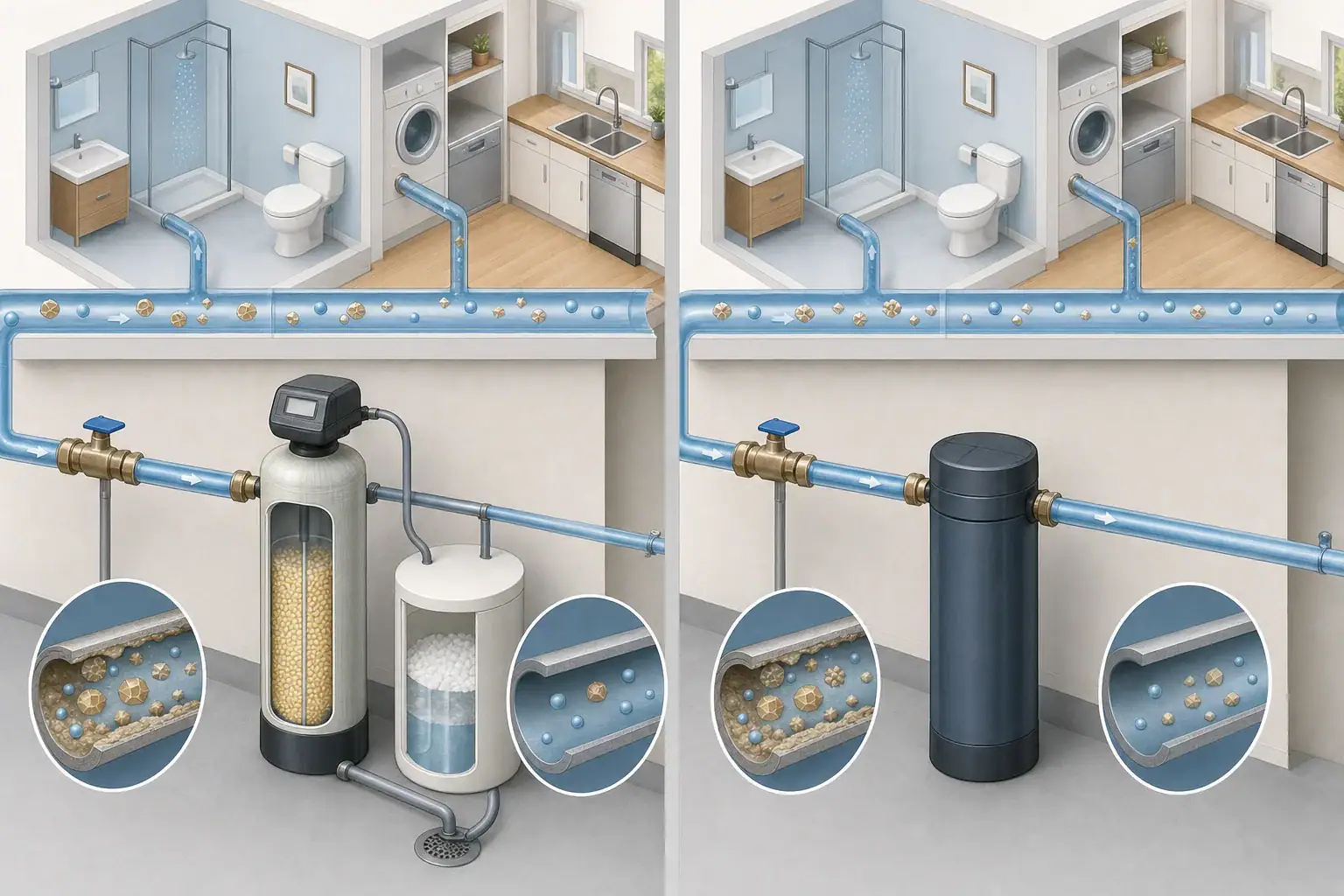
Quick answer: In a salt-free conditioner vs water softener comparison, an ion-exchange softener reduces measured calcium and magnesium hardness. A non-removal conditioner is intended for model-specific scale control and may leave a hardness reading largely unchanged. Choose based on the result you need, then verify the exact model’s limits, installation requirements, and listed claims.
Salt-free conditioner vs water softener: the practical difference
Water hardness is principally caused by dissolved calcium and magnesium, according to the U.S. Geological Survey. The key choice is whether the household needs those minerals removed or needs documented control of scale formation.
A conventional ion-exchange water softener exchanges calcium and magnesium for sodium or potassium ions. When it is operating properly and within its design conditions, treated water should show lower hardness in a hardness test.
A salt-free conditioner is not automatically a water softener. Non-removal conditioners leave calcium and magnesium in the water and instead may be designed to reduce scale formation under specified conditions. As a result, an outlet hardness result can be much the same as the inlet result.
Hardness reduction and scale reduction are separate performance claims. Do not infer either outcome from terms such as “whole-house,” “salt-free,” or “salt-free softener.”
What changes with each system?
| Decision point | Ion-exchange softener | Salt-free conditioner |
|---|---|---|
| Measured hardness | Should be lower downstream when the unit is working properly. | Often changes little for a non-removal design. |
| Primary purpose | Reduce calcium and magnesium hardness. | Provide model-specific scale control. |
| Soap performance | Reduced hardness can reduce mineral interference with soap. | Do not assume softened-water soap performance because hardness remains. |
| Salt and regeneration | A conventional self-regenerating unit uses regenerant salt or potassium chloride. | No brine regeneration in a non-removal design. |
| Drain and discharge | Needs a suitable drain connection for regeneration discharge. | A non-backwashing unit generally has no regeneration discharge; confirm the complete system design. |
| Electricity | Many control valves use power; check the model. | May be passive or may use a monitor or valve; check the model. |
| Routine upkeep | Add regenerant and maintain the brine tank, valve, and other specified components. | Replace media, cartridges, or other components as the manual specifies. |
| Performance evidence to seek | Exact model and listed hardness-reduction claim. | Exact model and listed scale-reduction claim or other model-specific evidence. |
Does a conditioner change a hardness test result?
Usually not when it is a non-removal conditioner. Hardness testing measures calcium and magnesium, commonly reported as milligrams per liter as calcium carbonate or grains per gallon. A process intended to affect scale formation does not necessarily remove those minerals from the sample.
In contrast, hardness reduction is within the scope of NSF/ANSI 44 for residential cation-exchange water softeners. NSF describes the standard as covering hardness reduction as well as softening capacity, rinse effectiveness, and brine-system accuracy. The standard is not proof that every product using related language is certified or has the same capacity: confirm the exact model and the claim in a current certification directory.
To check a softener, take untreated and treated samples using the same hardness method and comparable sampling conditions. TDS, taste, clarity, and a change in visible scale are not substitutes for a hardness measurement.
Simple before-and-after test-reading checklist
- Use a hardness test that reports a result in grains per gallon or mg/L as calcium carbonate.
- Collect the inlet sample before the treatment equipment and the treated sample from a cold-water point supplied by the equipment.
- Run the treated tap long enough to clear standing water in the plumbing, following the test kit instructions.
- Record the date, sampling locations, units, and the softener’s recent regeneration status.
- For a conditioner, interpret an unchanged hardness result as expected unless the manufacturer specifically documents mineral removal.
Which setup needs a drain?
Self-regenerating softeners
A conventional self-regenerating softener requires a suitable wastewater connection because regeneration uses water and regenerant and produces discharge. EPA’s water-softener selection and maintenance guide advises using demand-initiated regeneration where appropriate and checking local restrictions and septic-system compatibility. Follow the equipment manual and applicable plumbing requirements for the drain connection and any air-gap arrangement.
Not every ion-exchange arrangement has the same onsite plumbing. A service-exchange unit can be regenerated away from the home, so confirm the configuration rather than assuming all softeners have identical drain needs.
Salt-free conditioners
A non-backwashing conditioner does not run a brine regeneration cycle, so it generally has no regeneration discharge. That does not make every installation drain-free: a backwashing component, sediment prefilter, or other treatment stage can have separate drain requirements.
Power is also model-specific. For example, the Watts OneFlow manual for specified OFRES-K models describes a non-softening, non-regenerating system while also listing electrical requirements for its smart-monitor configuration. This is an example of why the manual for the exact configuration matters; it does not establish requirements for all conditioners.
How to verify water-softener and conditioner claims
Verify a claim about hardness reduction, scale reduction, capacity, rated flow, pressure drop, operating limits, or contaminant reduction. A standard number, a certification logo, or “tested to” language alone does not tell you the exact model or the actual listed claim.
- For a softener: Check whether the exact model is listed for the claimed application under NSF/ANSI 44. EPA identifies NSF/ANSI 44 as the relevant standard to look for when evaluating water softeners in its consumer guide.
- For a salt-free scale-control device: EPA points consumers to IAPMO/ANSI Z601. Search the exact manufacturer and model in the IAPMO product directory; do not rely solely on a product-family name or package statement.
- For material-related references: NSF/ANSI/CAN 61 and NSF/ANSI/CAN 372 can concern drinking-water-contact materials or lead-content requirements. They do not by themselves establish hardness removal or scale reduction.
- For other water concerns: Do not assume either technology reduces iron, lead, PFAS, microorganisms, or another contaminant. Seek an exact applicable reduction claim for the model and its stated operating conditions.
Certification listings can change. Confirm the manufacturer, full model number, standard, and claimed performance in the current certifier directory. The WQA product search may be relevant when the manufacturer identifies WQA as the certifier.
Manual-reading checklist before buying
- Model identity: Record the complete model number, not only a product family name or tank size.
- Promised result: Identify whether the literature claims hardness reduction, scale reduction, or both.
- Independent evidence: Match the model, certifier, standard, and specific listed claim.
- Feed-water limits: Review the manual’s limits for hardness, iron, manganese, pH, disinfectant, temperature, and pressure.
- Hydraulic fit: Check stated service flow, pressure-drop information, and whether a backwash cycle is required.
- Installation: Identify drain, electrical, bypass, space, and access requirements before purchase.
- Consumables: Note required regenerant, replacement media, cartridges, cleaning parts, and replacement triggers.
- Discharge: Find the documented regeneration-water information and check local and septic-system requirements where relevant.
- Maintenance and warranty: Read required tasks, exclusions, and conditions that affect coverage.
A practical choice based on the result you need
Choose ion exchange when the desired result is lower measured hardness and softened-water behavior, and the home can accommodate regenerant storage, an appropriate drain connection, and regeneration discharge.
Consider a salt-free conditioner when documented scale control is sufficient and avoiding brine regeneration is important. Match the exact unit to the home’s water chemistry and expected flow, rather than relying on a technology label.
Example: A household tests its incoming water at 12 grains per gallon and wants a lower post-treatment hardness result for laundry and bathing. That outcome points toward a properly sized ion-exchange softener, subject to drain and local-discharge requirements. If the same household primarily wants to address scale on a particular appliance but cannot accommodate regeneration discharge, it can investigate a conditioner—but should expect the 12-grains-per-gallon hardness reading to remain unless the chosen product documents hardness removal.
If the concern is a specific contaminant rather than hardness or scale, start with water-quality information and select treatment only after finding an applicable verified reduction claim. For broader context, see whole-house filters vs. water softeners and what NSF/ANSI 44 claims mean.
Frequently asked questions
Is a salt-free conditioner a water softener?
Not when it does not remove hardness minerals. “Salt-free” is sometimes used in marketing language, but a non-removal conditioner and an ion-exchange softener have different intended outcomes. Check the exact model’s documented claim.
Will a salt-free conditioner lower TDS?
Do not assume so. A non-removal conditioner leaves calcium and magnesium in the water, and a TDS reading is not a direct hardness measurement or a proof of scale-control performance.
Can a water softener solve every water-quality problem?
No. A softener is designed for hardness reduction. It should not be chosen for another contaminant unless the exact model has a relevant, verified claim for that purpose.
- NSF/ANSI standards explained (42/53/401/58)
- Clear trade-offs: pitcher vs faucet vs under-sink vs RO
- Maintenance planning: cost per gallon and replacement cadence