
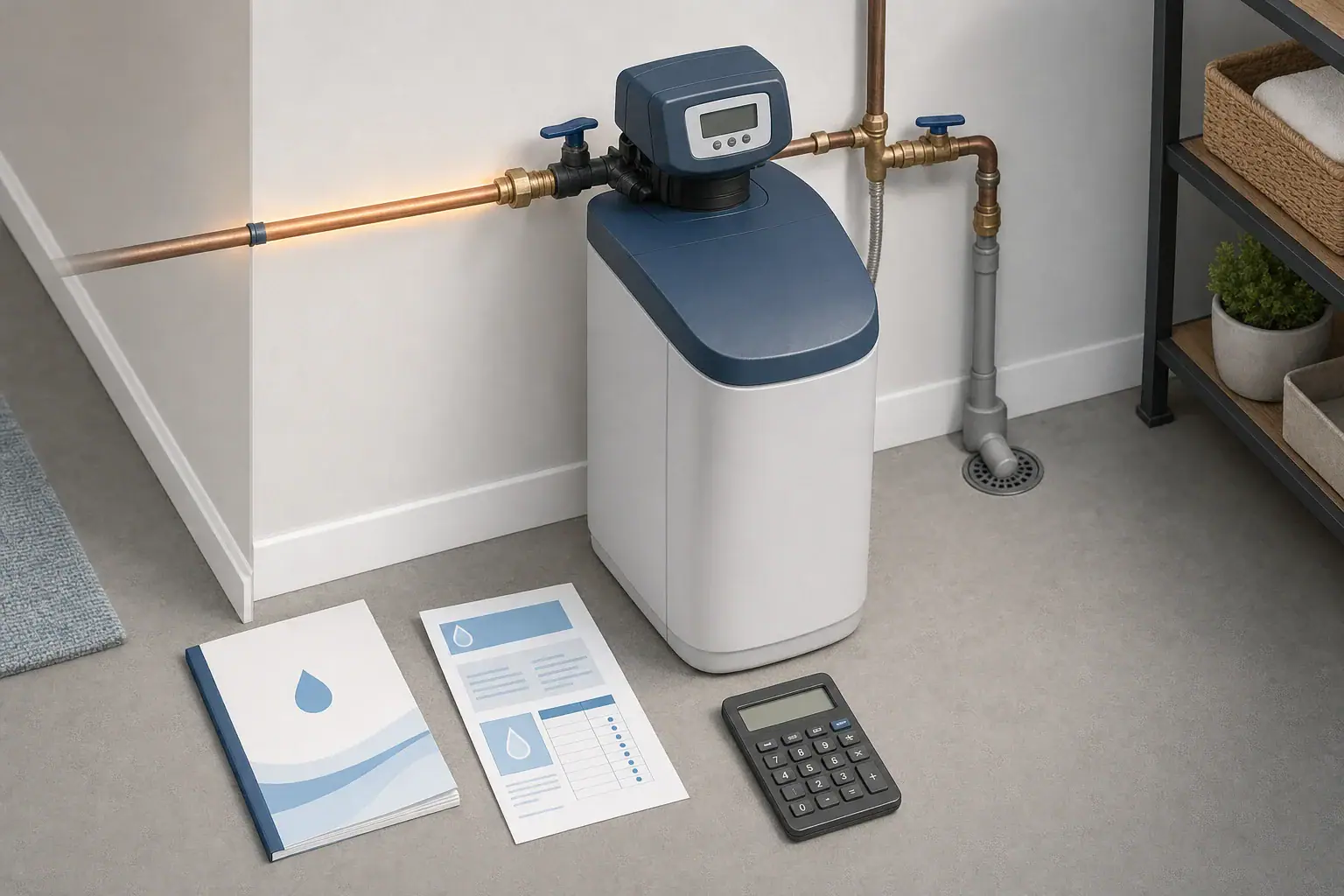
Quick answer: For a water softener hardness setting, enter the total hardness of untreated water entering the softener in the unit required by that model’s manual. If total hardness is reported as mg/L or ppm as CaCO3 and the controller uses grains per gallon, divide by 17.1. Apply an iron adjustment only when your exact manual instructs it.
Find the water softener hardness setting your controller expects
Start with the exact model’s current owner’s or service manual—not a generic online recommendation. Similar-looking controllers can use different units, entry ranges, menus, and iron instructions.
For example, the Pentair Fleck 5600SXT service manual identifies its hardness parameter as feed-water hardness in grains per gallon. That is an example of why the appropriate result is the hardness of water entering the softener, rather than a sample taken after treatment. Follow the manual’s stated procedure and do not change installer or master-programming values unless the manufacturer directs you to do so.
Manual-reading checklist
- Confirm the complete model number on the unit, not just the brand name.
- Locate the parameter called hardness, feed-water hardness, or similar wording.
- Confirm the required unit: grains per gallon (gpg), mg/L, ppm, or another unit stated by the manufacturer.
- Check whether the controller accepts decimals, whole numbers only, and any stated rounding instruction.
- Look for instructions that specifically address iron.
- Confirm whether the setting is available in the normal homeowner menu.
Use an untreated total-hardness result
Use the most current result that clearly represents untreated water at the softener inlet. Water hardness primarily reflects dissolved calcium and magnesium, according to the U.S. Geological Survey’s water-quality FAQ. A calcium-only value, alkalinity, pH, conductivity, or TDS reading is not automatically a total-hardness result.
| Available result | How to use it | What to check |
|---|---|---|
| Recent laboratory report | A strong choice when the sample represents untreated inlet water. | Look for total hardness, the reported unit, and whether the report says “as CaCO3.” |
| Drop-count kit or strip | Useful when used according to its instructions at an untreated sampling point. | Check expiration, test range, units, and whether it measures total hardness. |
| Utility report | Useful background when it represents your actual supply. | Check the service area, reporting period, unit, and whether it reports an average or a range. |
| Post-softener sample | Useful for comparing treated and untreated water. | Do not use it as the incoming-hardness setting. |
A systemwide utility value may differ from a current household sample. For example, Denver Water notes that hardness can vary by season and water-supply source. The key point is to compare the sample location and date before treating two different results as contradictory.
Inlet-water measurement checklist
- Use an existing cold-water sampling point that is upstream of the softener.
- Confirm that another treatment device does not alter hardness before that point.
- Record the result, unit, test date, and sampling location.
- Confirm that the measurement is total hardness; retain the report wording, including “as CaCO3” where applicable.
- Keep a separate iron result, including its unit and stated iron form, if one is available.
If a strip, a utility report, and a laboratory report differ, first determine whether they describe the same water, analyte, unit, and time period. Do not average incompatible results. Instead, repeat the preferred test on untreated inlet water or obtain a current laboratory result.
Convert hardness to grains per gallon only when needed
Convert only when the water report and controller use different units. The Water Quality Association glossary states that one grain equals 17.1 ppm as calcium carbonate equivalent. For a result explicitly reported as total hardness in mg/L or ppm as CaCO3, use:
Hardness in gpg = total hardness in mg/L as CaCO3 ÷ 17.1
Do not use this calculation for TDS, alkalinity, calcium alone, or another measurement that is not total hardness as CaCO3. For a fuller unit reference, see water hardness: grains per gallon vs. ppm.
Worked example: mg/L as CaCO3 to gpg
Assume a laboratory report shows 257 mg/L total hardness as CaCO3, and the manual requires gpg:
257 mg/L ÷ 17.1 mg/L per gpg = 15.03 gpg
If that specific controller accepts whole numbers only and its manual directs whole-number rounding, the entry would be 15 gpg. This is a unit-conversion example only; it does not include an iron allowance or establish a setting for every controller.
Use iron compensation only when your manual supports it
There is no universal iron-compensation factor for every softener. The applicable instruction can depend on the controller, the measured form of iron, and the manufacturer’s stated operating conditions.
As one model-specific example, the Whirlpool WHES33 manual instructs users to add 5 grains for each 1 ppm of ferrous, or clear-water, iron. The same manual distinguishes ferric, bacterial, and colloidal iron from the iron it says this model is designed to remove. Do not transfer that calculation to another softener unless that model’s own manual gives the same instruction.
Contact the manufacturer or a qualified water-treatment professional if the iron form is unknown, the manual has no applicable instruction, the result may exceed a stated operating limit, or the needed control is in an installer-only menu. For background on identifying iron-related water issues, see iron in water: staining, taste, and filtration options.
Enter, document, and verify the setting
- Confirm the untreated total-hardness result and the controller’s required unit.
- Convert the result only when the units differ.
- Apply an iron adjustment only when a separate iron result and the exact manual support it.
- Use the manual’s normal programming procedure to enter the value.
- Record the original result, unit conversion, final setting, test date, sampling location, and model number.
- If you need to investigate performance later, compare untreated and treated hardness using the same method and sampling conditions before changing the setting again.
The programmed hardness number is not the softener’s grain-capacity rating. On metered systems, feed-water hardness can be used in regeneration calculations, but changing that number does not by itself prove treatment performance or establish removal of unrelated contaminants. If treated water still appears hard after normal operation, use this water softener diagnostic checklist rather than repeatedly guessing at the setting.
Frequently asked questions
Should I use the hardness reading after the softener?
No. Use untreated water entering the softener for the programmed feed-water hardness value. A post-softener result can be useful for comparison, but it does not represent the hardness the softener must treat.
Is ppm the same as grains per gallon?
No. For total hardness reported as ppm or mg/L as CaCO3, divide by 17.1 to convert to grains per gallon. Confirm that the report is actually total hardness as CaCO3 before converting.
Does a higher hardness setting make the water softer?
Not necessarily. The setting is an input used by the controller; it is not a direct softness control. Use the incoming test result and the exact model manual rather than raising the number based on feel, taste, or appearance alone.
- NSF/ANSI standards explained (42/53/401/58)
- Clear trade-offs: pitcher vs faucet vs under-sink vs RO
- Maintenance planning: cost per gallon and replacement cadence